Nonfarm payrolls rose by only 29,000, yet the Nasdaq gained 1.2%. BiyaPay Market Watch: Where does the confidence behind the U.S. stock rebound come from?


- Core View: U.S. September nonfarm payrolls came in below expectations, and the market's reduced bets on a rate hike drove U.S. stocks higher, but long-end U.S. Treasury yields rose in tandem, indicating that the market is divided over growth, inflation, and funding costs. The sustainability of the rebound depends on whether corporate earnings can deliver.
- Key Elements:
- September nonfarm payrolls rose by only 29,000, far below the revised 133,000 in August, while the unemployment rate rose to 4.2%, with hiring continuing to remain at a low pace.
- The implied probability of a 25bp rate hike at the October meeting fell from 64.2% a week earlier to 22.7%. The adjustment in rate expectations was the core driver of the day's stock market gains.
- The 10-year U.S. Treasury yield closed at 5.279%, and the 30-year closed at 5.628%. The decline in yields after the employment data did not persist, and long-end pressure remains.
- Nvidia hit a new high, and HPE was boosted by data center demand. AI infrastructure continues to attract capital attention, but under high interest rates, divergence among companies is intensifying.
- The market's subsequent path depends on the alignment of cooling employment with inflation and earnings. A single nonfarm payrolls report is not enough to judge the trend.
The U.S. jobs report came in weaker than expected, and U.S. stocks rose; Treasury yields fell first and then climbed, while the Nasdaq still closed up 1.2%. If we explain this day solely with "the data is weak, so rates will fall," we would miss the most important contradiction in the market.
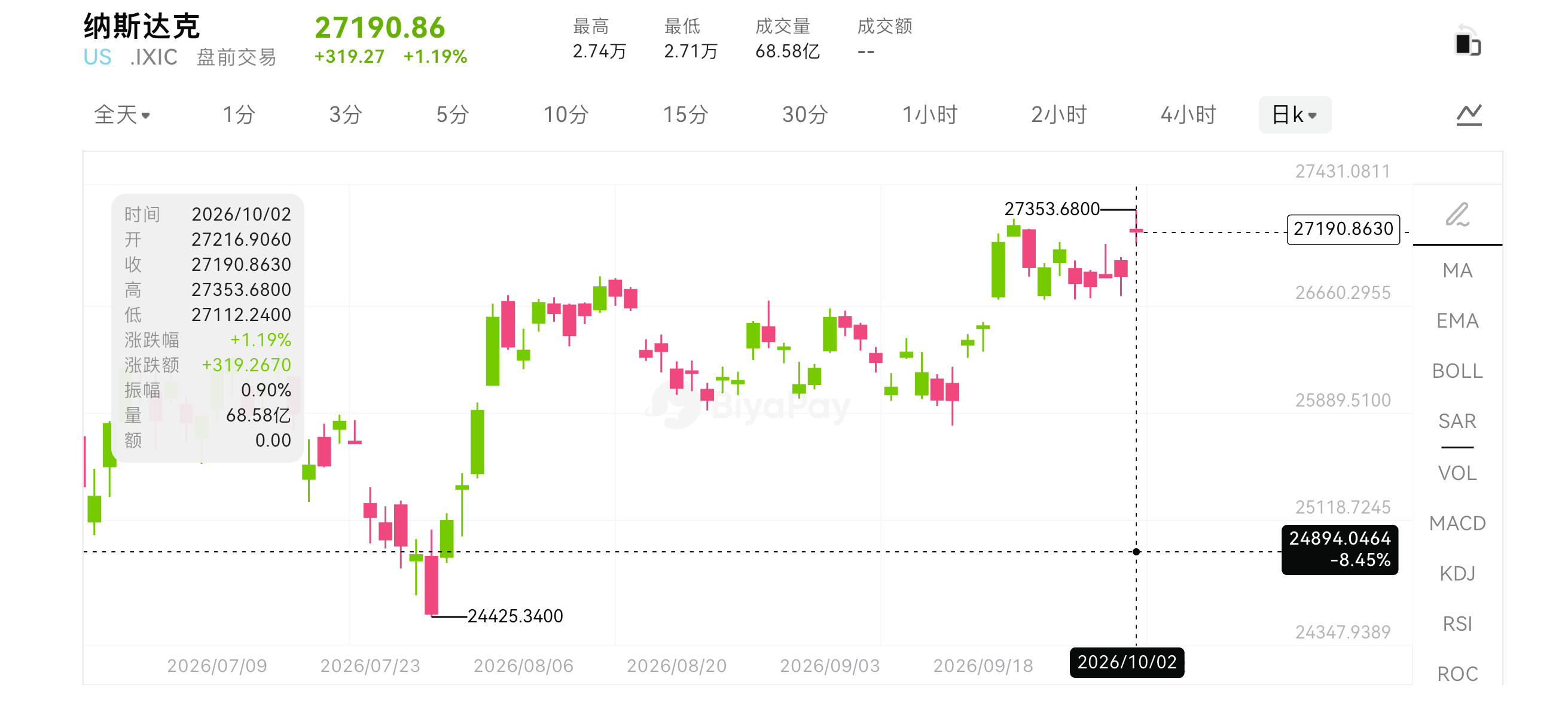
On October 2, BiyaPay market data showed that the Nasdaq Composite rose 1.2%, the S&P 500 rose 0.7%, and the Dow rose 0.5%. On the same day, the 10-year Treasury yield closed at 5.279%, and the 30-year closed at 5.628%. Stocks and long-end yields rising at the same time shows that the market did not give a consistent answer on growth, inflation, and the cost of capital.
Where the jobs report was weak also needs to be seen clearly
September nonfarm payrolls added 29,000 jobs, below the revised 133,000 in August; July was revised to a loss of 10,000. The unemployment rate rose to 4.2%, but since March it has remained in the 4.1% to 4.3% range. Over the past three months, job gains averaged about 51,000 per month, slightly above the 45,000 monthly average over the past 12 months.
Therefore, a more accurate meaning of this report is that the signs of employment acceleration the market had previously seen were affected by revisions, and hiring continues to be in a low-speed state. It did not provide enough evidence that the economy is rapidly stalling, nor did it support the judgment of strong growth. This in-between state is exactly what gave the market room to readjust rate expectations.
Wages and working hours are also worth looking at together. In September, average hourly earnings rose 0.1% month over month and 3% year over year, while the average workweek was 34.4 hours. These indicators did not show an obvious reacceleration in wages, but they also cannot directly replace consumption or inflation data. The jobs report answers questions about the labor market, while the Fed and corporate earnings still have to face broader information.
When observing this kind of linkage, BiyaPay, as a global one-stop asset allocation platform, allows users to view U.S. stocks, Hong Kong stocks, BTC, ETH, and other markets in one place, supports cryptocurrency exchange for USD and HKD, and enables real-time participation in stock trading without applying for an offshore account. Combined with public Treasury and macroeconomic data, it becomes easier to compare how different markets react to the same piece of news.

Bad news can lift stocks, but there is one precondition
After the weaker jobs data, the market reduced its bets that the Fed would continue raising rates. A report on October 2 showed that the implied probability of a 25 basis point hike at the October meeting was 22.7%, compared with 64.2% a week earlier. This number is the rate futures market's pricing of the future and will keep changing; it cannot be understood as a confirmed meeting outcome.
Stock prices depend on both future cash flows and the return rate the market demands. If weaker data only reduces the pressure for further tightening without clearly damaging corporate revenue, then valuation improvement may gain the upper hand. This is why some economic data that misses expectations can instead push stocks higher.
But this logic has boundaries. If employment continues to weaken and spreads to household income, consumption, and corporate orders, earnings expectations will be revised down. At that point, even if the market expects lower rates in the future, reduced cash flows and a higher risk premium could offset the valuation benefits. Whether "bad news is good for stocks" holds depends on the degree of economic slowdown, not on a fixed rule.
Rising long-bond yields limit optimistic imagination
What was most noteworthy in the bond market that day was that the yield decline after the jobs report did not last. The short end more directly reflects the next few Fed meetings, while the long end also includes long-term inflation expectations and term premium, as well as the market's comprehensive judgment on Treasury supply and the economic outlook. Reducing a bet on one rate hike is not enough to resolve all long-end pressure.
This is also why the federal funds rate cannot be used directly as a substitute for the discount rate in stock valuations. Corporate funding costs also involve credit spreads, and the return demanded by shareholders also includes a risk premium. Easing Fed expectations may help valuations; but if long-bond yields and market risk compensation remain high, companies may not immediately obtain a cheaper financing environment.
It is also necessary to distinguish between nominal rates and real rates. Merely seeing the 10-year yield rise does not directly prove that the real rate rose by the same magnitude; inflation expectations are also changing. For U.S. stocks, what truly affects valuations is the cost of capital after these factors work together, not just a single yield figure.
AI trades still have support, but companies are diverging
That day, Nvidia hit a new high, and HPE was boosted by expectations for data center networking demand, showing that capital is still paying attention to AI infrastructure. But in a high-rate environment, growth expectations must withstand stricter financial scrutiny. The gaps between orders, margins, and cash flow will become a source of divergence in individual stock performance.
Chip companies need to convert orders into shipments and profits, cloud service providers need to prove that added computing power can generate revenue, and software companies need to show paid demand for AI features. Two companies with similar revenue growth may receive different valuations if one needs to keep investing large amounts of capital while the other has already formed relatively stable cash flow.
Large tech companies also have advantages in cash reserves and financing capacity, and the impact of rate changes on them may not be the same as on fast-cash-burning growth companies. Grouping all tech stocks under "they rise when rates fall" ignores business structure, balance sheets, and competitive position. A Nasdaq rally may include the strength of a few heavyweight companies and does not automatically mean the entire growth sector is improving in sync.
After the index rebound, we need to see whether earnings can catch up with expectations
To judge this rebound, besides the index gain, we also need to see whether the advance has spread to more industries, whether earnings expectations have improved, and whether financial guidance supports current prices. If the index is mainly driven by a few heavyweight stocks while revenue and profit expectations for more companies are still being revised down, the foundation of the market move will be relatively concentrated.
Different paths lie ahead. If employment cools moderately, inflation eases in tandem, and corporate earnings can be maintained, valuations may gain more room; if growth weakens markedly, the market will worry about earnings; if inflation proves sticky and long-end rates remain high, valuation pressure may reappear. These paths need to be verified by subsequent data, and at present it is impossible to choose based on just one nonfarm payrolls report.
The rise on October 2 showed that the market is willing to reprice on reduced rate hike pressure. But the closing performance of Treasuries also reminded the market that the cost of capital has not disappeared along with it. Whether the U.S. stock rebound can continue ultimately still depends on whether companies can deliver the growth already priced in, and whether the rate environment can leave enough valuation room for that growth.