BiyaPay Market Watch | US stocks pull back, Intel and AMD surge against the trend—has the AI chip trade switched to a new main line?


- Core View: All three major US stock indices closed lower, but the semiconductor sector diverged against the trend. Capital has not exited AI and chips; rather, under a high-interest-rate environment, it is shifting from a single-leader narrative to more granular supply chain pricing, re-selecting companies with orders and earnings recovery logic.
- Key Elements:
- The Dow fell 1.2%, the S&P 500 dropped 0.6%, and the Nasdaq declined 0.3%; Intel rose about 9%, AMD gained nearly 6%, while Nvidia pulled back about 2%.
- Brent crude briefly broke above $100, and the 10-year US Treasury yield rose to about 4.8%, with inflation and rate pressures weighing on highly valued assets.
- Intel drew attention on expectations of roughly 10% PC CPU price hikes in October, as the market reassesses its pricing power and earnings recovery potential.
- Qualcomm announced a partnership with Amazon to customize AI data center chips and optical interconnect solutions, involving optical connectivity capabilities of up to 1.6T.
- AMD was lifted by sentiment around AI chips and the server supply chain, but the market is assigning it a challenger premium rather than a certainty premium.
- The AI trade is expanding from main lines such as Nvidia, TSMC, and memory into segments including Intel, Qualcomm, AMD, and ASML.
- Key upcoming variables: US August CPI on September 11, the FOMC meeting on September 15-16, and order validation across the AI supply chain.
U.S. stocks reopened after the long holiday, and the market did not directly extend its previous risk appetite.
On September 8, BiyaPay market data showed that the three major U.S. stock indices closed lower collectively, with the Dow down 1.2%, the S&P 500 down 0.6%, and the Nasdaq down 0.3%. On the surface, this was an ordinary pullback, but what is truly interesting is that while the indices weakened, the semiconductor sector showed clear divergence. Intel surged about 9%, AMD rose nearly 6%, and Qualcomm, Broadcom, and ASML also posted varying gains; on the other side, Nvidia fell about 2%, while memory-related names such as Micron and SanDisk showed relative weakness.
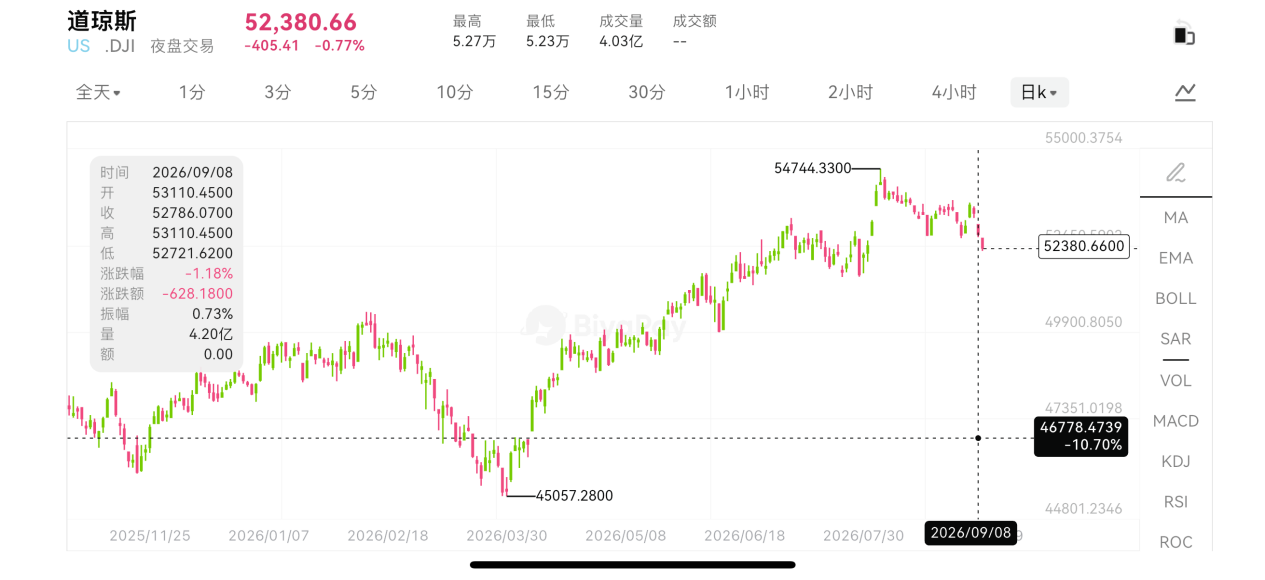
This kind of market action is most likely to create illusions. Looking only at the indices, one might think tech stocks are cooling off; looking only at individual stocks, one would find that capital has not left AI and chips, but is rapidly rotating between different directions. Especially when oil prices, U.S. Treasury yields, Federal Reserve expectations, and the AI industry chain are all disturbing the market simultaneously, it is easy to miss the real signals by looking at just one market.
When watching this kind of market action, it is more customary to observe several assets together. For example, in the BiyaPay App, one can simultaneously follow U.S. stocks such as Intel, AMD, Qualcomm, and Nvidia, as well as track changes in Hong Kong stocks, BTC, ETH, gold, crude oil, and other assets. As a global one-stop asset allocation platform, BiyaPay covers digital assets, U.S. stocks, Hong Kong stocks, fiat currency exchange, and other multi-asset scenarios, making it more suitable for observing price changes across different markets. For this kind of highly volatile market, the key is not to chase daily gains and losses, but to see whether capital is actually trading interest rates, inflation, AI orders, or risk appetite.
This shows that capital has not simply withdrawn from AI and chips, but is re-selecting directions.
For some time, U.S. tech trading has been highly concentrated around keywords such as Nvidia, AI servers, memory chips, and computing power capital expenditure. But when oil prices surge again, U.S. Treasury yields rise, and the Federal Reserve's September meeting approaches, the market's tolerance for highly valued assets will decline. At this time, capital is more willing to look for two types of companies: one type with clear orders or customer validation, and another type with a clearer logic for earnings recovery.
Intel, Qualcomm, and AMD being pulled back up by capital this time is precisely behind this logic.
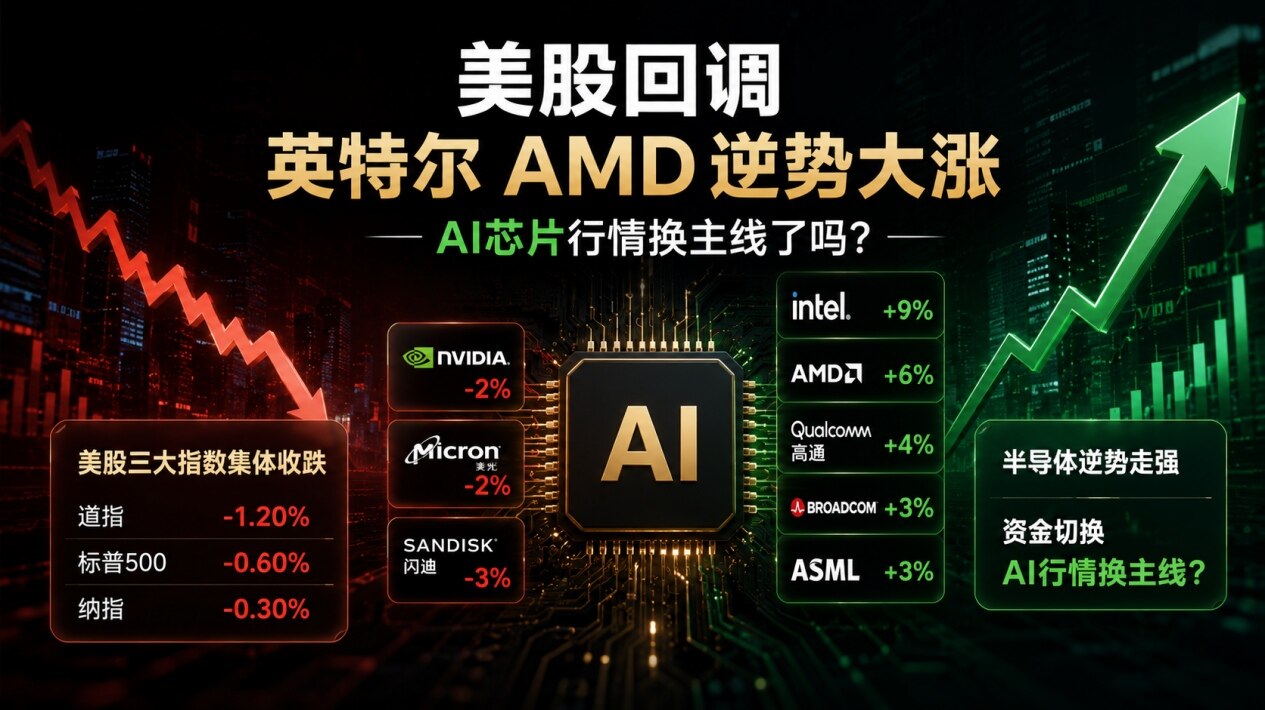
Why can chip stocks still rise while the broader market is under pressure?
The pressure on U.S. stocks this round comes first from macro factors.
Brent crude oil once approached and briefly broke through the $100 mark, while WTI also rose above $90. Rising oil prices will push inflation expectations higher again, and once inflation becomes more sticky, it becomes harder for the Federal Reserve to quickly shift to easing. At the same time, the 10-year U.S. Treasury yield rose to around 4.8%, and the 30-year U.S. Treasury yield also remained at a high level. For U.S. stocks, with oil prices, inflation, and interest rates overlapping, the pressure falls first on valuations.
Logically, tech stocks should be more sensitive, because many high-growth companies have valuations built on future cash flows. The higher the interest rate, the less attractive discounted future profits become. But this time the Nasdaq's decline was actually smaller than the Dow's, and semiconductors even strengthened against the trend, indicating that the market is not broadly selling off tech, but making structural switches.
What capital is really trading is who can continue to clearly articulate growth in a high-interest-rate environment, and whose price increases, orders, customers, and product roadmaps are more likely to translate into profits.
Intel's rise is not just sentiment repair
The apparent trigger for Intel's surge this time was prices and earnings expectations.
DigiTimes said Intel may raise PC CPU prices again in October, by about 10%. This news drove Intel's stock price sharply higher, making it one of the top performers in the S&P 500 that day. It should be noted that Intel has not made an official comment on this, so it cannot yet be treated as company guidance that has already been realized. But the market is willing to buy in, indicating that capital is watching whether Intel's pricing power has returned.
This point is crucial.
Over the past few years, Intel's biggest problem was not a lack of revenue, but that margins, manufacturing investment, and competitive pressure had been weighing on its valuation. Now, if CPU prices rise, server-side demand improves, and cost pressures are gradually passed on, the market will re-evaluate its room for earnings recovery. Combined with AI data centers' demand for server CPUs, interconnect, and infrastructure, Intel is no longer just a traditional PC cyclical stock, but is being repriced as part of the AI infrastructure chain.
Of course, Intel's logic has not yet reached the stage of a complete reversal. What truly determines how far valuation repair can go is not a 9% gain in one day, but whether it can prove in the coming quarters that price increases will not significantly dampen demand, whether the data center business can continue to improve, and whether advanced process and foundry businesses can reduce market doubts.
Qualcomm's highlight is moving from phones to AI data centers
Qualcomm's strength this time is more about industrial incremental growth.
Qualcomm officially announced on September 8 a multi-generation product collaboration with Amazon, focusing on custom chips and optical interconnect solutions for large-scale AI data centers, with emphasis on AI inference and optical connectivity capabilities up to 1.6T. What the market is watching is not just the customer name Amazon, but whether Qualcomm can use this to open a second growth curve beyond phone chips.
In the past, Qualcomm's core labels were phones, basebands, and mobile computing. But after AI entered the inference stage, data centers need not only GPUs, but also more efficient inference chips, low-power computing, and high-speed interconnect. If Qualcomm can migrate the energy efficiency advantages accumulated in mobile to data centers, it will have a chance to move beyond the traditional phone cycle.
However, it is also important to see clearly that the so-called potential scale of up to $60 billion does not equal confirmed order revenue. Some reports mentioned that this is related to Amazon warrants and future procurement conditions, and whether it can all be converted into Qualcomm revenue still depends on subsequent product delivery, customer procurement pace, and the competitive landscape. The short-term market rally is repricing Qualcomm's entry into AI data centers, rather than fully confirming ten years of revenue.
Why was AMD also lifted?
AMD's rise was more driven by sentiment in AI chips and the server chain.
AMD has always been in a delicate position. It is not an absolute AI leader like Nvidia, but it is not completely without presence either. When the market looks at AMD, there are really just two core points: first, whether the MI series AI accelerators can continue to win large customer orders; second, whether server CPUs and the data center business can maintain share gains.
When Qualcomm secured cooperation with Amazon and Intel was repriced for its pricing power, AMD would also be placed into the same question for comparison. Apart from Nvidia, who else can carve out a large enough slice of the AI infrastructure expansion? This is the source of AMD's elasticity.
But AMD's problem lies here as well. What the market gives it is not a certainty premium, but a challenger premium. Challenger rallies usually rise quickly and are also prone to pullbacks due to order pacing, gross margins, supply chain, and software ecosystem issues. Therefore, AMD's rise cannot be judged only by a single-day gain, but more by whether subsequent AI revenue share, customer expansion, and product iteration continue to deliver.
This is not an AI retreat, but AI pricing has become more selective
In this round of semiconductor divergence, what is most worth noting is not who rose and who fell, but that AI trading is shifting from a single-leader narrative to more granular industry chain pricing.
Earlier, the market preferred companies with the strongest certainty, so Nvidia, TSMC, memory chips, and AI servers were the main line. But as valuations rose, capital began to look for new interpretive frameworks. For example, Intel is trading on prices and earnings recovery, Qualcomm is trading on AI inference and a new entry point into data centers, AMD is trading on replacement elasticity beyond Nvidia, and ASML and semiconductor equipment are trading on the advanced process capacity expansion cycle.
It is still AI, but the positions are no longer the same.
This also explains why semiconductors can rise against the trend when the broader market falls. The market is not unconcerned about interest rates, but is looking for tech assets that can better prove their own value in a high-interest-rate environment. As long as AI capital expenditure has not been falsified, chip stocks will not simply exit, but will only rotate among different segments.
What should we really watch next?
In the short term, the counter-trend rise in semiconductors sends a signal to the market: the main line of AI and chips has not disappeared, but capital has begun to look for new fulcrums from crowded trades. Nvidia falling does not mean AI is retreating; Intel, Qualcomm, and AMD rising does not mean the market has fully switched. More accurately, the market is redistributing pricing power within the AI industry chain.
Several variables are crucial next.
First is the U.S. August CPI. The U.S. Bureau of Labor Statistics schedule shows that August CPI will be released on September 11. Oil prices have already risen significantly, and if inflation data comes in stronger again, pressure on the Federal Reserve's September meeting will continue to increase. Second is the FOMC meeting on September 15-16. The market currently still prices a relatively high probability of a September rate hike, and the rate path will directly affect tech stock valuations. Third is subsequent orders in the AI industry chain. Qualcomm's cooperation with Amazon, Intel's price increase expectations, and AMD's server demand all need to be further verified in subsequent earnings and guidance.
Therefore, this round of semiconductor gains looks more like a structural revaluation than a simple sentiment rebound.
Oil prices surging and U.S. Treasury yields rising would originally suppress risk assets; but semiconductors strengthening against the trend shows that capital is still willing to pay for AI infrastructure, just more selectively. Companies that can continue to stand out in the future may not be the ones telling the liveliest stories, but the ones that can connect customers, orders, prices, and profit margins.
The broader U.S. stock market is still under pressure, but AI chips have not gone out. The real question is not whether chip stocks can still rise, but who will prove next in this round that AI investment can ultimately turn into cash flow.