Trump trouble ahead? US Treasury yields approach 5% – what does it mean for US stocks, gold, and digital assets?


- Core View: Treasury yields approaching 5% are the core driver of current market volatility, triggering a repricing of global assets. The market's concern is not a single rate hike, but rather that the high-rate environment may persist longer than expected, putting pressure on US stocks, prompting a pullback in gold, and intensifying volatility in digital assets.
- Key Factors:
- On September 1, the 10-year Treasury yield rose to 4.79%, with the 30-year nearing 5.3%. All three major US stock indices fell for three consecutive sessions, with the Nasdaq down 1%.
- Rising Treasury yields directly suppress high-valuation tech sectors in US equities, shifting market focus from growth expectations to profits, cash flow, and certainty.
- Gold faces headwinds from high rates and a strong dollar, but fiscal deficits and geopolitical risks provide support – real interest rates are key to gauging its trajectory.
- Digital assets like Bitcoin are affected by tightening liquidity in the short term, dipping to around $77,900 on September 1, but may be repriced over the medium to long term due to fiscal and monetary credibility concerns.
- With the Fed's September meeting approaching and 12-month PCE inflation still at 3.7%, there is little basis for policy easing. Data releases and Treasury auctions will be critical observation points.
In this round of market volatility, the real protagonist isn't a specific stock or sector, but U.S. Treasury yields, which are approaching key levels once again.
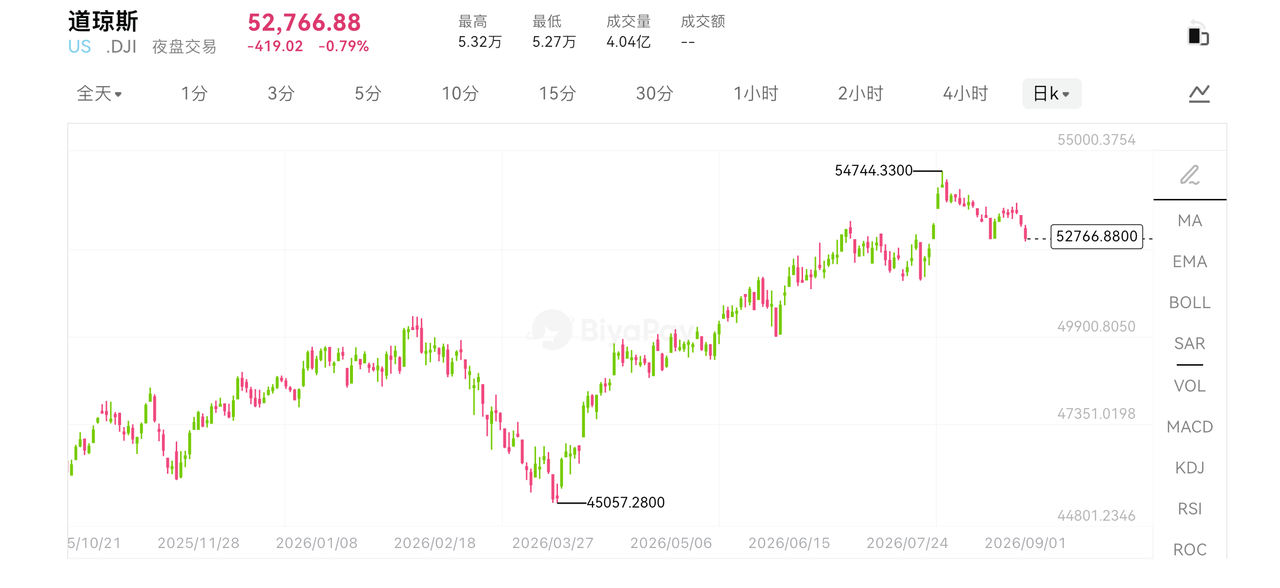
On September 1, BiyaPay market data showed that all three major U.S. stock indices continued to weaken. The Dow fell 0.8%, the S&P 500 dropped 0.7%, and the Nasdaq declined 1%, with major indices closing lower for a third consecutive trading day. Meanwhile, the 10-year Treasury yield rose to approximately 4.79%, and the 30-year yield approached 5.3%. Rising oil prices, inflation concerns, the upcoming September Fed meeting, and U.S. fiscal pressures—multiple factors stacking together have naturally prompted the market to reassess the math.
Why Are Treasury Yields So Important?
Because they are one of the most critical benchmarks for global asset pricing. When rates rise, stocks, gold, and digital assets are all pulled into the same equation for comparison. Equities need to ask whether valuations can hold up, gold needs to watch how real rates and the dollar move, and digital assets like Bitcoin and Ethereum are more sensitive to liquidity and risk appetite.
That's why Treasury yields approaching 5% cannot be dismissed as just a bond market issue.
When Treasuries move, stocks get nervous—this isn't a new story. But this time, pressure isn't coming solely from the Fed; it also stems from oil prices, fiscal deficits, the policy pace of the Trump administration, and financing demand driven by AI capital expenditure. What the market truly fears isn't a single day's rise or fall, but that the high-rate environment may persist longer than expected.
As correlations between these assets grow stronger, focusing on just one market risks missing signals. For example, on the BiyaPay app, users can simultaneously track market movements across U.S. stocks, Hong Kong stocks, BTC, ETH, and more. As a one-stop global asset allocation platform, BiyaPay covers multi-asset scenarios including digital assets, U.S. stocks, Hong Kong stocks, and fiat currency exchange—making it well-suited for observing price shifts and risk-appetite rotations across different markets.
For highly volatile conditions like these, what truly matters isn't fixating on a single price point, but understanding the interplay between Treasuries, the dollar, tech stocks, gold, and digital assets—who reacts first, and who follows. Looking at U.S. stocks, gold, or digital assets through this lens makes the logic far clearer.
Treasuries Approaching 5%—Markets Worry About More Than Just Rates
The 10-year Treasury yield near 4.8% and the 30-year yield close to 5.3% together reflect not merely short-term rate-hike expectations, but a repricing of long-term capital costs.
Short-end rates are more tied to Fed policy, while long-end rates are more complex. They factor in inflation, fiscal deficits, Treasury supply, growth expectations, and whether long-term capital is willing to absorb new issuance. U.S. debt has already surpassed $40 trillion, and interest payment pressure is mounting. With the Treasury needing to issue continuously, the market naturally demands higher yields to compensate for risk.
That's where Trump's dilemma lies. Politically, he wants a strong economy, stable markets, and low financing costs. But the bond market doesn't just listen to rhetoric—it watches inflation data, fiscal trajectories, and long-term creditworthiness. If oil keeps climbing, inflation pressures will return; if the fiscal deficit doesn't ease, long-end supply pressure won't disappear. As long as these factors remain, Treasury yields won't be easily pushed down.
So the core of this market cycle isn't as simple as “will the Fed hike or not.” Rather, capital is questioning whether the high-rate environment will last longer than previously imagined.
For U.S. Stocks, Pressure Lands on Valuations First
Rising Treasury yields have their most direct impact on U.S. equity valuations. Tech stocks, AI names, and high-growth sectors especially tend to have elevated future growth expectations priced into their shares. When risk-free rates rise, the discounted appeal of future cash flows diminishes, and the market's tolerance for richly valued assets declines.
This explains why the Nasdaq has underperformed in this pullback. The AI narrative hasn't been invalidated—cloud computing, chips, data centers, and energy infrastructure remain areas of focus. But the problem is that the AI supply chain has rallied too fast, with many companies already pricing in years of growth. Now that yields are ticking up, the market naturally asks whether orders can continue to materialize, whether margins can hold, and whether capex will weigh on cash flow.
Simply put, in a low-rate environment, markets are more willing to pay for distant narratives; in a high-rate environment, they care more about profits, cash flow, and certainty.
This is the key for U.S. stocks going forward. It's not that good earnings always mean gains, or bad results always mean losses—it's whether the quality of growth companies deliver can offset the valuation pressure created by rising rates.
Gold Is Not a Simple Safe-Haven Trade Either
Rising Treasury yields have a more nuanced impact on gold.
Gold itself pays no interest. When Treasury yields climb and the dollar strengthens, the opportunity cost of holding gold increases, typically pressuring prices. Gold's recent pullback from highs reflects this logic. Public market data shows that on September 1, gold futures briefly fell below the $4,400 level, having notably corrected from late-August highs.
But gold isn't purely a rate asset. As long as markets worry about fiscal deficits, geopolitical risks, resurgent inflation, and monetary credibility, gold retains demand as a hedge and safe haven. Gold now faces two opposing forces: high yields and a strong dollar suppress prices on one side, while fiscal and geopolitical risks provide support on the other.
This means that in the short term, gold shouldn't be viewed purely through the lens of “safe haven.” What truly needs monitoring is the real interest rate. If nominal yields rise faster than inflation expectations, gold is likely to face pressure; if inflation and fiscal concerns continue to intensify, gold could regain capital inflows.
Digital Assets Are About Liquidity and Risk Appetite
Digital assets like Bitcoin and Ethereum are also highly sensitive to Treasury yields. The reason isn't complicated—liquidity and risk appetite carry significant weight in short-term digital asset trading.
When Treasury yields rise and the dollar strengthens, capital tends to rotate toward assets with more certain returns, putting risk assets under pressure. Reports show that on September 1, Bitcoin briefly fell to around the $77,900 level in pre-market trading, declining alongside U.S. tech stocks amid rising rates. This demonstrates that digital assets do not completely decouple from the global liquidity environment when macro pressures intensify.
But digital assets have another side. Whenever markets discuss U.S. fiscal deficits, monetary credibility, and long-term debt pressures, Bitcoin gets revisited by some capital within a “macro hedge asset” framework. In other words, it faces short-term pressure from high rates, yet may be repriced over the medium term by fiscal and monetary concerns.
This is precisely what makes digital assets most complex right now. They are neither purely risk assets nor stable safe havens; instead, their narrative shifts across different market environments. When rates rise, they suffer alongside risk assets; when fiscal credibility comes into question, they may draw renewed attention.
Ahead of the September Meeting, Markets Will Keep Watching the Data
The Fed's next FOMC meeting is scheduled for September 15-16. In his Jackson Hole speech, Warsh emphasized that the 2% PCE inflation target is a fixed goal, with short-term rates remaining the primary tool for achieving the dual mandate. He also noted that 12-month PCE inflation stands at 3.7%, with the six-month change at 4.1%, indicating inflation remains above target.
These remarks had a direct impact on markets. The Fed offered no clear path forward but conveyed one message: as long as inflation doesn't return to target quickly enough, policy cannot easily pivot toward easing.
Going forward, nonfarm payrolls, CPI, PCE, oil prices, and Treasury auction results will all influence market expectations. If data continues to come in strong, or if inflation pressures show no meaningful cooling, Treasury yields may stay elevated, and valuation pressure on U.S. stocks will persist. If economic data deteriorates notably, the market will pivot from worrying about inflation to worrying about growth.
This is what makes current market conditions so difficult to judge. Inflation isn't fully resolved, growth can't visibly stall, and both the Fed and markets are waiting for more evidence.
The Real Variable: Cost of Capital Is Rising Again
With Treasury yields approaching 5%, the impact on U.S. stocks, gold, and digital assets is real—though the directions differ.
U.S. stocks fear valuation repricing most, especially AI and tech growth names. Gold faces short-term pressure from high rates and a strong dollar, but fiscal, geopolitical, and inflation risks leave it with underlying support. Digital assets sit between liquidity pressure and macro-hedge narratives, meaning short-term volatility will be greater.
Whether Trump can stabilize market sentiment ultimately depends on whether the bond market buys in. As long as long-end Treasury yields stay elevated, global assets will repeatedly undergo repricing. U.S. stocks hinge on whether earnings can offset rate pressure; gold depends on real rates and safe-haven demand; digital assets rely on liquidity and risk appetite.
The real takeaway from this market cycle is that the trading environment built purely on growth narratives is shifting. As the cost of capital rises again, every asset class must answer the same question: can the expectations embedded in prices withstand the test of high rates?