From payments to one-stop asset management, BiyaPay expands the boundaries of global diversified financial services


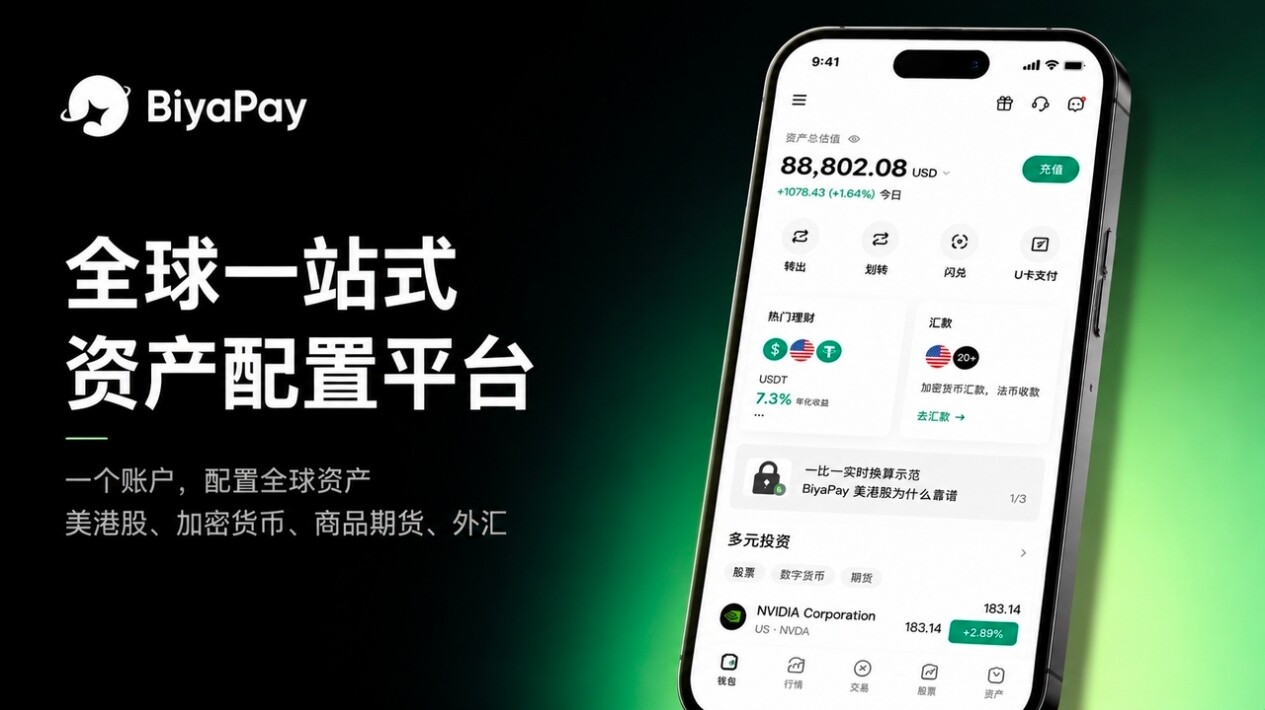
- Key Insight: Behind the crypto market recovery, user demand is shifting from single-purpose payment tools to global one-stop asset allocation platforms. Starting with cross-border remittance and using USDT to connect capital scenarios, BiyaPay has gradually expanded into diversified services including US and Hong Kong stocks, cryptocurrencies, foreign exchange, and wealth management, aiming to build an account-based platform that connects the entire capital flow chain.
- Key Elements:
- The market recovery is driven by multiple factors including liquidity expectations, institutional capital inflows, and spot ETF demand, with Bitcoin fluctuating around the $80,000 level and Ethereum holding firm above $2,500.
- Traditional cross-border remittance suffers from pain points such as opaque fees, unstable settlement timelines, and uncontrollable intermediary bank costs. BiyaPay uses USDT as a capital gateway, integrating the exchange, remittance, and payment chain.
- After remittance is completed, user funds need to enter different asset scenarios. BiyaPay leverages its zero-commission US stock trading mechanism to enable "buying real US and Hong Kong stocks with USDT," connecting to traditional securities markets.
- The platform offers access to trading for over 200 mainstream digital assets, and also covers foreign exchange, commodity futures, and demand deposits (with annual yields up to 10.22%), addressing global asset allocation and idle capital management needs.
- BiyaPay combines Web2 (mature financial and consumer scenarios) with Web3 (stablecoins and on-chain capital flows) capabilities to build a multi-asset, cross-market global asset convergence gateway.
- Product expansion comes with higher requirements for account security, risk control, fee transparency, and multilingual localized services to support global platform operations.
Recently, the crypto asset market has shown signs of a staged recovery. Bitcoin is fluctuating around the $80,000 mark, Ethereum has briefly held above $2,500, and mainstream digital currencies such as BTC, ETH, and SOL have once again become the focus of market attention.
This market rebound is driven by multiple factors, including shifting liquidity expectations, institutional capital inflows, demand for spot ETFs, and the covering of short positions. However, beyond the price rebound, what deserves more attention is the changing way users manage global assets: digital currencies are no longer just a single asset in an isolated account, but are gradually becoming connected to needs such as cross-border remittance, currency exchange, stocks, forex, wealth management, and global payments. What users truly need is no longer just a remittance tool or a single trading entry point, but a one-stop asset allocation platform capable of handling fund flows, asset allocation, and payment spending.
Cross-border remittance and payments were BiyaPay's starting point for entering the market. As user needs continue to expand, its services have gradually come to cover scenarios including US and Hong Kong stocks, cryptocurrencies, forex, commodity futures, and wealth management. Pay addresses the first step of capital flow, and BiyaPay is now answering the next question: after funds arrive, how can they be managed more efficiently within a single account?
Starting with Cross-Border Remittance, Connecting Global Fund Scenarios with USDT
In cross-border financial services, remittance and payment is a fundamental business that has long been plagued by pain points.
For international students, tuition, rent, and living expenses need to be transferred between different countries and accounts; for overseas workers, salary settlement, family remittances, and multi-currency exchange are high-frequency needs; for freelancers and cross-border professionals, receiving overseas payments, account transfers, and fund settlement directly impact their day-to-day operational efficiency.
The pain points of traditional cross-border remittance are not unfamiliar. Cross-border remittance often involves multiple issues: opaque fees, unpredictable settlement times, uncontrollable intermediary bank charges, unclear exchange rate spreads, complex beneficiary account requirements, and a lack of smooth connectivity for subsequent use of funds.
BiyaPay's early choice of cross-border remittance as its entry point was based on a straightforward product logic: first, solve the most basic and high-frequency problem of user capital flow.
BiyaPay's cross-border remittance business places greater emphasis on the integration of the entire fund transfer chain. Users can use USDT as a capital entry point, completing digital asset exchange, fiat currency conversion, and cross-border remittance within the platform, and then allocate funds to overseas accounts, investment accounts, or other payment scenarios based on their actual needs.
The significance of starting with cross-border payments goes beyond bringing in BiyaPay's first batch of users. It also allowed the platform to establish a foundational layer of trust capabilities around identity verification, account security, risk control, customer service, and fund transfer. These capabilities later became an important cornerstone for the platform's expansion into other financial services.
As the number of users and use cases grew, BiyaPay gradually discovered that a user's needs do not end once a remittance is completed.
After receiving living expenses, international students may need to convert funds into local currency for online spending; after receiving their salary, overseas workers may wish to transfer a portion back to family accounts while using the rest for savings or investments; users holding digital assets like USDT may need to complete currency exchange, cross-border remittance, or further participate in markets such as US and Hong Kong stocks.
In these scenarios, payment is only the first step in the fund flow chain. After a remittance is completed, funds still need to enter different accounts, assets, and spending scenarios. The problem users face shifts from "how to complete a cross-border remittance" to "how to manage cross-border funds within a single account."
This became the practical foundation for BiyaPay's evolution from a payment tool to a broader range of financial services.
From a product logic perspective, BiyaPay does not view cross-border remittance as an isolated function, but rather places it within the capital flow chain of global asset allocation. Cross-border remittance solves the problem of moving funds across regions, USDT conversion and fiat remittance solve the problem of funds entering different currency and account systems, and subsequent products such as US/HK stocks, digital assets, wealth management, and forex further accommodate the management and usage needs of funds after they arrive.
From Crypto to US & Hong Kong Stocks, BiyaPay Expands Multi-Asset Service Scenarios
The product boundaries of a cross-border financial platform are often determined by the next destination of user funds.
Once funds have completed cross-border transfer, users typically have several options: convert to currencies such as USD or HKD to enter stock or other financial markets; hold as digital assets like USDT to participate in Crypto-related services; or move funds into wealth management products for idle capital management.
Many users already hold USDT, but their needs extend beyond Crypto trading to connecting their funds with broader global asset markets such as US and Hong Kong stocks.
Under the traditional path, users looking to participate in US and Hong Kong stocks typically need to set up overseas bank or brokerage accounts and complete multiple steps including currency exchange, deposits, and fund transfers. For users who already hold USDT, they also need to convert their digital assets into fiat currency before moving funds into a stock account through other channels. The entire process involves multiple platforms and accounts, creating a long capital path that brings time and operational costs.
BiyaPay's product expansion follows precisely this capital path. In the US and Hong Kong stock scenarios, BiyaPay seeks to connect cross-border funds with traditional securities markets. Users are not just viewing stock quotes; they can participate in real stock markets through relevant brokers and clearing services. Unlike tokenized stocks, real stocks correspond to actual asset rights in traditional securities markets, with relevant orders, clearing, and dividend arrangements executed according to the respective market and service rules.
Through mechanisms such as $0 commission on US stock trades, BiyaPay lowers the fundamental cost for users to participate in the market, enabling users to further participate in real stock-related services in US and Hong Kong markets, fulfilling the promise of "buying real US and HK stocks with USDT."
Cryptocurrency services further expand BiyaPay's asset coverage. As digital assets like Bitcoin and Ethereum gradually become part of global users' asset allocation, users are no longer concerned only with price movements, but also with asset exchange, fund transfers, fee transparency, and account security. Through its related Crypto services, BiyaPay provides users with access to view, trade, and manage over 200 mainstream digital assets, connecting them with cross-border fund scenarios.
Forex and commodity futures address another category of globalization-related needs. Exchange rate fluctuations affect the real costs of studying abroad, travel, cross-border operations, and overseas investments, while commodity prices are closely tied to inflation, energy markets, and the global economic cycle. The platform's coverage of forex and commodity futures is not just about adding two more product categories, but about enabling users to observe and manage assets across a more complete market dimension.
Wealth management services address the management needs of USDT funds that have no immediate designated purpose. After completing remittances, currency exchanges, or asset adjustments, some users retain a portion of idle funds. The demand deposit product offers an annualized yield of up to 10.22%, providing more options between liquidity and yield needs.
US/HK stocks, cryptocurrency, forex, wealth management, and commodity futures may appear to be different product categories, but they correspond to the same user journey: once funds enter an account, they need to continuously flow between exchange, allocation, and management.
From cross-border payments and the USDT capital entry point to US/HK stocks, forex, Crypto, and wealth management services, BiyaPay's product expansion is not simply stacking features, but is progressively unfolding along the user's capital flow path.
Connecting the Full Fund Flow Chain, BiyaPay Moves Toward One-Stop Asset Management
Global financial services are shifting from point tools to account-based platforms.
"Future financial services will not remain confined to a single market, a single currency, or a single asset class," a BiyaPay CEO once stated. "What users need is an account that can connect global stock, digital asset, and forex markets, allowing capital to flow more freely between different assets, currencies, and scenarios."
BiyaPay is attempting to play that role. From cross-border remittance to US/HK stocks, from cryptocurrency to forex and commodity futures, and then to wealth management and global payments, the platform's product matrix is gradually covering four key segments: "capital flow, asset allocation, fund management, and global spending."
BiyaPay aims to get ahead in this cycle of technological convergence between traditional finance and digital finance, building the first gateway for global asset integration by combining Web2 and Web3 capabilities. On the Web2 level, BiyaPay connects mature financial and consumption scenarios such as US/HK stocks, forex, commodity futures, and U-card payments; on the Web3 level, the platform leverages stablecoins like USDT, digital asset trading, and on-chain capital flow capabilities to provide users with more flexible capital pathways.
One account connecting diverse scenarios—BiyaPay is evolving from a tool into a one-stop asset allocation platform. When these scenarios are brought into a single account system, what BiyaPay offers is no longer an isolated function but a relatively complete global capital usage path. The goal is to break down barriers between assets, allowing value to flow more freely.
Multi-asset allocation also places higher demands on the platform. The more products there are, the more clearly the platform must articulate the service providers, fee structures, market risks, and applicable regions for different services; the richer the range of asset classes, the more account security, identity verification, risk management, and customer support need to be improved in tandem.
For a global user base, multi-language support has also become a critical component of a globalized platform. For cross-border users, localization is not just about translating page text into another language; it also includes whether product rules can be accurately understood, whether fees are clearly displayed, whether risk disclosures align with local contexts, and whether users can receive effective support when they encounter issues.
From a remittance tool to multi-asset financial services, BiyaPay is redefining its service boundaries. Pay is the starting point, but in today's ever-evolving landscape of global user needs, it is clearly not the endpoint.
As traditional finance and digital finance continue to converge, BiyaPay also hopes to become an important gateway connecting the two, helping more users around the world enter a new financial phase characterized by multi-asset, cross-market, and liquid possibilities. BiyaPay's next stop: building a global one-stop asset allocation platform for users.