






Tonight's US Nonfarm Payrolls Big Test: "Good News" Is Also "Bad News"


- Core View: The US August nonfarm payrolls report is about to be released, with market expectations pointing to a modest rebound from July. However, under the current policy environment, employment data has entered a "good news is bad news" framework: strong employment will fuel rate hike expectations and weigh on equities. JPMorgan believes next week's CPI data will have a greater impact on the September FOMC meeting than this nonfarm payrolls report.
- Key Elements:
- Market consensus expects August nonfarm payrolls to add 55,000 jobs (versus -23,000 in July), with the unemployment rate holding at 4.1%. Goldman Sachs is more cautious, estimating only 40,000 jobs.
- Leading indicators are mixed: ADP added only 38,000 jobs (below expectations), while Challenger layoffs rose to 52,900. Initial jobless claims climbed to 207,000 during the survey window.
- Temporary protected status for approximately 300,000 Haitian immigrants expired at the end of July. Barclays estimates roughly 25,000 will disappear from August employment statistics, creating a mechanical downside drag.
- The BLS annual benchmark revision shows employment data was systematically understated by 0.1% (79,000 jobs)—far smaller than last year's massive 911,000 upward revision—but the private sector downward revision reached 178,000.
- JPMorgan has set the "Goldilocks zone" at 30,000–70,000 new jobs. If the data exceeds 100,000, US stocks will come under pressure and rate hike expectations will intensify; if it turns negative again, it will freeze rate hike expectations and trigger stagflation concerns.
Original Author: Xu Chao
Original Source: Wall Street CN
The US August non-farm payroll report will be released tonight. Wall Street expects a modest rebound from July's negative reading, but the market logic has quietly shifted—for investors, a strong report isn't necessarily good news, and a dismal jobs report doesn't necessarily spell disaster either. The core of the data game lies in the Fed's next move on the rate hike path.
Market consensus expects August non-farm payrolls to add 55,000 jobs, rebounding from July's decline of 23,000, with the unemployment rate expected to hold at 4.1% and average hourly earnings projected to rise 0.3% month-over-month. Goldman Sachs takes a more cautious stance, expecting only 40,000 new jobs, slightly below consensus. According to JPMorgan's market intelligence team, Fed Chair Warsh made clear at the Jackson Hole symposium that the economy is at full employment and inflationary pressures remain elevated, which means the non-farm payroll data is operating under a "good news is bad news" framework—strong employment will push bond yields higher and weigh on US stocks.
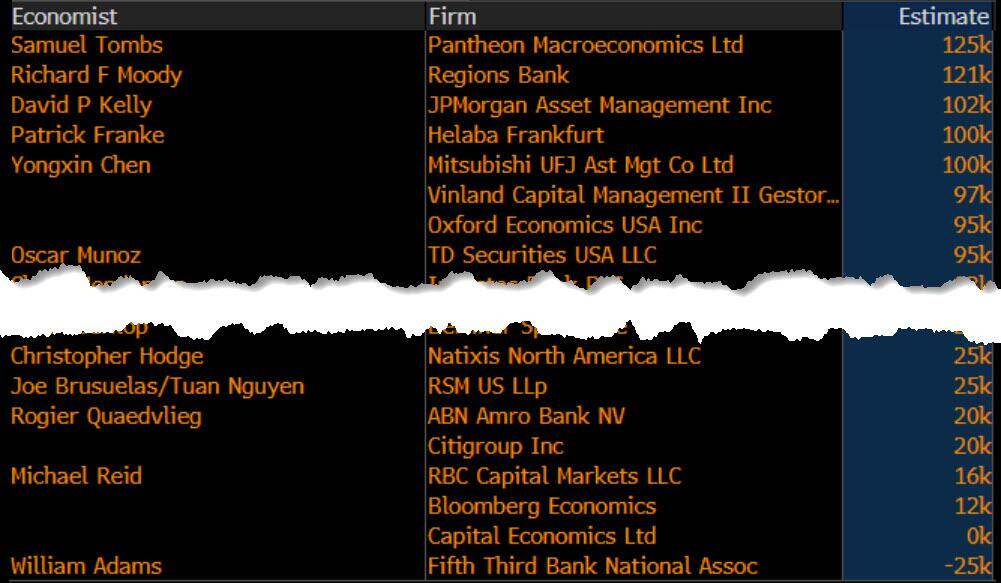
In terms of market impact, JPMorgan believes that under the current policy environment, next week's CPI data will have a greater impact on the September 16 Fed meeting than today's non-farm report. According to JPMorgan, options expiring on September 4 imply a move of approximately 1.1% for the S&P 500 index. According to Bloomberg Chief Economist Anna Wong, if August non-farm payrolls turn negative again, "in the modern history of the Fed, there is no precedent for the Fed raising rates after two consecutive months of negative non-farm payroll growth."
Data Expectations: Mixed Signals, Conflicting Indicators
Leading indicators for the August jobs market show notable divergence, making forecasts more challenging than usual.
ADP reported private sector employment increased by just 38,000 in August, the slowest pace since January this year, below the consensus of 47,000—representing the largest downside miss in recent memory.
Revelio public labor statistics show the economy added 36,500 jobs in August, a marked slowdown from July's 79,200. Initial jobless claims rose to 207,000 during the BLS survey window, up from 189,000 during July's survey period. Goldman Sachs' alternative employment indicators averaged 31,000, down from 65,000 in July. Additionally, Challenger reported that employers announced 52,900 layoffs in August, up notably from 33,400 in July.
But layoffs remain broadly restrained—Challenger data shows cumulative layoffs of approximately 530,000 in the first eight months of 2026, the lowest for the same period since 2022; hiring plans are at their highest level since 2023.
The monthly average of initial jobless claims stands at 204,000, below July's 210,000, and the JOLTS layoff rate declined 0.1 percentage points month-over-month to 1.0%. Furthermore, employment in leisure and hospitality has fallen by a cumulative 83,000 over the previous two months, while local government education employment has declined by 61,000—both sectors have room for normalization-driven rebounds.
Job openings data (combining JOLTS, Indeed, and LinkUp) was largely flat in July, with no significant trend emerging recently.
Business survey signals are similarly mixed: the ISM manufacturing employment index dipped slightly to 51.2, still in expansion but at a slower pace; the ISM services employment index edged up to 47.8, remaining in contraction territory for a second consecutive month; while S&P Global's manufacturing and services PMI employment components both strengthened, with the latter recording its fastest pace of job growth in nearly 18 months.
TPS Expiration: Potential Downside Tail Risk
Analysts have specifically flagged a policy factor that could mechanically depress the jobs data—approximately 300,000 immigrants (primarily of Haitian descent) had their Temporary Protected Status (TPS) expire at the end of July, terminating their work authorization in the US.
According to Barclays estimates, roughly 200,000 of these individuals were still counted as employed during July's non-farm survey. An estimated 25,000 are expected to disappear from August statistics as employers remove them from payrolls. As remaining individuals complete their eligibility reviews, this will continue to be a drag in the coming months. Some have filed for asylum before the deadline, with certain approvals granted before status expiration, preserving their work eligibility; others may temporarily remain on employer payroll records as employers have yet to complete work authorization verification.
According to Bloomberg Chief Economist Anna Wong's assessment, factoring in these elements, there is a reasonably high probability that August non-farm payrolls will show a second consecutive month of negative growth.
Annual Benchmark Revisions: Employment Data Already Understated
Adding to the context of this release, one must also factor in the annual benchmark revision estimates published by the Bureau of Labor Statistics (BLS) in August.
The revisions show that as of March 2026, seasonally unadjusted employment was 79,000 lower than previously estimated, a decrease of approximately 0.1%. This magnitude is far smaller than last year's revision—the benchmark revision for the March 2025 reference period was as large as 911,000.
Looking at the breakdown, private sector employment was revised down more significantly by 178,000, meaning average monthly growth was actually 24,000 rather than the previously reported 38,000. By sector, retail trade saw the largest downward revision (-154,600), transportation and warehousing saw the largest upward revision (+135,100), and government was still revised up by 99,000 despite federal workforce reductions. The final revised data will be formally incorporated into the February 2027 employment report.
Fed Policy Path: After Non-Farm, CPI Is the Real Key
On the Fed policy front, analysts' assessments are notably consistent: Non-farm payrolls coming in near expectations with the unemployment rate holding steady would align with the narrative that "the jobs market is cooling but not deteriorating sharply"—a scenario that would keep policymakers focused on their inflation-side policy objectives.
The scenario that would truly alter the policy logic is a sharply negative non-farm print. Anna Wong stated unequivocally that if August non-farm payrolls turn negative again, "there is no precedent in modern Fed history for proceeding with rate hikes after two consecutive months of negative job growth," which would immediately freeze any market expectations of a rate hike.
From a market reaction framework perspective, JPMorgan believes that with only one non-farm report and one CPI report remaining before the September 16 Fed meeting, the latter carries greater weight. A strong non-farm reading would push bond yields higher, weighing on equities through the self-reinforcing logic of "more jobs → more consumption → further corporate hiring," and this transmission mechanism deserves particular attention given that Warsh has already flagged concerns about loose financial conditions at Jackson Hole.
JPMorgan has set its "Goldilocks zone" at 30,000 to 70,000 new jobs, within which the market is more likely to remain relatively stable.
If Data Exceeds 100,000, US Stocks Will Face Notable Pressure
According to JPMorgan, here are the market reaction paths for different data ranges:
If the data exceeds 100,000, US stocks will face notable pressure, the 10-year Treasury yield will move higher, and markets will more fully price in a September rate hike; if it falls in the 70,000–100,000 range, equities will dip modestly with yields rising moderately; the 30,000–70,000 range is the "Goldilocks zone" with a relatively neutral market reaction; if it comes in below 30,000 or turns negative, short-end rates will decline rapidly, but a negative reading could trigger "stagflation concerns," making market assessments of the Fed's policy path highly complex.
Goldman Sachs expects average hourly earnings to rise 0.4% month-over-month, above the consensus of 0.3%, citing positive calendar effects that should support stronger wage data. Goldman's wage tracker shows Q2 hourly earnings growing at a 2.8% annualized rate quarter-over-quarter and 3.6% year-over-year, still below its estimated 4% growth threshold consistent with the 2% inflation target.


