America’s AI capital gamble is betting on the fate of the dollar


- Core Thesis: The United States is mobilizing capital on an unprecedented scale, deeply tying the AI race to the hegemony of the dollar. By opening capital markets to financing and reshaping the global accessibility of the dollar through blockchain asset tokenization, it aims to leverage AI leadership to reinforce the dollar's status. However, this model raises the correlation between the dollar and the stock market, weakening its safe-haven properties, and leaving its fate dependent on the outcome of the AI race.
- Key Elements:
- Scale of Capital Mobilization: U.S. companies are expected to spend approximately $800 billion on AI capital expenditures this year, with over $400 billion raised in AI venture capital. Investment-grade credit financing by companies like Google and Meta has reached roughly ten times their annual average, with all three channels conducting large-scale fundraising simultaneously.
- Shift in Financing Structure: With the U.S. twin deficits running high, foreign official sector demand for U.S. Treasuries has declined, but private capital inflows are filling the gap; in Q2 2026, foreign equity capital inflows exceeded $400 billion, setting an all-time quarterly record and surpassing debt capital inflows.
- Progress in Asset Tokenization: DTCC, which custodies approximately $115 trillion in assets, has completed its first batch of tokenization tests; the SEC has issued a "no-action" letter confirming that securities can trade on both traditional and on-chain dual tracks; the NYSE and Nasdaq are developing 24/7 trading platforms and tokenization solutions, respectively.
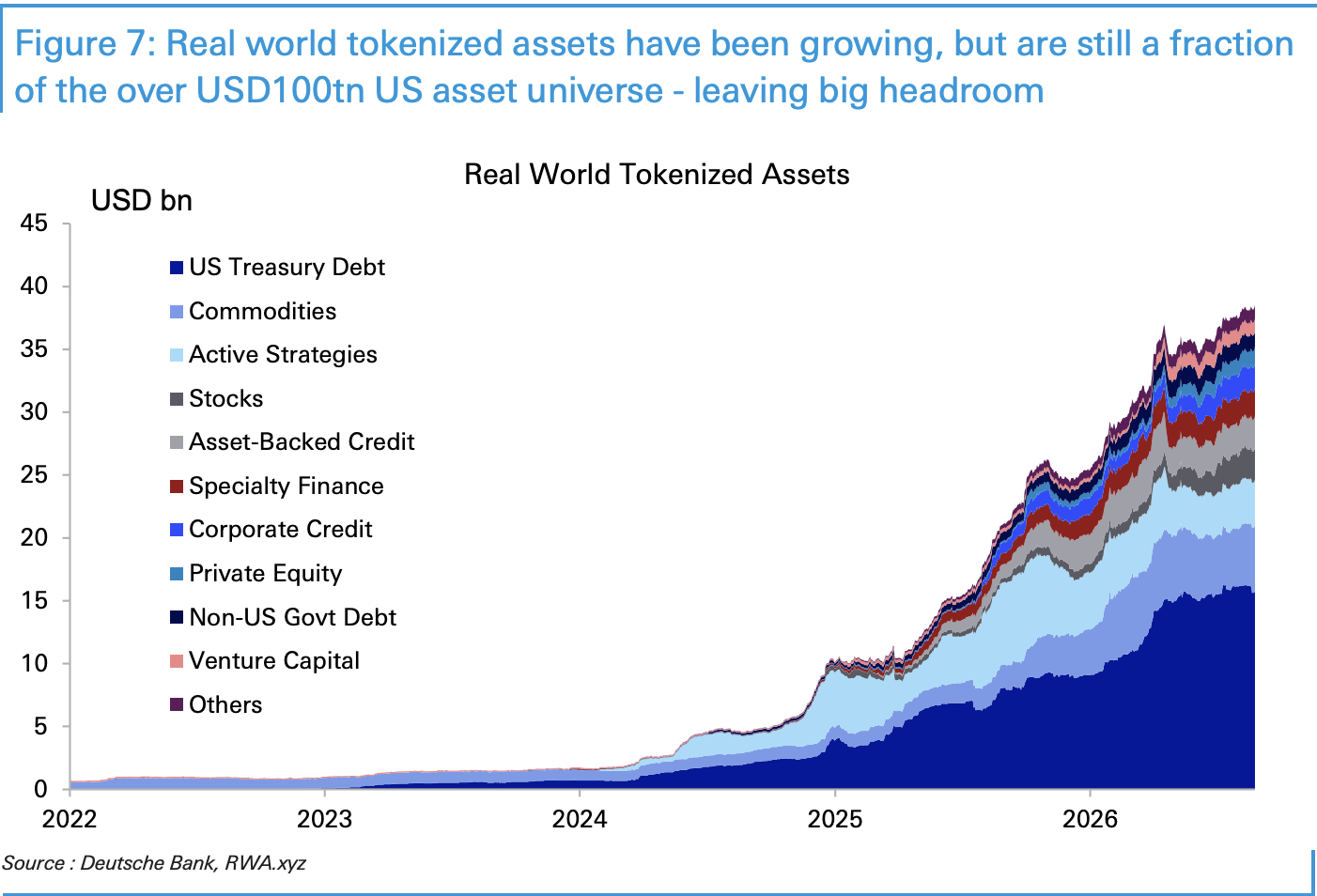
- Strategic Significance and Risks: Tokenization enhances collateral liquidity and capital efficiency, expanding the demand base for dollar-denominated assets, but it equally reduces friction for capital outflows; the global tokenized asset market stands at approximately $40 billion, projected to reach between $2 trillion and $30 trillion by the 2030s.
- Reshaping of Dollar Risk: Financing is shifting from official long-term capital to private short-term tech capital, raising the correlation between the dollar and equities while diminishing its traditional risk-hedging attributes; if the AI model is disproven or the U.S. falls behind, the dollar will face downward pressure.
- Model Vulnerability: The U.S. adopts an "open markets + closed technology" model, relying on AI companies sustaining technological leadership and monetizing pricing power; failure to generate sufficient economic returns would undermine the core logic of foreign investment and exacerbate fiscal deficit pressures.
- Deeper Proposition: The AI race is seen as the ultimate test of the shareholder capitalism model. AI revenue streams are expected to improve the U.S. current account by approximately 1 percentage point over the next decade, but this depends on companies maintaining pricing power and successfully monetizing international users.
Original Author: Zhao Ying
Original Source: Wallstreetcn
The United States is mobilizing capital on an unprecedented scale, deeply intertwining the AI race with the hegemony of the US dollar. The logic behind this high-stakes bet is clear and aggressive: fuel AI infrastructure through a fully open capital market, reshape the global accessibility of dollar assets with blockchain technology, and then use AI leadership to reinforce the dollar's status. However, the inherent fragility of this model is equally apparent — the dollar is increasingly resembling a high-risk stock rather than a traditional safe-haven anchor.
According to the ZhuiFeng trading desk, citing a Deutsche Bank FX special report released on September 3, US companies are expected to spend approximately $800 billion on AI capital expenditure this year. AI venture capital has already raised over $400 billion this year, with the two largest AI labs alone securing a combined nearly $217 billion, both nearing $1 trillion valuations. Meanwhile, hyperscalers like Google, Meta, Amazon, and Oracle have raised roughly ten times their average annual level from 2020 to 2024 through the investment-grade credit market this year.
The impact of this capital mobilization is directly translating into structural risks for the dollar. As the US funding source shifts from official long-term capital to private short-term tech capital, the dollar's correlation with the stock market is rising, and its traditional risk-off hedging properties are weakening. If AI business models are proven invalid, or the US falls behind in the AI race, the dollar will face severe downward pressure.
Capital Floodgates Open: Three Financing Channels Activated Simultaneously
The US is concurrently raising massive funds through three channels: private equity, public debt, and the stock market.
In the private markets, AI venture capital has raised over $400 billion this year, with more than 90% of the largest deals concentrated in the US, growing at an annualized rate three times that of last year. In the debt markets, hyperscalers are being forced to turn to bond financing on a large scale for the first time — Google, Meta, Oracle, and Amazon have raised roughly ten times their average annual levels from 2020 to 2024 through the investment-grade credit market this year. In the public stock markets, Google completed its first stock issuance since its 2004 IPO in June 2026, raising $85 billion; SpaceX completed the largest-ever new stock listing with a market capitalization of nearly $2 trillion.
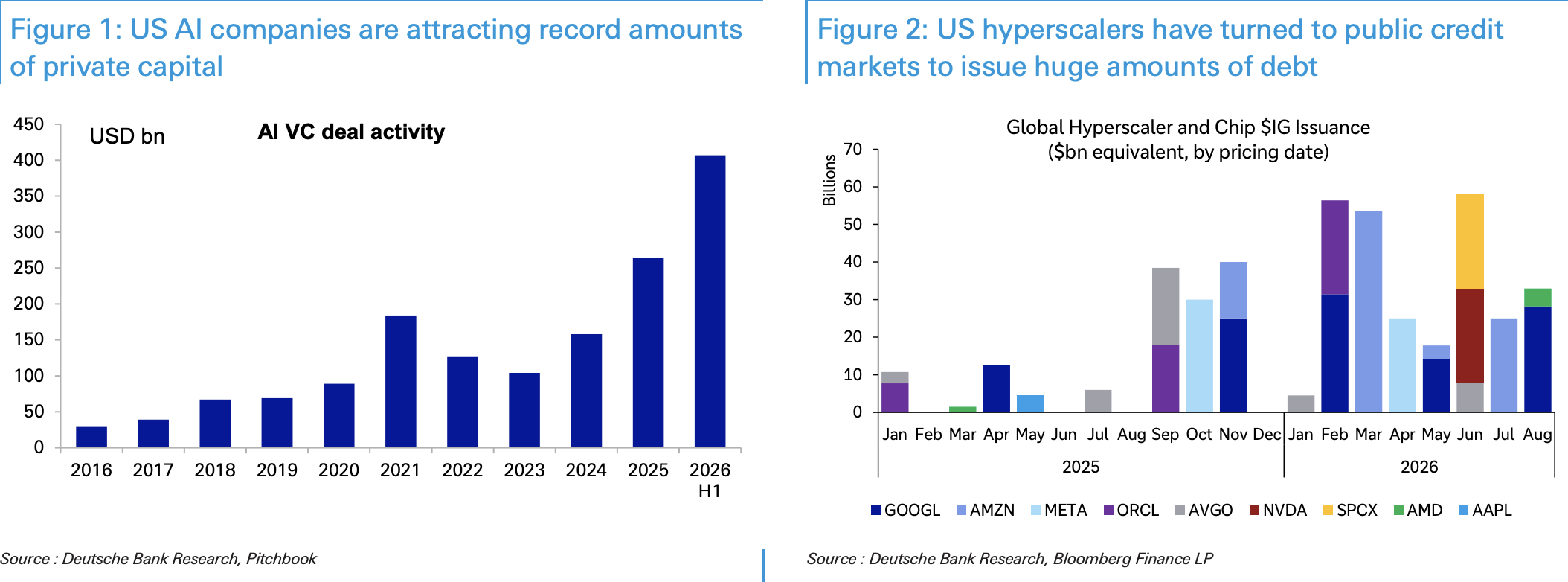
This financing wave is set against the backdrop of the US's widening twin deficits — a fiscal deficit exceeding 6% of GDP and a current account deficit nearing 4% of GDP. In the absence of domestic fiscal savings, the incremental demand for AI capital expenditure must be filled by foreign capital. Deutsche Bank data shows thatin Q2 2026, the US attracted over $400 billion in foreign equity capital in a single quarter, far surpassing any historical quarterly level and significantly exceeding debt capital inflows — which had long been the primary source of US capital account financing.
Notably, foreign official sectors' long-term appetite for US Treasuries is declining due to geopolitical rifts, but the appeal of tech assets is filling this gap through private channels like retail investors. SpaceX reportedly reserved about 30% of its IPO shares for retail investors, more than triple the traditional IPO allocation, reflecting US companies' clear awareness of the shifting financing structure.
Asset Tokenization: The Next Technological Pillar of Dollar Hegemony
Alongside large-scale financing, the US is deploying blockchain technology as infrastructure to attract global capital, pushing asset tokenization from concept to reality.
Asset tokenization refers to converting ownership of financial assets such as stocks, bonds, and real estate into digital tokens recorded on a blockchain. The Depository Trust & Clearing Corporation (DTCC), which currently holds in custody approximately $115 trillion in US assets, completed the tokenization of its first batch of assets in July 2026 and used them in real transactions, with 40 financial institutions participating. This included tokenization tests of the S&P 500 ETF (SPY) and tests where JPMorgan used tokenized assets to meet CME Group margin requirements. DTCC plans to officially launch tokenization services in October 2026.
On the regulatory front, the US Securities and Exchange Commission (SEC) issued a "no-action" letter to DTCC in December 2025, confirming that the same security can trade in parallel on both traditional and on-chain tracks, with the same investor protections and ownership rights. A subsequent ruling in January 2026 further clarified that the issuance format or custody method of a security does not affect the application of federal securities laws. This provides substantial regulatory backing for tokenization.
At the exchange level, the New York Stock Exchange is developing a new digital platform with Securitize, aiming for 24/7 trading, instant settlement, fractional stock trading, and stablecoin settlement; Nasdaq has announced its "Equity Token Design," planning to achieve full tokenization capabilities by 2027, and has already announced it will launch 23/5 trading by the end of 2025.
Deutsche Bank believes the strategic significance of tokenization for the dollar lies in two aspects: on one hand, tokenized assets offer higher collateral liquidity, improving capital efficiency and enhancing the attractiveness of US assets to global investors; on the other hand, if US stocks and bonds achieve 24/7 instant settlement, it will significantly lower the entry barrier for global retail investors, further expanding the demand base for dollar assets. The case of South Korea provides a reference — South Korea accounts for only 2% of global nominal GDP, yet contributed approximately 10% of the $740 billion in foreign capital that flowed into US stocks last year, partly because South Korea opened fractional trading of foreign stocks earlier.
Currently, the global scale of tokenized real-world assets stands at approximately $40 billion. Compared to the US's asset base of over $100 trillion, the growth potential is immense. Market forecasts suggest that by the 2030s, the scale of tokenized assets could reach between $2 trillion and $30 trillion.
The Dollar's New Risk Profile: From Safe Haven to AI Bet
This dual gamble on capital and technology is reshaping the dollar's risk characteristics.
Deutsche Bank points out that the US is experiencing a fundamental shift in its financing structure: from official sector-dominated, long-term, geopolitically driven capital inflows to private sector-dominated, short-term, tech-return-driven capital inflows. This shift has significantly increased the dollar's correlation with the stock market, weakening its historical role as a hedge against equity risk.
This logic implies that the dollar's fate is deeply intertwined with the outcome of the AI race. If AI capital expenditure ultimately proves to lack economic viability, or if the US loses its technological lead, a large-scale exodus of private capital would deliver a direct shock to the dollar.
At the same time, while tokenization lowers the barriers to capital inflows, it equally reduces the friction of capital outflows. Enhanced capital mobility is a double-edged sword — it can accelerate capital inflows during favorable conditions, but it can also accelerate capital flight during adverse conditions.
From a broader perspective, Deutsche Bank argues that the US is competing in the AI race with an "open markets + closed technology" model: attracting global capital through comprehensive capital market openness while keeping AI model weights closed to preserve corporate pricing power and shareholder returns. The core premise of this model is that US AI companies can sustain their technological lead and convert it into sustainable profitability.
The Capitalist Model Itself Faces a Stress Test
Deutsche Bank's report raises a deeper proposition: the AI race is not merely a technological contest but also a competition between economic models, and America's shareholder capitalism model itself is facing a stress test.
The internal logic of the American model is: open capital markets attract global capital → massive capital investment drives technological innovation → technological leadership supports corporate pricing power → high profit returns attract more capital inflows. The viability of this positive feedback loop depends on AI companies' ability to charge high subscription fees to global users and monetize intellectual property in international markets.
However, this loop has clear vulnerabilities. If AI business models fail to generate sufficient economic returns, or if US corporate pricing power is eroded, corporate profits will come under pressure, undermining the core logic for attracting foreign capital and exacerbating already elevated fiscal deficit pressures.
Deutsche Bank also notes that AI revenue streams could improve the US current account by approximately 1 percentage point over the next decade through enhanced service exports, but this outlook is highly dependent on whether US AI companies can maintain pricing power and successfully monetize their international user base.
The report ultimately characterizes this race as the ultimate test of the core American creed that "free and open capital markets always foster optimal innovation." The outcome of the AI race will, to a considerable degree, determine whether this creed still holds, and whether the dollar's role as the global capital hub can endure.