Lighter Flash Crashes 20% — Is Robinhood Really "Breaking Up"?


- Key Takeaway: Robinhood announced it will offer perpetual contract services to U.S. users through Bitstamp. Market expectations of an upgraded Robinhood-Lighter integration have fallen through, causing LIT to plummet nearly 20% in a short squeeze. However, the existing partnership between the two parties has not been terminated — regulatory qualifications are the core obstacle preventing the collaboration from expanding.
- Key Elements:
- Robinhood will offer perpetual contract trading to U.S. users through Bitstamp, which it acquired in 2025, supporting assets such as BTC, ETH, and SOL, with up to 10x leverage on BTC/ETH.
- LIT plunged nearly 20% in a short squeeze as market expectations fell through. Its valuation premium had previously been driven by the core narrative of "leveraging Robinhood to tap into massive retail traffic."
- The founders of Robinhood and Lighter are high school classmates. Robinhood previously participated in Lighter's $68 million Series B funding, and Robinhood Wallet has already integrated Lighter's products.
- Bitstamp and Lighter coexist within the Robinhood ecosystem, serving different markets and product scenarios respectively — it is not an "either-or" relationship.
- Lighter has not yet obtained the regulatory qualifications required for U.S. derivatives business, while Bitstamp already has them. This is the practical reason Robinhood chose Bitstamp.
- Lighter's founder previously participated in CFTC advisory committee work, and the market expects the project to be among the first batch to receive U.S. compliance approval. Licensing progress is a key catalyst.
Original | Odaily (@OdailyChina)
Author | Azuma (@azuma_eth)

An announcement from Robinhood dealt an unexpected blow to Lighter (LIT).
On the morning of September 30 (Beijing time), Robinhood announced at its annual conference that it will offer perpetual contract trading services to eligible U.S. users through its cryptocurrency exchange Bitstamp (acquired by Robinhood in 2025 for $200 million). The service will initially support crypto assets including BTC, ETH, SOL, XRP, DOGE, ADA, LINK, and HYPE, with BTC and ETH eligible for up to 10x leverage and other assets up to 3x leverage.
This would ordinarily be a highly positive product development, but as the news broke, Lighter's native token LIT plunged nearly 20% in short order, giving back a large portion of its previously accumulated gains.
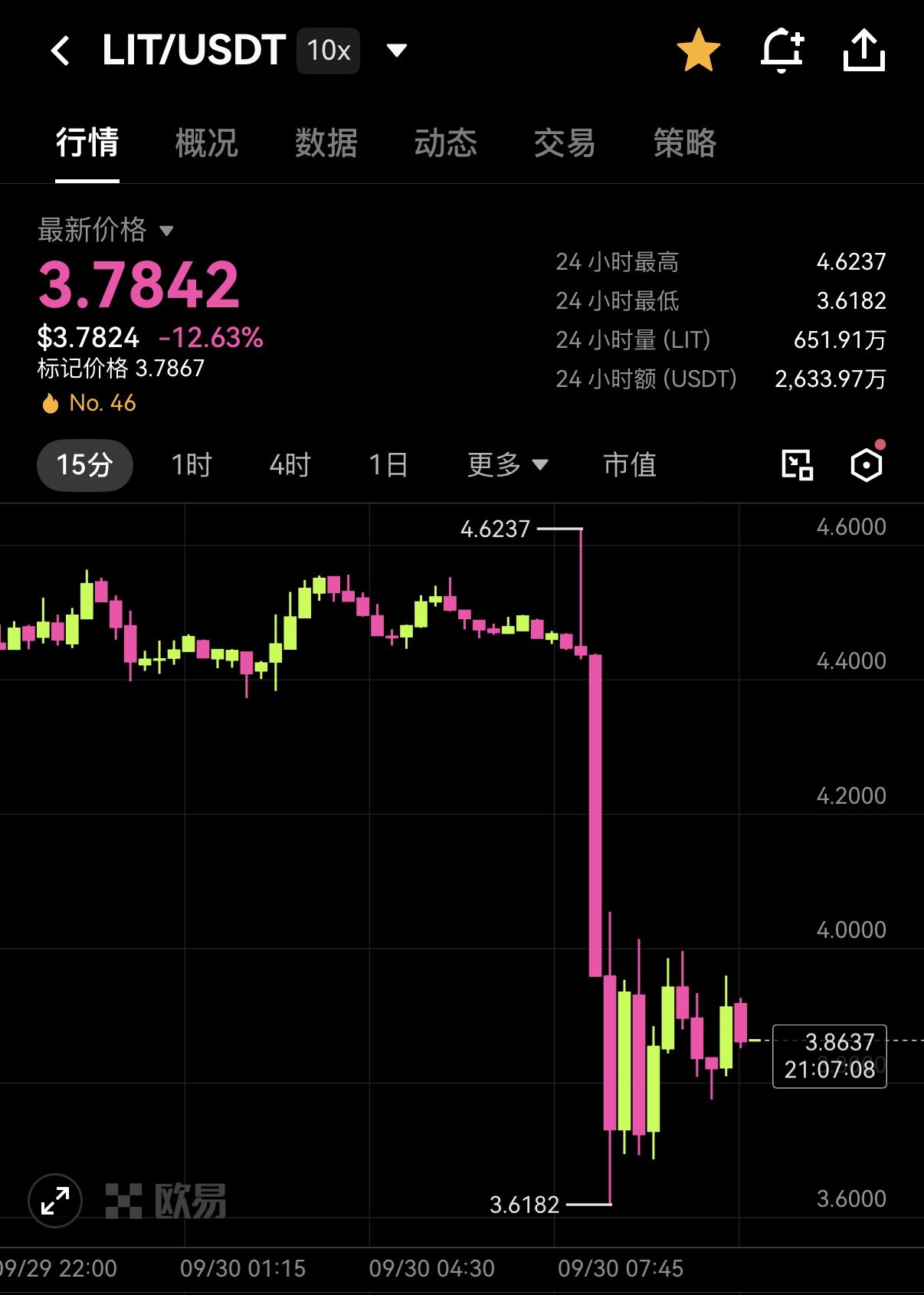
Why would Robinhood's progress cause LIT to crash? Over the past period, the core narrative that allowed LIT to lead many Perp DEXs and command a valuation premium far exceeding its competitors in the same sector was precisely that "Lighter is expected to leverage its ties with Robinhood to tap into the latter's massive retail flow." But when Robinhood confirmed it would offer perpetual contract services in the U.S. market through its "own flesh and blood" Bitstamp, the binding upgrade the market had been anticipating temporarily fell through, and some even began to question whether Lighter would be marginalized within Robinhood's ecosystem matrix.
Can LIT be bought on the dip? Is Robinhood really about to abandon Lighter? These are undoubtedly the questions all LIT holders care about most right now. Before answering, we need to first clarify exactly which market expectations this announcement has broken, and whether the existing partnership between the two parties has truly changed.
How Does Robinhood's Choice of Bitstamp Break Market Expectations?
To understand why LIT's price reaction was so severe this time, we must first see where the market's expectation gap comes from.
For a long time, the market has maintained strong confidence in the ties between Robinhood and Lighter. The founders of the two companies, Vladimir Novakovski and Vlad Tenev, are high school classmates — both graduated from Thomas Jefferson High School for Science and Technology, one of America's top public high schools, and were even the only two Valedictorians in their school.
In 2025, Lighter announced the completion of a $68 million Series B funding round, with Robinhood participating directly. Later, in mid-2026, Lighter completed an integration with Robinhood Wallet, allowing the latter's users to directly use the former's products within the wallet for perpetual contract and stock token trading.
The wallet-side collaboration gave Lighter its first channel to reach Robinhood users, and also led the market to begin imagining broader business synergies between the two parties in the future. Especially against the backdrop of Robinhood's continued expansion of its cryptocurrency business and its push into on-chain assets and derivatives trading, Lighter, as the Perp DEX closest to Robinhood, naturally attracted higher expectations. It was not hard for the market to further speculate that Robinhood might bring Lighter into its main app, or even leverage its technology and liquidity to expand into more markets beyond the United States.
But the plan Robinhood unveiled this time clearly did not unfold along this expected path. According to information disclosed at Robinhood's conference, it will offer perpetual contract services to eligible U.S. users through Bitstamp, which it acquired in 2025. For Robinhood, this is not surprising — using a trading platform already under its umbrella to conduct derivatives business has an existing operational foundation and facilitates unified management of related trading services.
On the other hand, however, this also means that at least in the current U.S. perpetual contract business, Lighter has not been chosen by Robinhood as its partner. Previously, the market may have already priced in expectations of an upgraded partnership between the two, and with those expectations temporarily unmet, LIT has consequently borne the corresponding valuation pressure.
Is Robinhood Really Going to Abandon Lighter?
It should be noted, however, that the failure of an expected partnership upgrade and the termination of the partnership are two entirely different things — concluding that Robinhood will abandon Lighter based solely on this announcement is clearly overinterpreting the situation.
If we observe Robinhood's perpetual contract business across different regions and product scenarios, Bitstamp and Lighter are not actually in a "zero-sum" relationship. In fact, Bitstamp and Lighter have long coexisted in parallel across different business scenarios at Robinhood — Bitstamp has already been offering perpetual contract services in the European market, while the partnership between Robinhood Wallet and Lighter primarily targets non-U.S. markets that support the feature. The two respectively serve trading demands in different markets and product scenarios.
Robinhood's move to offer perpetual contracts to U.S. users through Bitstamp is more about extending an existing business model to the U.S. market rather than directly replacing Lighter's existing role on the wallet side.
More notably, as of now, Robinhood Wallet's relevant official documentation still lists Lighter as the underlying platform for its perpetual contract trading, and no public information indicates that the two parties have terminated their partnership or plan to remove the integration. This means that, at least at the existing business level, the partnership between Robinhood and Lighter will continue.
Of course, the preservation of existing cooperation does not mean it will necessarily continue to expand in the future. Whether Robinhood will continue to provide traffic channels for Lighter and whether it will add deeper technical or commercial synergies remains to be confirmed by subsequent information.
For Lighter to Go Further, It Still Needs to Clear the Licensing Hurdle
Rather than whether Robinhood intends to abandon Lighter, regulatory qualifications may be the more important practical factor behind why this partnership has not expanded further.
Behind Robinhood's announcement that it will offer perpetual contract services to U.S. users through Bitstamp is a background that cannot be overlooked: the U.S. derivatives market has strict regulatory requirements. Lighter has not yet obtained the regulatory qualifications needed to conduct relevant business in the United States, so even if Robinhood were inclined to bring it into its main app, it would first need to resolve the corresponding compliance issues.
Bitstamp, however, already has the foundation to conduct relevant business, and after Robinhood acquired it, it can leverage this existing platform to advance perpetual contract services in the U.S. market. From this perspective, Robinhood's choice of Bitstamp this time may not necessarily be a rejection of Lighter's technology or business capabilities, but rather a more operable business arrangement under the current regulatory environment.
It is worth mentioning that Lighter founder Vladimir Novakovski previously participated in work related to a U.S. Commodity Futures Trading Commission (CFTC) advisory committee and has publicly discussed plans to pursue regulatory qualification applications. The market had previously expected that Lighter would be among the first batch of Perp DEX projects to obtain compliance approval in the U.S. market.
For Lighter, the progress of obtaining relevant licenses will directly affect the expansion of its future business scope. If it can obtain Designated Contract Market (DCM) status under the CFTC regulatory framework in the future, it will have the opportunity to further explore compliant business arrangements in the U.S. market. However, there is still a gap between application progress, final approval, and the subsequent actual conduct of business, and the relevant outcomes cannot be determined in advance.
If Lighter successfully obtains the required qualifications later, whether Robinhood will incorporate it into a broader perpetual contract business system will become a new variable worth watching. At that point, whether the existing partnership between the two can extend further into larger-scale trading scenarios will also have a clearer basis for discussion.
So Can You Buy the Dip?
Back to the most practical question from the opening — after the crash, can LIT be bought on the dip now?
The answer may depend on what your underlying logic for buying LIT actually is. If your holding thesis is built on "Robinhood will directly channel tens of millions of U.S. retail users' contract flow into Lighter in a short period," then this trade may have been betting on the wrong timing from the start. But if you are betting on "Lighter as a fundamental building block of Robinhood's on-chain ecosystem," then the current panic may instead offer a window to re-examine its risk-reward ratio.
For investors considering entering, directly "catching a falling knife" on the left side may not be a wise choice right now. In the short term, as sentiment unwinds and liquidity drains away, the market often needs time to establish a new turnover platform. In the medium to long term, the real reversal signal lies neither in short-term price rebounds nor in verbal endorsements from Robinhood, but in when two core catalysts materialize — first, substantive progress on Lighter's key regulatory licenses; second, whether Robinhood will release concrete actions to deepen cooperation beyond the wallet side.
Until the uncertainty is fully cleared, let the dust settle a little longer.