Interview with PPP: The World Cup Sparks the Prediction Market – How to Find "Reproducible Smart Money"?


- Core Viewpoint: The prediction market has seen a boom driven by the World Cup, but ordinary users often suffer losses when copying "smart money" due to information lag or non-reproducible strategies. PPP (Prediction Position Platform) uses AI modeling combined with manual review to filter out trading strategies with long-term stability, lowering the barrier to entry for users through structured copy-trading tools.
- Key Elements:
- The prediction market is currently at a historical peak in trading volume and user participation, but ordinary users who copy trades manually are easily put on the defensive, and opportunity costs vanish in an instant.
- Traditional copy-trading tools only use "total profit" or "recent win rate" as criteria, causing users to overlook key factors like drawdown and liquidity, thereby falling into the "smart money trap."
- PPP employs multi-dimensional AI modeling (encompassing profit stability, win rate, drawdown, position allocation ratio, etc.) and manual review to weed out incidental profits and screen for replicable strategies.
- The product is divided into "Strategy Square" (verified over six months, low risk) and "Trading Leaderboard" (high profit over the last 30 days, high volatility), catering to users with different risk preferences.
- The underlying infrastructure is a non-custodial wallet, where users retain control of their private keys; copy trading supports custom trigger amounts, slippage, take-profit parameters, and other settings to control execution risk.
Original by Odaily (@OdailyChina)
Author: Azuma (@azuma_eth)
With the World Cup igniting, the prediction market has experienced an unprecedented surge in activity.
From match outcomes, group stage progression, championship winners, to the Golden Boot rankings... massive amounts of capital are actively trading in the prediction market, pushing trading volumes and user engagement to all-time highs. Yet beneath the excitement, most average users face an awkward reality — staring at fluctuating probabilities on the screen, unsure how to operate to achieve consistent profitability.
In search of certainty for profits, many users track "smart money" movements on social media or news platforms. However, in practice, this "wait for signals, then manually copy" approach easily leads to a passive position. Since prediction market probabilities fluctuate in real-time, opportunity costs are often fleeting, making manual operations difficult to keep up with the pace.
To address this, some users have started looking at standard copy-trading tools available on the market, which harbors a more insidious "smart money trap." Many tools simply use "total profit" or "recent win rate" as the sole criteria to display so-called smart money addresses. Users, seeing these "masters" flaunting millions of dollars in eye-popping returns, blindly follow, only to end up with losses after entry.
"Not all profitable addresses are suitable for copy-trading."
When discussing the reasons behind this situation, we recently came across a prediction market strategy platform PPP (Prediction Position Platform), which provided the above answer.
PPP explained that some addresses might profit due to special information, extreme positions, one-off market movements, or capital size advantages. If average users only look at profit rankings, they easily overlook drawdown, liquidity, position style, and actual followability. Once they blindly copy, unexpected results are likely. In other words, "profitability" itself does not equate to "copyability."
"An address that can be safely followed by average users must demonstrate stable profitability over a long period with a large sample size. Win rate, maximum drawdown, strategy stability, and position allocation... each indicator is indispensable. Only addresses that withstand scrutiny across these dimensions have a replicable profit logic."
AI Modeling + Manual Review: Filtering Truly Replicable Strategies
According to PPP, the biggest problem facing current prediction market users is how to filter out truly "replicable, verifiable, and sustainable" smart money addresses from the vast sea of trading addresses, and to track their dynamics in a simpler way to participate in copy-trading.
To this end, PPP is attempting to build a comprehensive system — structuring complex address data and trading signals, ultimately transforming them into strategy entry points that average users can understand and use.
Lorne, a member of the PPP team, stated: "The market doesn't lack monitoring tools, nor does it lack copy-trading tools. What it lacks is a strategy mechanism that structures complex trading behaviors, cleanses them, and transforms them into something ordinary users can understand, dare to use, and find easy to operate."
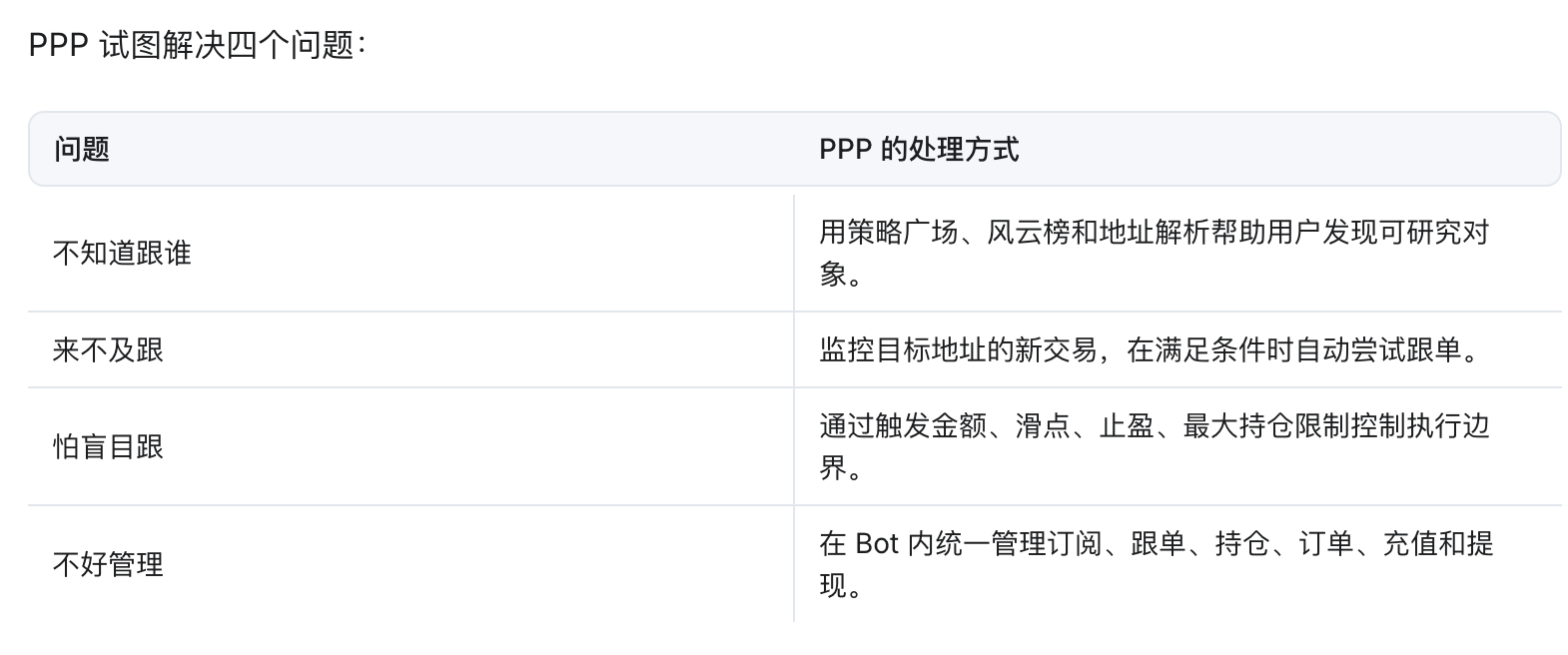
Lorne added that PPP employs a dual mechanism based on AI modeling and manual review, conducting a comprehensive analysis of specific addresses across multiple dimensions, including but not limited to:
- Profit performance and stability;
- Win rate structure;
- Maximum drawdown and risk exposure;
- Capital size and position allocation;
- Activity level and trading frequency;
- Holding period...
After comprehensive AI modeling of these indicators, the system first eliminates "accidental profits" and "abnormal trading samples." Then, combined with multiple rounds of manual review, it ultimately selects a batch of trading addresses that are statistically more stable and have sustained research value.
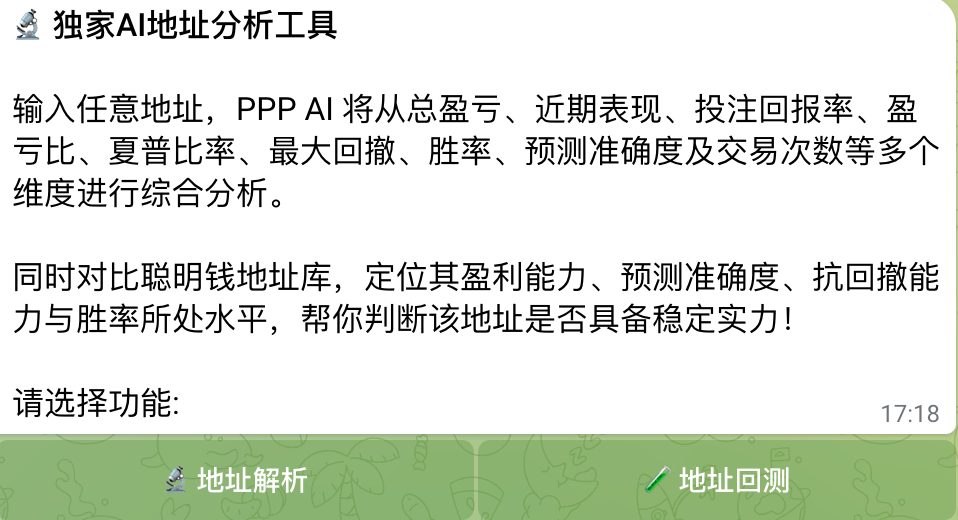
PPP emphasizes that its AI algorithm model itself is not publicly disclosed. However, the platform makes the analytical capabilities of this model available to users through an "AI Address Parsing Tool." Users can paste their tracked addresses on PPP, compare them against the smart money address library, and assess their profitability, informational advantage, drawdown resilience, and win rate level to determine if the address possesses stable strength.
Strategy Tiering: Meeting Diverse Needs
After completing the initial screening, PPP further tiers these replicable smart money addresses, constructing two core product systems tailored to different user needs.
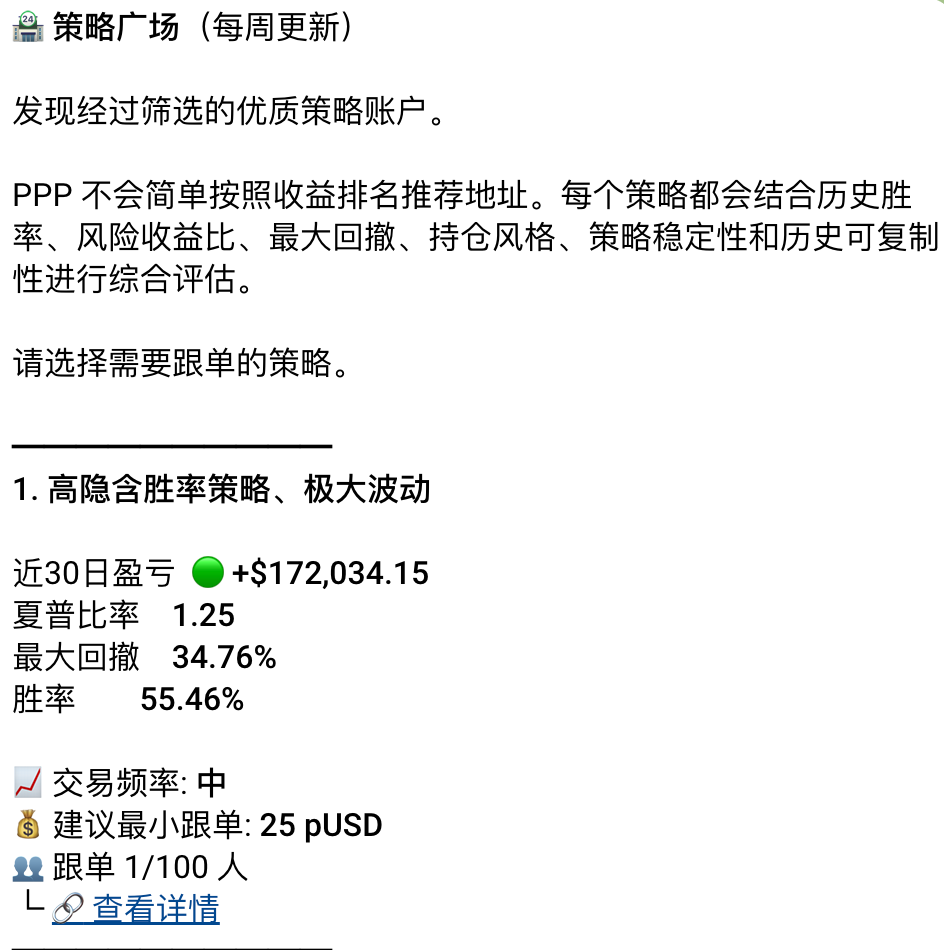
First is the "Strategy Square." According to Lorne, the Strategy Square aggregates stable trading strategies that have been validated over a longer period. Addresses entering this system typically need to meet stricter selection criteria, including:
- At least six months of historical trading verification;
- A passing AI multi-dimensional score;
- Manual review confirming strategy consistency;
- Focus on risk-return ratio and drawdown control ability;
- Emphasis on strategy replicability and long-term stability;
In summary, the Strategy Square can be understood as a filtered, long-term strategy pool, aiming to provide users seeking stable copy-trading with more sustainable options. PPP also conducts regular reviews of strategies in this section weekly to ensure their continued effectiveness.
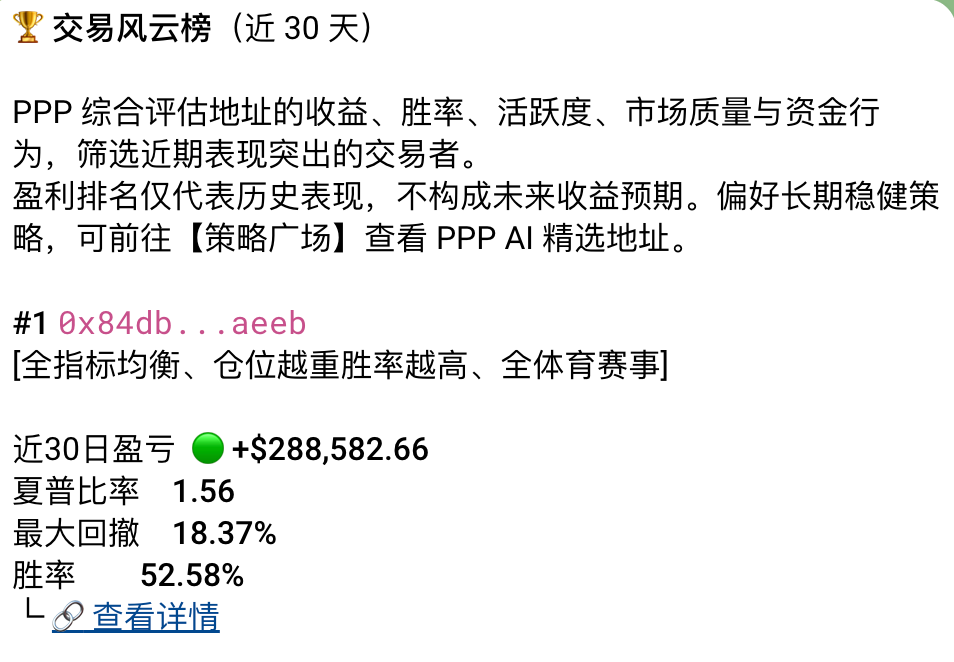
Second is the "Trading Leaderboard." Lorne explained that unlike the Strategy Square, the Trading Leaderboard leans more towards capturing phase-specific opportunities. This list is generated by PPP through AI multi-dimensional models and manual review, primarily screening top-performing traders from the last 30 days, focusing on dimensions such as:
- Profit growth rate;
- Win rate trend changes;
- Activity level and market participation;
- Short-term capital behavior characteristics;
In this system, high returns often come with higher volatility. PPP has also clearly stated: "This list is more suitable for users looking for phase-specific opportunities, rather than long-term stable copy-trading strategies."
To meet users' diverse operational needs,PPP provides simple, easy-to-understand abstract summaries and descriptions of the specific styles of strategies and addresses in the Strategy Square and Trading Leaderboard (e.g., "High Implied Win Rate Strategy, High Volatility"), enabling users to clearly understand the differences between strategies and make informed choices.
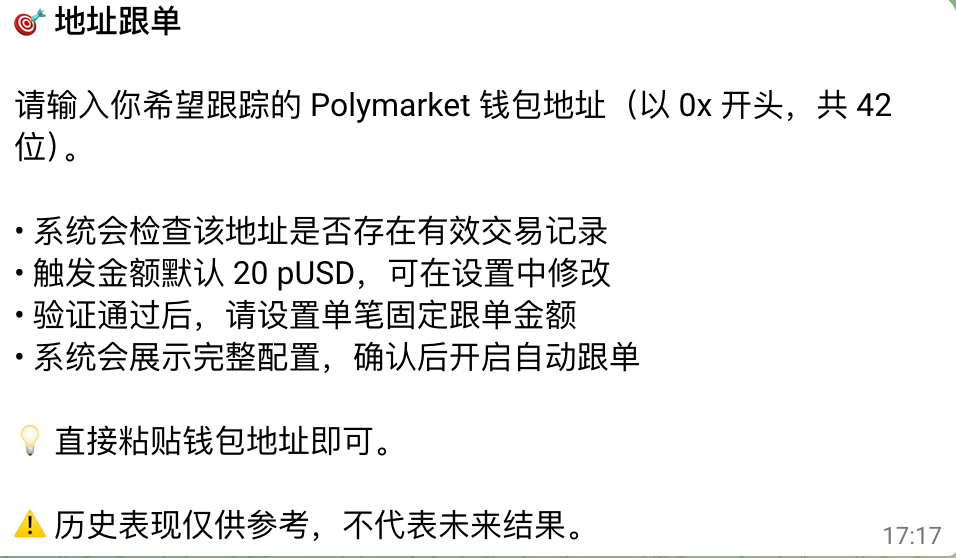
In addition to the two standardized list systems above, PPP also offers a one-click trading function and an address copy-trading function. The former helps users immediately copy trades upon receiving a signal; the latter allows users to input any address they are interested in for copy-trading.
Lucky Break During Trial: Single-Day Return Over 60%
Lorne revealed that PPP recently launched its Telegram Bot product. Currently, this product serves as the primary user interface, while the website and other products are under active development.
Guided by Lorne, we also tried the complete user flow as an ordinary user.
Upon first entry, users need to log in to their account and create a wallet via the Telegram Mini App. PPP's wallet system is non-custodial, meaning users always retain control over their wallet (the private key can be exported according to the process; please store it safely yourself). This implies that any potential future gains from this wallet, such as potential airdrops from Polymarket, will belong entirely to the user.
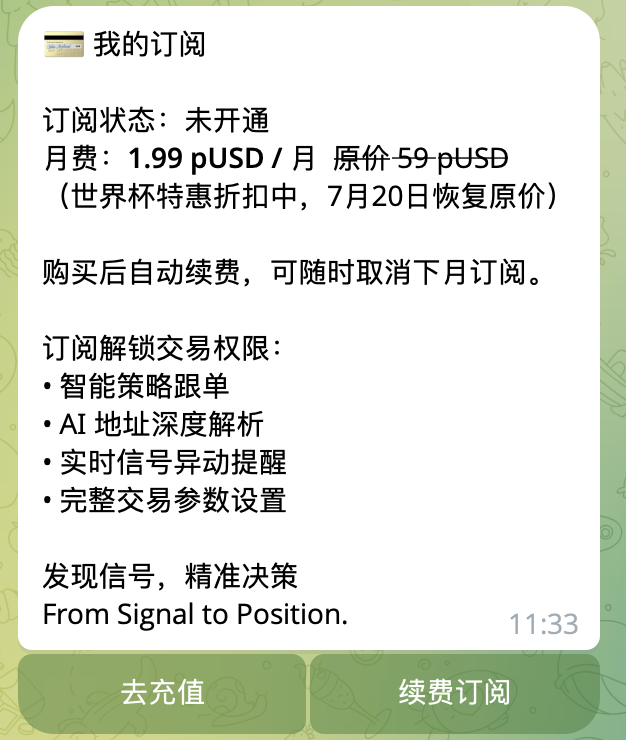
Next come the deposit and subscription steps. PPP operates on a subscription model. Users need to subscribe first to unlock full functionality. The monthly subscription fee is 59 USDC, but it is currently offering a limited-time discount at 1.99 USDC for initial users to experience the platform at a low cost.
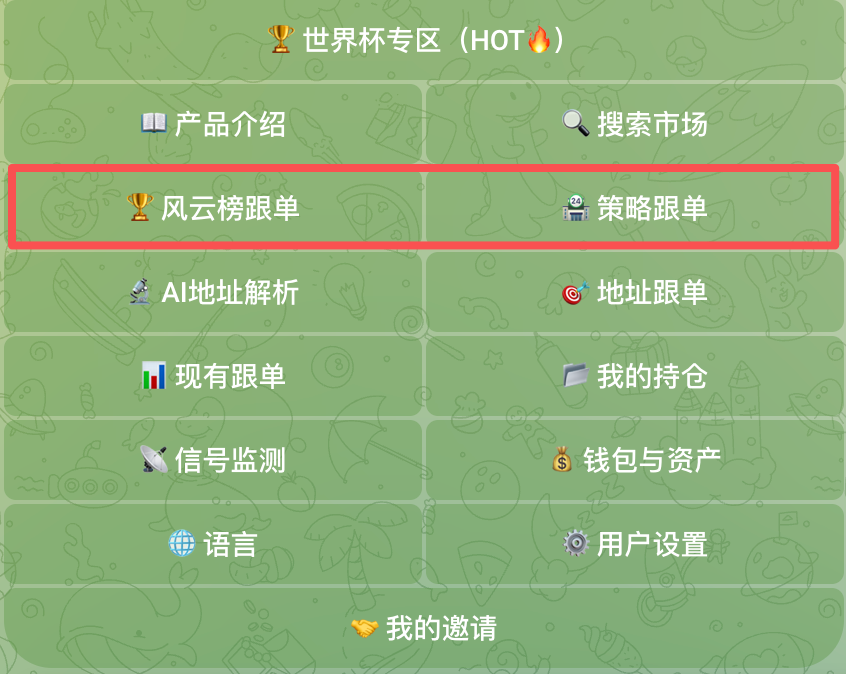
After subscribing, users can see the unlocked full suite of services on PPP's homepage, including the previously mentioned Strategy Square, Trading Leaderboard, Address Copy-Trading, AI Address Parsing, and also "Wallet & Assets" to check balances, "Existing Copied Trades" to view current positions, and "Signal Detection" to follow the latest market movements. PPP has also launched a dedicated World Cup section, where users can check real-time match schedules and view continuously updated smart money movements and key trading signals, quickly identifying where capital is betting.
As for the specific copy-trading operation, after selecting a strategy, users can view its key indicators across various dimensions. Once they confirm it meets their needs, they can choose the copy amount or customize settings to start copying. Notably, there is a "Copy Settings" feature within the functions. Users can actively adjust parameters like trigger amount, copy amount, slippage, take-profit, and maximum position limit for different strategies to control the execution boundaries of the copy-trading.
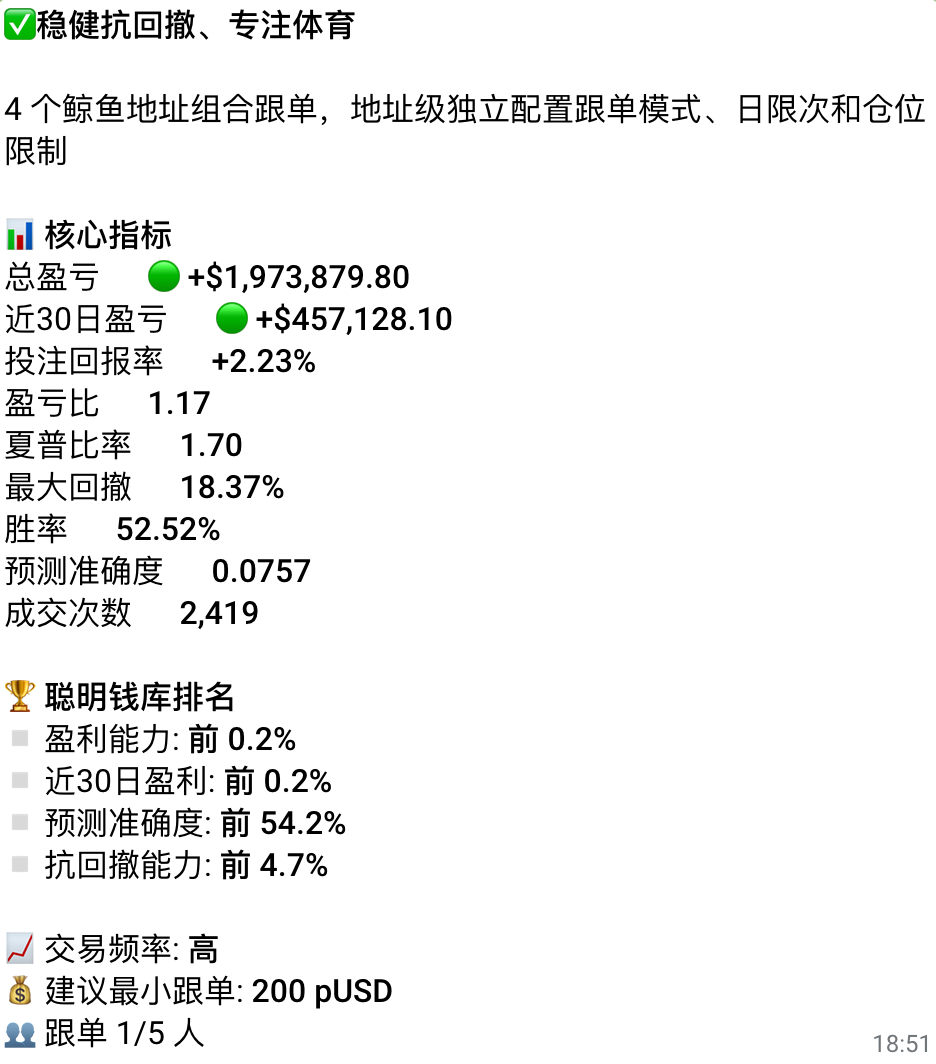
I personally deposited $100 to test the platform for a day, following two strategies from the Strategy Square and two addresses from the Trading Leaderboard. When I checked the next day, I was surprised — my account net value had peaked at $164, a single-day return of over 60%.
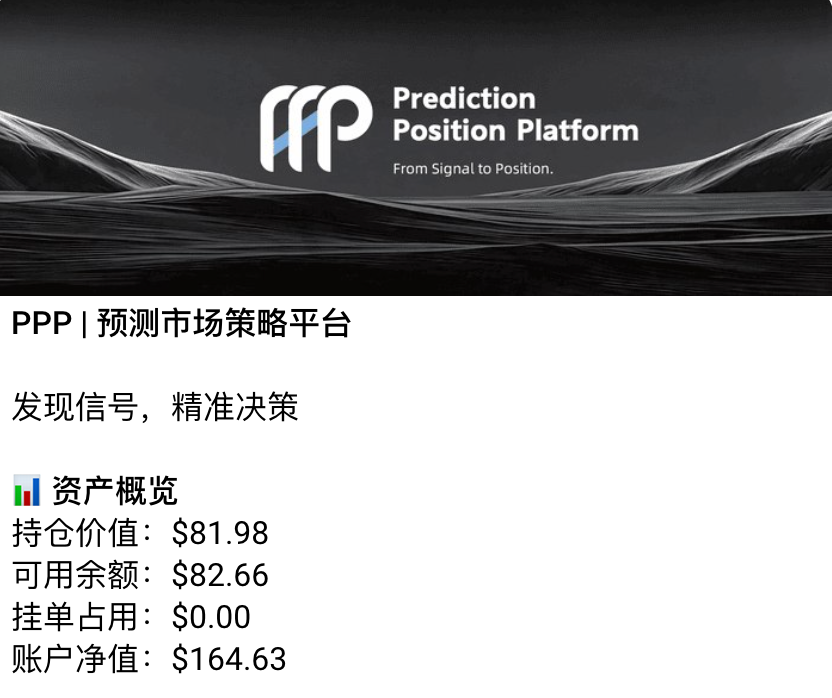
However, in subsequent tests, the account experienced some drawdown. The main issue was not setting different copy amounts for strategies with varying risk profiles, causing a low-probability event to erode too much capital.
Lorne candidly stated: "Although PPP has rigorously screened and reviewed the historical performance of selected strategies, recognizing the address's capability through multi-dimensional modeling, the platform cannot guarantee that strategy accounts will continue to be profitable in the future. Therefore, users are advised to try within their acceptable risk range and not to get carried away."
Finding Certainty in an Uncertain Market
After testing for a few days and having an in-depth conversation with Lorne, our most intuitive feeling is that PPP should not be simply understood as a "copy-trading tool"; it is more like an attempt to build a structured "compilation" path from "trading signals" to "executable strategies."
Smart money indeed exists, but it is scattered across countless addresses, strategies, and short-term fluctuations. Profit records are also real, but the underlying risk structure, capital behavior, and strategy stability are often obscured by simple profit figures. This explains why "following smart money" is often unstable in practice — users see the results, but the market operates on the process; users want to replicate the profits, but often overlook the path.
PPP attempts to bridge this gap. Through the deep integration of AI's complex algorithms and manual review, it denoises and structures the originally chaotic and random on-chain trading signals, extracts truly "replicable" smart money strategies, and delivers them to users via a low-barrier TG Bot. This serves as an effective defense against the "smart money trap" and helps eliminate information asymmetry in the prediction market.
Of course, as Lorne emphasized, no historical backtesting or strategy screening can offer a 100% guarantee of future returns. High returns in the prediction market are inevitably accompanied by high volatility and risk. While PPP provides a set of deeply processed "weapons" to help users increase their win rates and avoid obvious pitfalls, ultimately, success in the long-term game depends on the user's own capital management skills and risk appetite.