






After Apple's event, AAPL edged lower. BiyaPay market observations: can Ternus's debut sustain a new AI cycle?


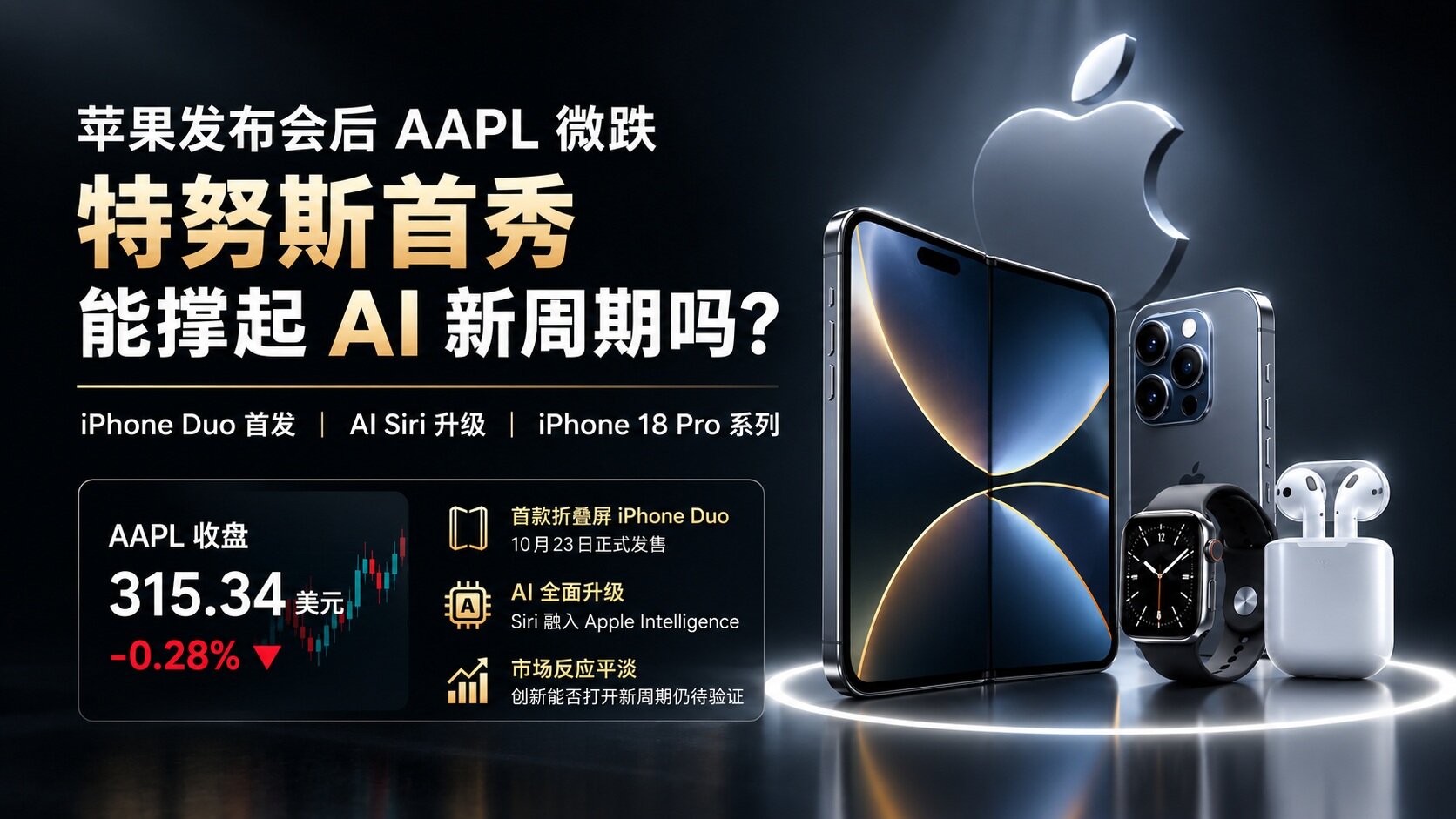
- Core View: Apple's fall event introduced its first foldable iPhone Duo and AI-enhanced features, but the market reaction was muted, with the stock dipping 0.28%, reflecting that investors are more focused on whether the new products can drive an upgrade cycle and monetize AI, rather than relying solely on symbolic innovation.
- Key Elements:
- The iPhone Duo starts at $1,999 and goes on sale October 23, with a 7.6-inch unfolded inner display and the A20 Pro chip, positioning it as a probe into the ultra-premium market.
- Apple's AI approach focuses on on-device processing and privacy, with Siri AI rolling out alongside the iOS 27 beta, but its monetization cycle is longer than that of competitors such as Microsoft and Google.
- AAPL closed at $315.34, down 0.28%, while its market cap remains above $4 trillion, and under a high valuation the market demands greater earnings elasticity.
- If foldables scale up, they will drive the panel, hinge, titanium structural component, and other supply chains, but order volume, yield rates, and per-unit value still need to be watched.
- In Ternus's first appearance after succeeding Cook, the market is watching whether Apple can shift back from supply-chain-driven growth to product-innovation-driven growth.
Apple's fall event generated plenty of buzz, but the market reaction was hardly euphoric.
On September 9, Apple unveiled its first foldable phone, the iPhone Duo, alongside the iPhone 18 Pro, iPhone 18 Pro Max, Apple Watch Series 12, and AirPods 5. The event was anything but conservative, and the foldable iPhone marked Apple's first entry into an entirely new hardware category in years.
Yet the stock reaction was far less enthusiastic than the product launch. BiyaPay market data shows AAPL closed at $315.34 that day, down 0.28%.

That's what makes this so interesting.
If you look only at the event, Apple has finally delivered a foldable, filling in a product form factor that has been debated for years. If you look at the stock price, the market clearly isn't in a hurry to assign it a higher valuation. The reason isn't complicated. Apple's problem now isn't whether it has new products—it's whether those products can open a new upgrade cycle, whether AI can truly land in the user experience, and whether Ternus can prove that Apple's next chapter isn't just a continuation of the Cook-era supply chain and services revenue, but a re-entry into a product innovation cycle.
When I watch this kind of event-driven market action, I don't just fixate on AAPL alone. In the BiyaPay App, for instance, you can simultaneously track AAPL, other US tech stocks, the Hong Kong consumer electronics supply chain, as well as BTC, ETH, and other assets. As a global one-stop asset allocation platform, BiyaPay covers digital assets, US stocks, Hong Kong stocks, and fiat currency exchange across multiple asset scenarios. For information-dense market conditions around an event like this, observing price reactions across different markets makes it easier to discern whether capital is trading on new product expectations, the AI narrative, or a shift in overall risk appetite.
Ternus's Debut: What the Market Is Really Watching Isn't Presence
The reason this event drew attention wasn't primarily the iPhone—it was the person.
After Ternus succeeded Cook, Apple entered a new narrative phase. Cook-era Apple was strongest in supply chain, profit margins, inventory management, services ecosystem, and shareholder returns. Apple's ability to sustain high profitability over the long term was fundamentally due to Cook's operational prowess. But over the past few years, the biggest doubts about Apple have also been clear: hardware innovation has slowed, AI deployment lags behind Microsoft, Google, Meta, and the Nvidia ecosystem, and iPhone growth increasingly depends on existing users upgrading.
So when Ternus hosted his first event, the market wasn't watching whether he spoke smoothly—it was watching whether Apple has genuinely changed its playbook.
Looking at his background, Ternus comes from hardware engineering and has long been involved in important product lines like Mac, iPad, and Apple Silicon. That background naturally leads outsiders to expect him to pull Apple back into a "product-driven" story. The foldable iPhone Duo making its debut at his first event does carry symbolic significance. It doesn't feel like a routine upgrade; it feels more like Apple signaling to the market that the iPhone still has new forms, and that Apple is still willing to enter a category it hasn't personally defined before.
But capital markets won't pay for symbolism alone. Whether the foldable can sell, whether the price can hold, what supply chain yields look like, and whether users are willing to pay a premium for a new form factor—these are the real questions that will determine AAPL's trajectory going forward.
iPhone Duo Is a Highlight and a High-Price Probe
According to Apple's official information, the iPhone Duo is Apple's first foldable iPhone, with a 7.6-inch inner display when unfolded and a 5.4-inch outer display, powered by the A20 Pro chip, supporting multitasking, starting at $1,999, with pre-orders opening October 16 and official sales beginning October 23.
The significance of this product isn't just that Apple finally made a foldable—it's that Apple has packed some of the iPhone and iPad use cases into a single device. Foldables have long been an Android camp story, but the problems have been obvious: bulk, creases, app adaptation, durability, and price all limited their move from niche to mainstream. Apple's advantage in entering now lies in software-hardware integration, ecosystem adaptation capability, and a premium user base; the pressure is equally obvious, because the $1,999 starting price is already far above ordinary flagship phones.
This feels more like a probe into the premium market.
If the iPhone Duo can unlock demand among core users, it will bring two changes. First, Apple can continue pushing up the iPhone average selling price, alleviating the slowdown in smartphone shipment growth. Second, the foldable form factor could provide new entry points for multitasking, gaming, video, productivity, and AI assistants, strengthening Apple's ecosystem stickiness.
But if sales are just early adopters trying it out and can't form a sustained upgrade wave, its contribution to Apple's performance will be relatively limited. The market not sharply pushing the stock higher after the event reflects exactly this judgment. The new product is new enough, but it hasn't yet proven it can become a new cycle.
AI Finally Takes Center Stage, But Not Enough to Reassure the Market
Another keyword at this event was AI.
Apple strengthened Apple Intelligence and Siri AI across the iPhone Duo, iPhone 18 Pro series, and iOS 27. According to Apple's official introduction, Siri AI will launch in beta alongside iOS 27, with emphasis on personal context understanding, on-screen content awareness, cross-app operations, and privacy and on-device processing capabilities.
This approach differs from Microsoft, Google, and Meta. Apple isn't building a large model platform first, nor selling AI as a cloud service to enterprises—it's trying to stuff AI back into its own device ecosystem. It's not talking about "biggest model" but "closest to personal use scenarios." Strategically, this fits Apple's DNA. iPhone, Apple Watch, AirPods, Mac, and iCloud form a high-frequency device network, and if Apple can truly bring AI into these devices, it should theoretically be closer to daily needs than a standalone chatbot.
The problem is, the market is no longer willing to just listen to AI stories.
Over the past year, AI trading has moved from "who has a model" to "who can monetize," from "who dares to invest" to "who can generate returns." Microsoft has cloud revenue and Copilot, Google has search, cloud, and Gemini, Meta has advertising efficiency improvements, Nvidia has chip orders and data center revenue. Apple's AI logic is slower, relying more on future device upgrades and services ecosystem penetration. It's not without value—it's just that the payoff cycle is longer.
This is also the core reason behind AAPL's muted post-event performance. The market acknowledges Apple's advantage in AI devices, but wants to see clearer indicators: whether iPhone upgrade rates can improve, whether services revenue can accelerate, whether Siri AI truly changes user habits, and whether high-priced hardware can steadily lift profits.
Why Didn't AAPL Rise? Not Because There Weren't Enough New Products, But Because Expectations Were Too Full
Apple's stock dipping slightly after the event doesn't mean the market rejected the new products. More precisely, much of the information had already been traded in advance.
The foldable, iPhone 18 Pro price increases, AI Siri, new Apple Watch and AirPods—these directions all had relatively high expectations beforehand. By the time the event actually landed, capital would reassess two questions: Is the surprise big enough, and have the risks gotten smaller? Apple delivered a new form factor and a new AI entry point this time, but didn't immediately solve the performance elasticity question the market cares about most.
Current AAPL valuation isn't cheap. Public market data shows Apple's market cap remains above $4 trillion, with the P/E ratio at a relatively high level. At this position, the market's demands on Apple are higher than for an ordinary company. For an ordinary company, one innovative product might send the stock up first; for a company of Apple's size, investors will ask whether this product can support revenue growth over the next few years, whether it can expand the ecosystem profit pool, and whether it can enhance long-term competitiveness in the AI era.
So Apple doesn't lack attention—it lacks a new growth answer that can be verified by earnings reports.
Supply Chain and Hong Kong Stocks Will Also Be Repriced
Apple's new product launch affects US stocks beyond just AAPL itself—it also transmits to the supply chain and the Hong Kong consumer electronics chain.
If the iPhone Duo ramps up, the most directly affected areas are foldable panels, hinges, titanium structural components, thermal management, camera modules, batteries, and advanced packaging. The iPhone 18 Pro series continuing to upgrade cameras, chips, and thermal management will also refocus the market on Apple chain companies with stronger bargaining power and higher technical barriers. Many consumer electronics companies in Hong Kong and A-shares often fluctuate in the short term following Apple new product expectations as well.
But this line can't be judged solely by event hype. The core of the Apple chain isn't whether there's a concept—it's order volume, yields, per-unit value, and profit margins. If the foldable is just a small-batch premium product, its pull on the supply chain will be more structural; if it starts entering a broader product line next year, the supply chain elasticity will be more pronounced.
For the market, Apple's event is more like a starting point. Real verification will come with pre-order data, launch performance, supply chain scheduling, and the next earnings report.
The Report Card Apple Really Needs to Deliver Next
After this event, Apple needs to answer three questions.
First, can the foldable open a premium upgrade cycle? The $1,999 starting price determines that the iPhone Duo won't be a mass-market device—it's more like Apple probing the ultra-premium market. If early demand is strong, Apple can gain higher ASP and stronger brand premium; if demand is average, it's more likely just a halo product.
Second, can AI become usage frequency rather than event vocabulary? Apple's AI advantage is devices and privacy, but what the market ultimately watches isn't feature names—it's whether users actually use it daily, whether developers are willing to adapt, and whether services revenue benefits as a result.
Third, can Ternus build new investor trust? In the Cook era, the market believed Apple could make money; in the Ternus era, the market also needs to believe Apple can redefine products. This shift won't be completed by one event, but this event at least provides an observation window.
So Apple's event wasn't without highlights. The iPhone Duo is a rare new form factor from Apple in years, the iPhone 18 Pro series continues to strengthen the premium route, and Siri AI finally puts Apple's AI in a more central position. But AAPL's stock not rising significantly also shows the market has entered a more rational phase.
For Apple, the event is responsible for creating expectations, and the stock price is responsible for testing them. Ternus's debut is complete, but the real exam has just begun. Next, pre-order data, launch performance, AI feature feedback, and the next quarterly earnings will determine whether Apple is opening a new cycle this time, or just telling a familiar story a little more beautifully.





