Fomo "Top 4" Whale's Practical Sharing: Earning $5 Million in This Meme Cycle Through Insight


- Core Thesis: The explosive growth of Robinhood Chain this cycle stems from its precise embrace of retail speculative culture. Positioned as the rise of a brand-new ecosystem akin to Solana in Q4 2023 or Base in Q1 2024, its AMM pairing mechanism between stocks and Meme tokens is set to redefine the paradigm for anchoring on-chain asset value.
- Key Elements:
- Top trader AJC profited by heavily positioning in launchpad platform token PONS. The core logic is that PONS uses 80% of platform revenue to buy back tokens, with an FDV/buyback multiple of only ~2x — far lower than Pump.fun's 10-15x — indicating significant undervaluation.
- PONS outperformed competitors primarily because it offers a "cannot be exploited" token binding mechanism, aligning with the market's new consensus of "generating real revenue and buying back tokens." This represents a paradigm shift in token launches — listing tokens on day one of product release.
- Robinhood Chain captures up to $3 million in daily network revenue, surpassing many major Ethereum L2s. Its ecosystem vision encompasses the tokenization of all assets, including US stocks and collectibles, positioning it as "the chain with the widest moat for retail distribution."
- The core of the stock-Meme pairing mechanism: when users buy BONER tokens, the underlying capital flow injects an equivalent value of HIMS stock spot into the AMM pool, creating a forced value linkage between real-world assets and on-chain Memes, driving a market maker arbitrage flywheel.
- This mechanism carries a critical risk: during weekend market closures when US stocks are off, the on-chain minting/redeeming channel locks up, arbitrage stabilization fails, and paired tokens may severely depeg. Users should be highly cautious about blindly buying the dip.
- Bitcoin is in a "bullish consolidation" phase, with limited reasons for decline and more potential catalysts for upside. However, the author admits they cannot predict the specific trigger, with future upward momentum depending on liquidity recovery and macroeconomic policy drivers.
Original Author: threadguy
Compiled by Odaily (@OdailyChina); Translated by Azuma (@azuma_eth)
Editor's Note: This is a video interview by podcast host threadguy with AJC, the Meme master currently ranked fourth on Fomo's overall profit leaderboard. AJC is also a researcher at Blockworks Research and has previously shared deep market insights on multiple occasions.
During the recent Robinhood Chain rally, AJC has been one of the few top-tier traders with a public track record who is willing to share real strategies with the market. In the interview below, AJC not only discusses his own practical trading experiences but also offers in-depth analysis on topics including "The Rise of Robinhood Chain," "PONS vs PUMP," and "Stock & Meme Pairing."
The following is the content of the interview video, compiled and translated by Odaily.
The Highlight of My Trading Career
(Skipping the opening small talk)
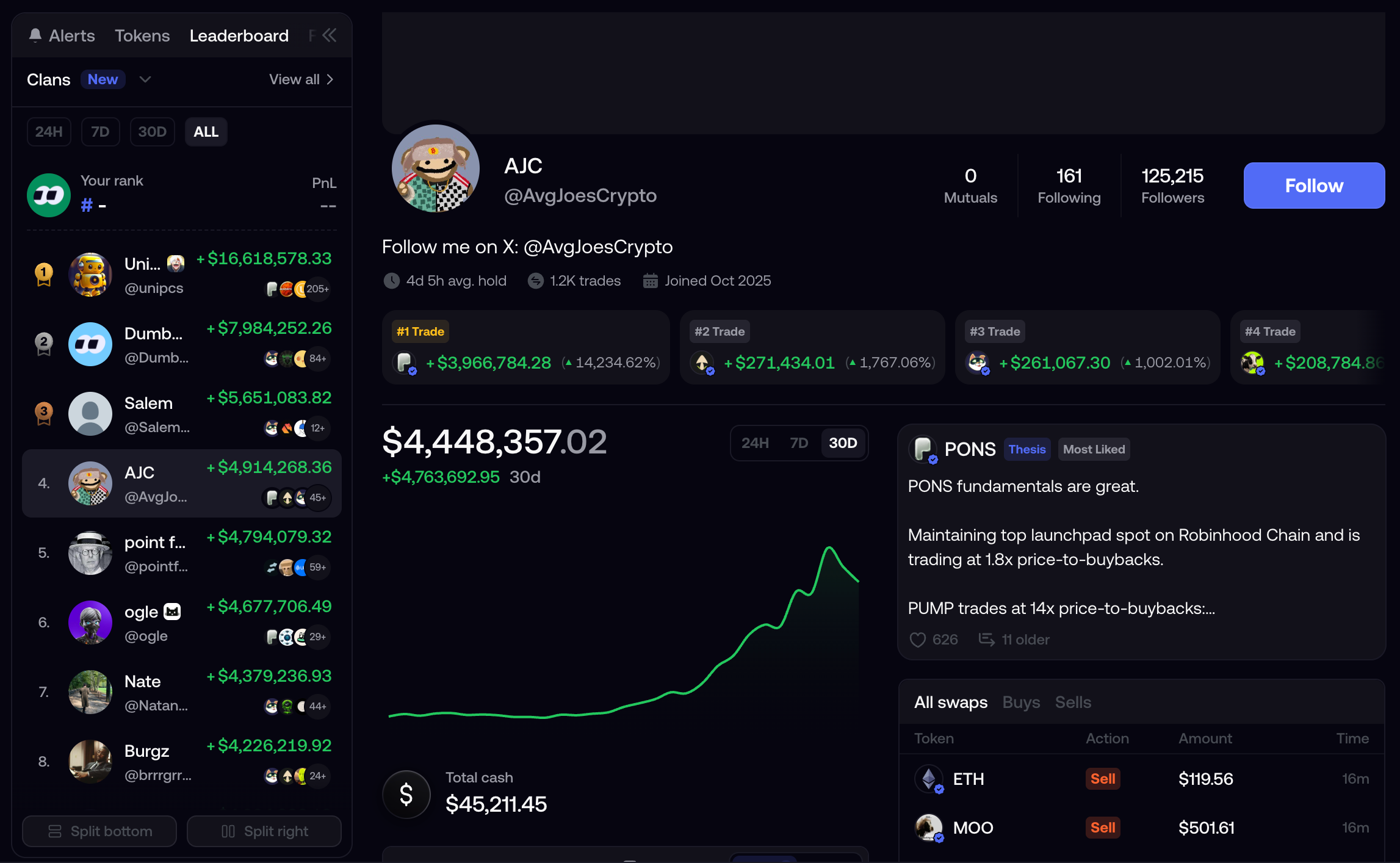
Host (threadguy): First of all, congratulations — this is definitely your moment right now. We were just watching your FOMO account, and your assets have grown to nearly $3 million (approaching $5 million as of writing), although the vast majority is still unrealized gains.
AJC: Haha, actually, I have been taking some profits too. I sell gradually, but I'm not the type to dump my entire position at the absolute peak.
So basically, every time I open the Fomo app, I might sell about $1,000 worth of PONS.
Host: Okay, I have to admit, you're better than me. You're already in the top ten on the leaderboard. Can you tell us what you've been through over the past month?
I've always thought of you as someone very sharp, with good judgment and strong trading skills, but this time it really seems like you've caught a generational wave.
AJC: Alright. Honestly, this is all thanks to Robinhood Chain.
I have to admit, I missed the very first wave when Robinhood Chain launched. That period coincided with Messari being acquired by Blockworks, and I was busy settling in and adapting, so I wasn't trading very frequently.
At the time, I knew Robinhood Chain was definitely going to take off, but I thought to myself, "There's still time, this thing won't pump that fast." Then Vlad (Robinhood co-founder and CEO) went and followed Cash Cat, and the whole situation changed instantly.
Fortunately, another opportunity came later — the NOXA platform shut down for inexplicable reasons, essentially throwing away their "cash cow." I observed at that point and thought, Robinhood genuinely cares about this chain. You can tell from Vlad's social media that this is not a flash in the pan.
A lot of people got tripped up here by fixed thinking, because the crypto industry has seen plenty of public chain projects that fizzled out. But Robinhood is a completely different beast altogether.
So I went to explore the launchpads on the chain, and besides NOXA, the one with the best data and momentum was Pons. At the time, I was completely out of position just watching, as it rallied all the way to around an $18 million market cap.
Then, Brian changed his profile picture to that classic Meme avatar...
Host (interjecting): Haha, I remember that. It single-handedly crashed all the Meme coins.
AJC: Yeah! It was insane. I was watching the charts too, and PONS dropped 80% in a single day along with everything else. Then I thought, okay, this is the moment!
I decided to take a gamble. Because by then I had already concluded that the top launchpad on Robinhood Chain should be worth a 9-figure market cap, and here it was down to $4 million, still the absolute leader. The worst case was losing $25,000, but the risk-reward ratio was just too good to pass up.
The journey afterwards was full of ups and downs. PONS rallied to a $60 million market cap, then fell all the way back to $10 million. During that entire process, I didn't sell a single token. At the time, there was intense competition among the various launchpads on Robinhood Chain, but in the end, Pons emerged victorious. I think a key reason Pons ultimately won was that it actually had its own token, which we can discuss in more detail later.
And in the last two weeks, the market has started repricing it. I've basically just been watching it, staring at the charts, and seeing my expectations materialize step by step.
So this period has indeed been quite chaotic, but on the other hand, the truly difficult part is already done. Right now, it's basically just sitting there, watching my "piggy bank" get bigger and bigger.
Robinhood Chain's Path to Success
Host: I wrote something in the Telegram group earlier — in the crypto space, "first-mover advantage" often acts as a disguised punishment. Think of early NFT launchpads, Vector, and so on. There are so many examples — you start too early, and the latecomers not only learn from your failures but are often more willing to bet big and take on risk.
Honestly, when Robinhood Chain first launched, my attitude was totally "meh, whatever" — looking back now, that mindset was absurd. Because what Robinhood is doing is truly interesting. If other centralized exchanges' chains launch later, they might adopt a similar strategy.
Robinhood came in with an extremely meticulous plan, fully embracing on-chain culture, understanding the Meme coin mechanism inside and out. Every step was executed with military precision — no mistakes, no disgusting over-marketing (triple shilling), no weird deployment issues... All the amateurish mistakes we've seen time and time again from traditional Web2 giants building on-chain products, they avoided every single one. Even the "soft shill" of Cash Cat during the earnings call was perfectly calibrated. Has this entire approach surprised you? Or do you think it was to be expected?
AJC: It's fifty-fifty. First of all, Robinhood is a massive publicly traded giant. If they are determined to make their chain succeed, they have every resource and ace up their sleeve to get it done.
However, how thoroughly they embraced the native on-chain degen culture did surprise me a bit at first. But when you think about it, it makes perfect sense, right? Think back to 2021. Why did DOGE and SHIB absolutely explode and go mainstream? The core driver was Robinhood. Their user base is naturally very receptive to these kinds of high-volatility assets.
So I think, from that perspective, it's quite logical for them to deeply activate this aspect of their platform. We should probably give Robinhood's team credit — they keenly captured the market's emotional vacuum. At that time, on-chain players were generally disillusioned and hurt by major exchanges and new public chains, feeling ignored and abandoned, like no one really cared about retail investors.
Then, the most influential retail trading platform in the US for the younger generation enters with its own chain, opening its arms wide to embrace these on-chain natives. At that instant, everyone's reaction was basically "holy shit." So yes, their choice of entry path was somewhat unexpected, but the success of Robinhood Chain is not surprising at all from a logical standpoint.
Where Are We in This Meme Cycle?
Host: How are you managing the active positions in your portfolio right now? And where do you think the explosion of the Robinhood ecosystem over the past two weeks fits into the broader narrative evolution? What stage of the cycle are we actually at?
AJC: This is very hard to predict with precision. My personal strength lies in keenly sensing the "inflection point where something is about to take off." But once the rally truly gets going, I typically just ride the roller coaster, and I often end up round-tripping my profits. I've always been like that.
So I might not be the most authoritative person on "calling the top," but I do think you can quite accurately compare this wave to Solana in Q4 2023, or Base in Q1 2024 — this is a brand new ecosystem just getting off the ground. What's likely to follow is a long, sustained bull run, not a short-lived pulse. Right now, this is probably just the foreplay.
Of course, I'm heavily positioned here, so I naturally hope this scenario plays out. But I genuinely cannot believe that if Robinhood is sincere about tokenizing all the US equities on its platform and truly opening the door to real-world DeFi, this chain could only be a flash in the pan.
I watched a podcast with Vlad. His goal is to tokenize all asset classes — US stocks, collectibles, everything in your portfolio — onto the chain. And none of these major moves have actually landed yet! Since the big guns haven't even been fired, I find it hard to believe Robinhood Chain has already peaked.
Admittedly, the Meme coins and related stocks have been a bit crazy in recent days. I recall that yesterday alone, Robinhood Chain captured around $3 million in daily network revenue, directly overshadowing many major Ethereum L2s.
So in the short term, given how aggressive the recent rally has been, a local top is entirely possible. But I firmly believe that if the overall crypto market re-enters a bull phase and the market isn't dead calm, then the real Alpha and the absolute main battlefield will be on Robinhood Chain.
Its retail distribution moat is incredibly wide. Ordinary people who don't understand the esoteric mechanisms of crypto naturally trust the Robinhood endorsement. When they see US equity tokens on the chain, they feel very secure and are willing to try them. And the lending, trading, and Meme derivatives ecosystem built on top of these assets will naturally absorb them seamlessly.
So my conclusion is that a sharp short-term surge might lead to some consolidation or a local top, but it will absolutely not result in a scenario where "capital scatters after the top and everyone returns to their old chains." If you are firmly bullish on the broader crypto market over the next 6 to 12 months, you must have significant allocation to Robinhood Chain. It is the optimal way to capture this round of dividends.
PONS vs PUMP
Host: Let me interject with a completely unimportant tangent here before we continue. I noticed Ethereum mainnet is now only capturing about $4,000 a day in revenue through Robinhood Chain. It really shows how disastrous the L2 model is. Anyway, that's not important.
Back to positions. You're holding a massive PONS position. Actually, just a few months ago, I also regained strong interest in on-chain ecosystems, especially Pump.fun. When the platform coins Anon and Cash both ran to 9-figure market caps in a frenzy, my first reaction was "on-chain is about to go completely crazy, Pump's earning power is insane." Solana was the obvious beneficiary, but I don't really like holding SOL spot, so I bought Pump and Anon.
Then Bitcoin broke out and the whole ecosystem rapidly exploded. But the crypto world's narrative shifts faster than any traditional market. In just over ten days, the entire discourse has been completely dominated by Robinhood Chain. Now, even mentioning Solana on a livestream seems outdated, almost taboo. The speed of this shift is incredible.
So, from your current trading perspective, how do you view the relative battle between PONS and PUMP, and the Solana ecosystem versus the Robinhood ecosystem?
AJC: If I had to choose, I'd want to be long both. I don't see them as mutually exclusive, zero-sum competitors.
Host: Are you holding PUMP right now?
AJC: I don't have a PUMP position right now, but I am definitely a bull in spirit. I genuinely hope it keeps going up. I am absolutely not a PUMP hater.
From a pessimistic PvP perspective, yes, PONS and PUMP are competing for the same on-chain users and speculative liquidity. But I prefer to take an optimistic "growing the pie" view — Robinhood Chain will bring a massive influx of new, off-chain users on-chain, and this overflow of capital and attention will eventually feed back into other chains like Solana. Everyone can coexist and thrive together.
Think back to Q4 2024. While Pump.fun's revenue was exploding parabolically, Virtuals was also surging ahead. Both pumped simultaneously in the same environment. So I would never view them as mortal enemies, nor do I think investors have to make an either/or choice. If PUMP goes on to 5x from here and revisits its all-time high, that would be incredibly bullish for PONS, because it directly raises the valuation ceiling for the entire crypto launchpad sector.
As for the L1 tokens you mentioned, I completely agree. I don't hold any SOL either. If I had to bet a coin between PUMP and SOL, I'd choose PUMP without hesitation. Because launchpads are extremely unique products — they are among the few killer apps in crypto with the strongest product-market fit. As you've pointed out multiple times, even during the deepest bear market, they can still rake in millions of dollars in real revenue daily.
You can mock this user base as a bunch of gamblers, but these people show up every day without fail to place their bets. You can have moral qualms, but that's just the reality.
However, the entire crypto capital market has been hypnotized by the "institutional narrative" over the past few years — what do institutions like? How do we tell stories to institutions? This has led to launchpad protocols being chronically and severely undervalued. Everyone thinks "serious institutions won't touch this kind of thing." But look at Pump.fun's actual revenue capture. It obliterates countless "star projects" backed by top institutions.
Host: Indeed, the data is brutal.
AJC: So for me, this is the perfect asset you can only dream of finding in a bear market: it has proven, robust PMF; it enjoys extremely low historical valuation multiples due to mainstream capital's prejudice and neglect; and the protocol's cash flow is more than sufficient.
PUMP is an excellent expression of this logic, and PONS is also a fantastic vehicle. My logic for shilling PONS so hard was brutally simple — you compare Pump.fun's revenue to Pons's revenue, and calculate the ratio of their FDVs to buyback size.
At the time, PUMP's FDV / buyback multiple was around 10 to 15x. When I entered my position in PONS, its multiple was only around 2x, and even later, it hovered between 1 and 2x.
If you believe on-chain ecosystems are heading into a bull market overall, the logic follows naturally: Both PUMP and PONS are severely undervalued. There is absolutely no need for a pair trade; if you're going to pair, the strategy should be "long both."
Host: But have you considered this problem: when you calculate Pons's platform revenue, aren't the hottest and top tokens on Robinhood Chain right now not actually launched from Pons? Isn't that a potential risk?
AJC: I don't see that as a problem at all.
Host: What if a competitor (like Long) suddenly issues a token?
AJC: I'm not sure they will. I'm increasingly leaning towards a "horseshoe theory" of token launches — either you launch your token on day one of the product's release, or you never issue one at all.
I believe this is precisely the core reason PONS managed to break through. There used to be a tired, old-school belief in the industry that "launchpad platforms shouldn't issue their platform token too early, otherwise the token price would put an invisible ceiling on the platform's ecosystem." But after being burned so many times by junk tokens and teams effectively extracting value from holders, the on-chain retail crowd has become completely savvy. If they don't see a clear, tamper-proof token bonding mechanism from day one, or if they don't feel the team's interests are aligned with holders, users have no incentive to stay on your platform long-term.
This is the key to PONS's victory. When PONS first came out, it wasn't even officially launched by the team itself. It was launched organically by the community, after which the team took over directly (CTO), clearly announcing: "This is our official platform token, and 80% of the platform's revenue will be used to buy back