SK Hynix's Most Profitable Quarter Ever—Why Is It Still "Below Expectations"?


- Core Thesis: SK Hynix recorded its highest-ever profit in Q2 2026, but both revenue and operating profit fell short of market expectations, causing sharp stock price volatility. The market is divided on how to re-price its future growth potential, with no consensus between bulls and bears.
- Key Points:
- SK Hynix's Q2 revenue reached 79.32 trillion KRW (+257% YoY), with operating profit at 60.54 trillion KRW (+557% YoY) and a profit margin of 76%. All figures set new records but slightly missed market expectations.
- Following the earnings report, the stock price first dropped approximately 9%, then recovered to turn positive, before falling over 9% again, reflecting market disagreement over the sustainability of the AI memory super-cycle.
- The increased proportion of HBM products and long-term supply agreement pricing mechanisms limited profit elasticity from spot price increases in traditional DRAM/NAND, leading to the "below expectations" performance.
- The company forecasts global DRAM demand to grow in the mid-20% range in 2026 and NAND demand to grow at a high single-digit to low double-digit rate. Management has not signaled any slowdown in AI investment and remains optimistic about long-term growth.
- SK Hynix has completed long-term supply agreements with approximately 10 clients and plans to accelerate capacity expansion (e.g., the M15X fab, Yongin Fab), with capital expenditure remaining high, demonstrating confidence in AI memory demand.
- The next-generation HBM4 began shipping in Q2, and HBM4E samples have been provided to clients. This product cadence maintains its leadership in the high-end AI memory market.
Original by Odaily (@OdailyChina)
Author: Azuma (@azuma_eth)
On July 29, Beijing time, SK Hynix released its second-quarter 2026 financial report.
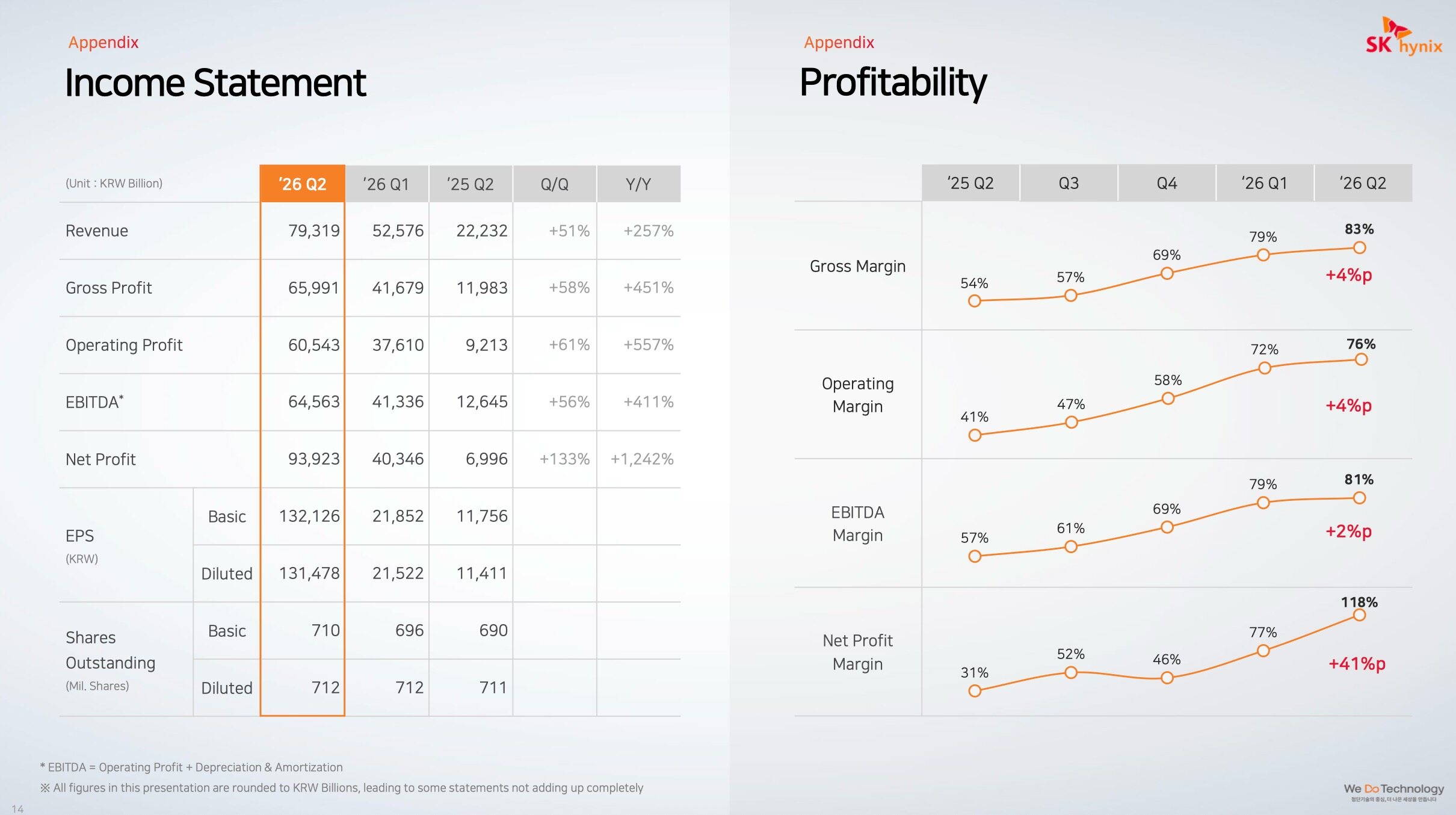
The financial data shows that SK Hynix recorded revenue of 79.32 trillion KRW in the second quarter, a 257% year-over-year increase and a 51% quarter-over-quarter increase; operating profit reached 60.54 trillion KRW, up 557% year-over-year and 61% quarter-over-quarter, with the operating margin further rising to 76%, hitting an all-time high. Including a one-time investment gain of 62.166 trillion KRW from the partial sale of Kioxia shares, the company's net profit reached 93.92 trillion KRW.
In any industry, this would be a report card shocking enough to shake the market.
However, the initial reaction from the capital markets was quite the opposite. As both revenue (actual 79.32 trillion KRW vs. market expectation of 84 trillion KRW) and operating profit (actual 60.54 trillion KRW vs. market expectation of 64 trillion KRW) slightly missed market expectations, coupled with SK Hynix's stock price already retreating over 40% in the preceding month amid intertwined pessimistic sentiment, SK Hynix's US ADR fell about 9% in after-hours trading following the earnings release (the US stock market had already closed with a nearly 9% decline the previous day). However, as investors gradually digested the details of the report, the stock price quickly recovered all losses and even turned positive.
Meanwhile, after the opening of the Korean stock market this morning, SK Hynix shares initially opened higher, rising 4%, before gradually weakening and falling over 9% again as of 10:00 AM.
Why did a record-breaking earnings report first face a wave of selling, then quickly recover losses, only to reverse downwards again? The answer may lie in the fact that what the market truly cares about is far more than how much SK Hynix earned in the second quarter; it's about how to re-price future growth potential — and the bulls and bears have clearly not yet reached a consensus on that.
The Most Profitable Quarter Ever, Yet Still Below Expectations?
Looking purely at the numbers, SK Hynix remains near its peak profitability.
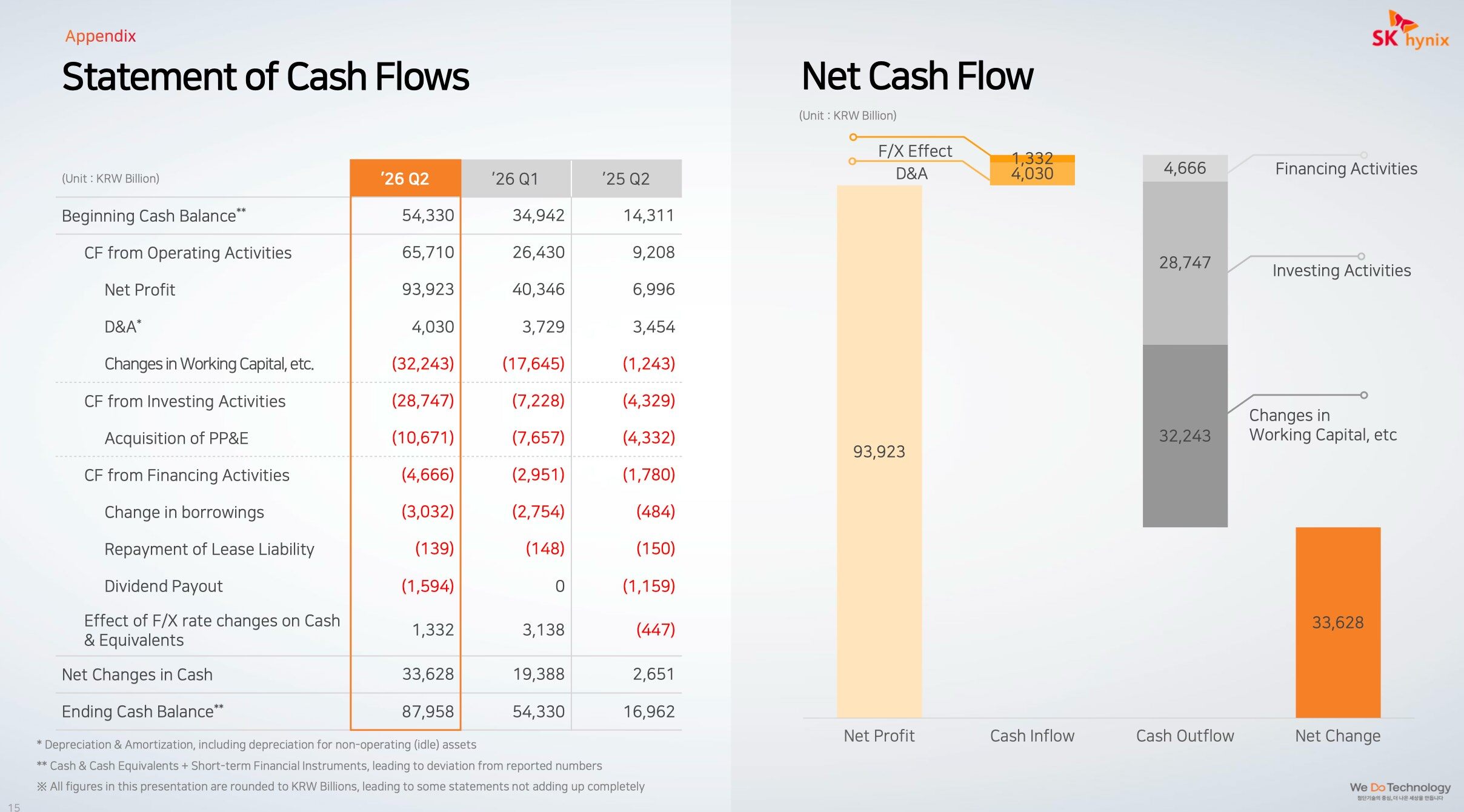
In the second quarter, the company's gross margin reached 83% and operating margin hit 76%, meaning that for every 100 KRW of products sold, approximately 76 KRW was converted into operating profit. This profitability level even surpasses the vast majority of global semiconductor manufacturers. Meanwhile, the company's cash and short-term financial assets continued to grow rapidly to 87.96 trillion KRW, further expanding its net cash position and providing ample ammunition for subsequent capacity expansion.
But the issue is that the market had already set expectations higher. The consensus estimate before the report had SK Hynix's second-quarter revenue around 84 trillion KRW and operating profit around 64 trillion KRW, while the actual figures fell short by about 5% and 6%, respectively.
For a typical company, such deviations aren't significant. But for SK Hynix, labelled as the "biggest AI beneficiary" with a valuation built on high growth expectations, any data missing expectations gets amplified by the market.
A closer look at the report reveals that this "miss" wasn't actually due to a deterioration in market demand, but rather stemmed from changes in the profit structure.
First, somewhat counterintuitively, the increasing share of HBM products actually reduced profit elasticity. In past quarters, a major driver of rapid profit expansion across the memory industry was the sustained price increase of spot-market traditional DRAM and NAND. However, because SK Hynix's HBM revenue share is much higher than its peers, and HBM is primarily priced under Long-Term Agreements (LTA), it couldn't fully capture the benefits of the rapid spot price increases like conventional DRAM.
Additionally, SK Hynix disclosed that the average selling price of general DRAM rose about 30% quarter-over-quarter in Q2. While still growing, this was notably lower than the growth rate in Q1; NAND average selling prices rose 50%-55% quarter-over-quarter, also slowing compared to Q1.
In other words, more AI products were sold, but the pace of price increases for traditional products slowed; long-term orders locked in future revenue but also limited short-term profit flexibility. This explains why a record profit still failed to meet the numbers the market had previously "fantasized" about.
Is the Memory Super Cycle Still On? What the Earnings Say
If the operational data answers how much SK Hynix earned in Q2, then the information provided by management in the earnings report and subsequent conference call addresses another question more critical to the market — has the AI memory super cycle already started to cool down?
For now, SK Hynix's answer remains relatively optimistic.
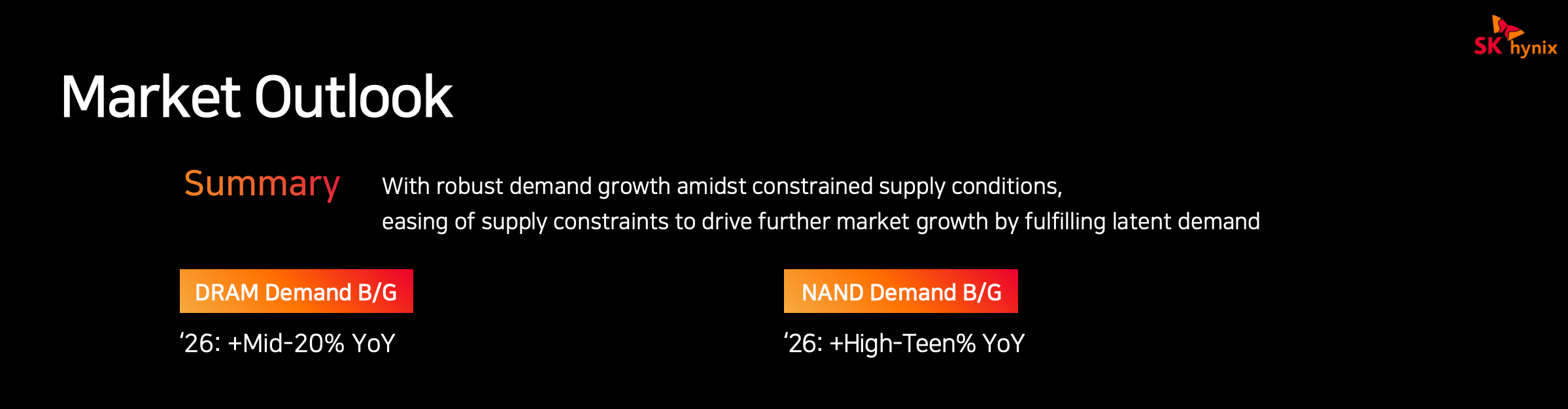
First, regarding demand outlook, the company did not release any clear cautious signals as the market had feared. SK Hynix expects global DRAM market demand in 2026 to grow in the mid-20% range year-over-year, and NAND market demand to grow in the high teens percentage year-over-year. Management also stated during the post-earnings conference call that no signs of a slowdown in AI investment have been observed yet and predicted that AI infrastructure investment would maintain steady growth even after 2027.

Second, another key piece of information worth noting is the further advancement of Long-Term Agreements (LTAs). SK Hynix disclosed that it has currently completed LTA negotiations with approximately 10 customers and continues negotiations with other major industry clients. The new generation of long-term agreements will adopt pricing mechanisms capable of handling price fluctuations and ensure contract performance through corresponding financial mechanisms, thereby enhancing the stability and predictability of future demand.
For the memory industry, this change carries significant weight. In the past, products like DRAM and NAND relied more on spot market pricing, whose violent fluctuations prevented the industry from shedding its "cyclical stock" label. However, as the share of HBM products rises in the AI era, more and more large cloud providers are starting to lock in supply capabilities years in advance. Supply-demand dynamics are thus gradually evolving from short-term speculation to longer-term, more stable cooperative relationships. While long-term agreements may compress profit elasticity during periods of rapid spot price increases, as seen this quarter, what they buy is higher revenue certainty for the coming years.
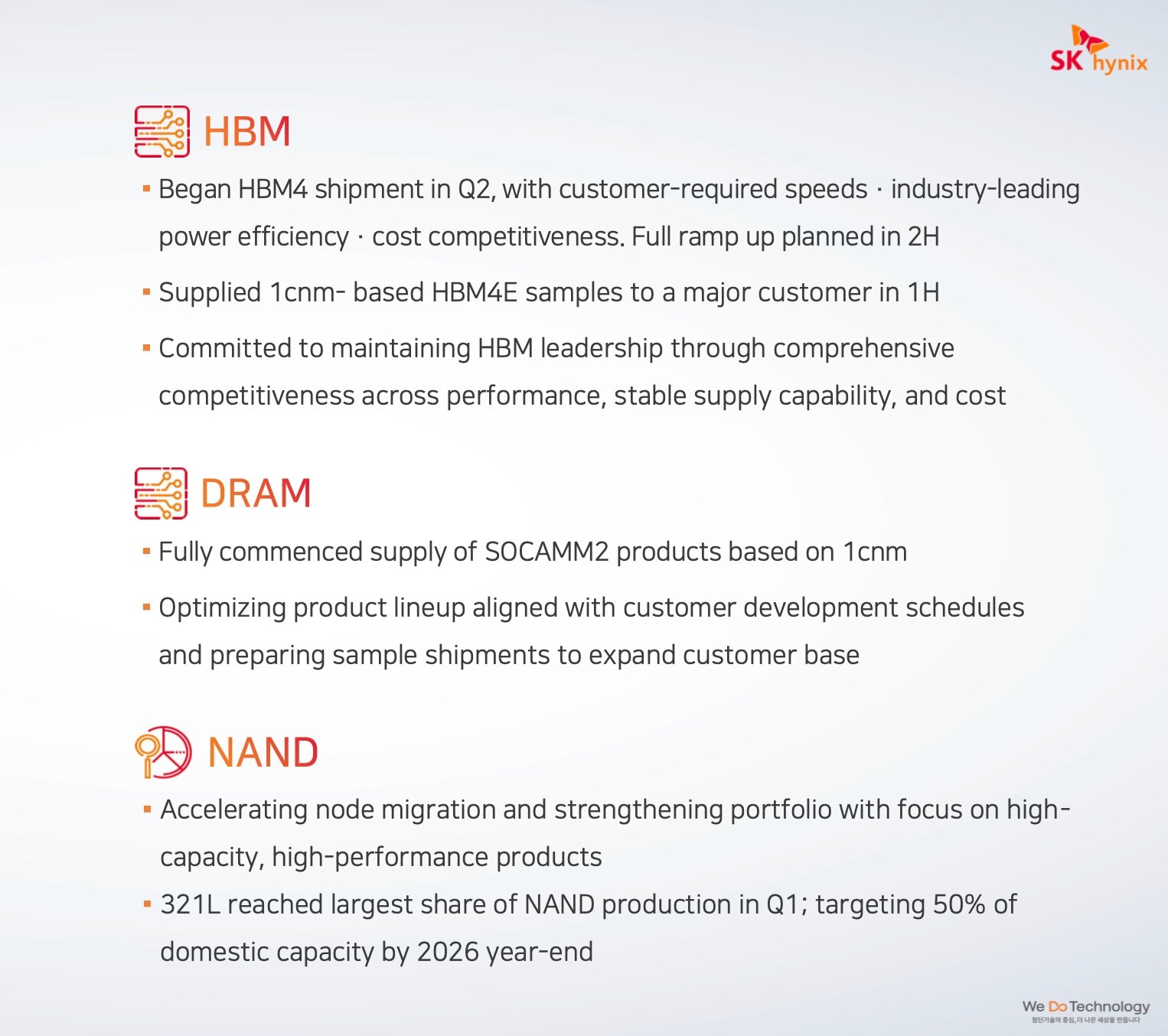
Furthermore, the rollout pace of SK Hynix's next-generation products has proceeded without any hiccups. The earnings report shows that SK Hynix began shipping HBM4 products in the second quarter and plans to ramp up volume production in the second half of the year; the next-gen HBM4E has already completed sampling for key customers in the first half of the year; additionally, SOCAMM2 products based on the 1cnm process have begun formal supply.
This means SK Hynix maintains its leading position in product cadence for next-generation AI GPU platforms. Considering HBM4 will be a crucial companion memory for NVIDIA's next-gen AI platforms like Rubin, its successful volume production also indicates that the company currently firmly holds the leading position in the high-end AI memory market.

Finally, regarding Capital Expenditure (CapEx), arguably the most accurate reflection of management's true judgment, SK Hynix not only maintained its expectation for 2026 CapEx in the high range of over 40 trillion KRW, but also plans to advance the mass production timeline for the M15X fab, accelerate the construction of the Yongin Fab Phase 1, and continue pushing forward with mid-to-long-term projects such as P&T7, M17, and Korea's new semiconductor cluster.
For a company that has weathered multiple memory cycles, such an aggressive expansion plan is an attitude in itself — management firmly believes that the AI memory demand in the coming years will be sufficient to absorb this new capacity.
The Focus of Bull-Bear Battle
Today, SK Hynix has become a core battleground for bulls and bears in the AI memory cycle.
For bulls, record profits, continuously expanding HBM demand, and the AI infrastructure investment cycle still support the company's long-term growth thesis. For bears, the earnings miss, valuation pressures, and market concerns about the sustainability of AI capital expenditure are amplifying short-term adjustment pressures. Bulls are betting on the continuation of AI infrastructure expansion, while bears worry that the market has already priced in future growth prematurely.
Heavy is the head that wears the crown. SK Hynix enjoys the valuation of an industry leader but must inevitably bear the leader's burden — when the market already believes your story, excellent performance is no longer enough; only consistently surpassing even higher expectations can drive the valuation higher.