Where Should You Provide LP for Stock Tokens? A Quick Look at Five Emerging AMMs on Robinhood Chain


- Key Takeaway: As Meme coin trading activity on Robinhood Chain surges, providing liquidity (LP) for pairs combining stock tokens and Meme coins has become an alternative high-yield strategy, while emerging AMM projects are attracting users through first-miner bonuses and airdrop expectations.
- Key Elements:
- Popular Meme coins on Robinhood Chain are mostly paired with stock tokens in trading pairs, creating complex trading routes that offer substantial fee revenue opportunities for LPs. KOLs claim that high-fee LPs on Uniswap V4 can achieve daily APYs exceeding 100,000%.
- Uniswap V2, V3, and V4 account for over 90% of Robinhood Chain's trading volume, but emerging AMM projects like up. and Fables are on the rise, competing for market share with revenue-sharing models and points programs.
- up. is a native ve(3,3) protocol that returns 100% of protocol revenue to token holders, with a total TVL of $12.74 million and a real circulating market cap of only approximately $15 million.
- Fables introduces a Hook mechanism to dynamically adjust fee rates and has launched a 6-week points program. It is expected to undergo a TGE in October and may airdrop up to 115 million governance tokens.
- RAMSES has been deployed from Arbitrum to Robinhood Chain, adopting the V3 DLMM model; the Delta platform automatically converts revenue into liquidity, with total fees reaching $895,000.
- Although Ekubo boasts a TVL of $19 million on Starknet, it has only secured $910,000 on Robinhood Chain, failing to replicate its earlier success and highlighting competitive differences between ecosystems.
Original by Odaily Planet Daily (@OdailyChina)
Author: Golem (@web3_golem)
Without a doubt, the Robinhood Meme trench environment has gradually become "overheated." The dual concentration of capital and attention has significantly increased the difficulty of the game, and ordinary players who cannot be faster and sharper than the "P small players" are bound to be weeded out.
Fortunately, there's more than one way to make money on Robinhood. Players have discovered that pairing stock tokens with Meme coins as an LP is also a lucrative business. The reason is that most Meme coins that go viral or pump quickly on Robinhood Chain are paired with stock tokens. The typical trading route for regular users on front-end aggregators is WETH → USDG → Stock Token → Meme coin. If users are on FOMO platforms, they may even need to go through an additional step.
Meme coin trading demand is highly susceptible to market sentiment. Once a specific Meme coin goes viral in a short period, its underlying LP fees can spike instantly. Crypto KOL @0xanonnnn stated in a post, "For memes on Robinhood Chain that are specifically paired with stock or LT pools, the Uni V4 high fee-level LPs can generate daily APY as high as 100,000+%." Clearly, the returns from providing LP for stock tokens and hot Meme coins are not necessarily lower than chasing Meme coins themselves.
Providing LP is one of the classic strategies in DeFi AMMs, and veteran players are no strangers to it. Since the launch of Robinhood Chain, Uniswap has quickly become the dominant AMM and liquidity infrastructure, with Uniswap V2, V3, and V4 accounting for over 90% of the trading volume on Robinhood Chain. Therefore, most users choose to provide LP on Uniswap.
However, within the Robinhood Chain ecosystem, some emerging AMM projects are also on the rise and beginning to attract attention. The advantage of participating in early-stage AMM projects lies in capturing the "first miner's bonus" and speculating on future token launches and airdrop expectations. Odaily Planet Daily will introduce 5 emerging AMM projects on Robinhood Chain in this article.
(Risk disclaimer: Players need to consider and evaluate a series of "hidden" costs, including impermanent loss from LP, high token price volatility, and risks associated with new protocols.)
up.: 100% of Protocol Revenue Returned to Token Holders
up. is a native ve(3,3) trading and liquidity layer on Robinhood Chain, launched on July 11. The protocol issued its UP token at the same time, with a current market cap of $390 million and a total token supply of 500 million. However, this includes non-circulating tokens. Over half of the supply has been burned, and the actual circulating supply at launch was only 20 million tokens, with approximately 1 million tokens released into circulation weekly. Therefore, the true circulating market cap is only around $15 million.
As of the time of writing, up.'s total TVL stands at $12.74 million, ranking 7th on Robinhood Chain. The platform currently has two pools with TVL exceeding $1 million: the UP/WETH liquidity pool has a TVL of $2.39 million, and the UP / STONKBROKER liquidity pool has a TVL of $1.64 million.
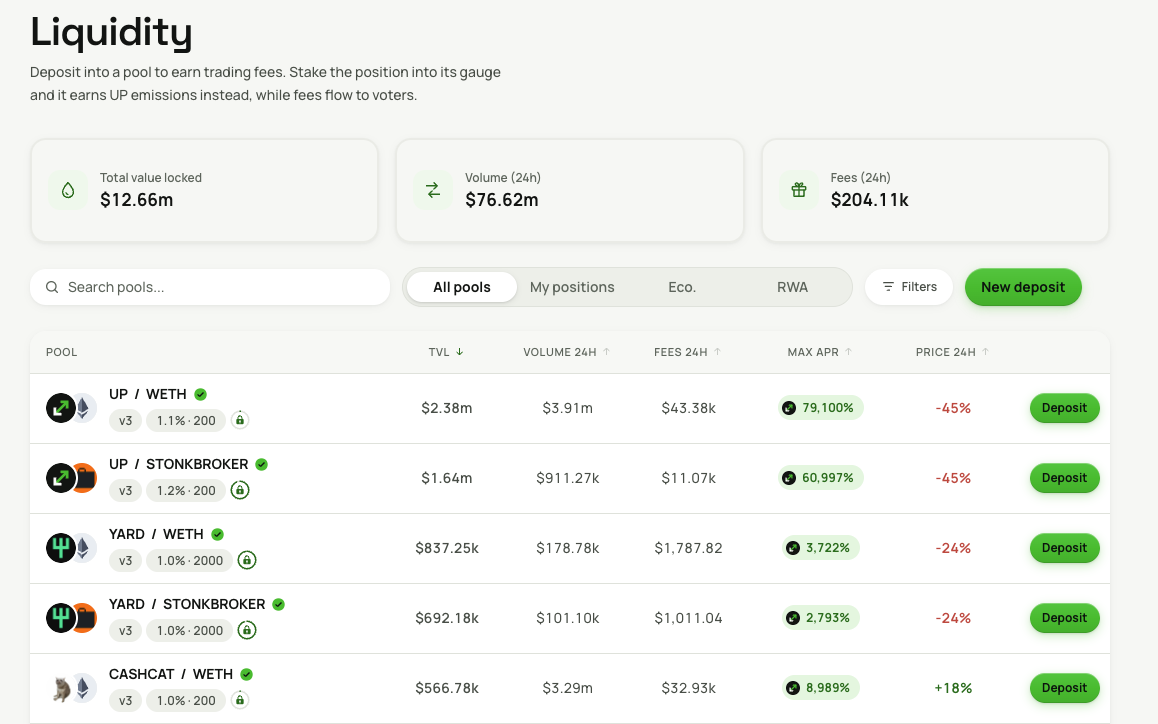
up. returns 100% of protocol revenue to UP holders. According to DeFiLlama data, up. is also the third-highest protocol on Robinhood Chain in terms of revenue earned by token holders from the protocol over the past 30 days.
Fables: Points Program Launched, TGE in October
Fables is also a native ve(3,3) DEX on Robinhood Chain, launched on August 18. The key difference between Fables and up. is that Fables incorporates Hooks. Through Hooks, Fables writes individual fee logic for each liquidity pool, setting transaction fees at the time of the trade, allowing fee rates to adjust in real-time based on market fluctuations over time.
Meanwhile, Fables has also already issued a token called PROLOGUE, with a total supply of 1 billion tokens and a current market cap of $5.7 million. However, Fables has also announced a future TGE. The official governance token will be FABLES, also with a total supply of 1 billion tokens. At TGE, PROLOGUE can be exchanged for FABLES at a 40:1 ratio. All creator fees generated from PROLOGUE trading will be rewarded to Fables LPs in the form of USDG.
According to the official announcement, up to 115 million FABLES tokens will be airdropped directly to the community at TGE. Fables has also launched a 6-week TGE program (August 24 to October 5), after which Fables will conduct its TGE. The entire campaign distributes a total of 1 billion points daily, and providing LP to any liquidity pool on Fables earns points.
However, Fables has not specified whether the TGE will be listed on exchanges or if the token will only be issued on-chain.
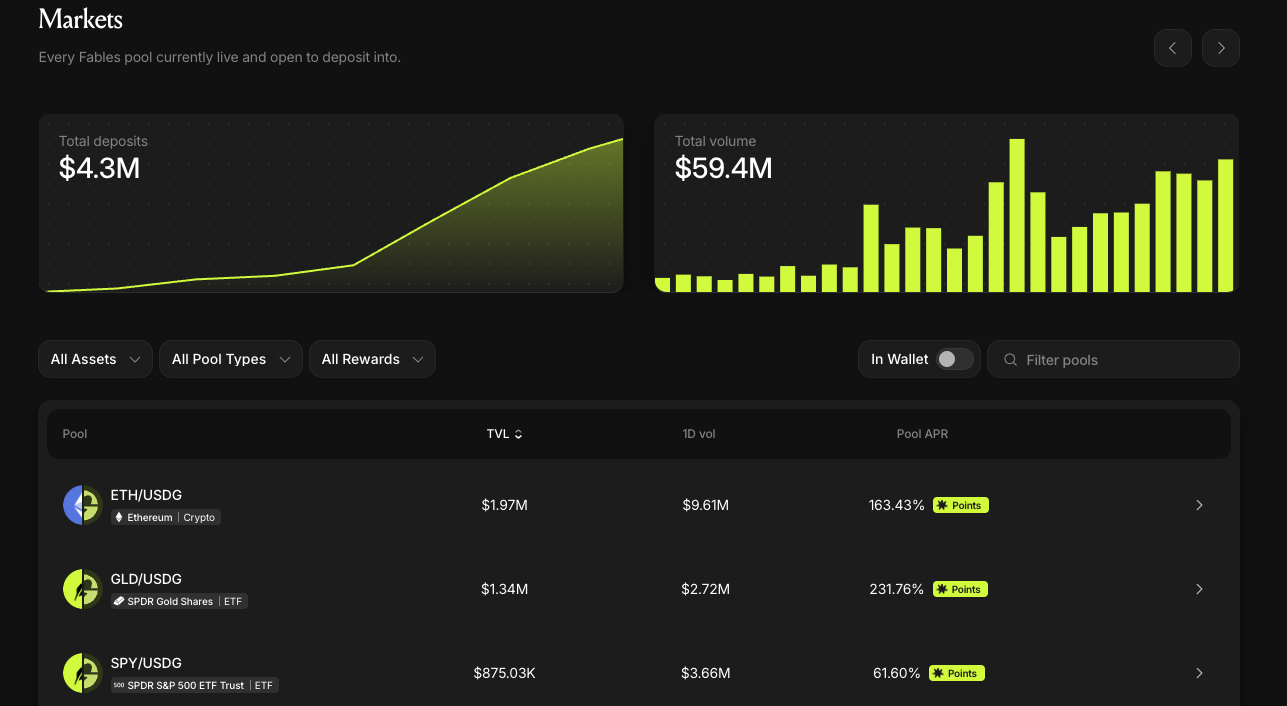
As of the time of writing, Fables' total platform TVL has reached $4.3 million, with two pools exceeding $1 million in TVL: the ETH / USDG liquidity pool has a TVL of $1.97 million, and the GLD / USDG liquidity pool has a TVL of $1.34 million.
RAMSES: Well-Known Arbitrum AMM Arrives
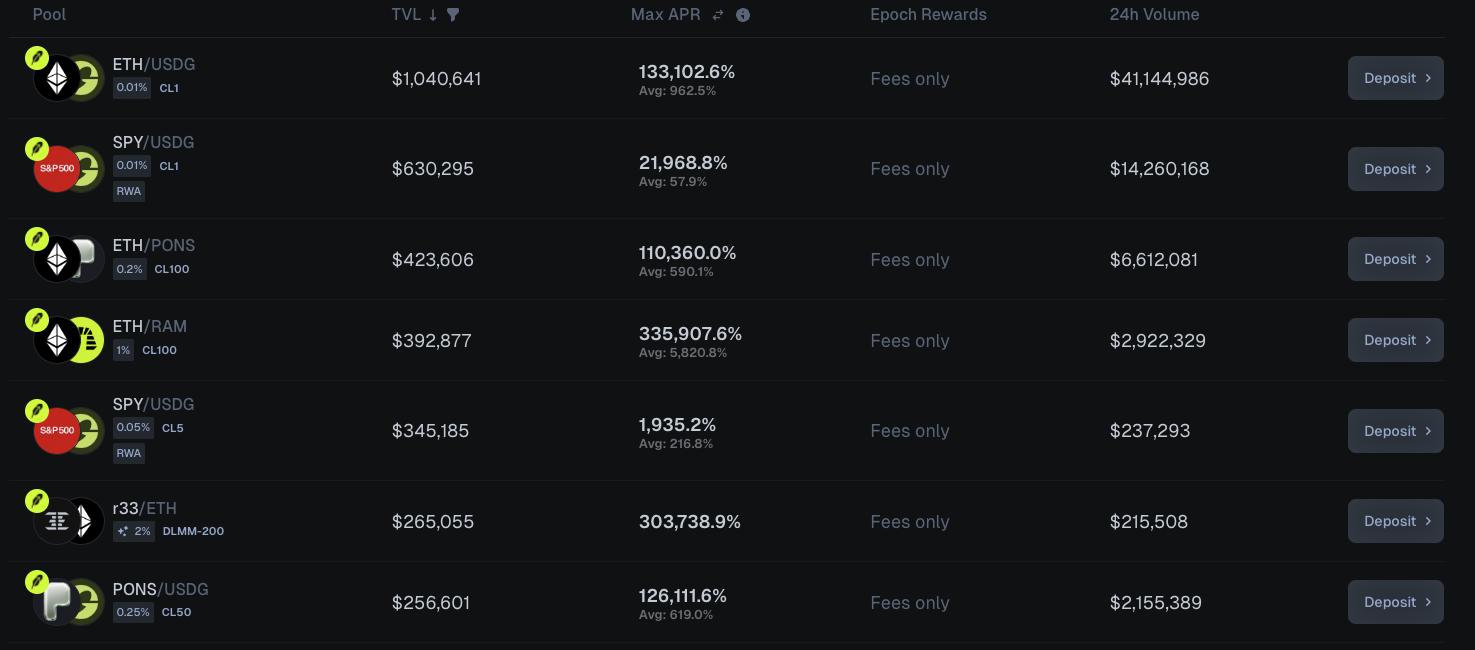
Ramses is a multi-chain AMM that has been operational since 2023 and is a relatively well-known AMM on Arbitrum. It has now been deployed to Robinhood Chain. The difference between Ramses and up. and Fables lies in its use of a pure V3 DLMM fee model on Robinhood Chain, without ve governance.
Ramses has also issued a new token, RAM, on Robinhood Chain, with a current market cap of approximately $8 million. As of the time of writing, Ramses' largest TVL pool on Robinhood Chain is ETH/USDG, with a TVL of approximately $1 million.
Delta: Automatically Converting Protocol Fees into Liquidity
Delta is a liquidity layer on Robinhood, launched on August 10. Delta employs a traditional AMM architecture, supporting users in adding both bilateral and unilateral liquidity to token trading pairs. Users can also directly deposit tokens into staking pools, while the project automatically converts revenue into liquidity, which is then reinjected into the pool. As of the time of writing, Delta's total platform TVL has reached $1.37 million, with total fees amounting to $895,000.
Delta has also issued its DELTA token, with a current market cap of approximately $16.8 million. The market cap peaked at $38 million.
Ekubo: Starknet Veteran Project Fails to "Gild" Itself
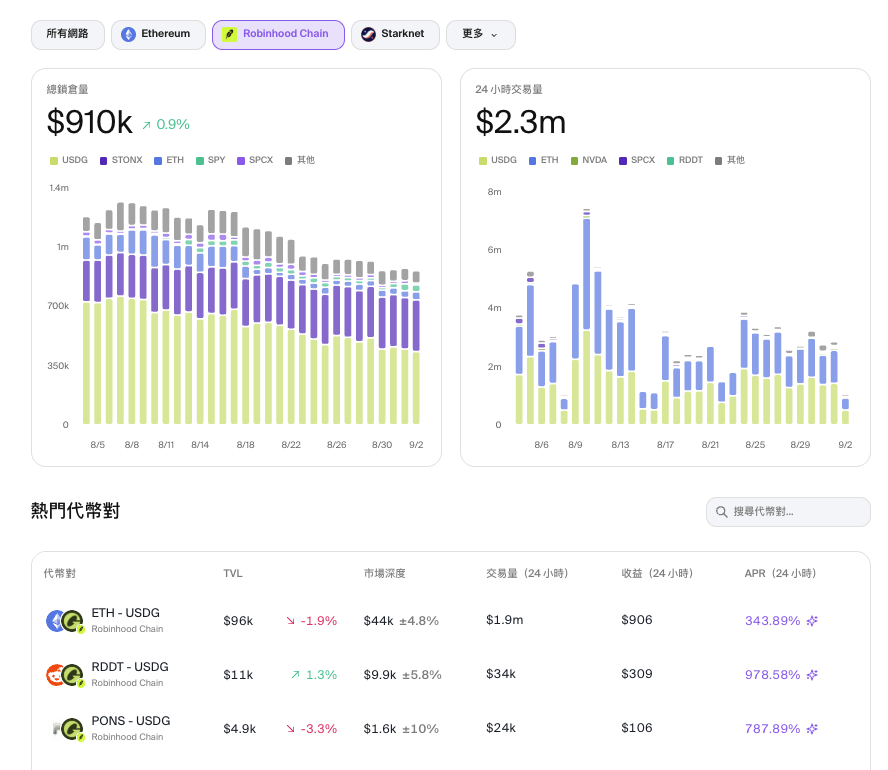
Ekubo is an AMM project founded in 2023 that was previously active in the Starknet and Ethereum ecosystems. Its total TVL on Starknet has reached $19 million.
On July 31, Ekubo announced support for Robinhood Chain, allowing players to provide liquidity for token trading pairs on the chain. However, Ekubo's TVL on Robinhood Chain is not particularly high, standing at only $910,000. The most popular liquidity pool is ETH/USDG, with a total TVL of $96,000. Clearly, the project has not successfully "gilded" itself on Robinhood Chain.