Regardless of whether Warsh "raises rates" or not, he is definitely "one of their own"


- Key Takeaway: In his Jackson Hole debut, new Fed Chair Warsh struck a hawkish tone, reaffirming the 2% inflation target and exploring the possibility of rate hikes. His goal is to rebuild policy credibility in the short term, paving the way for a future easing cycle driven by AI-driven productivity gains—a "hawkish in appearance, dovish in substance" policy path.
- Key Elements:
- Warsh reiterated that the 2% inflation target is "unwavering," noting that data shows no "meaningful improvement" in inflation. Markets now price a 56% probability of a 25bp rate hike on September 16.
- Warsh argues that unconventional policies like QE should only be deployed during genuine crises, and opposes the Fed's excessive "hand-holding communication" with markets. He aims to reset the central bank's operational logic and avoid a "hall of mirrors" effect.
- Warsh has close ties to Trump (through his father-in-law, Ronald Lauder) and shares Treasury Secretary Bessent's philosophical grounding in Druckenmiller-style market thinking. However, he must prove he is "not a puppet" to maintain bond market credibility.
- The policy path unfolds in three steps: first, establish inflation credibility (raising rates if necessary); second, observe whether AI can lift productivity to create a combination of "strong growth + lower inflation"; and finally, coordinate with the Treasury to bring policy tools back to short-term rates.
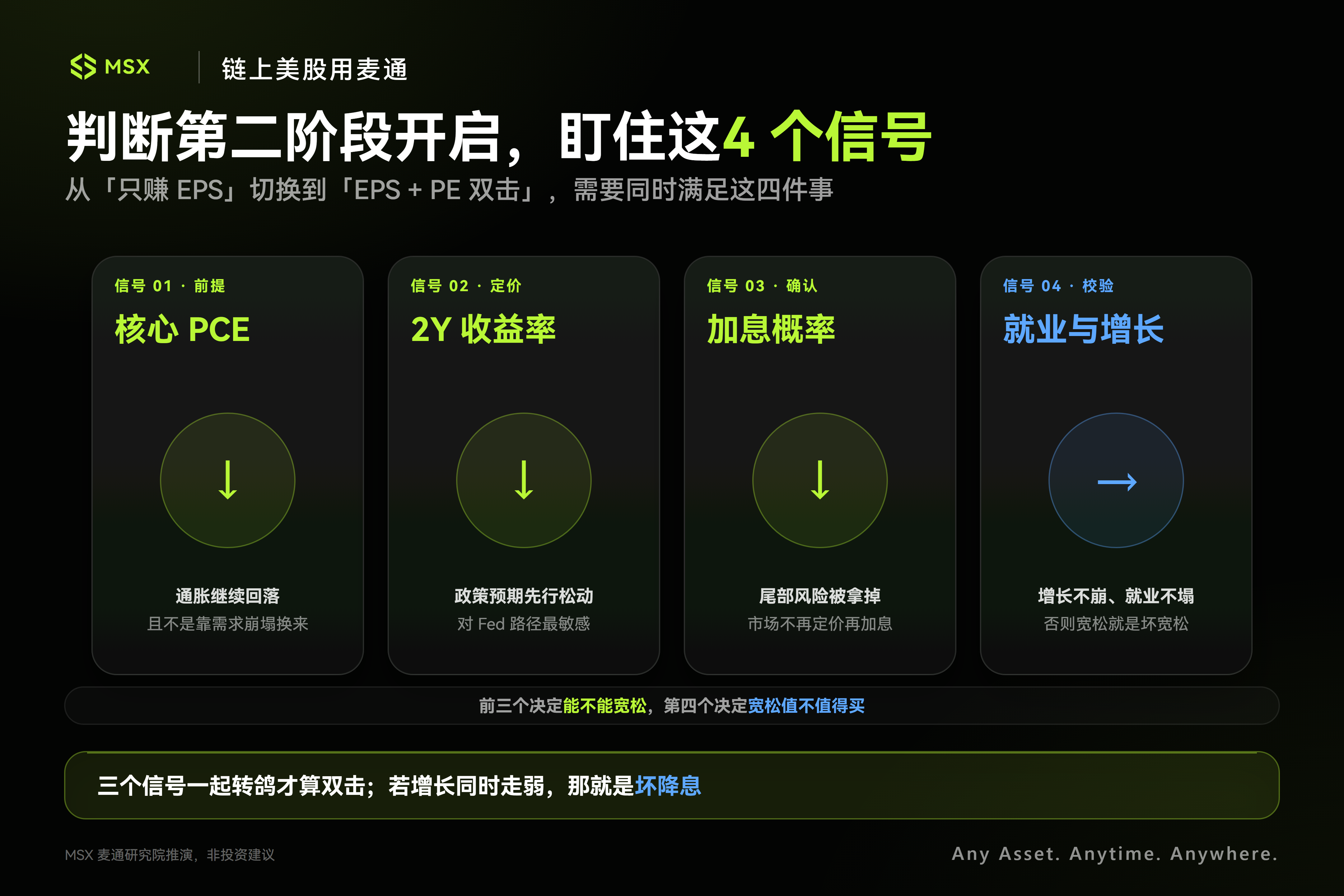
- Market trading logic also proceeds in three phases: the first focuses on AI earnings (upward EPS revisions), the second on valuations (PCE cooling + 2Y yield breaking lower), and the third on easing beta rotation (small caps, REITs, Biotech, etc.)—requiring a clear distinction between "good cuts" and "bad cuts" scenarios.
Just 100 days after replacing Powell, the new Fed chair personally selected by Trump has already begun discussing "rate hikes."
On August 28, Kevin Warsh delivered his inaugural Jackson Hole address, emphatically reiterating that the 2% inflation target remains "unwavering" and that the data is insufficient to demonstrate a "meaningful improvement" in inflation trends.
No sooner had the hawkish tone landed than markets swiftly began repricing.
As of writing, prediction markets show the probability of a 25bp rate hike on September 16 has surged to roughly 56%, up from just over 30% previously.
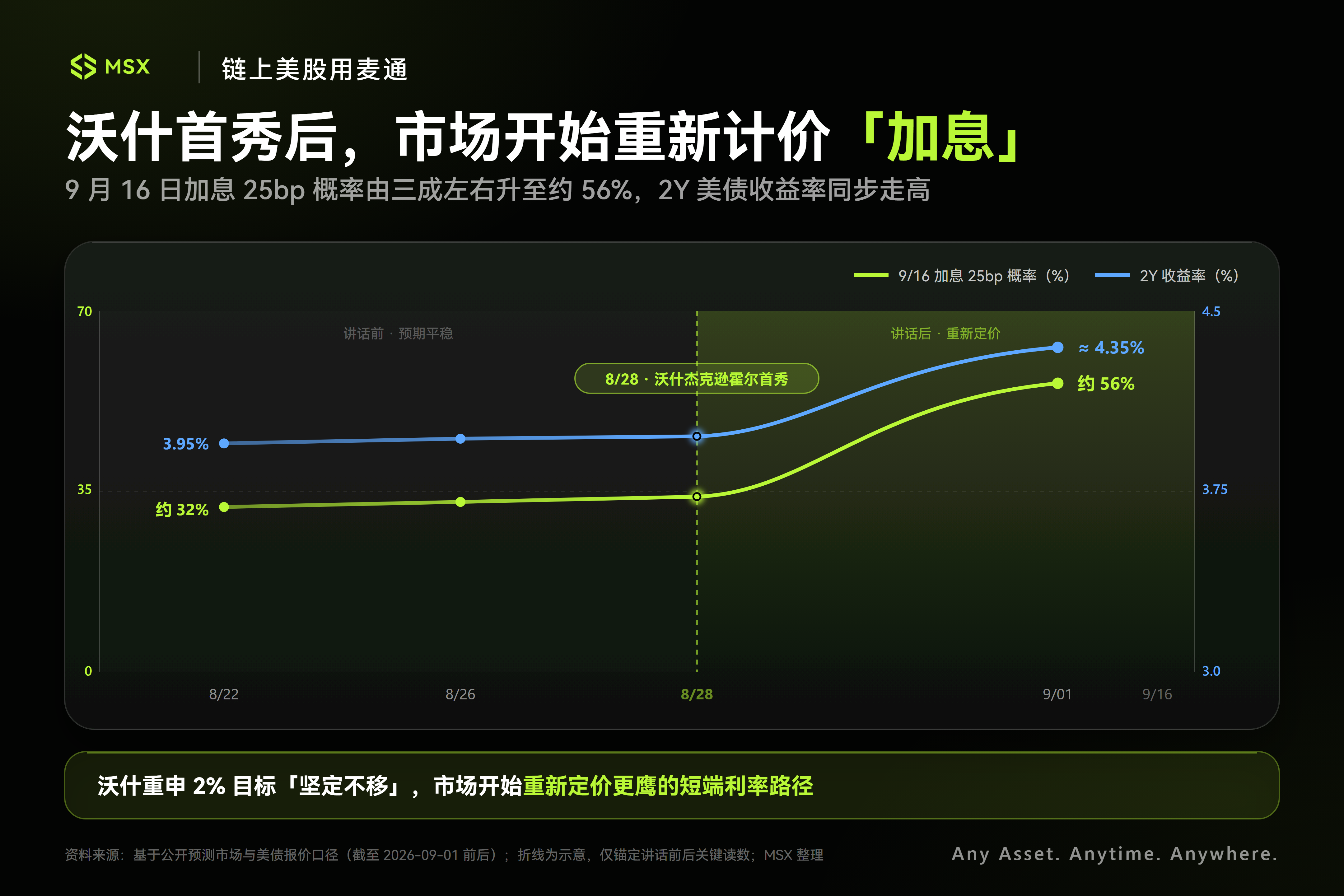
More curiously, Trump has not publicly attacked Warsh the way he once did Powell. Instead, he has uncharacteristically stated that he "has great respect" for Warsh and that "he'll do what he has to do."
This raises an even more intriguing question: Is Warsh's current hawkish posture a sign that he's preparing to part ways with Trump?
The answer may be quite the opposite.
1. The More "One of Us" You Are, the Less You Can Appear to Be One of Us
Judging solely by the Jackson Hole speech, it's hard to connect Warsh with the "low-interest-rate Fed chair Trump wants."
He not only emphasized that inflation remains too high, but also put forward an extremely hawkish restructuring vision for the Fed's operational paradigm over the past two decades: Unconventional policies like QE should be reserved as much as possible for genuine crises, and the Fed should reduce its "hand-holding communication" with markets.
For years, Wall Street has grown accustomed to poring over dot plots, press conferences, and leaks from Fed spokespeople to divine whether the next meeting will bring a hike or a cut.
Warsh clearly finds this deeply objectionable.
In his view, when markets wait daily for the Fed to signal "what the next trade should be," and the Fed in turn gauges the economy based on market prices, the entire system devolves into a self-reinforcing "Hall of Mirrors."
At bottom, Warsh served as a Fed governor as early as 20 years ago. Compared to the technocrats of the Bernanke era who relied heavily on economic models, dot plots, and forward guidance, he resembles more a reformer attempting to reshape the central bank's operational logic from the outside.
Viewed from this perspective, the purpose of Warsh's hawkish remarks is clear: to rebuild his policy credibility as quickly as possible at the start of his term.
After all, for a chair personally selected by Trump, if markets begin trading on "loss of Fed independence," surging long-term Treasury yields and unanchored inflation expectations would rapidly backfire on the economy.
By the same token, for Trump, a chair who can first prove he "doesn't take orders" may ultimately be better positioned to actually cut rates in the future.
In fact, as early as last year, when the MSX Research Institute analyzed Fed chair candidates, Warsh was a key focus of discussion.
What enabled him to ultimately emerge from the candidate list was a combination of a résumé recognized by both traditional Wall Street and the Fed establishment, plus a network situated extremely close to Trump (see extended reading: The Fed "Succession" Reversal: From "Loyal Dove" to "Reformer" — Has the Market Script Changed?).
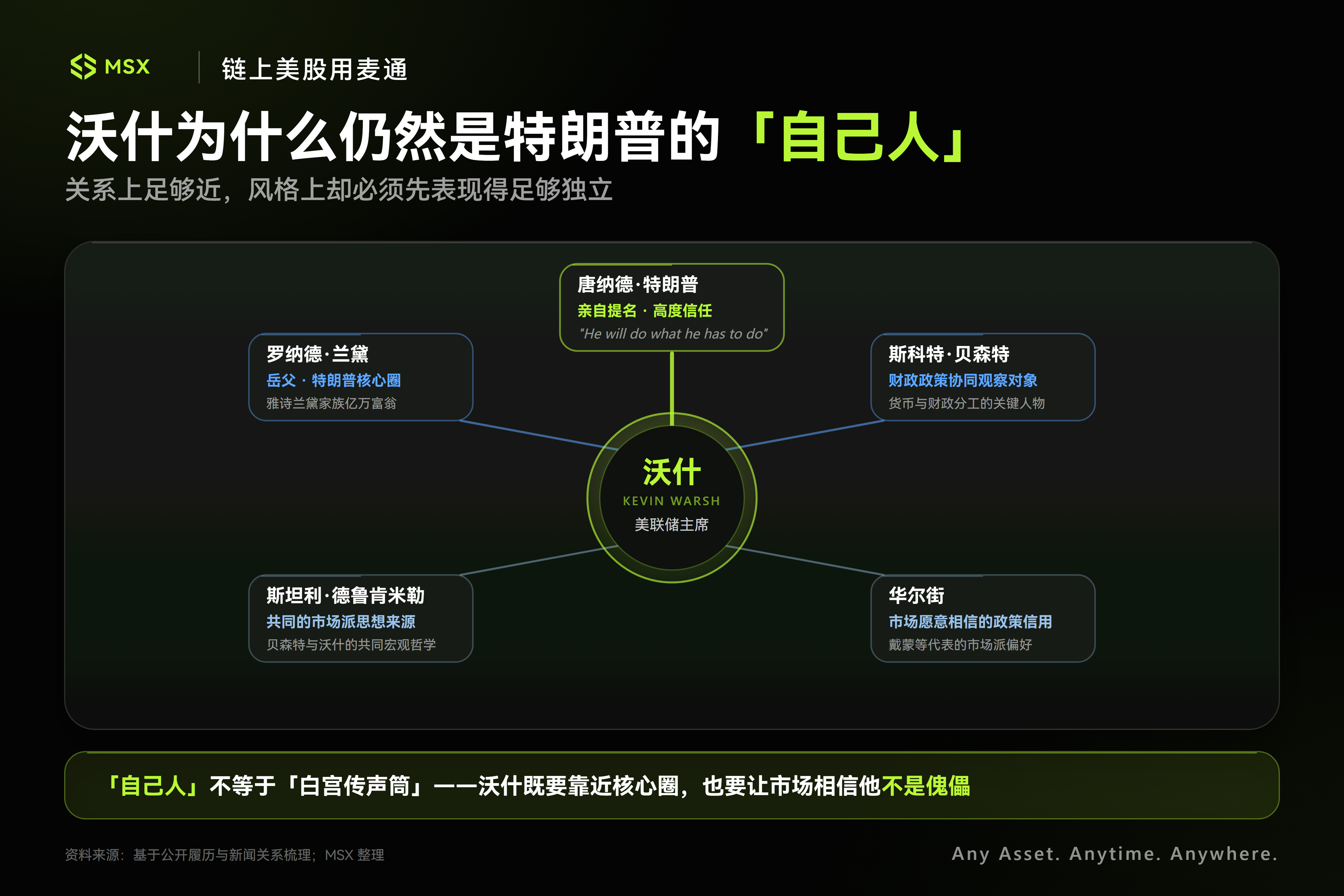
Warsh's father-in-law, Ronald Lauder, patriarch of the Estée Lauder family, has known Trump since their University of Pennsylvania days. They have maintained a personal relationship ever since, and Lauder is one of the key allies in Trump's political and business circles.
Looking further up the chain, Warsh and current U.S. Treasury Secretary Bessent also share an intriguing common intellectual origin in market philosophy:
Stanley Druckenmiller.
Bessent worked for years at the Soros Fund and was deeply influenced by Druckenmiller. After Warsh left the Fed, he also maintained a very close relationship with Druckenmiller and even became his business partner.
Strictly speaking, the two are not "fellow disciples" in the traditional sense, but today, the two most important monetary and fiscal policy positions in the United States happen to be held by individuals both deeply shaped by Druckenmiller's market philosophy — which is undoubtedly a fascinating development.
The fact that Trump can still publicly say "I respect him" indicates that, at least for now, Warsh remains one of "his own" who is permitted to "demonstrate independence."
Indeed, viewed from another angle, the more Warsh can prove he is not Trump's puppet, the greater his latitude will be when genuine easing is eventually needed.
2. "Hawkish in Words, Dovish in Deeds" — Could AI Rewrite the Traditional Rate-Cut Playbook?
One way to understand Warsh, therefore, is "hawkish in the short term, but preserving the easing option over the long term."
The notion of being "hawkish in words, dovish in deeds" is, of course, not to say Warsh has already decided to cut rates in the future — there is currently no evidence to support such a conclusion.
More precisely, Warsh has floated a new possibility centered on AI: "The potential for substantially higher growth is on the rise." In other words, if the U.S. economy maintains higher growth while inflation recedes, the Fed need not wait for a clear economic downturn before cutting rates.
This is where the "hawkish in words, dovish in deeds" framing becomes genuinely interesting. Reasoning through this path, it roughly unfolds in three steps.

1. Re-Establish Inflation Credibility First
The greatest constraint Warsh currently faces remains inflation running above the 2% target. Easing prematurely in this environment could not only re-stimulate demand but also risk unanchoring long-term inflation expectations.
Therefore, regardless of whether September actually brings a hike, Warsh must first convince the market that 2% is not merely a slogan — and that, if necessary, the Fed genuinely dares to hike once more.
This is precisely why September 16 carries such significance.
Until then, employment data and the CPI release on September 11 will determine whether Warsh has sufficient grounds to translate his hawkish Jackson Hole rhetoric into actual policy action.
If inflation remains sticky while employment stays resilient, a September hike is not unthinkable. Conversely, if data deteriorates quickly, Warsh can just as easily choose not to hike.
Only by establishing such credibility first can future rate cuts be more readily understood as "normal easing permitted by inflation" rather than "political rate cuts under White House pressure."
2. Wait for the Supply Side to Genuinely Open Room for Rate Cuts
The next thing truly worth watching is whether AI productivity can gradually transition from a narrative into macroeconomic data.
This is also the most easily overlooked keyword in Warsh's Jackson Hole speech: AI.
Warsh devoted considerable attention to whether AI is becoming a new factor of production and whether it can ultimately deliver sustained productivity gains.
The underlying logic here is actually crucial.
If AI, capital expenditure, energy expansion, and regulatory relaxation ultimately enhance the U.S. economy's supply capacity, then we could see the economic combination Trump most desires — growth remaining robust while inflation begins to decline.
This is fundamentally different from recession-driven rate cuts. For equity markets, it could even represent a more comfortable environment than traditional cuts — namely, EPS continuing to grow while discount rates begin to fall.
If PCE retreats and 2-year Treasury yields decline, while the economy and employment show no significant collapse, markets would be trading a shift from "economic recession → rate cuts" to "productivity gains → declining inflation → soft landing or even no-landing easing."
3. Fiscal and Monetary Policy: A New Division of Labor
This is also a thread worth close attention between Warsh and Bessent.
The two may have clear overlap in their ultimate objectives — neither wants U.S. long-term financing costs to spiral out of control.
Their methodologies, however, are not entirely aligned.
Bessent is more inclined to actively influence the long-end financing environment through Treasury buybacks of long-dated bonds and adjustments to market structure. Warsh, by contrast, places greater faith in market pricing and opposes the Fed's prolonged large-scale balance sheet intervention in bond markets.
So rather than understanding this as a conspiracy between the two to "suppress rates," it's better understood as a new policy division of labor: The Treasury handles more of the structure and liquidity of the long-end Treasury market, while the Fed seeks to consolidate its primary policy tools back to short-term rates.
If this combination truly materializes, the U.S. could even experience an easing cycle quite different from the past decade and a half: first safeguarding inflation and long-end bond market credibility, then lowering short-end policy rates once conditions mature, while keeping the Fed's balance sheet relatively restrained.
This may be where the "hawkish in words, dovish in deeds" framework genuinely offers tradable value.
Today's hawkishness does not mean perpetual hawkishness. Conversely, the more credible the hawkishness today, the more willing markets may be to believe in the pivot when genuine dovishness is eventually needed.
3. If the Logic Holds, What Should U.S. Equities Trade?
For us, whether Warsh is truly a "White House insider" matters less.
What matters is this: if his macro logic gradually plays out, where does money go first, and where does it go next?
The MSX Research Institute believes that rather than simplistically splitting the market into three parallel scenarios — "hike / no hike / cut" — it's more useful to understand three sequential trading phases that may unfold.

Phase One: Trade AI "Earnings."
At this stage, rates remain elevated and the Fed is even revisiting rate hikes. The most comfortable assets here are not companies hoping for rapid Fed cuts.
Rather, they are companies that can digest valuation pressure through their own earnings growth even if high rates persist.
This is why, in the first phase, the highest-quality AI leaders remain the focus, along with the infrastructure chain forming around AI Factories.
This includes AI chips, Hyperscalers, data centers, networking, storage, and power and energy infrastructure. Their common thread is that earnings growth is fast enough to offset the valuation pressure from high discount rates.
In this phase, the market is truly trading EPS upgrades. As long as AI CapEx can genuinely convert into revenue, profits, and free cash flow, these names are more likely to continue attracting capital in a Higher-for-Longer environment.
Conversely, long-duration growth companies with only forward-looking stories and no stable profits will continue to face pressure from high rates.
This also implies continued divergence within AI itself — profitable AI and unprofitable growth stories may increasingly become two different asset classes.
Phase Two: Then Trade AI "Valuation."
Here, the key signals to watch are PCE declining + 2Y Treasury yields breaking lower + a rapid drop in Fed hike probabilities.
If all three signals appear simultaneously, with no significant collapse in employment and economic activity, markets will likely begin to believe that the economy is still fine, corporate earnings are still rising, but inflation now permits the Fed to stop tightening — or even prepare for easing.
At this stage, the AI leaders that already rallied in Phase One may experience a second re-rating, as the driver shifts from primarily EPS ↑ to EPS ↑ + discount rate ↓.
Earnings upgrades plus PE expansion — this could be the most comfortable stretch of the entire AI trade.
Corporate earnings would not have experienced the large-scale downgrades typical of traditional recession cycles, yet valuations would begin receiving renewed support from falling rates.
Of course, viewed this way, AI leaders are not merely Phase One assets — they may well span both Phase One and Phase Two.
In Phase One, they earn money from earnings; in Phase Two, they earn money from valuations.
Phase Three: Time for "Easing Beta."
Once the downward trajectory of rates is clearly confirmed, capital may begin rotating outward from AI leaders. Assets that were most suppressed by high capital costs over the past few years will undoubtedly gain greater valuation elasticity.
This includes the Russell 2000 (IWM), REITs (XLRE), homebuilders (XHB, ITB), biotech (XBI), select regional banks (KRE), and high-beta Crypto names (COIN, MSTR), among others.
The key difference between these assets and those in Phase One is that they don't rely solely on economic growth — they more critically need capital costs to genuinely decline.
For example, small caps rely more heavily on bank loans and capital market financing; REITs and the residential construction chain are highly sensitive to financing costs; biotech is a classic long-duration asset; and high-beta Crypto is especially sensitive to dollar liquidity and risk appetite shifts.
Conversely, if Warsh continues his hawkish stance and the dollar alongside real rates strengthens, these would also be the most sensitive assets to liquidity changes.
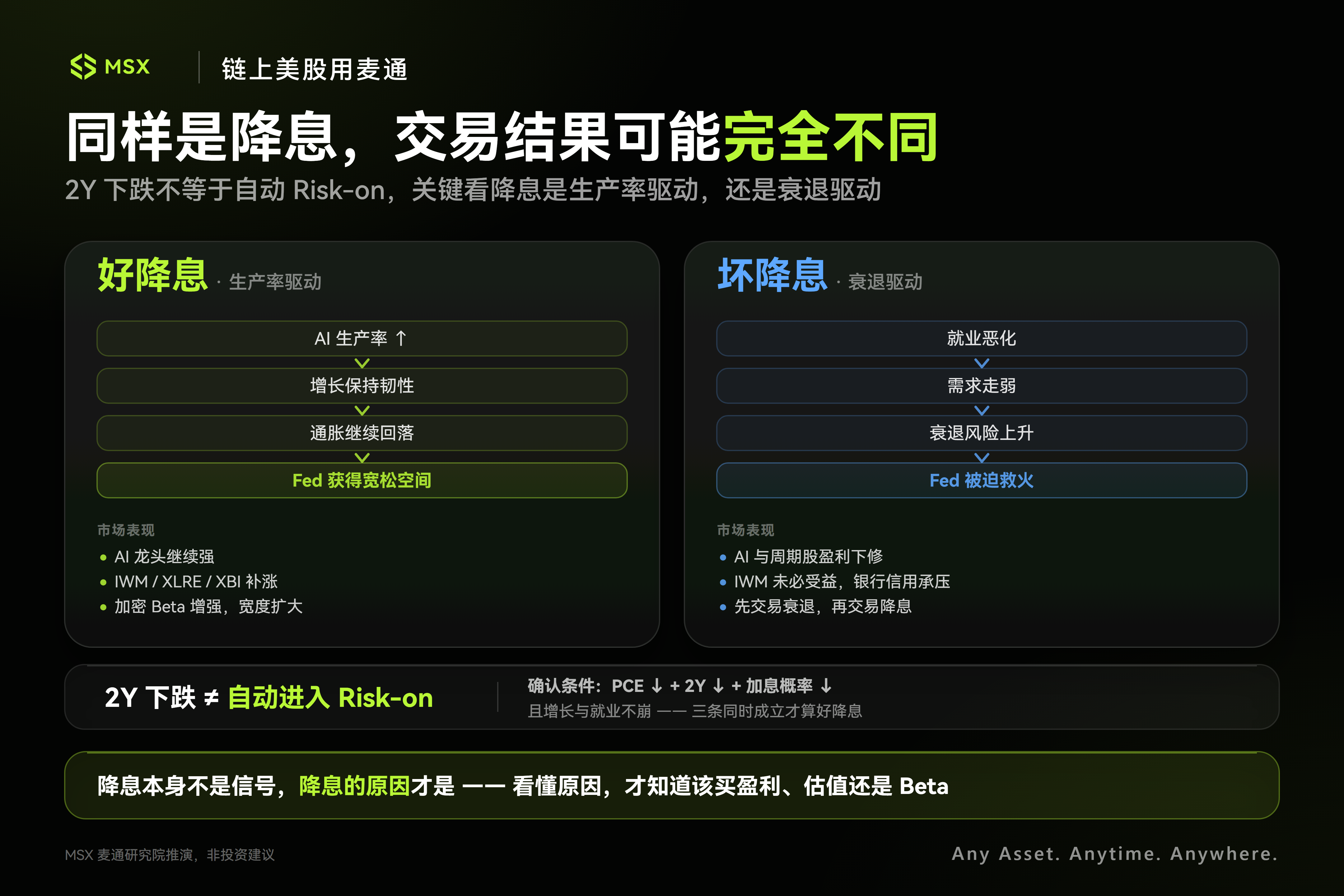
Ultimately, not all "rate cuts" warrant buying the same basket of assets. If what emerges is "AI productivity gains → growth remains resilient → inflation declines → the Fed gains room to cut," that is the ideal "good rate cut."
In that scenario, we could see AI leaders continuing to strengthen alongside catch-up gains in small caps, REITs, biotech, and crypto beta, with market breadth expanding notably.
But if instead we see "sudden employment deterioration → economic recession → inflation declines → the Fed forced to cut rates to put out fires," that is an entirely different "bad rate cut."
In that case, even if 2-year Treasury yields fall just as quickly, small caps, regional banks, and cyclicals may not benefit immediately — because markets would first trade earnings downgrades and credit risk.
These are two completely different scripts.
Final Thoughts
Warsh is clearly no "outsider."
He has served as a Fed governor, lived through the 2008 financial crisis, and spent years steeped in both Wall Street and Washington policy circles.
If the Fed of the past 20 years resembles an increasingly sophisticated machine reliant on models, forward guidance, and market communication, then Warsh today indeed looks like the disruptor ready to shake things up.
Talk less, promise less, use less QE, and let markets rediscover price discovery — except no one knows whether the outcome will be good or bad.
For Trump, a Fed chair who can convince bond markets that "he is absolutely not a political puppet" is precisely the one who possesses the credibility to genuinely lower benchmark rates in the future.
This is why the more Warsh looks like a hawk today, the more room he creates for every card he may need to play down the road.
From September 16, to October 28 and December 9 that follow, the next three months will soon reveal what the first complete playbook of the Warsh era truly looks like.