Kalshi hits the brakes as regulators set their sights on user trading incentive programs in prediction markets


- Core Viewpoint: The CFTC is investigating reward programs on prediction market platforms, concerned that they may constitute misleading promotion and encourage wash trading. Polymarket, with the largest reward scale, may become a key target, while Kalshi has preemptively terminated its trading volume incentive program to avoid regulatory risk.
- Key Elements:
- The CFTC issued an advisory opinion in August warning that reward programs could encourage wash trading and market manipulation, with review or enforcement action expected within this week.
- Polymarket has distributed approximately $128 million in cumulative rewards, accounting for 54.3% of its trading fees; 24H fees reached $3.21 million but revenue was only $400,000, with about $2.8 million used for rewards.
- Polymarket's reward system covers five major channels including LP rewards, maker/taker rewards, holding rewards, and referral rewards, with Perps liquidity rewards annualized spending reaching $27 million.
- New users in January and March 2026 reached 233,000 and 259,000 respectively, with growth nodes highly coinciding with the launch of maker rewards and referral rewards.
- Kalshi has moved up the end date of its trading volume incentive program to October 2026, following wash trading behavior on its ETH perpetual contracts that saw "trades at $5,500."
- Reward programs have become deeply embedded in Polymarket's liquidity system, and cutting or halting them would lead to market maker retreat, widened bid-ask spreads, and liquidity depletion in long-tail markets.
Original |Odaily(@OdailyChina)
Author|Golem(@web3_golem)
On September 29, according to foreign media reports, the U.S. Commodity Futures Trading Commission (CFTC) is investigating reward programs in prediction markets, driven by concerns that prediction markets are using misleading advertising/promotional campaigns to attract traders. A source said the investigation's outcome could include targeted scrutiny of prediction markets or a direct enforcement investigation. Although CFTC Chairman Michael Selig has not yet decided on a specific approach, some form of "action" is expected before the end of the week.
Prediction market platform Kalshi has already terminated its trading volume incentive program, and Polymarket, along with other prediction markets that rely on rewards to maintain platform liquidity depth and user growth, may become the CFTC's key target. As for the reason behind the CFTC's action, it is said that the CFTC believes prediction market companies have ignored the compliance advisory opinion it issued in August...
CFTC's Regulatory Opinion on Prediction Markets
On August 12, the CFTC issued an advisory opinion on prediction market reward programs, specifically addressing market making, liquidity, trading, and reward program registration in prediction markets. In the document, the CFTC emphasized that prediction market companies are trying to encourage heavy traders and are encouraging companies to act as market makers in order to expand market participation and trading volume, and that these reward programs may present compliance issues.
In addition to registered trading rebates and "guaranteed profit" promises, the CFTC warned that certain rewards targeting high-volume market participants could also increase wash trading, and that market maker reward programs could also facilitate fraud and market manipulation.
It is not entirely the prediction market companies' fault for not taking the CFTC's opinion seriously. For prediction market platforms such as Polymarket, maker liquidity and holding rewards, new user subsidies, and referral rewards are inherently key strategies for increasing market depth and user growth. Sometimes, to make prediction contracts in a certain sector (such as sports competitions) more liquid, project teams even sign private contracts with market makers.
In the fierce market competition, no one dares to unilaterally abandon these measures, because once they stop, contract liquidity depth and user experience could deteriorate, leading to user attrition.
It is currently unclear which companies will be affected by the CFTC's upcoming action, but prediction market platforms operating in the United States, such as Kalshi and Polymarket, are all offering reward measures that could draw regulatory attention.
And Polymarket may become the CFTC's key focus.According topolyscalpingdata, since Polymarket began charging trading fees in January 2026, it has generated $229 million in trading fees, while Polymarket has distributed a cumulative $128 million in rewards, accounting for 54.3% of trading fees.

Polymarket's Reward Programs Cost Millions of Dollars Daily
Polymarket is currently one of the most liquid prediction markets on the market, and the price it pays for this is spending millions of dollars every day to maintain liquidity depth.
According to DeFiLlama data, Polymarket ranks fifth among blockchains by 24H fees at $3.21 million, about $1 million higher than sixth-place Hyperliquid. However, Polymarket's 24H revenue is only about $400,000, ranking just 16th in the industry, meaning approximately $2.8 million was rewarded to platform traders and market makers in various forms.
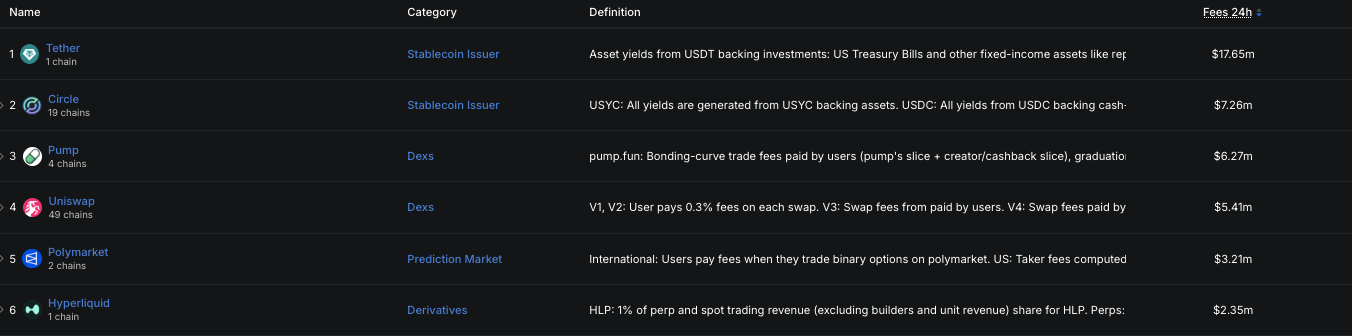

Comparison of Polymarket's 24H Fees and Revenue Rankings
Polymarket's platform reward programs primarily operate through 5 channels: LP Rewards, maker rebates, taker rebates, Holding Rewards, and referrals. LP Rewards have been in place since November 2023 (Odaily note: at that time Polymarket had not yet begun charging fees); Holding Rewards began in July 2025, mainly providing annualized yield for holding pUSD; maker rebates, taker rebates, and referral rewards all began this year.
The five reward channels have distributed a total of approximately $128 million, with proportions and specific amounts shown in the figure below.

In May of this year, Polymarket opened Perps trading and also launched a Perps liquidity reward program to quickly build liquidity depth. The Perps liquidity reward budget is fixed at $75,000 per day, distributed among active perpetual markets. At this pace, this single item alone represents an annualized expenditure of $27 million.
The above are only Polymarket's regular reward programs. During special events and competitions, Polymarket also launches additional reward programs to encourage traders and market makers to participate.
For example, during the crypto TWAP transition period in August this year, Polymarket provided an additional $1 million in liquidity rewards to the market; during the World Cup and popular events, Polymarket also increases additional event incentives. In Polymarket's U.S. site sports March Madness event, a single match's liquidity reward reached $100,000.
Spending Money to Fuel Hundreds of Thousands of User Growth
These reward programs not only maintain Polymarket's platform liquidity depth but also play a significant role in user growth. According to Dune data, in the first few months of 2026, Polymarket's new user growth suddenly accelerated, coinciding exactly with the launch of its various reward programs.
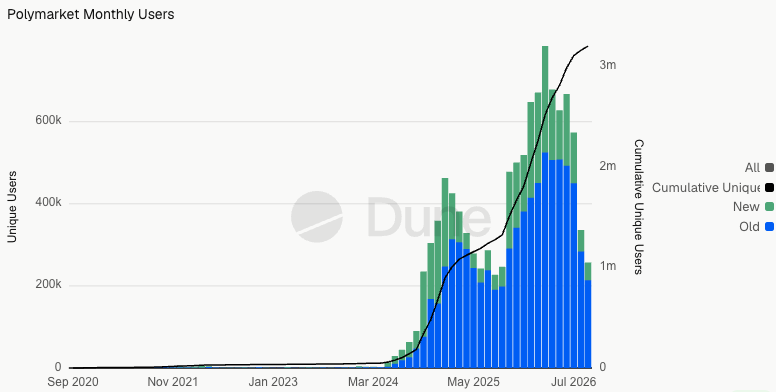
In January 2026, Polymarket's monthly new users reached 233,000, the first time it exceeded 200,000 since January 2025 (the month Trump was elected president), and this timing coincided exactly with Polymarket's launch of its maker rebate program; in March 2026, Polymarket's monthly new users hit a new high of 259,000, which also coincided exactly with Polymarket's launch of its referral reward program.
Of course, Polymarket's explosive new user growth is not determined by reward programs alone; factors such as regulatory maturity, expanded advertising and marketing promotion, and occasional development opportunities (such as the World Cup) also played a role. But judging from the degree of time overlap, the various reward programs Polymarket launched this year have a strong correlation with user growth.
Will Polymarket Be Drawn into the Regulatory Vortex Again?
In summary, reward programs are crucial to Polymarket's business operations and user retention. If the CFTC takes substantive action to clean up prediction market reward programs, then Polymarket, as the prediction market company with the largest reward amounts and proportions on the market, will certainly become the first target of attention.
Kalshi, which focuses on a compliance narrative and has keen "political instincts," has already shut down its trading volume incentive program. On September 28, Kalshi filed with the CFTC stating that it would change the end date of its platform trading volume incentive program from October 1, 2027 to October 13, 2026. The filing did not explain the reason for Kalshi's decision.
In mid-to-late September, users had already discovered wash trading behavior in ETH perpetual contract trading on the Kalshi platform involving "$5,500 trades," with approximately $5,500 trades accounting for 50% of ETH perpetual notional volume for several consecutive days. This is precisely the typical pattern of prediction market wash trading named in the CFTC's August document. Therefore, there is reason to believe that Kalshi's sudden announcement regarding its trading volume incentive program was to avoid regulatory scrutiny.
Polymarket will likely find it difficult to stop as abruptly as Kalshi. For Polymarket, reward programs are already deeply embedded in its liquidity and user growth system. Once rewards are substantially reduced or stopped, it would lead to liquidity withdrawal, market makers reducing quote depth, wider bid-ask spreads in popular markets, and long-tail markets potentially even losing sufficient counterparties.
Polymarket's future situation will depend heavily on the CFTC's interpretation of prediction market reward programs. If regulators insist on treating "trades users make to obtain rewards" as non-genuine trades, then following the insider trading issue, Polymarket may once again be drawn into a regulatory vortex of wash trading and fraudulent trading caused by reward programs.