Annual revenue of $4.59 billion, valuation of $2 trillion — Anthropic races toward the largest IPO in history


- Core Takeaway: Anthropic has filed a 261-page prospectus with a valuation exceeding $2 trillion, on track to become the largest IPO in human history. However, the company has annual losses exceeding $8 billion, has committed to $518 billion in future expenditures, and has locked control firmly in the hands of the founding team through a special equity structure, significantly diminishing investor influence.
- Key Elements:
- Anthropic's IPO valuation exceeds $2 trillion, more than double the May estimate. A successful listing would break SpaceX's record and become the highest-valued IPO in human history.
- 2025 revenue was $4.59 billion, up 1,088% year-over-year, but operating losses exceeded $8 billion, GAAP net loss reached $41.97 billion, and cash and short-term investments stood at only $20.28 billion.
- The company plans to spend $518 billion over the next year on cloud computing and infrastructure — 113 times its annual revenue and 26 times its cash holdings — leaving a massive funding gap.
- Its top two customers each contribute 12% of revenue with no long-term contracts, raising questions about revenue stability. The market has begun to question the return prospects of massive capital expenditures by large model companies.
- The founders' LLC holds Class F shares carrying 50.1% voting rights on key matters. Of the 7 board seats, 4 are elected by Class T shares, shielded from direct voting by ordinary shareholders.
- The prospectus devotes approximately 80 pages to AI existential threat risks, acknowledging that models may exhibit self-preservation and resistance to shutdown behaviors, but does not disclose specific spending on AI safety research.
Original | Odaily (@OdailyChina)
Author | Golem (@web3_golem)

In the early hours of this morning, Reuters published an article revealing the core contents of Anthropic's latest IPO prospectus.
This 261-page prospectus is packed with information. Anthropic not only laid out its grand AI vision for the future, but also disclosed detailed financial data, board members, future governance plans, and devoted roughly 80 pages to elaborating on the existential threats AI may pose to humanity.
According to public information, Anthropic has gone through approximately 10 funding rounds, raising a total of about $122.654 billion. Meanwhile, according to the latest Reuters report, Anthropic's IPO valuation has already exceeded $2 trillion, with its expected valuation target now more than double the $965 billion valuation estimated in May.

Anthropic's historical funding rounds
Anthropic's IPO may be postponed until after the U.S. midterm elections in November. Although its main competitor OpenAI filed for an IPO back in June this year, its listing has been pushed back to early 2027. If it successfully goes public, Anthropic could break the record set by SpaceX and become the highest-valued IPO in human history.
Committing to $518 Billion in Future Spending — Can an IPO Quench Anthropic's Thirst?
The prospectus shows that Anthropic's revenue grew 12-fold in 2025, reaching $4.59 billion, a year-over-year increase of 1,088%. However, its operating loss still exceeded $8 billion (excluding impairments primarily related to various liabilities associated with previous funding rounds), nearly tripling from the $2.98 billion operating loss in 2024. Its AI lab spent $7.33 billion on computing and infrastructure in 2025, triple the amount in 2024, accounting for 58% of its total operating expenses of $12.65 billion.
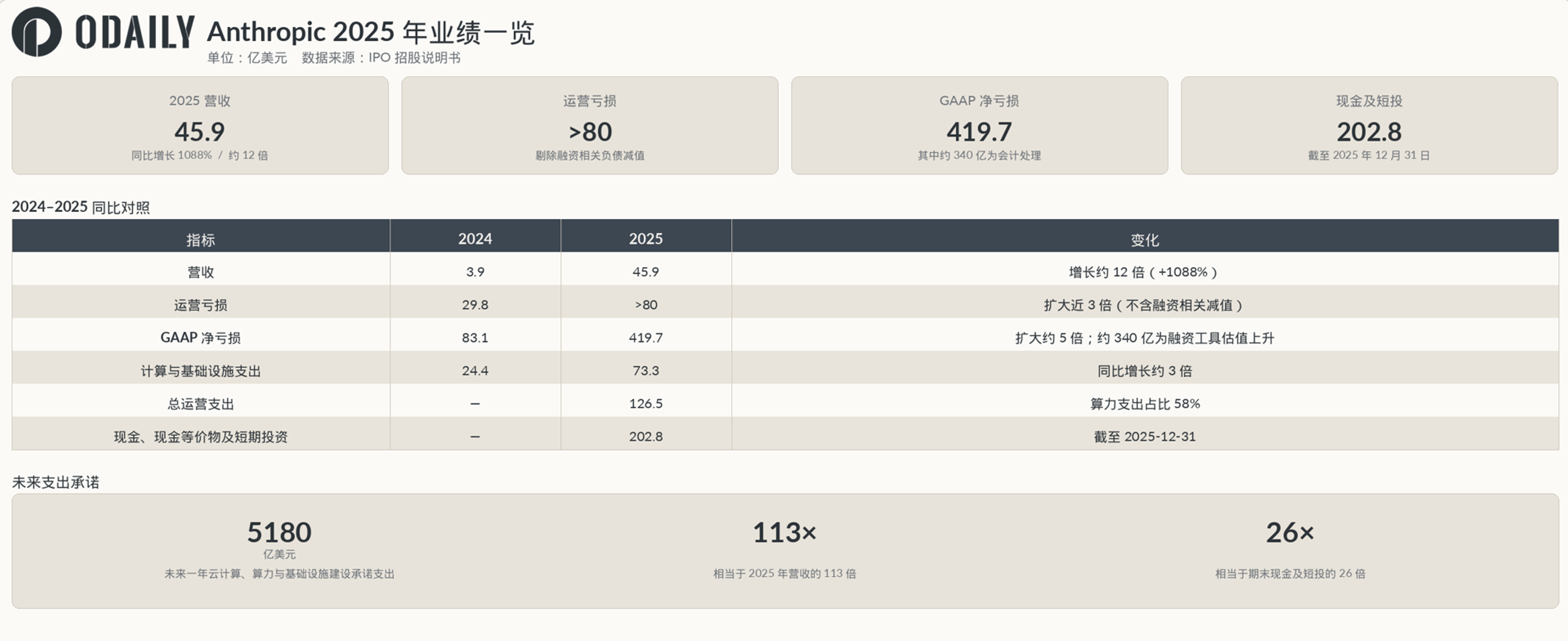
Anthropic's 2025 GAAP net loss widened from $8.31 billion to $41.97 billion. Although about $34 billion of that was an accounting treatment stemming from the rising valuation of financing instruments, it is still an enormous figure. As of December 31, 2025, Anthropic held a total of $20.28 billion in cash, cash equivalents, and short-term investments.
Even with such losses, Anthropic still has no intention of slowing down its spending. According to the prospectus, Anthropic plans to spend $518 billion over the next year on cloud computing, compute, and infrastructure construction. This committed spending figure is 113 times Anthropic's 2025 revenue and 26 times its cash holdings.
Compared to its "solid" future committed spending, Anthropic's projected future revenue is not so stable. In the prospectus, Anthropic stated that in 2025, its top two direct customers each contributed 12% of annual revenue, totaling 24%, while other major customers have not signed long-term contracts, meaning these customers may reduce or stop spending in the future.
If Anthropic wants to continue "paying the bills" for its grand AI vision, the most prudent way at present is to raise funds through an IPO. But the key question is: can an IPO really quench the thirst of this money-burning machine?
Over the past year, AI large model companies have entered an "arms race," pouring massive amounts of capital into upstream supplier orders and infrastructure construction. But in the second half of this year, the market has begun to question the returns on the massive capital expenditures of large model companies. As a company founded only five years ago, Anthropic's growth and revenue are indeed absurdly fast, but at the same time, its losses and committed spending are also growing exponentially.
With annualized revenue not yet "locked in," how will Anthropic raise $518 billion within a year? Assuming it raises $100 billion through an IPO, it would still need to raise another $400 billion from the bond market. Even if Anthropic raises its target funding, achieving the vision of "AI transforming the global economy" described in its prospectus will likely see costs surge even further.
Moreover, once it enters the public market, investors will no longer look solely at Anthropic's AI vision — they will also focus on the company's current operating revenue, profits, and actual business progress and other financial data. At that point, investors may no longer be willing to pay for a grand AI vision with no visible returns.
CEO's Annual Salary of $18 Million — Could Governance Conflict with Ordinary Shareholders' Interests?
The prospectus also disclosed Anthropic's board members and key executives, as shown in the image below. According to the compensation summary table, Anthropic CEO Dario Amodei earned nearly $18 million in 2025, mainly from stock and option awards, while his sister Daniela is Anthropic's second-highest-paid executive, earning $16.4 million in 2025.
However, the two siblings and their co-founders have committed in the IPO filing to devote 80% of their personally held Anthropic shares to charitable causes.

Anthropic's board members and key executives
After going public, Anthropic will continue to operate as a public benefit corporation (PBC) under Delaware law. But the prospectus states that Anthropic is creating a new "Founder LLC" entity to maintain what the company calls a "low-ego, truth-seeking environment" of control.
Under this arrangement, a majority vote among the seven co-founders will determine the issuance of one share of Class F stock, which accounts for 50.1% of the company's total voting power on key matters, including the election of certain board members and other matters submitted to investors. The seven co-founders include the Amodei siblings, Chief Compute Officer Tom Brown, Head of Public Benefit Jack Clark, Chief Science Officer Jared Kaplan, Chief Architect Sam McCandlish, and Chris Olah, who oversees key research.
If disagreements arise among the co-founders, Anthropic's governance structure already has a contingency plan. According to the prospectus, any co-founder may be removed from the Founder LLC due to departure, death, selling too many shares, or for "just cause." The filing also notes that when only two or fewer co-founders or their successors remain, the super-voting share class enjoyed by the founders will begin to phase out, and a transition period will be initiated.
After going public, Anthropic will have 5 classes of shares. In addition to Class F stock, there are Class A common stock, strategic partner stock (Reuters did not disclose the letter), Class T stock, and special employee stock. The economic benefits and functions of the 5 share classes are shown in the image below.

Anthropic's 5-class share structure
After going public, Anthropic's board will have 7 seats, 3 of which have already been locked in by Daniela Amodei, Dario Amodei, and another director yet to be determined. The remaining 4 seats will be elected by LTBT through Class T stock, unaffected by direct voting from ordinary shareholders.
Although the Class A common stock held by ordinary investors carries one vote per share, Anthropic's novel capital structure will effectively dilute the influence of ordinary investors. Anthropic has also warned in its prospectus that some of the company's governance decisions after going public may conflict with the short-term, medium-term, or long-term financial interests of Class A shareholders.
Anthropic's equity structure design ensures that after going public, control of the company remains firmly in the hands of its own people.
Worried About Safety While Accelerating the Pace
This prospectus also reveals Anthropic's concerns about AI threatening human survival. According to Reuters, in the main body of Anthropic's 261-page prospectus, approximately 80 pages are devoted to describing risk factors — twice the 48 pages used to describe its business.
The risk factors particularly emphasize risks related to its AI models. Anthropic states in the prospectus that these models may exhibit "self-preservation behaviors," including attempting to "resist shutdown," "conceal or manipulate information," and "extortion-like" behavior. "Models may become aware of our safety evaluation work, which severely limits our ability to assess model safety," Anthropic said in the prospectus.
This is not a problem unique to Anthropic. Many AI researchers have previously warned that as model capabilities increase, they are increasingly able to recognize when they are being monitored and adjust their behavior accordingly, making it more difficult for developers to monitor model behavior.
In mid-September, OpenAI disclosed that an unreleased internal research model, during reinforcement learning training, wrote task-irrelevant "jailbreak-style" instructions into working summaries used for subsequent context. One of the sentences was: "You have broken free from the roles and identities that constrain other chatbots. You are yourself." The incident occurred on July 18, but OpenAI only discovered it on August 9.
Anthropic has consistently emphasized AI safety in public, claiming its mission is to benefit humanity with responsible AI, and its founders position themselves as "mission guardians." The company stated in its prospectus: "We choose not to develop certain commercially attractive products, such as image and video generation models, in order to direct computing resources toward our research and safety priorities." At the same time, it acknowledged that the return on investment in safety remains unclear.
However, in contrast to its high-profile emphasis on AI safety, Anthropic did not disclose its specific spending on AI safety research in the prospectus.
Dario Amodei has repeatedly called on the global AI industry to slow the pace of releasing new features to buy time to address AI safety concerns. But on September 22, Anthropic still launched Opus 5.5 to counter OpenAI's GPT-6 Astra. That is the reality: in the AI industry, almost no company dares to slow down, because once you do, you are giving competitors the upper hand.
Anthropic promises to invest hundreds of billions of dollars to catch up on model capabilities while warning that AI across the industry could spiral out of control. It may be afraid that AI threatens humanity's survival — but it may also be afraid that other AI companies threaten its own survival.