






AAVE's Biggest Obstacle to a Rally: The Next 473 Days of Revenue May Not Feed Back Into the Token Price


- Core View: Due to an approximately 75,000 ETH shortfall left behind by the rsETH attack, Aave has tapped into treasury funds and taken on long-term loans. Protocol revenue must first be used to repair the balance sheet, making it difficult to restart AAVE buybacks in the short term.
- Key Elements:
- On April 18, the Kelp DAO cross-chain bridge was attacked. After recovery efforts from multiple parties, an rsETH shortfall of approximately 163,183 ETH still left roughly 75,000 ETH outstanding.
- Under the recovery plan, Aave DAO directly contributed 25,000 ETH (which has already disappeared from the treasury) and obtained a loan of up to 30,000 ETH from Mantle with a 36-month term.
- In the 144 days following the incident, Aave DAO's retained revenue was only about $24 million, averaging $167,000 per day, a decline of approximately 41% compared with the same period previously.
- Based on a static calculation using current revenue, repaying the $79 million Mantle loan would take about 473 days, whereas in April it was expected to take only 10 months.
- A buyback restart depends on a recovery in protocol revenue growth and repair of the balance sheet. Only after revenue is no longer prioritized for filling the hole can AAVE's value capture logic restart.
Source: DeFi researcher Chado
Compiled by Odaily (@OdailyChina); translated by Azuma (@azuma_eth)
Editor's note: The core of this article is DeFi researcher Chado's research on "when will AAVE restart its buyback?" Odaily has supplemented certain background and details on this basis.
Altcoin markets have recently staged a recovery, and AAVE has drawn considerable attention as well. However, since the Kelp DAO hack in April (see "DeFi hacked again for $292 million — is even Aave no longer safe?"; "Final fix unveiled, the Aave bad debt saga is finally coming to an end"), Aave's token buyback has been suspended for months, which has led to persistent disagreement in the market over AAVE's current value capture capability.
As UNI expanded the scale of its buyback thanks to the success of the Robinhood Chain ecosystem — which in turn drove its price higher — AAVE holders have grown increasingly concerned about the status of AAVE's buyback restart. But in the view of the author, Chado, reactivating the buyback in the short term will not be easy.
Below is Chado's research, compiled and supplemented by Odaily.
Why Has the Buyback Still Not Returned?
To understand why the AAVE buyback has not yet restarted, we first need to go back to the rsETH incident that occurred on April 18.
That day, Kelp DAO's LayerZero bridging route was attacked, and a large amount of rsETH not fully backed by ETH was minted and flowed into multiple onchain markets. The attacker then deposited this rsETH into Aave as collateral and borrowed a large amount of WETH.
Aave quickly froze the rsETH and wrsETH related markets and took measures to limit the spread of risk. But because the attacker had already completed the collateralized borrowing, the loss of the assets themselves would not automatically disappear when the markets were frozen. According to Aave's subsequent disclosures, as many as 152,577 rsETH were stolen from LayerZero's lock-up at one point. Based on the reference ratio at the time of 1.0696 rsETH to 1 ETH, this equated to a shortfall of roughly 163,183 ETH.
Afterward, Kelp froze and recovered about 40,373 rsETH, equivalent to roughly 43,168 ETH; the Arbitrum Security Council froze 30,766 ETH held by the attacker; and liquidations of the attacker's positions in Aave and Compound are expected to recover up to about 12,323 WETH and 1,845 WETH respectively. Together, the four parts total about 87,955 ETH, reducing the original shortfall of more than 160,000 ETH to roughly 75,000 ETH.
The remaining question is: who fills this gap?
How Much Did Aave Put In? How Much Does It Still Owe?
In late April, Aave DAO, together with EtherFi, Lido, Ethena, Mantle, and other parties, launched a recovery plan called DeFi United.
The plan ultimately formed a rather complex funding structure. First, ecosystem participants including EtherFi, Lido, Ethena, Ink, BGD, and Stani (Aave's founder) together provided about 14,570 ETH. This portion is a donation and does not need to be repaid by Aave. Aave DAO itself directly contributed 25,000 ETH. This one is particularly noteworthy — although it is not a loan nor funds to be repaid in the future, it was taken directly from the DAO treasury to cover losses. In other words, these 25,000 ETH have truly disappeared from Aave's balance sheet.
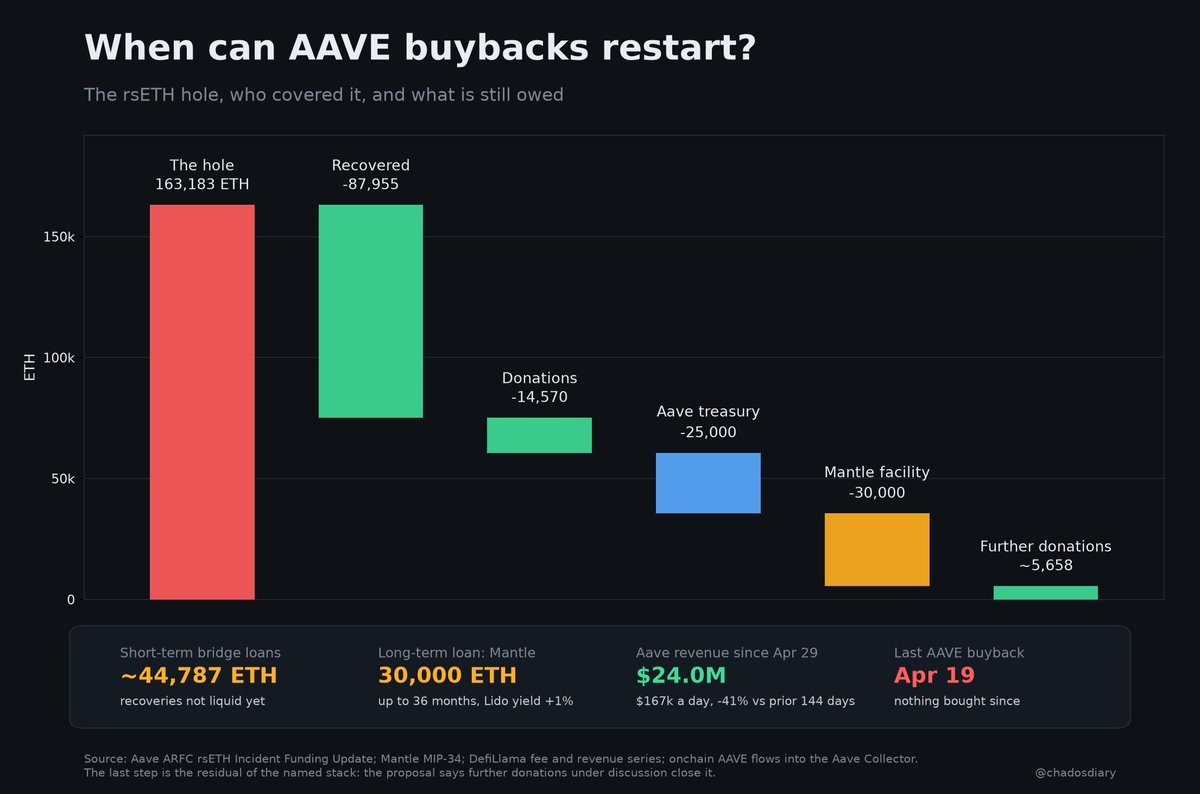
The rest was resolved through borrowing. The largest single loan came from Mantle, with a maximum size of 30,000 ETH. Under the relevant plan, Mantle provided a credit facility with a maximum term of 36 months, at an interest rate of the Lido staking yield plus 1%.
In addition, to allow frozen or pending-liquidation assets to first enter the recovery process, Aave also needed about 44,787 ETH in short-term bridge funding.
With this, the accounts become fairly clear. The shortfall was about 75,200 ETH, and the funds used to fill it included 14,570 ETH in donations, 25,000 ETH from the Aave treasury, up to 30,000 ETH in long-term loans from Mantle, and about 44,787 ETH in short-term bridge loans — at first glance, these numbers even exceed the original shortfall, but that is because part of the funds was only temporarily used for bridge advances.
After excluding the short-term bridge loans, the most direct balance-sheet impact of that incident on Aave was the 25,000 ETH already paid out, plus the 30,000 ETH long-term loan from Mantle that will pressure future cash flows.
At the Current Revenue Rate, How Long Will It Take to Repay?
So what does this have to do with restarting the AAVE buyback? The answer lies in Aave's revenue.
Chado compiled data for the 144 days following the incident. From April 29 to the release of his research, the Aave protocol generated total fees of about $181.2 million, but the Aave DAO actually retained only about $24 million in revenue, averaging about $167,000 per day.
More notably, Aave's current revenue level has already fallen significantly compared with before the incident. In a previous 144-day period of the same length, Aave DAO retained about $40.5 million in revenue. This means that revenue in the 144 days after the incident has dropped by about 41% compared with before.
Now let's look at Mantle's long-term loan. Based on a maximum size of 30,000 ETH, and using the ETH price of about $2,639 at the time of Chado's analysis, this loan corresponds to about $79 million.
If we simply calculate based on the revenue pace of the past 144 days, with Aave able to retain about $167,000 per day, repaying $79 million would take roughly 473 days, or more than a year and three months.
Of course, this does not mean Aave has definitively decided to use all of its revenue for the next 473 days to repay Mantle, nor does it mean the buyback must wait 473 days before it can resume. This is a relatively extreme static stress test — assuming future revenue remains at the current level and the DAO uses all retained revenue to repay this 30,000 ETH long-term financing, then in theory it would take about 473 days to pay it off.
In fact, Chado conducted the same data calculation in April this year, when Aave DAO's daily revenue was about $266,000, and it was estimated that a loan of the same size could be repaid in about 10 months. But now, as revenue has declined, the debt repayment cycle has been stretched to about 15.6 months.
This also explains why the buyback has still not returned: Aave does not lack revenue right now; rather, before the balance sheet is repaired, it is difficult for that revenue to flow preferentially to AAVE.
Restarting the Buyback Is Not So Simple
So the real problem AAVE currently faces is when the revenue captured by the protocol can once again become "free cash flow" and flow back to the token level.
After the rsETH incident, Aave has already used 25,000 ETH of treasury funds to fill part of the gap, while also carrying up to 30,000 ETH in long-term financing. As long as this account is not fully sorted out, it will be difficult for Aave DAO to continue distributing protocol revenue to AAVE holders as it did before.
This also means that AAVE's next "bull run" depends not only on the DeFi market itself, but also on two variables — whether protocol revenue can grow again, and whether the balance sheet can gradually recover.
After all, only when the money the protocol earns no longer needs to be prioritized for filling holes can AAVE's revenue capture logic truly start turning again.





