






SEC Opens a "Pandora's Box": On-Chain Tokenized Stock Trading Officially Begins


- Core Viewpoint: Under the name of an "innovation exemption," the U.S. SEC has for the first time allowed tokenized stocks to be traded on a limited basis on compliant on-chain venues (TSVs) for a five-year period, marking a substantive step forward for tokenized U.S. stock trading and accelerating the convergence of traditional finance and the crypto market.
- Key Elements:
- The SEC introduced an "innovation exemption" framework allowing tokenized NMS stocks to be traded on a limited basis on Tokenized Securities Venues (TSVs), with an exemption period of five years through approximately September 2031.
- TSVs must be U.S. entities and operate under a licensing-based access system; synthetic tokenized stocks are prohibited; tokens must be tokenized by the issuer or an unaffiliated third party, and holders are entitled to dividends and voting rights.
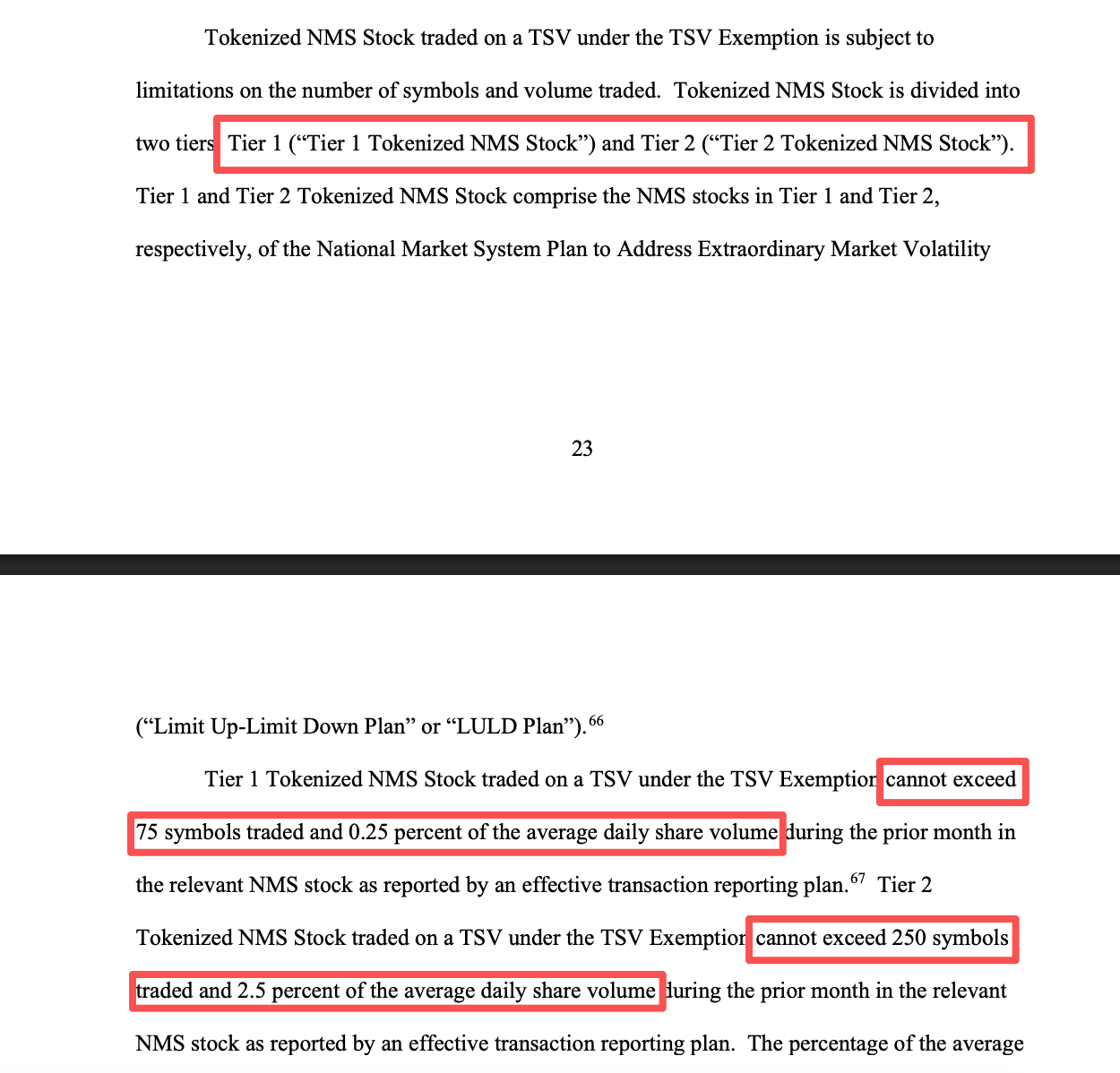
- Strict caps are placed on trading volume: Tier 1 stocks are limited to no more than 0.25% of average daily volume per month, and Tier 2 to no more than 2.5%; each TSV may trade a maximum of 75 and 250 instruments, respectively.
- Stock tokens must be deployed on public permissionless blockchains, smart contracts must be auditable, and trading halt mechanisms must be synchronized with the underlying stock.
- Following the announcement, on-chain tokenized stock meme coins broadly rose over 20%, the DeFi sector showed strong performance, and UNI, HYPE, and others gained more than 10%.
- The Robinhood CEO said the U.S. has entered the tokenization era, while the AMC CEO praised the new rules and emphasized three principles: investor protection, a ban on synthetic assets, and the issuer's right to object.
Original|Odaily (@OdailyChina)
Author|Wenser (@wenser 2010)
SEC Chairman Paul Atkins is enjoying a surge in credibility!
Although the CLARITY Act previously failed to pass a Senate vote, Paul Atkins declared in a high-profile manner at the time that regardless of whether the relevant legislation could advance, the SEC would take decisive action to provide a clear regulatory framework for American investors and entrepreneurs, adding, "Stay tuned." In just one day, the SEC made a bold move, opening the door wide for tokenized stock trading under the name of an "Innovation Exemption."
According to official documents, based on this temporary, conditional "Innovation Exemption," the SEC permits tokenized stocks to be traded on a limited basis on certain onchain venues—Tokenized Securities Venues (TSVs).
With this, a magnificent "Great Tokenization Era" has officially begun, and the "Pandora's Box" belonging to the traditional financial industry may have quietly been opened.
Clearing Away Obstacles to Tokenized Stocks in Phases: The SEC Offers a New TSV Solution
In the past, tokenized stock trading was hampered on the one hand by SEC review and approval, and on the other hand by trading platforms.
The former refers to applications already filed by US stock exchanges Nasdaq and NYSE, as well as some technical implementation challenges; the latter is what truly concerns everyone in both traditional financial markets and crypto markets—the key question being: where is it more reasonable to trade tokenized stocks?
Now, the SEC's answer is—Tokenized Securities Venues (TSVs).
Tokenized Securities Venues as a Compromise Solution, But Still With 4 Hard Requirements
In subsequent official remarks, SEC Chairman Paul Atkins also laid out 4 clear conditions for the exemption boundaries of Tokenized Securities Venues:
- First, the TSV must be a US entity and comply with the economic and trade sanctions regulations of the US Office of Foreign Assets Control (OFAC);
- Second, a licensing-based access system must be implemented, allowing only eligible participants to trade tokenized NMS (National Market System stock, i.e., stocks listed on major US exchanges) stocks;
- Third, trading of synthetic tokenized stocks is prohibited; the relevant tokenized stocks must be tokenized by the underlying stock issuer or by an unaffiliated third party, and holders must enjoy the same rights as traditional securities, including dividends and voting rights;
- Fourth, issuers have the right to object to and block their securities from being traded on a TSV, and the anti-fraud and anti-manipulation provisions of federal securities laws still fully apply to the relevant securities activities.
Through this "new role" that sits between traditional financial industry stock exchanges and crypto market exchanges, the SEC has provided the market with a two-in-one solution. Of course, the relatively clear regulatory boundaries also mean that the previously gray and ambiguous zones have been greatly narrowed—especially as mainstream synthetic tokenized stocks on the market may once again be shut out of the US market due to this ban, potentially further shaking tokenized US stock assets.
TSV Implementation Details: Five-Year Term, Licensing-Based AMM, Same Asset Same Rights, Synchronized Trading Halts, Trading Volume Caps
In terms of implementation timeline, the official statement explicitly notes that the Innovation Exemption takes effect from the date of publication and lasts for five years (until approximately September 2031), after which it may be adjusted or converted into more permanent rules. At the same time, the SEC is actively soliciting public comments for later rule refinements.
In terms of entry thresholds, TSVs are where liquidity providers, after meeting disclosure and recordkeeping conditions, provide one or more permissioned automated market maker liquidity pools, allowing corresponding participants to interact and reach trading terms, while setting participant access standards, thereby matching buyers and sellers to complete transactions.
In terms of product rights, stock tokens must represent ownership of the actual underlying securities and be tokenized by the issuer or on behalf of the issuer, or by an unaffiliated third party. Holders must enjoy the same rights as traditional stocks, including dividends and voting rights. Synthetic tokens (products that only provide price exposure without representing actual ownership) are explicitly excluded. In other words, the various synthetic tokens on Robinhood Chain that cannot achieve same-asset same-rights do not fall within this category of assets.
In terms of trading halt mechanisms, the various major stock tokens on TSVs halt trading in sync with the underlying stocks on the primary listing exchanges.
In terms of trading volume limits, according to information officially provided by the SEC, for Tier 1 stocks (mainly including S&P 500 and Russell 1000 constituents and eligible ETPs and other highly liquid stocks), each TSV may trade at most 75 instruments; the trading volume of each stock must not exceed 0.25% of that stock's average daily volume (ADV) in the previous month (based on data reported under an effective transaction reporting plan); for Tier 2 stocks (i.e., other US stocks), each TSV may trade at most 250 instruments; the trading volume of each stock must not exceed 2.5% of that stock's average daily volume in the previous month.
In addition, the smart contracts of stock tokens must be auditable, public, and deployed on public, permissionless blockchain networks, meeting requirements for public disclosure, transaction transparency, circuit breaker coordination, recordkeeping, and technical safeguards; before third-party tokenization, the TSV must send written notice to the issuer and give it an opportunity to object (typically at least 30 days; if the issuer objects, trading must not proceed).
It can be seen that the current TSV model is an "experimental field for tokenized stock trading" created by the SEC. They are also very wary of a series of industry challenges such as insider manipulation and investment risks, and therefore have imposed certain controls on related activities, especially trading volume caps, in order to slow the pace and impact of tokenized stock trading on traditional financial market securities trading.
The SEC Opens "Pandora's Box": A "Crypto Ghost" Looms Over the Traditional Financial Industry
Regarding this exemption innovation, SEC Commissioner Hester M. Peirce, who contributed significantly, specifically published an article sorting out the key issues involved, and formally raised six at the SEC's overnight trading roundtable:
- How should US stock markets draw on the experience of long-running forex, cryptocurrency, and futures markets?
- When overnight liquidity is fragmented and spreads widen, how should broker-dealers fulfill their best execution obligations and strengthen retail investor protection?
- When overnight liquidity is insufficient and execution costs are high, is it still a reasonable fiduciary decision for asset managers to choose not to trade overnight?
- Will extended trading hours change the way listed companies release earnings and material information?
- Given that EDGAR filings submitted after 5:30 PM Eastern Time are typically not processed until the next business day, does the SEC need to adjust the EDGAR system to ensure timely disclosure of material information during overnight trading sessions?
- Should the SEC provide relevant guidance or regulatory exemptions for listed companies, especially small companies?
According to her disclosure, extended US stock trading hours are gradually forming a "23×5" trading model, but currently overnight trading accounts for less than 1% of total NMS stock trading volume and is highly concentrated in a few stocks. If the status quo is to be changed going forward, much work remains to be done.
Regardless, tokenized US stock trading has taken a concrete step forward, and this also provides new guidance documents for the previous debate between the Robinhood CEO and the AMC CEO over the legitimacy of "stock tokenization."
After the news came out, Robinhood CEO Vlad Tenev posted that the US is entering the tokenization era. Thanks to the SEC's push, Americans can begin to enjoy the benefits brought by tokenization, including instant settlement, 24/7 trading, and fractional trading enabled by default. He called this an important moment for American innovation.
AMC CEO Adam Aron subsequently also praised the new regulatory rules and highlighted three principles, including that investor protection must not be absent, synthetic assets must not be used, and stock issuers have the right to object to their securities being traded on tokenized securities venues. He stated that under the framework published by the SEC, eligible stock tokens should have full voting rights and dividend rights, and listed companies should also have the right to prevent their securities from being tokenized and traded. He also called out to Robinhood co-founder Vlad Tenev, urging Robinhood to follow the same standards in its overseas stock token business, especially regarding investor protection, synthetic assets, and issuer objection rights.
From the crypto market side, despite the many restrictions, this move is still expected to usher in an "era of explosive growth in stock tokenization." As time goes on, more stock instruments will undergo tokenization and become commodities on the "big shelf" of the crypto market, with the only difference being whether they actively push for issuance themselves or passively have others issue on their behalf.
As for whether the onchain market will see a new rally due to the tokenization of US stocks, the short-term boost is relatively significant.
Last night, after the SEC approved limited trading of tokenized stocks on onchain platforms, multiple onchain stock-related meme coins rose: Robinhood onchain ecosystem stock-token paired meme coins such as MEME, BONER, microduck, Artificial Inu, CATGPT, and MOO all posted gains of over 20%; today the crypto market broadly rose in tandem, with the DeFi sector performing strongly: Genius (GENIUS) rose 20.66%, while Uniswap (UNI) and Hyperliquid (HYPE) rose 14.81% and 10.01%, respectively; in terms of price, UNI peaked at $7.93, up over 14% in 24 hours; ONDO peaked at $0.3792, up over 7% in 24 hours; BP peaked at $0.55, up nearly 14% in 24 hours.
Recommended Reading
24/7 Stocks: SEC Roundtable Remarks by Hester Peirce
Statement on Innovation Exemption by Mark T. Uyeda
Statement on Innovation Exemption: A Bridge Toward Durable Rulemaking By Paul Atkins


