2026 이더리움 미래 발전 전망 2.2만 자 심층 보고서 (상편): "인프라"에서 "생태계 허브"까지 얼마나 남았나?


- 핵심 관점: 이더리움은 단일 기술 시스템에서 실행, 검증, 조정 및 자금 분배를 포괄하는 종합적 인프라로 진화하고 있습니다. 내부 아키텍처 재편, 프로토콜 최적화(ePBS, SSF, Blob 확장 등) 및 L1과 L2 관계 조정을 통해 거버넌스 논란, 성능 병목 및 외부 경쟁 과제에 대응하고 있습니다.
- 핵심 요소:
- 이더리움 재단은 조직 개편을 단행하여 인력을 감축하고 전략적 초점을 Layer1으로 재조정했으며, 자금 지원 방식을 "수동적 접수"에서 "능동적 유도"로 전환하여 연간 지출 비율을 5%로 낮췄습니다.
- Pectra 업그레이드는 EIP-7251(검증인 상한을 2048 ETH로 상향)과 EIP-7691(Blob 목표 수를 6개로 상향)을 통해 PoS 스테이킹 효율성과 Layer2 데이터 가용성을 최적화했습니다.
- MEV 집중화 문제를 해결하기 위해, Glamsterdam 업그레이드의 EIP-7732(ePBS)를 통해 제안자-빌더 분리 메커니즘을 프로토콜에 내장하여 타사 중계자에 대한 의존도를 낮출 계획입니다.
- Rollup 생태계의 파편화에 대응하기 위해 "이더리움 경제 구역(EEZ)" 및 네이티브 Rollup(EIP-8079) 방안을 제안하여 L1과 L2의 협력 및 메인넷 가치 포착을 강화하고자 합니다.
- 사용자 경험 최적화를 위해 단일 슬롯 확정성(SSF)의 장기적 구상과 과도기 방안인 "빠른 확인 메커니즘(FCR)"을 제안하여 확인 시간을 수 분에서 약 13초로 단축하는 것을 목표로 합니다.
As one of the most important smart contract platforms today, Ethereum has built the richest on-chain ecosystem and continues to lead the direction of Web3 technological innovation. However, as the ecosystem's scale continues to expand, a series of problems accumulated in Ethereum's underlying architecture and development path are gradually emerging and becoming more complex. For example, controversies remain in the ecosystem governance and benefit distribution mechanisms; during the scaling process, it's difficult to balance consensus security, validation efficiency, and decentralization; uncertainties persist in data availability and expansion paths (such as sharding and the Blob mechanism); the architectural transformation centered on Rollups impacts the main chain's value capture and ecosystem structure; the power distribution and sequencing mechanisms surrounding MEV are reshaping the block production system; competition from high-performance public chains creates external pressure on Ethereum's performance and ecosystem appeal.
Against this backdrop, the Ethereum Foundation and core developers have intensively pushed forward a series of key adjustments and innovative attempts over the past year. These include restructuring the Foundation's organizational structure, clarifying the responsibilities of the Protocol team, redefining the functions of L1 and L2, adjusting the Foundation's positioning within the ecosystem, exploring Ethereum's commercialization path, and participating in the formulation of agent economic standards. This series of changes signifies that Ethereum is evolving from a single technical system into a comprehensive infrastructure system encompassing execution, validation, coordination, and fund allocation.
Based on this, this research report will take the core problems currently faced by Ethereum as a starting point, systematically sort out its latest progress in technology, architecture, and ecosystem levels, and interpret Ethereum's medium to long-term development direction. At the same time, it will combine its exploration of funding mechanisms and potential commercialization paths to further analyze the strategic direction of the Ethereum Foundation and assess the potential risks it may face during its development, helping you fully understand the logic behind Ethereum's frequent moves.
Author: ShirleyLi, Researcher at Web3Caff Research
Cover: Photo by Unsplash+, Typography by Web3Caff Research
Word Count: Nearly 22,000 words in total
Note: Due to space constraints, this research report is published in two parts. This is the first part (including chapters: Background, Review of Ethereum Core Issues). The remaining chapters (Strawmap Draft Details, Exploring Compliant Commercialization Paths, Market Competition and Risk Assessment, Other Directions Worth Attention, Ethereum Foundation's Support Directions, New Risks the Ethereum Ecosystem May Face, Future Outlook) will be updated and completed in the second part.
Table of Contents
- Background
- Review of Ethereum Core Issues
- Criticism Towards the Ethereum Foundation and Vitalik Buterin
- Improvements in PoS Technology
- Blob Capacity Crisis
- A Rollup-Centric Future
- The Battle for MEV
- Impact from Layer1s like Solana and Sui
- Strawmap Draft Details
- Gigagas L1
- Post Quantum L1
- Private L1
- Seven Upgrades Planned by the Strawmap Draft
- Exploring Compliant Commercialization Paths
- Commercialization Attempts
- Compliance
- Other Directions Worth Attention
- Adjustments to the Gas Mechanism
- From DeFi to Defipunk
- AI
- Ethereum Foundation's Support Directions
- New Risks the Ethereum Ecosystem May Face
- Future Outlook
- Key Points Structure Diagram
- References
Background
Since Vitalik Buterin and his team formally introduced Ethereum to global users at an international conference in 2014, the network has gone through nearly twelve years of development. From an early niche experiment to the core infrastructure supporting a diverse ecosystem today, Ethereum has grown into one of the most influential underlying platforms in the Web3 world. However, as the ecosystem's scale continues to expand, the physique of this "giant beast" Ethereum is growing larger, and its pace is becoming increasingly heavy. Under the harsh law of the jungle, this inherent burden is being constantly amplified by external challengers – it must not only deal with its own operational pressures but also face eager newcomers.
For Ethereum, "maintaining stability" and "seeking change" have always been contradictory yet tightly intertwined directions. On one hand, it needs to maintain network stability to ensure the steady progress of the entire ecosystem; on the other hand, it must continuously point the ecosystem in new directions. To this end, Ethereum has continuously confirmed and revised its development coordinates by publishing phased roadmaps.
Between 2014 and 2016, Ethereum gradually formed an early phased development plan during its progress, divided into four stages: Frontier, Homestead, Metropolis, and Serenity. Among them, the first three stages are generally regarded as the Ethereum 1.0 phase, mainly focusing on basic function improvement and network stability enhancement. Serenity represents its long-term evolutionary goal, the core of which is to achieve a leap in scalability and performance through the reconstruction of consensus mechanisms and underlying architecture.
In 2020, Ethereum further clarified the technical path for the Serenity phase, formally establishing the transition to the PoS (Proof of Stake) mechanism and introducing sharding logic, marking the beginning of Ethereum's entry into a stage of systemic architectural restructuring.
In 2022, Ethereum released a relatively complete medium to long-term roadmap, establishing a Rollup-centric scaling path. This meant that Ethereum shifted the execution layer to Layer 2 networks, while the main chain's positioning began to focus on security and data availability. This change set a new tone for subsequent ecosystem development but also laid hidden dangers.
In February 2026, the Ethereum Foundation once again released the "Strawmap" roadmap draft for the next ten years, proposing more specific optimization goals for multiple dimensions such as the consensus layer, data layer, and execution layer, further refining Ethereum's long-term optimization direction, reflecting Ethereum's continuous thinking on the evolution direction of the overall architecture in its mature stage.
Review of Ethereum Core Issues
However, the adjustment and improvement of the development path itself reflect Ethereum's dynamic trade-offs among multiple goals such as scalability, security, decentralization, and ecosystem benefit distribution based on actual development progress. Each version of the plan or roadmap can be seen as a phased balance of the system's overall structure.
In a research report at the end of 2024, "Ethereum's Future Path: Development Amidst Controversy, Can the Ecosystem Giant Withstand Potential Crises?", the author discussed some problems Ethereum was facing, including:
- Controversies remain in the ecosystem governance and benefit distribution mechanisms;
- During the scaling process, it's difficult to balance consensus security, validation efficiency, and decentralization;
- Uncertainties persist in data availability and expansion paths (such as sharding and the Blob mechanism);
- The architectural transformation centered on Rollups impacts the main chain's value capture and ecosystem structure;
- The power distribution and sequencing mechanisms surrounding MEV are reshaping the block production system;
- Competition from high-performance public chains creates external pressure on Ethereum's performance and ecosystem appeal.
So, over a year later, what is the latest progress on these issues? The author will sort them out one by one in the following content.
Criticism Towards the Ethereum Foundation and Vitalik Buterin
Since the establishment of the Ethereum Foundation, the team centered around Vitalik Buterin has undergone multiple rounds of personnel changes. Due to Vitalik Buterin's prominent influence in the Ethereum ecosystem, the power structure of the Foundation has also been under long-term external scrutiny and discussion.
In this context, some believe that certain projects may tend to cater to Vitalik Buterin's technical preferences or the Foundation's funding directions, leading to periodic resource concentration or even overcapacity in specific tracks. Meanwhile, the distributed nature of the technical team makes it difficult for Ethereum's overall advancement efficiency to meet expectations for its iteration and innovation speed.
Furthermore, the selling activities of the Ethereum Foundation and Vitalik Buterin have once sparked market concerns. Although Vitalik Buterin and related Foundation members have stated that this funding is mainly used to support ecosystem development and project funding, these actions have still triggered some discussion and interpretation at the market level.
Latest Progress:
In early 2025, against the backdrop of a recovering overall market environment and the emergence of new narratives, Ethereum's development pace was relatively slow, which also triggered some community dissatisfaction. Some believe that the Ethereum Foundation and core developers lagged in terms of advancement efficiency, market communication, and ecosystem expansion, showing a certain disconnect from the overall industry rhythm.
To respond to these criticisms, the Ethereum Foundation made a series of important adjustments.
In February 2025, Aya Miyaguchi, who had served as Executive Director of the Ethereum Foundation since 2018, transitioned to the newly established role of President. Her responsibilities shifted from daily operations and executive management to external cooperation, institutional relations, and cultural dissemination. Meanwhile, Nethermind founder Tomasz Stańczak and Hsiao-Wei Wang jointly assumed the position of Co-Executive Director.
Under the new management structure, the Ethereum Foundation streamlined its operations, laying off 19 employees, and shifted its strategic focus from Layer 2 back to Layer 1 itself. At the same time, the Foundation began to place greater emphasis on external communication, further increasing transparency in technical routes, development directions, and resource usage to enhance community trust.
In June 2025, the Ethereum Foundation also restructured its internal research and development system. The former department name, "Protocol Research & Development (PR&D)", was simplified to "Protocol", aiming to achieve three goals in the short term: scaling L1 performance; scaling Blobs; and improving user experience. This adjustment signified a shift in its R&D focus from being research-oriented towards engineering implementation and actual delivery. Earlier this year, the Protocol team further upgraded its work objectives, specifying them as:
- Scale: Scaling L1 performance by increasing the gas limit, advancing proposer-builder separation, introducing zkEVM to the mainnet, and optimizing the Blob mechanism;
- Improve UX: Improving user experience by continuously advancing native account abstraction and cross-chain interoperability;
- Harden the L1: Strengthening L1 security and censorship resistance by enhancing post-quantum security preparations, reducing node burdens, and lessening reliance on centralized infrastructure.
However, in February 2026, Tomasz Stańczak announced his resignation as Co-Executive Director of the Ethereum Foundation, with Bastian Aue and Hsiao-Wei Wang jointly succeeding him. During his tenure, Tomasz Stańczak promoted exploration in areas including privacy protection, quantum computing security, and the integration of AI with Ethereum. After his resignation, he will focus more on building products and infrastructure related to the convergence of AI and blockchain. [1]
Interestingly, in his resignation statement, Tomasz Stańczak revealed a mindset of "realizing he was no longer the core driving force, it's better to gracefully pass the baton." This also reflects the gradual decentralization of power within the Ethereum Foundation's governance layer. This change essentially reflects the friction and balance between "Ethereum," a decentralized open ecosystem, and the "Ethereum Foundation," a centralized core coordination body. This contradiction actually exists throughout the entire Web3 system and is one of the key issues that all projects in the industry must continuously face.
According to the latest internal organizational structure, the board members of the Ethereum Foundation include Vitalik Buterin, Aya Miyaguchi, Patrick Storchenegger, and Hsiao-Wei Wang. They are primarily responsible for Ethereum's governance and strategic direction adjustments, while specific execution and operations are shared by the management and various functional teams. The Ethereum Foundation divides its overall work into multiple directions based on function, mainly including:
- Protocol Team: Responsible for advancing the design and implementation of Ethereum's underlying protocols, covering sub-areas like zkEVM, post-quantum, and dAI.
- Privacy Team: Responsible for promoting research and implementation of on-chain privacy-related technologies, such as private transactions and zero-knowledge proof systems.
- Ecodev (Ecosystem Development) Team: Responsible for promoting the construction of the Ethereum ecosystem, including developer support, project incubation, and ecosystem coordination.
- Ecosystem Unblocking Team: Responsible for promoting ecosystem development through fund coordination, research support, and public goods infrastructure construction.
- Operations Team: Responsible for the day-to-day operations of the organization, including finance, legal, human resources, and internal management.
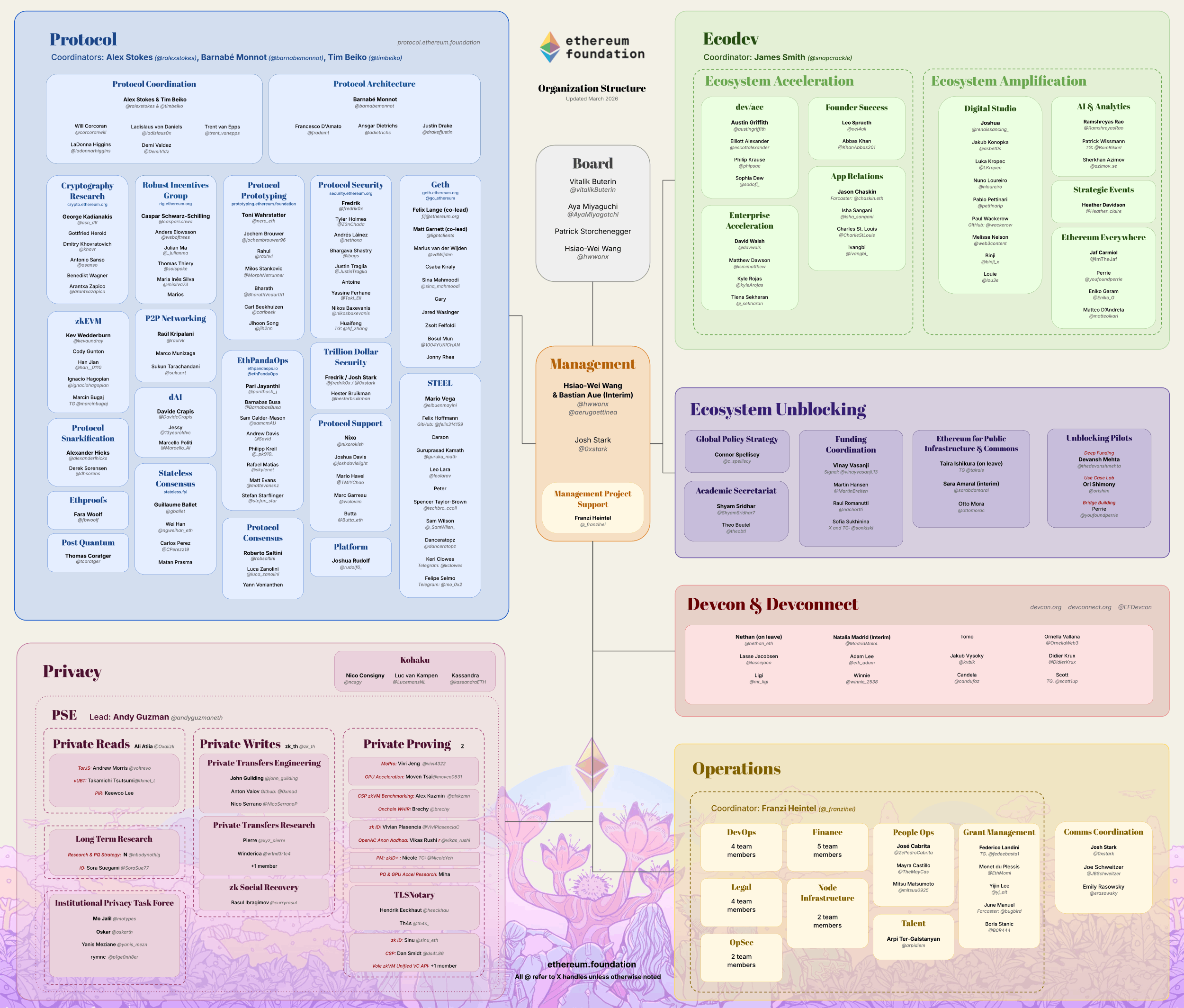
Source: Ethereum Foundation
At the same time, to respond to the changing stages of ecosystem development and resource allocation needs, the Ethereum Foundation also made key adjustments to its grant system in August 2025, pausing the open grant program that had been running since 2018. It relaunched a new Ecosystem Support Program (ESP) in November. After adjustment, the fund allocation model shifted from "passive application processing" to "active guidance." The initial funding directions covered areas such as cryptography, privacy, application layer, security, and community growth. Meanwhile, the Foundation decided to reduce the annual expenditure rate from approximately 15% to 5% to slow down the depletion of ETH reserves. [2] This adjustment marks the Ethereum Foundation's shift from a broad-coverage ecosystem funding model to a refined resource allocation strategy focused on infrastructure and core technologies.
In May of this year, Ethereum Foundation researchers Carl Beek and Julian Ma successively announced their departures, while former Ethereum Foundation researcher Dankrad Feist publicly stated that the Ethereum ecosystem needs a new organization more aligned with Ethereum's economic interests to "save" Ethereum. In response, Vitalik Buterin and Ethereum co-founder Joe Lubin successively responded, stating that these controversies essentially reflect the friction between Ethereum's "long-term technology building" orientation and the current commercialization process, but this is also a necessary phase of "growing pains" during development.
Improvements in PoS Technology
While the transition to the PoS (Proof of Stake) mechanism allowed Ethereum to bid farewell to the energy-intensive consensus model, the 32 ETH staking threshold implicitly raised the barrier to entry for validators, also inducing a risk of centralization of validation rights. To lower the staking threshold for individual validators while increasing their number, the key question becomes how to reduce the communication and coordination costs for the network to reach consensus and increase the cost of malicious attacks.
In response, Vitalik Buterin proposed enhancing network security by increasing the participation ratio required for finalizing a block (e.g., from the current ~2/3 threshold signature to 75% or higher). The core idea is to hedge potential security risks by raising the consensus threshold, potentially balancing decentralization and security to some extent.
Latest Progress:
In May 2025, the Pectra upgrade was activated on the Ethereum mainnet.
In this upgrade, EIP-7251 increased the maximum effective balance cap for validators from 32 ETH to 2048 ETH. Note that 32 ETH remains the minimum staking threshold to become a validator. The main effect of this proposal is to increase the upper limit of consensus weight a single validator can represent, meaning one validator can directly represent more ETH in voting. Through this adjustment, large stakers no longer need to split their stake into multiple validator nodes to receive corresponding incentives, thus helping reduce the number of validator nodes controlled by the same entity, thereby lowering communication and coordination overhead among nodes during the network-wide consensus process.
EIP-7002 optimized the staking withdrawal mechanism. It introduces an execution layer-triggered withdrawal method, allowing stakers to complete withdrawal operations under specific conditions without requiring an active signature from the validator. This mechanism helps enhance stakers' control over their assets, reducing the operational complexity of entering and exiting staking, and further improving the overall flexibility of the PoS system.
Furthermore, the Ethereum Foundation has also explored applying Distributed Validator Technology (DVT) to optimize the staking structure. This technology essentially splits a single validator's private key and signing capabilities across multiple nodes for collaborative execution, thereby reducing the risk of single points of failure. In traditional models, the system demands high stability and private key management capability from the validator node, whereas in a multi-node collaborative mode, validation responsibilities are shared, thus lowering the requirements for the continuous online capability and maintenance level of any single node. However, multi-node collaboration introduces additional system complexity. Therefore, the Ethereum Foundation is attempting to first introduce a lightweight implementation (e.g., DVT-lite) to simplify the deployment and operation of distributed validators. According to information disclosed by the Ethereum Foundation in March 2026, approximately 72,000 ETH were participating in staking through related mechanisms.
Blob Capacity Crisis
EIP-4844, implemented in the Dencun upgrade, introduced a low-cost data availability space called Blobs on Ethereum, primarily for storing temporary data. Currently, Layer 2 networks can submit batch transaction data to Blobs, reducing the cost of publishing on-chain data to some extent.
By design, each block targets 3 Bl