






大摩数字资产主管:比特币破百万不意外,但真正启动可能需要一场击碎旧体系的危机


- コア見解:モルガン・スタンレーのデジタル資産戦略責任者であるエイミー・オルデンバーグ氏は、ビットコインの次なる大幅な上昇は、新製品や政策の好材料から来るのではなく、既存の伝統的金融システムを打ち砕くのに十分な危機を触媒として必要とする可能性があると考えている。同時に同氏は、ビットコインが5年以内に100万ドルを突破しても驚かないが、より緩やかな上昇を望んでいる。
- 主要要素:
- モルガン・スタンレーの現物ビットコインETF(MSBT)は、同行の初日発行記録を更新した。主に顧客の需要によるものだが、銀行持株会社という立場上、FRB(連邦準備制度理事会)の厳格な監督下にあり、独立系資産運用会社のように迅速に行動することはできない。
- 多くのファイナンシャルアドバイザーが依然としてビットコインを積極的に推奨していない理由の一つは、大モルガン・スタンレー公式の推奨ポートフォリオ配分(中程度の積極性を持つポートフォリオに対して2%~4%)が発表されて以来、ビットコイン価格がレンジ内で推移し、上昇の勢いを欠いており、アドバイザーが推奨する動機が弱まっていることだ。
- 教育と認識のギャップが重要な障壁となっている。これには、顧客とアドバイザーの間で、ビットコインとその他の暗号資産の違いに対する理解不足や、ETP(上場投資商品)の保有と現物ビットコインの保有(自己カストディ)の本質的な違いが明確でないことが含まれる。
- 世界の主流資本の関心が他の資産(金やAIなど)に分散しており、規制と資本効率の制限が重なり、銀行がビットコインを保有する動機は低く、より資本処理効率の良い資産を好む傾向がある。
- オルデンバーグ氏は、ビットコインの採用は「Jカーブ」のような急騰ではなく、緩やかに上昇する穏やかなプロセスになると考えている。その将来価値は、危機的イベント(例えば伝統的システムの崩壊)を通じて再評価され、その後に大きな飛躍を遂げる可能性がある。
Compiled & Translated by: Odaily
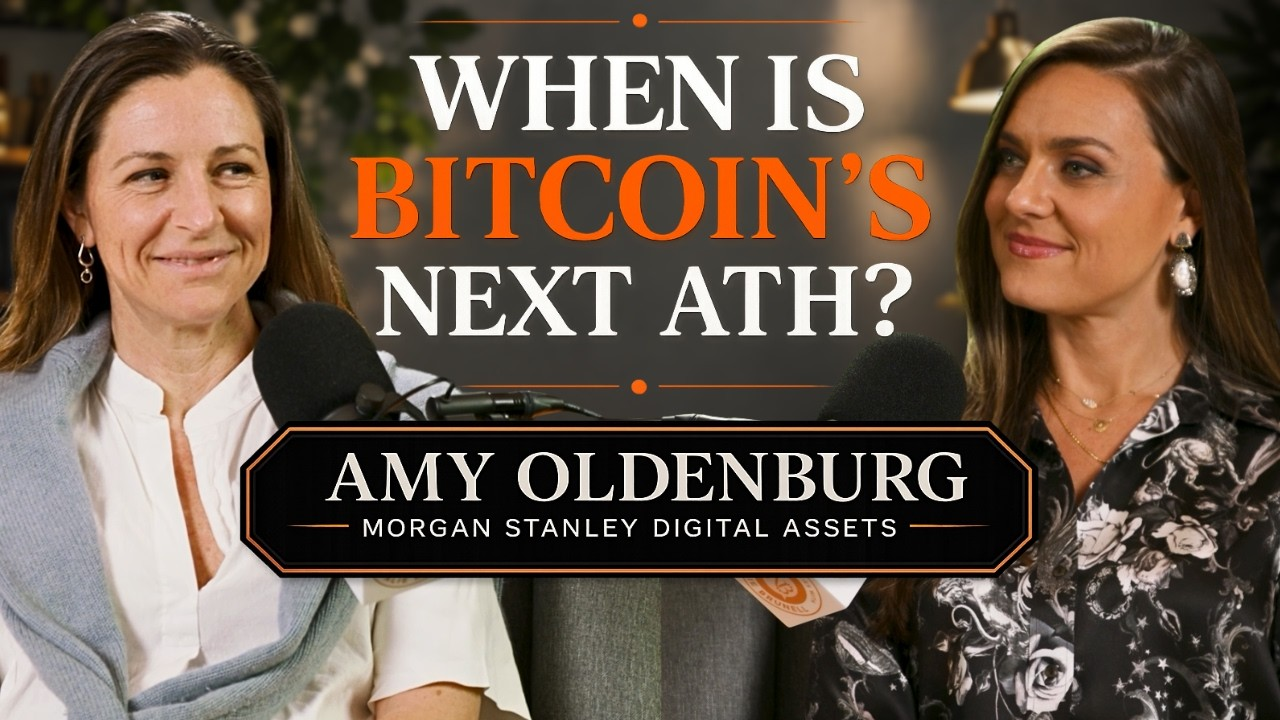
Guest: Amy Oldenburg, Head of Digital Assets Strategy at Morgan Stanley
Host: Natalie Brunell
Podcast Source: Natalie Brunell
Original Title: When Will Bitcoin Hit a New ATH? Wall Street Insider Explains
Air Date: June 10, 2026
Key Takeaways
Morgan Stanley, which manages trillions of dollars in assets, is now bringing Bitcoin to its clients. In this conversation, Amy Oldenburg, Head of Digital Assets Strategy, reveals a paradox: MSBT set the bank's record for first-day ETF volume, yet most financial advisors are still hesitant to recommend it to clients, because the Bitcoin price has barely moved since the recommendation. She doesn't believe the next surge will come from a new product or policy tailwind but may require a true system-shattering event as a catalyst. She wouldn't be surprised to see Bitcoin break a million dollars within five years, but she hopes the ascent is gradual.
Highlights
Tech Roots: From the 1999 Dot-com Bubble to Emerging Markets
- "Every stage of my life has been accompanied by a technological change that seemed obscure at the time, even facing massive skepticism. It’s only now that I can clearly see how the whole historical puzzle fits together."
- "The traders I dealt with daily in the market, those old hands who stuck with me through the 2008 global financial crisis, the core group among them became the early hardcore Bitcoin adopters."
- "Bitcoin's earliest evangelists and power users came not only from Silicon Valley's geek circle but also in large numbers from cross-border and international financial markets—people on the front lines of trading, desperately seeking alternatives to the traditional centralized banking system."
Why Bitcoin Made Sense Early On
- "In those underdeveloped markets, the traditional brick-and-mortar banking system is extremely backward. Most people can never open a bank account in their lifetime, so they have to fully rely on and embrace mobile money."
- "You could be in a small village without 24-hour electricity, with dirt roads, and there's a Vodafone kiosk that looks like a lemonade stand, with 'M-Pesa' written on it. That's where you put cash onto your phone."
- "Because we've worked so deeply in many emerging markets, we understand firsthand that people there have compelling reasons to embrace decentralization. The traditional financial infrastructure is unreliable, lacks contractual integrity, and is plagued by systemic corruption. These are not abstract concepts; we lived them at the trading desk."
Why Aren't Institutional Investors Fully Committed to Bitcoin?
- "Our entire group is structured as a bank holding company. This means we must adhere to much stricter capital adequacy and risk control requirements specific to the banking system, because we operate under the direct supervision of the Federal Reserve."
Record Demand for MSBT
- "You naturally advocate for your own product, but you don’t truly know what will happen until it goes live. The result surprised many."
- "Combining GSIB-level issuance with GSIB-level custody was our first goal in bringing this product to market, and it also served as a way to understand what else the ecosystem needs to develop."
Will Morgan Stanley Issue Digital Credit?
- "I know there is something valuable in digital credit. But most people haven't even figured out Bitcoin yet, let alone more advanced products built on top of it."
- "Education is the factor limiting the community and financial advisors from engaging with these products."
- "Some product elements are very compelling, but there's always something that doesn't quite fit perfectly. It's a bit like the early story of BlackBerry."
The Advisor Gap: Why Isn't Everyone Recommending Bitcoin?
- "If our recommendation had been made at $10,000 or $15,000 and the price later surged to $100,000, the momentum would have carried us naturally. But interestingly, since our recommendation, the price has largely been range-bound."
- "Financial advisors have a fiduciary duty to select appropriate assets for their specific clients. Not every client is a growth investor."
What's Holding Bitcoin Back?
- "We always get caught in binary debates: Will Bitcoin succeed or fail? But we live in a very complex world where different narratives are mixed together, fragmenting attention and allocation."
- "The attention and liquidity of global mainstream capital for asset allocation are brutally divided."
- "I hate to say this, but it might take a crisis—a situation where we shatter the existing system, and Bitcoin is the only thing left intact."
Company Balance Sheets
- "Banks don't hold Bitcoin because they dislike it, but because there are more capital-efficient assets available. If capital treatment conditions don't improve, we will focus our efforts on more favorable assets."
- "If there is no real demand for tokenized stocks, we have little reason to spend heavily on it. When demand arises, we will do it. The same logic applies to Bitcoin."
The Future of Bitcoin
- "I don't foresee a magical J-curve taking off suddenly in 2027. It's more likely that we'll see a continued slow climb, with more participants gradually entering, getting educated, and slowly understanding."
- "Bitcoin reaching a million dollars? That would be great. I see no reason it's impossible. Given everything I've seen in my life, I believe anything is possible."
Winner-Takes-All Tech vs. Redundant Finance: The Future of the Industry
- "That 'winner-takes-all' culture is prevalent in tech and many tech-related fields. It's completely at odds with financial services, whose essence is redundancy and having many participants."
- "When we run an RFP, we might start with a list of ten-plus, hoping to narrow it down to a top three. But in tech, often only one or maybe two can truly meet our hard requirements."
Responding to Skepticism of Large Banks
- "In emerging markets, the distrust of traditional official financial systems by ordinary people isn't an abstract theory written in textbooks; it's a bleeding reality every single day."
- "From the perspective of a hardcore Bitcoin believer, taking spot Bitcoin and putting it into a traditional financial institution's ETP is considered heresy by many. But it's happening at a scale I hadn't anticipated."
- "Holding an ETP share is not the same as holding Bitcoin. You own price exposure. This is a crucial point for continuous education."
Tech Roots: From the 1999 Dot-com Bubble to Emerging Markets
Host Natalie Brunell: Our guest today is Amy Oldenburg, Head of Digital Assets Strategy at Morgan Stanley. Amy, I'm particularly interested in hearing your story of how you got involved with Bitcoin and your over 20-year legendary career at Morgan Stanley.
Amy Oldenburg:
I've been at Morgan Stanley for 26 years, though that wasn't the plan. I grew up in a small Midwestern town in Ohio. It's funny—just like you asked me in our pre-chat: "How did you end up here? How did you get on this crazy journey of digital assets and Bitcoin?"
I'm a deep Gen Xer like you, and I really resonate with your experiences. Sometimes when I see memes online about how kids in the 80s and 90s grew up, you realize how technology started reshaping our lives at a very early age. I remember being around 7 or 8, spending hours in the basement with my cousins playing Atari, and later when the NES came out, we were obsessed with Super Mario Bros. It feels like every key milestone in my life was accompanied by some disruptive technological wave.
One Christmas, my dad bought us a Tandy computer, and we started playing early computer games—it seemed incredible. Then technology kept accelerating. In high school, we learned basic typing in the computer lab, but by college, technology started cutting deeper into our daily lives.
I remember one professor got early access to a BlackBerry, and our entire marketing class became its seed users. Sitting in the classroom, we had no idea what to use it for—it didn't even have apps; it was just a brick. We joked: "What's the difference between this and a high school pager? It can send letters and numbers, but none of our friends have one, who are we supposed to page?" Later it evolved into the version with the iconic full keyboard, became ubiquitous, and then suddenly got phased out. That's the reality.
Even funnier was my major in college. I was studying accounting, but the school didn't allow accounting majors to do study abroad. Back then, all I wanted was to escape Ohio—as far away as possible, even to an overseas market. Since I couldn't go abroad, the next best option was a domestic exchange program in San Francisco. I was studying in New York at the time, so in 1999, I packed my bags and headed to San Francisco—only to walk straight into the peak of the Dot-com Bubble.
Young and naive, I had no idea how crazy the world was. In Silicon Valley, I started working at an internet startup the next day. It helped Fortune 500 companies build websites. After two months of paid internship, I decisively dropped out of accounting, abandoning my major. The feeling was overwhelming—the technological change happening right then was absolutely going to reshape the future.
We followed the company to various industry conferences. Google was just a small startup then. They could only recruit by slipping a small piece of paper saying, "If you're interested, check out our Craigslist page to apply." We raised an eyebrow: "Google? What a weird name? The business model makes no sense—who would use it to search? It will never succeed."
So you see, Every stage of my growth was accompanied by technological changes that seemed extremely obscure and even met with widespread skepticism online. It's only now that I can clearly see how the whole historical puzzle fits together.
As for how I got into digital assets and Bitcoin, I actually joined Morgan Stanley after the Dot-com Bubble burst. I stayed with that San Francisco startup until it was relocated, then returned to New York for a full-time role. But everyone knew the environment had completely crashed—we were even forced to withdraw our S-1 filing. We didn't go public, and then the company went through two brutal rounds of layoffs. I had to activate Plan B immediately to pay rent—and there was no way I was going back to Ohio.
It was at this turning point that I stumbled into Morgan Stanley. A friend of mine worked in HR there. She told me: "I know you're not interested in traditional finance now, focused on tech. But I have many urgent positions to fill. If you know anyone looking for a job or wanting an interview, send them my way." I figured I might as well try it myself, just to have a backup.
And so, I transitioned into Morgan Stanley's Emerging Markets team. The aftershocks of the 1997 Asian Financial Crisis hadn't fully subsided, and the 1994 Tequila Crisis was still recent. It was a mess. The team I joined changed leadership several times within a few years. At the same time, we were feeling the severe impact of the tech bubble burst on financial assets—this was around 2000, 2001. More dramatically, exactly nine months after I joined, 9/11 happened. It was one crisis after another, while underlying technological changes were still racing forward.
At Morgan Stanley, I spent years on the trading desk, specializing in Programmatic Trading and Emerging Markets FX. The traders I dealt with daily—those old hands who stuck with me through the 2008 global financial crisis and weathered the storm together—became the core early adopters of Bitcoin.
Bitcoin's earliest evangelists and power users came not only from Silicon Valley's geek circle but also in large numbers from cross-border and international financial markets—people on the front lines of trading, desperately seeking alternatives to the traditional centralized banking system.
Because we've worked so deeply in many emerging markets, we understand firsthand the compelling reasons for people there to embrace decentralization. Traditional financial infrastructure is incredibly unreliable, lacks contractual spirit, and is often accompanied by severe systemic corruption. These are not textbook theories; we experienced these dark sides firsthand at the trading desk.
So, through this front-line experience in finance, combined with my early network in the tech scene (some friends were early developers of peer-to-peer music sharing software), I was extremely sensitive and got exposed to Bitcoin very early on. The digital trading and risk-tech skills from those days later transitioned quite smoothly into the digital asset space.
Why Bitcoin Made Sense Early On
Host Natalie Brunell: Since you got involved with the space this early, did you jump in and invest early on, or did you hold off until later when traditional financial institutions formally entered and the whole industry became regulated?
Amy Oldenburg:
Not really. It's funny. My brother visited last week, and we were reminiscing. Around 2012, he excitedly told me he wanted to get some machines to mine Bitcoin. I laughed at him, saying we didn't have powerful enough hardware at home to set up a mining rig.
And you have to understand, the crypto environment back then was extremely dangerous and Wild West-like—nothing like today, where you just download a sleek Coinbase app and click a few times to deposit and withdraw Bitcoin safely. Honestly, back then, if you wanted to buy, your only option was to deal with outfits like Mt. Gox. Working at Morgan Stanley, I was worried: if I touched that, I'd probably be fired the next day. For me, the compliance risk and operational cost were too high. So, although I was paying close attention and spending a lot of time observing from the sidelines, I was definitely not an early hardcore miner sitting at a computer writing code.
Host Natalie Brunell: Let's zoom out. Reflecting on your deep experience investing in emerging markets, is there any core conclusion that directly aligns with Bitcoin's subsequent strong rise? Is there a lesson from your emerging market "blood and tears" that made you realize: "Oh! So this is why Bitcoin makes sense!"
Amy Oldenburg:
Yes, and that intuition is incredibly strong. Let's go back to 2007, just before the global financial crisis. Today, people interested in fintech are probably familiar with M-Pesa and how mobile payments exploded in Africa and other emerging markets. But few know that our Morgan Stanley team was deeply


