






ONDO tăng 30% trong ba tuần, giới đầu tư đang đặt cược vào điều gì?


- Quan điểm cốt lõi: Trong bối cảnh thị trường tiền mã hóa nhìn chung trầm lắng và trào lưu meme đang suy thoái, cổ phiếu token hóa (RWA) đã trở thành một xu hướng cấu trúc mới. Ondo (ONDO), với hơn 70% thị phần trong mảng phát hành cổ phiếu token hóa, đang mở rộng từ vị thế "nhà cung cấp" sang các nền tảng giao dịch hạ nguồn. Mức tăng 30% gần đây của nó chủ yếu nhờ vào việc định giá lại dựa trên sự công nhận của tổ chức nhờ nâng cấp kênh phân phối (ví dụ: kết nối với DTCC).
- Các yếu tố then chốt:
- Sự chuyển đổi chủ đề thị trường: Trong tuần thứ ba của tháng 7, khối lượng giao dịch cổ phiếu token hóa và hàng hóa trên Hyperliquid (25,1 tỷ USD) lần đầu tiên vượt qua tài sản tiền mã hóa, việc giao dịch cổ phiếu Mỹ trên chuỗi đã trở thành chủ đề chính của ngành công nghiệp tiền mã hóa.
- Lợi thế thị phần của Ondo: Thị phần của Ondo Global Markets trong mảng phát hành cổ phiếu token hóa vượt quá 70%, với TVL hơn 50 tỷ USD. Thông qua nền tảng phát hành, nó hỗ trợ tài sản cơ sở cho các nền tảng giao dịch như Hyperliquid và trade[XYZ].
- Đột phá kênh phân phối: Vào ngày 15 tháng 7, Ondo đã phát hành cổ phiếu token hóa thông qua DTCC (trung tâm thanh toán chứng khoán Hoa Kỳ), xuất hiện trong cùng một danh sách với các tổ chức truyền thống như BlackRock và Goldman Sachs. Đây là chất xúc tác cốt lõi khiến giá của nó tăng 18% trong một ngày.
- Mở rộng kinh doanh (Ondo Perps): Vào ngày 7 tháng 7, Ondo đã ra mắt nền tảng hợp đồng vĩnh viễn của riêng mình, cho phép người dùng trực tiếp sử dụng cổ phiếu token hóa làm ký quỹ, giảm ma sát; doanh số hàng ngày khoảng 221 triệu USD, nhưng khối lượng hợp đồng mở (khoảng 50 triệu USD) vẫn còn nhỏ, khả năng tích lũy vốn cần được theo dõi thêm.
- Điều chỉnh kiến trúc kỹ thuật thực dụng: Ondo đã từ bỏ kế hoạch xây dựng L1 riêng, chuyển sang kiến trúc "lớp thực thi tập trung + thanh toán trên Ethereum" (sử dụng enclave phần cứng). Mặc dù thực dụng hơn, nhưng tính minh bạch công khai còn hạn chế; các chi tiết về khuyến khích và quản trị token vẫn chưa có lộ trình.
- Phân tích yếu tố thúc đẩy giá: Trong mức tăng gần 30% của ONDO, 18% đến từ việc định giá thông tin DTCC, khoảng 10% đến từ hợp tác SBI và beta ngành; nâng cấp kỹ thuật có tác động không đáng kể đến giá cả. Các chất xúc tác ngắn hạn (như kênh tổ chức) khó có thể tạo thành sự tăng trưởng cấu trúc dài hạn.
Original Author: Curly, TechFlow by Shenzhen
When the market is down, seeing which assets are still rising might be a signal to assess which projects are still building.
Bitcoin has been grinding around $63,000 for nearly a month, while most altcoins are languishing unnoticed. The crypto market in the first half of this year has been largely defined by one state: after the meme frenzy subsided, both capital and attention are searching for the next destination.
Memes on Robinhood represent one part, but they also seem to be cooling down; RWA is another high-conviction battleground.
For example, the ONDO token was at $0.31 in early July and has now climbed to around $0.40, a gain of nearly 30% in three weeks. This could, of course, be market maker activity or market cap management. But what's more interesting is that ONDO's gains are occurring against a larger backdrop.

On Hyperliquid, the trading volume for tokenized stocks and commodities hit $25.1 billion in the third week of July, reportedly surpassing the trading volume of crypto assets on the platform, according to Startup Fortune.
Trade[XYZ] listed on-chain contracts for SpaceX and the latest Changxin Memory Technologies, with tokenized stocks now accounting for 23 of Hyperliquid's top 30 assets. Binance is also following suit, capturing 56% of the RWA perpetual contract market share among CEXs. Even the SEC is discussing creating an "innovation exemption" for tokenized stock trading.
In other words, trading US stocks on-chain is clearly the narrative of this market cycle. And Ondo happens to be the most active player on this narrative recently.
Many of the US stock contracts on Hyperliquid are underpinned by Ondo's supply
If you only see ONDO's 30% rise as "another RWA token pumping," you're missing the point. Ondo's position at this table is different from that of Hyperliquid and Binance.
Hyperliquid and Binance are competing for trading volume.
Trade[XYZ] has captured 79% of the open interest in the RWA perpetual swap track, while Binance's cumulative RWA perpetual trading volume in Q1 reached $450 billion.
To use a rough analogy, they run the restaurants, while Ondo supplies the ingredients.
The tokenized stock contracts listed on Trade[XYZ] are largely backed by assets from Ondo Global Markets. According to AInvest, the on-chain tokenized stocks accessed by Hyperliquid via the Felix Protocol in May also utilized tokens issued by Ondo.
According to data from RWA.xyz, Ondo Global Markets holds over 70% market share in tokenized stock issuance, with a TVL exceeding $5 billion and cumulative trading volume surpassing $18 billion.
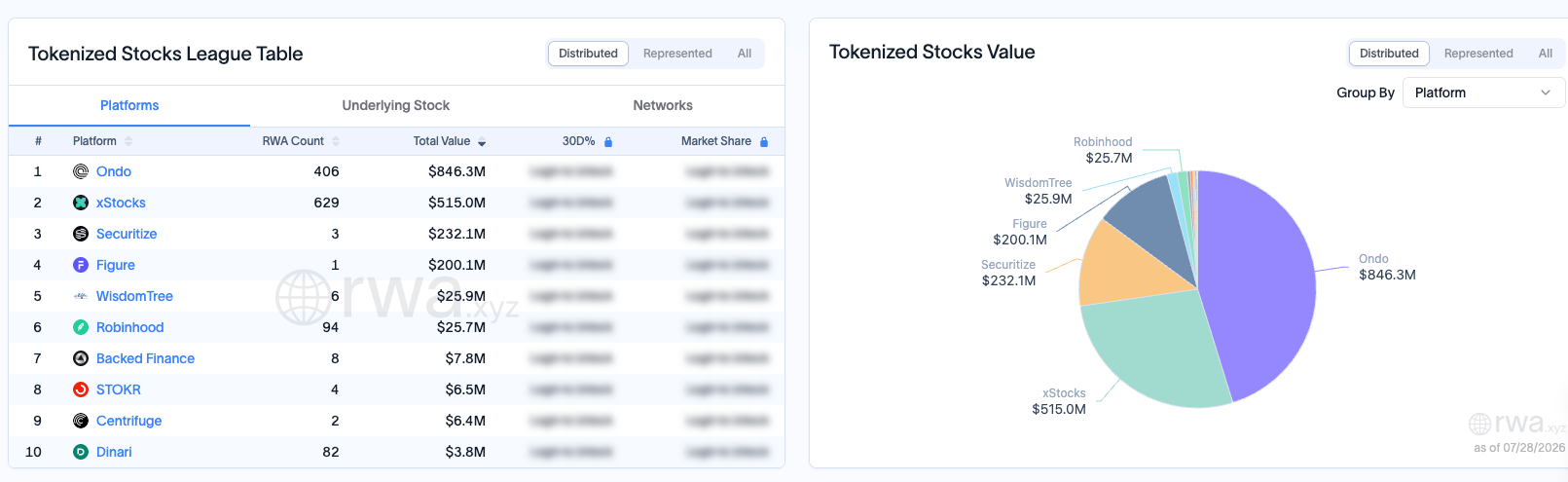
The platform features over 260 tokenized US stocks and ETFs, deployed across Ethereum, Solana, and BNB Chain, and distributed through channels like Binance, Bitget, MetaMask, and Blockchain.com.
When the DTCC news broke on July 15th, ONDO surged 18% in a single day. For an established token, such a strong market reaction happened precisely for this reason.
The DTCC is the settlement and clearing hub for US stock trading; nearly all US stock transactions ultimately pass through it. Ondo's on-chain US stock certificates, issued through the DTCC's tokenization service, appear on the same participant list as BlackRock, J.P. Morgan, Goldman Sachs, and Nasdaq.
This is not a "partnership announcement" level of news; it's a distribution channel level of news.
When Ondo Moves from Supplier to Running Its Own Store: Perps Data Analysis
After securing 70% of the upstream market share, Ondo is now moving downstream.
Launched on July 7th, Ondo Perps is essentially Ondo opening its own trading venue. It offers perpetual contracts on US stocks, ETFs, and commodities with up to 20x leverage.
This platform has a unique feature that competitors currently lack: the ability to use Ondo-issued tokenized stocks directly as margin. If you hold on-chain tokens representing Apple or Nvidia, you can use them directly to open positions.
On Hyperliquid or other perp platforms, you first need to convert your assets into USDC or USDT to use as margin because the trading platform and the asset issuer are separate entities. Ondo has integrated issuance and trading, eliminating that intermediate friction.
According to DefiLlama's RWA Perps ranking, as of July 28th, Ondo Perps recorded a 24-hour trading volume of $221 million, ranking fourth.

The growth rate is indeed fast, but open interest stands at only $49.92 million, representing 1.15% of the total market. The ratio of trading volume to open interest is 4.4x, indicating that capital comes in, circulates, and leaves within the day, leaving very thin overnight positions.
For comparison, Trade[XYZ]'s same metric is 1.6x, showing significantly higher capital retention.
Compared to Hyperliquid's $25.1 billion weekly trading volume, the $221 million daily figure is indeed a fraction. But Ondo Perps targets a different user base.
Its strategy is to convert holders in its own $5+ billion asset pool into traders, earning fees from issuance and trading. The logic of this play might not be about whether daily trading volume can catch up to Hyperliquid; it's more crucial whether open interest can climb from its current $50 million level. Trading volume can be incentivized through market making and promotions, but overnight positions cannot be easily manufactured.
It's worth noting that DefiLlama's main RWA Perps ranking and the Ondo Perps protocol page show two different sets of numbers, differing by nearly three times (the protocol page shows 24-hour volume of $77.53 million and open interest of $10.3 million). For those tracking this track, it's advisable to use a consistent source for longitudinal comparison; cross-referencing different sources can easily lead to errors.
Is the Planned Ondo Public Chain Abandoned?
On July 27th, Ondo released Ondo Network, effectively replacing the previously planned Ondo Chain public chain project that had been in development for over a year.
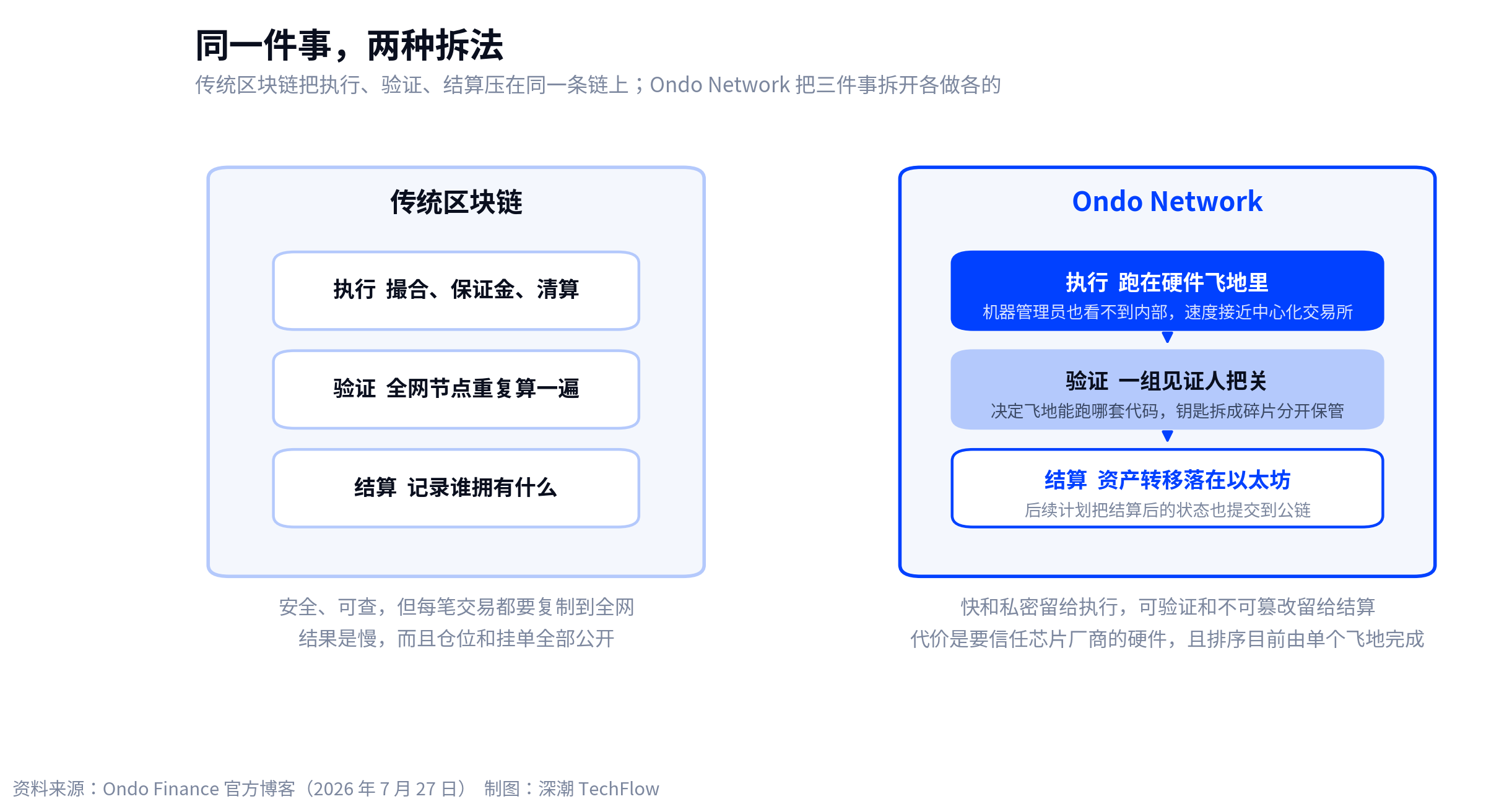
Simply put, Ondo now splits trading into two layers. Execution (matching, margin, settlement) runs within hardware enclaves – a sealed space inside the chip that even server administrators cannot see inside, offering speed close to centralized exchanges. Settlement (who owns what) still occurs on Ethereum. Ondo Perps operates on this architecture.
In my view, choosing not to build its own chain is more pragmatic than forcing a Layer 1.
The past two years have provided enough lessons from the L1 track. Building your own chain means accumulating liquidity and an ecosystem from scratch, whereas Ondo's assets are already spread across multiple chains like Ethereum and Solana. Isolating the execution layer as a separate, lighter component significantly reduces risk.
However, the current architecture has two compromises that Ondo itself acknowledges.
First, execution runs within a single enclave, not a distributed network; transaction verification is delegated to a group of independent operators called "witnesses," but their number, list, and identities are not public, which is somewhat decentralized.
Second, the security of the enclave solution is anchored to the chip manufacturer, but Ondo has not disclosed which manufacturer's which generation of hardware it uses, leaving the chip's actual security open to question.
These technical details don't constitute a buy or sell signal, but they imply that Ondo Network is currently closer to a "verifiable centralized execution layer," still distant from the decentralized end-state described in its whitepaper.
However, for those focused on the ONDO token, the key concern should be that while the CEO stated the ONDO token will play incentive and governance roles in the network's future decentralization, the witness economic model and staking reward distribution are all described as "potential directions" without any timeline.
What is the current ONDO price rally pricing in?
Breaking it down, approximately 18% of the gains came from the DTCC news, which prices in the upgrade to Ondo's distribution channels – specifically, the premium for being on the same list as BlackRock and Goldman.
Another roughly 10% likely stems from the partnership with SBI Group (access to the Japanese market) and the beta from the overall RWA sector's rise.
The news on July 27th about the architectural upgrade (moving from L1 to a trading layer) had a very limited impact on the token price.
So, the trading signal is quite clear: the catalysts are more strongly tied to the 70% market share in RWA issuance and institutional distribution channels, rather than the technical architecture.
From an investment perspective, ONDO is currently trading at $0.38, with a market cap of approximately $2 billion, down about 65% from its 52-week high of $1.13.
If you believe that on-chain trading of US stocks will become a multi-year structural trend (Hyperliquid's weekly data at least suggests the trend exists), then Ondo, commanding 70% of the issuance side, indeed has fundamental logic supporting it.
Ondo is undoubtedly building significant things, and tokenized stocks are indeed the narrative of this cycle. However, constrained by the broader downturn in the crypto market, short-term catalysts are unlikely to sustain long-term structural growth. The price action is more likely driven by short-term reactions to events and capital speculation.


