






存储周期见顶?请收下这份美国银行的「基本面心理按摩」


- Quan điểm cốt lõi: Bank of America cho rằng đợt điều chỉnh gần đây của cổ phiếu lưu trữ toàn cầu xuất phát từ việc thị trường hiểu quá mức các rủi ro như đơn hàng từ Meta, Trường Tồn gia nhập chuỗi cung ứng Apple và việc Hàn Quốc mở rộng sản xuất, chứ không phải sự đảo ngược xu hướng cơ bản. Ngành vẫn đang trong chu kỳ mạnh, nhưng thị trường sẽ chuyển từ tăng giá lan tỏa sang giai đoạn xác thực lợi nhuận và phân hóa cổ phiếu.
- Các yếu tố then chốt:
- Thị trường lo ngại Meta cho thuê sức mạnh tính toán sẽ cắt giảm đơn đặt hàng lưu trữ, nhưng Bank of America chỉ ra rằng nhu cầu về HBM, LPDDR5 và SSD doanh nghiệp của Meta vẫn đang tăng, động thái này nhiều khả năng là để thu hồi vốn.
- Bank of America dự đoán khả năng Apple áp dụng rộng rãi DRAM của Trường Tồn trong ngắn hạn là thấp, Trường Tồn có khả năng đóng vai trò là đòn bẩy thương lượng giá cho Apple với các nhà sản xuất như Samsung và SK Hynix.
- Kế hoạch mở rộng sản xuất trị giá 800 nghìn tỷ won của Hàn Quốc kéo dài hơn chục năm, khó tạo ra nguồn cung hiệu quả trong ngắn hạn, chưa thể làm căn cứ cho đỉnh chu kỳ.
- Khảo sát chuỗi cung ứng Nhật Bản cho thấy, giá DRAM và NAND trong quý 3 và quý 4 dự kiến vẫn tăng theo quý, ngành có thể tiếp tục thiếu hụt vào năm 2027, chi tiêu vốn của các nhà sản xuất vẫn được kiềm chế.
- Chi tiêu vốn của các nhà cung cấp dịch vụ đám mây siêu quy mô tiếp tục tăng, giá DRAM và NAND vẫn ở mức cao, nhu cầu lưu trữ cao cấp cho máy chủ AI và trung tâm dữ liệu vẫn mạnh mẽ.
Original report: BofA Global Research《Global Memory Tech》, July 2, 2026
Translated & Compiled by: DaiDai, MSX Maitong
Edited by: Frank, MSX Maitong
Key Takeaways:
- Bank of America believes that the recent concentrated pullback in memory stocks was primarily driven by risk narratives surrounding Meta's orders, CXMT entering Apple's supply chain, and South Korea's expansion plans, and does not signify a reversal of the industry's fundamentals;
- Meta offering data center or cloud services externally is more likely a strategy for monetizing computing power and business diversification, rather than a significant reduction in memory demand. Its demand for HBM, LPDDR5, and enterprise SSDs continues to grow;
- CXMT is unlikely to become a major DRAM supplier for Apple in the short term. Apple is more likely to use this as leverage in price negotiations with Samsung, SK Hynix, and Micron;
- Supply chain surveys in Japan indicate that DRAM and NAND prices are still expected to rise quarter-over-quarter in Q3 and Q4. The industry may continue to face shortages in 2027, with manufacturers' capital expenditures and wafer output remaining relatively restrained;
- The memory industry remains in a strong cycle, but with product prices and related stocks having risen significantly, future performance will be more dependent on earnings realization, potentially leading to increased sector volatility and stock divergence;
Over the past week, global memory stocks have experienced a notable correction.
The market quickly identified three seemingly plausible explanations for this decline: Meta's plan to sell some computing power externally might indicate an oversupply from previous data center builds; Apple is evaluating CXMT's DRAM, potentially disrupting the supply structure of Samsung Electronics, SK Hynix, and Micron; and South Korea announced another massive semiconductor cluster plan, further fueling concerns about future supply gluts.
All three narratives point to the same conclusion: Demand may be peaking, supply is about to expand, and the memory super-cycle might be nearing its end.
However, Bank of America's latest "Global Memory Tech" report suggests precisely the opposite.
In its view, while the aforementioned risks are not entirely nonexistent, the market has significantly overestimated their impact on the short-term supply-demand dynamics. Whether it's cloud capital expenditure, South Korean semiconductor exports, or spot and contract prices for DRAM and NAND, none have yet shown a directional reversal of the memory cycle.
What has genuinely changed is not a weakening of fundamentals, but the industry entering a new phase where fundamentals remain strong, yet trading difficulty has significantly increased following substantial price hikes and stock revaluations.
1. A Point-by-Point Analysis: Are Market Fears Justified?
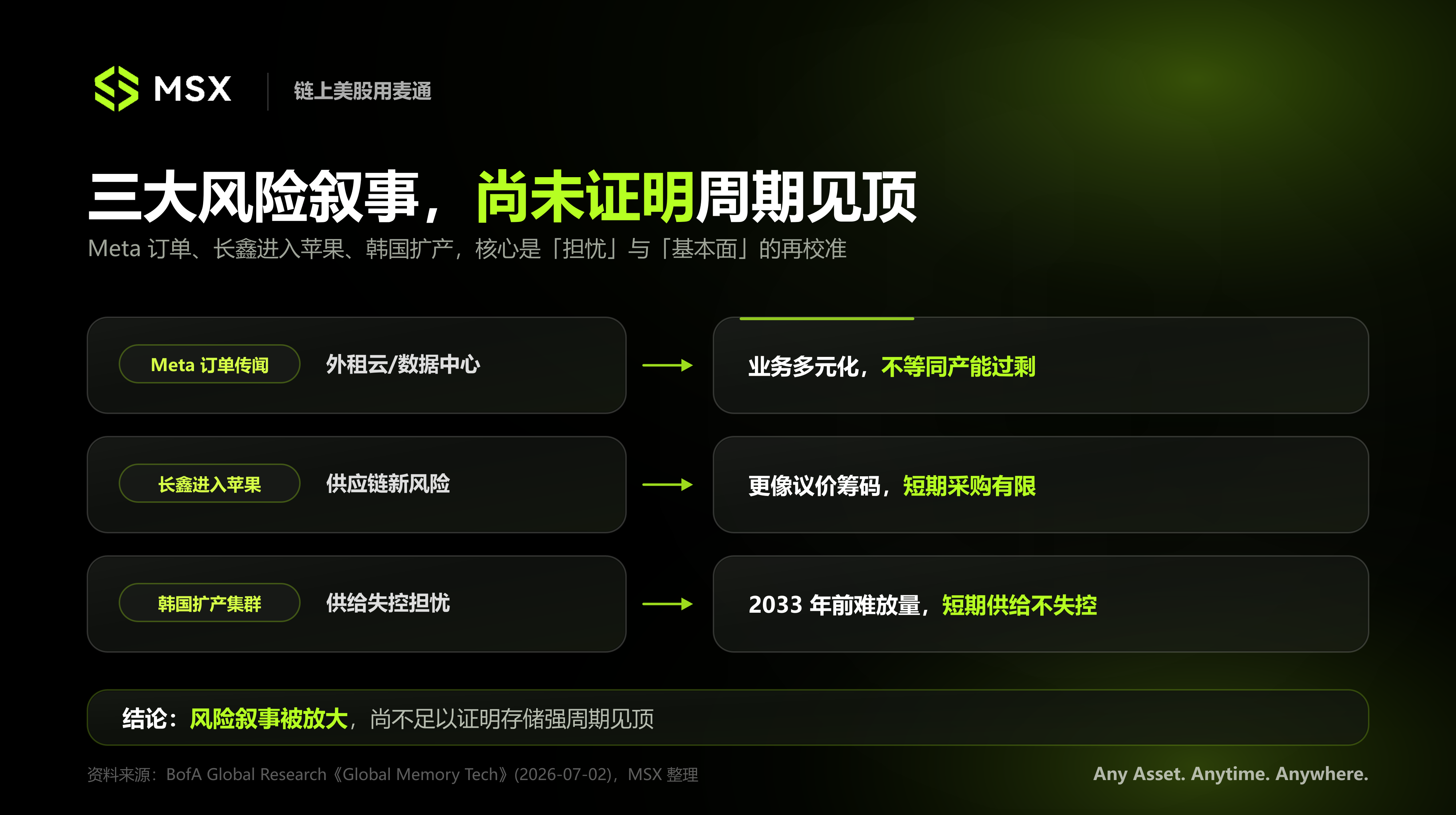
1. Meta Selling Computing Power ≠ Cutting Memory Orders
The market's concern regarding Meta stems from seemingly logical reasoning: If Meta starts opening its data centers or selling cloud services to external customers, does it imply the company purchased too many servers previously and its internal business cannot absorb the existing computing power?
If yes, demand for AI hardware like GPUs, HBM, server DRAM, and enterprise SSDs could subsequently decline.
However, the Bank of America report states that based on supply chain feedback, memory chip manufacturers believe Meta will continue to aggressively adopt high-performance memory products like HBM, LPDDR5, and enterprise SSDs in its AI data centers. Therefore, market speculation about "Meta renting out its over-invested AI servers or cloud infrastructure" lacks sufficient basis.
In fact, some NAND controller and packaging substrate manufacturers have indicated that Meta's chip and component orders are still strengthening. Hence, Meta opening its data centers to external customers is more likely an attempt at asset monetization and business diversification rather than a forced disposal of severely surplus computing capacity.
2. CXMT Entering Apple's Supply Chain: More a Price Negotiation Chip
The Bank of America report estimates that the probability of Apple adopting CXMT's DRAM on a large scale in the short term remains low.
Specifically, there are three main constraints:
- Policy and Supply Chain Restrictions: Apple must consider US restrictions related to China's semiconductor industry, along with associated compliance and supply chain risks;
- Technical Specifications: Apple has high requirements for mobile DRAM in terms of transmission speed, power consumption, and reliability, including transfer speeds exceeding 10Gbps, low power consumption around 1.1V, and ECC error correction capability. Whether CXMT can stably and massively meet these requirements over the long term requires further verification;
- Intellectual Property Risks: Core DRAM patents have long been concentrated among leading manufacturers like Samsung, SK Hynix, and Micron. If Apple were to adopt products with insufficient patent coverage on a large scale, it could face potential lawsuits and supply disruption risks;
Theoretically, CXMT could target orders for the low-end iPhone 18e, but given the scale of this model in the Chinese market, actual procurement volumes are expected to be limited.
Rather than genuinely restructuring its supply chain, Apple is more likely using this to enhance its bargaining power in contract price negotiations for the second half of 2026 or 2027. Therefore, this event is more likely to impact the pricing expectations of Samsung, SK Hynix, and Micron in the short term, rather than immediately altering the global DRAM supply-demand landscape.
3. Korea's Massive Expansion ≠ Short-Term Supply Out of Control
Another recent concern stems from South Korea's new semiconductor cluster plan.
Some investors believe the South Korean government's plan to invest approximately 800 trillion won in a new memory fab cluster in the southwestern region signals the memory cycle is nearing its peak. However, the Bank of America report dismisses this view, predicting that the project is unlikely to generate significant effective supply before the early 2030s. Currently, priority must be given to advancing the expansion of the Yongin and Pyeongtaek clusters from 2026 to 2035.
Thus, an industrial plan spanning over a decade cannot be directly equated to an imminent supply glut in the next two to three years. Long-term expansion warrants continuous monitoring, but it is not yet a direct basis for concluding that the current memory cycle has peaked.
4. Japan Supply Chain Survey Remains Relatively Optimistic
Bank of America's recent supply chain survey in Japan further reinforces an optimistic outlook for the memory industry.
Japanese investors generally acknowledge the current industry prosperity. However, with rapid increases in product prices and related stocks, the market is also paying more attention to potential downside cycles. Compared to investor caution, the management in the supply chain still offers a relatively positive assessment:
- Q2 memory ASP was strong, especially for NAND;
- Q3 and Q4 ASP are expected to be higher than Q2;
- DRAM and NAND may continue to be in a state of shortage in 2027;
- The number of long-term supply agreements is increasing, but they mainly involve commitments on procurement volumes;
- Capital expenditure and wafer output remain restrained, especially among Japanese NAND manufacturers;
This means that although the market has begun discussing the next supply cycle early, actual manufacturer expansion and customer procurement behavior do not yet indicate the industry has entered a phase of obvious oversupply.
5. Samsung's Memory Business Could Still Exceed Expectations
In a report released on July 2, Bank of America estimated that due to special bonus expenses and pressure on smartphone profit margins, Samsung Electronics' overall Q2 operating profit might be slightly lower than the market's more optimistic expectations. However, driven by strong average selling prices for DRAM and NAND, the standalone operating profit of its memory business was still expected to exceed market consensus.
Five days after the report, Samsung announced its preliminary Q2 results on July 7: consolidated sales of approximately 171 trillion won and operating profit of about 89.4 trillion won, representing year-on-year growth of 129.3% and 1810.3% respectively. The operating profit exceeded the market's prior expectation of around 86 trillion won, meaning Bank of America's assessment that group profit might slightly miss optimistic expectations ultimately did not materialize.
However, Samsung's disclosure was still preliminary group-level results, without detailed profit data for its memory, foundry, and mobile businesses. Therefore, confirmation of whether the memory division alone exceeded expectations awaits the full earnings report. Combined with the rising DRAM and NAND prices in Q2 and South Korea's significant surge in semiconductor exports, the memory business is highly likely the core driver of Samsung's current profit leap.
2. What Signals Are Exports, ASP, and Product Prices Sending?
1. South Korean Semiconductor Exports Surge Significantly
In June 2026, South Korea's semiconductor exports reached $44.8 billion, up 21% month-over-month and 199% year-over-year, marking the sixth consecutive month of triple-digit year-on-year growth.
This figure is roughly three times the average monthly export of $14 billion in 2025, reflecting that current memory price increases are clearly translating into export revenue and corporate profits.
Of course, rising export values do not entirely represent equivalent volume growth, as a significant portion of the increase comes from rapidly rising average selling prices. However, this precisely indicates that the core contradiction in the current supply chain remains price increases and tight supply, rather than inventory buildup or a significant demand contraction.
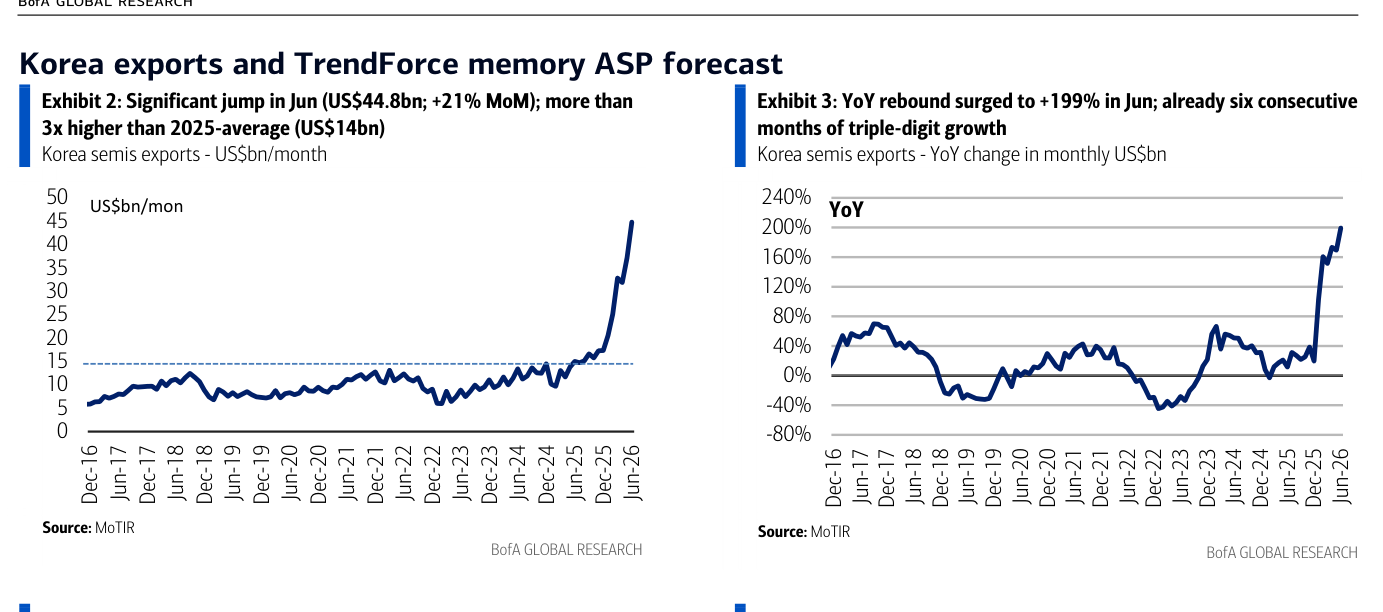
South Korea Semiconductor Exports and YoY Growth: Notable Jump in June 2026 (Original Report Page 2)
2. DRAM Remains the Strongest Memory Category Currently
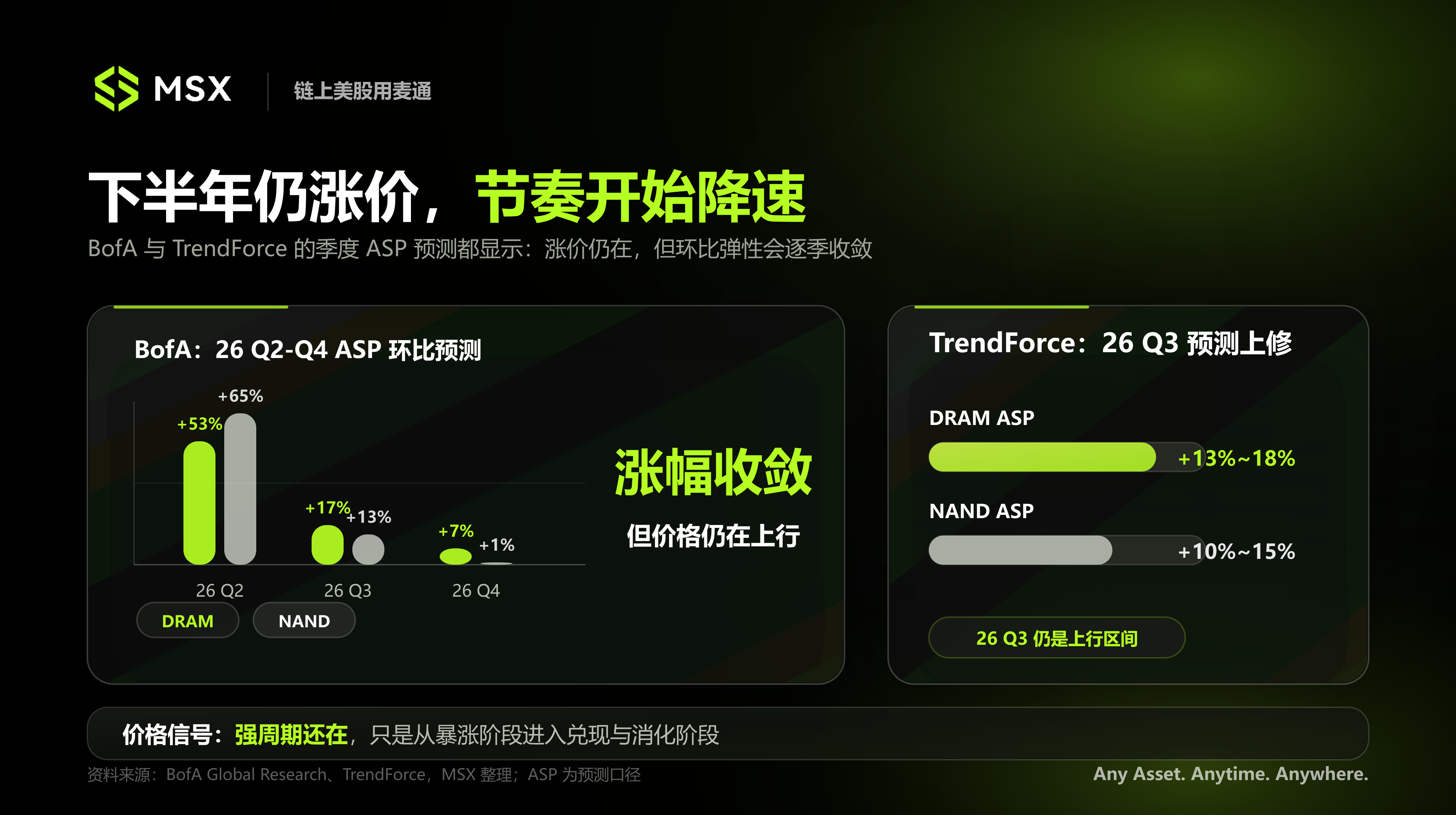
TrendForce has revised its Q3 2026 DRAM ASP forecast from a 3%-8% quarter-over-quarter increase to 13%-18%. Bank of America estimates Q2-Q4 2026 DRAM ASP will increase by 53%, 17%, and 7% quarter-over-quarter, respectively.
While the specific figures differ between the two sets of forecasts, they both point to the same trend: DRAM prices will continue to rise in the second half of the year, although the quarter-over-quarter growth rate may decelerate as the base price level increases.
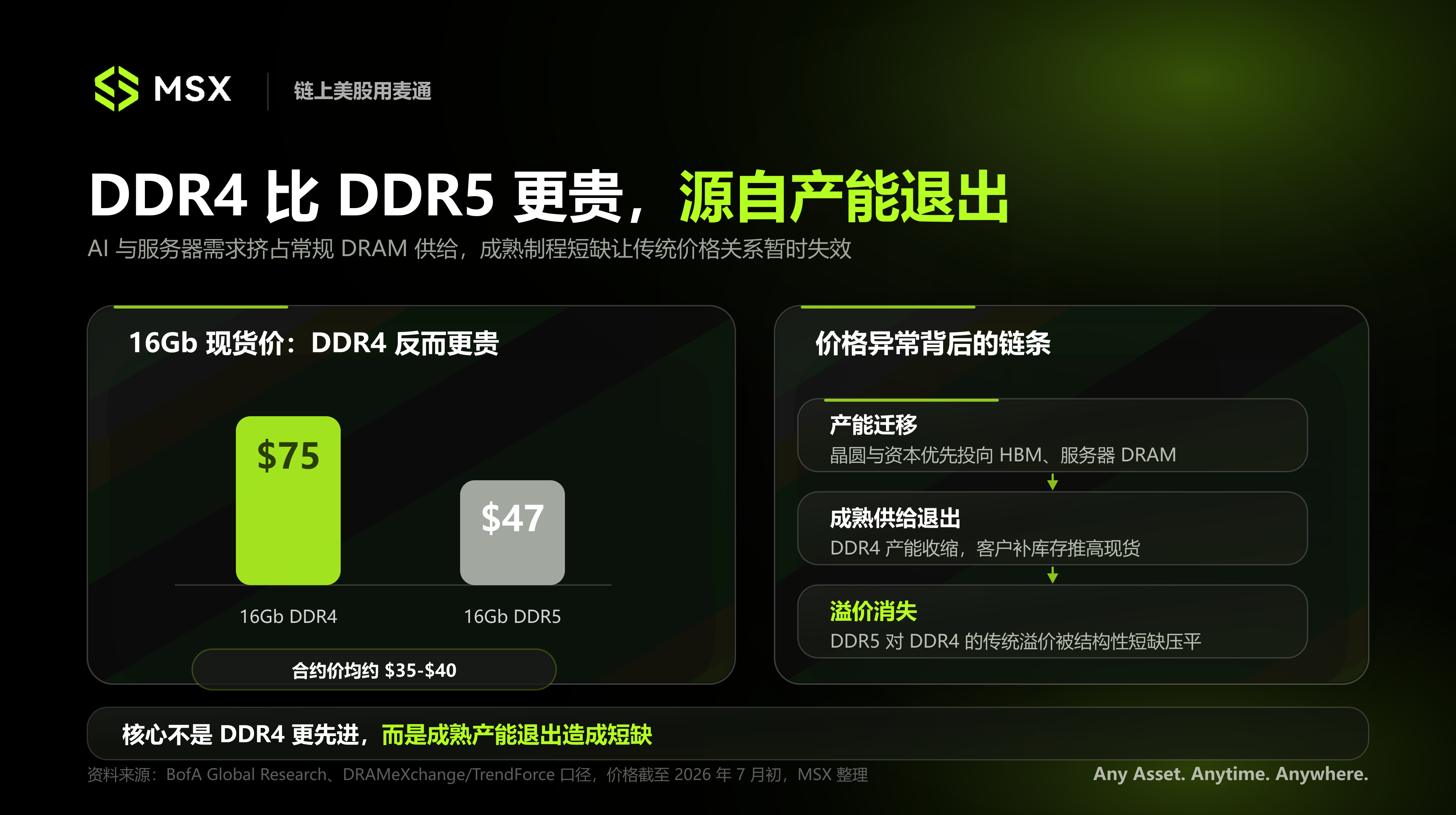
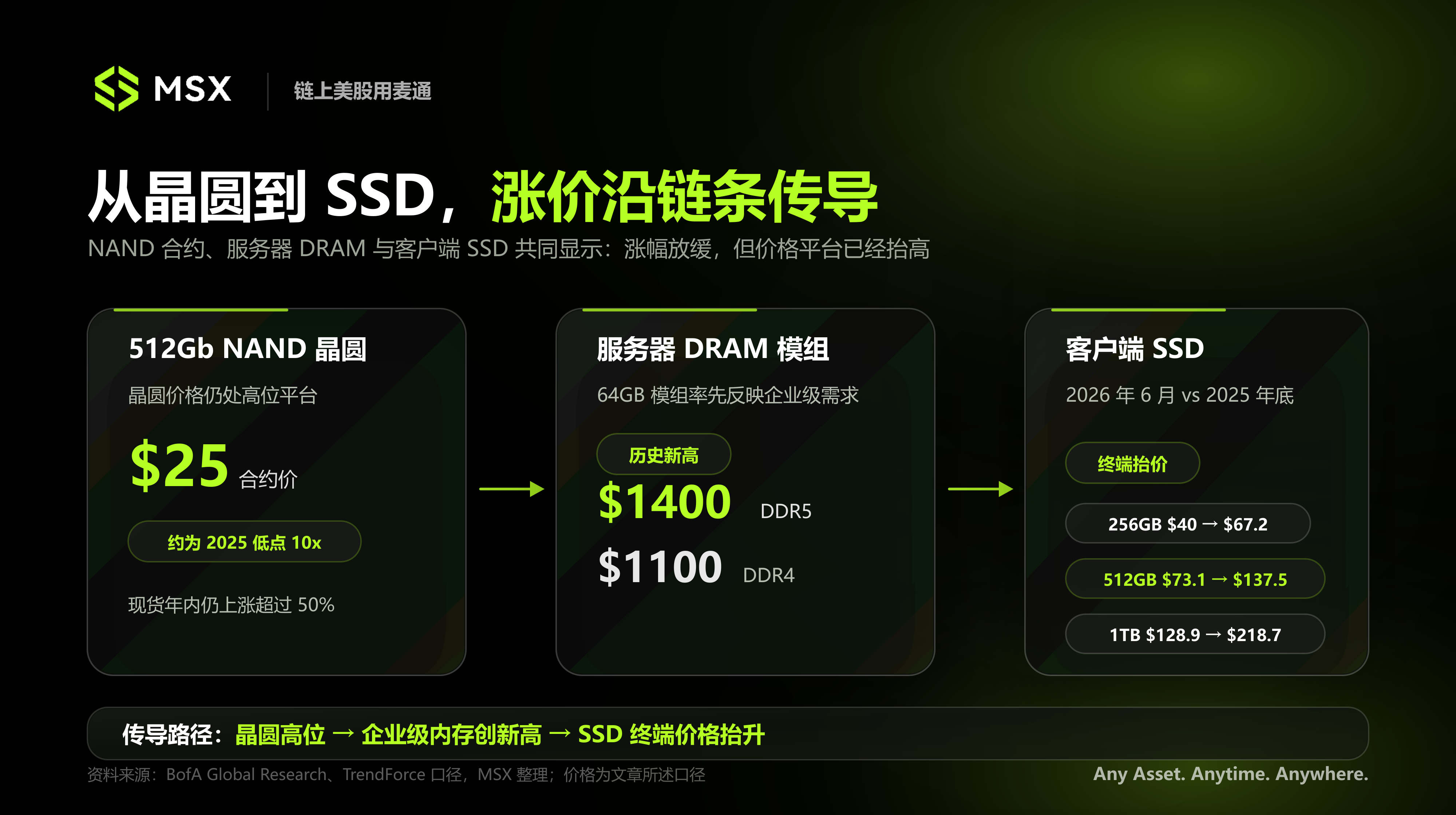
As of early July 2026, the spot price for 16Gb DDR5 is approximately $47, and the 16Gb DDR4 spot price is around $75. Both are significantly higher than the peak prices of the previous memory cycle. The core reason is not just end-customer inventory replenishment, but memory manufacturers continuously shifting wafer capacity towards higher-margin HBM and server DRAM.
After advanced capacity is absorbed by AI-related products, the supply available for traditional DDR4 and regular DDR5 decreases concurrently.
This is especially true for DDR4. As leading manufacturers gradually phase out mature products, DDR4 faces a pronounced structural shortage. Contract prices for both 16Gb DDR4 and DDR5 have risen to the $35-$40 range, virtually eliminating the long-standing technical premium of DDR5 over DDR4.
This doesn't mean the market favors the older DDR4 generation. Rather, the pace of manufacturers exiting the product line has outstripped the speed of customers completing product transitions, making the mature products scarcer instead.
3. NAND Price Increases Slow, but Absolute Prices Remain High
Compared to DRAM, the marginal changes in NAND prices are more pronounced.
After reaching a cyclical high in March 2026, the spot price for 512Gb NAND wafers stabilized or slightly declined between April and June. However, it is still up over 50% year-to-date and roughly eight times higher than the low point in February 2025.
The NAND contract price is around $25, approximately ten times the February 2025 low of $2.5. Following massive increases in Q4 2025 and Q1 2026, the month-over-month increase in NAND contract prices from April to June slowed to around 1%-5%.
This does not signal a reversal in NAND prices, but rather indicates that customers' tolerance for high prices is approaching its limit, and the pace of price increases is normalizing.
The change in client SSD prices is particularly illustrative. As of June 2026, the price for a 512GB client SSD had risen from $73.1 at the end of 2025 to $137.5, nearly doubling. This reflects the ongoing pass-through of upstream NAND price increases to end products.
Therefore, the current more accurate description for NAND is that absolute prices remain very high, but the pace of quarter-over-quarter increase is decelerating.
4. Server Memory Continues to Hit New Highs
Server memory remains strong.
The price of 64GB server DRAM modules has reached an all-time high, with DDR5 modules around $1400 and DDR4 modules around $1100. In June 2026, DDR5 server DRAM contract prices increased again, while DDR4 prices remained largely flat.
This illustrates that even though the pace of price increases for some consumer-grade memory products is slowing, demand for high-end memory related to AI servers and data centers remains robust.
3. Cloud Capex Remains the Anchor for Demand, but the Investment Logic is Shifting
1. Hyperscalers Continue to Expand
Hyperscale cloud providers like Amazon, Microsoft, Alphabet, and Meta are becoming the most significant source of incremental memory demand. The report estimates that the combined capital expenditure of these four companies in 2026 will be around $700 billion, representing approximately 80% year-over-year growth. By 2027-2028, annual capital expenditure could approach $1 trillion.
Furthermore, Bank of America has not seen any clear signs of major cloud providers significantly cutting back on capex in 2027. This implies these investments will ultimately translate into more AI accelerators and HBM, more server DRAM, more enterprise SSDs, and more data center and AI inference infrastructure.
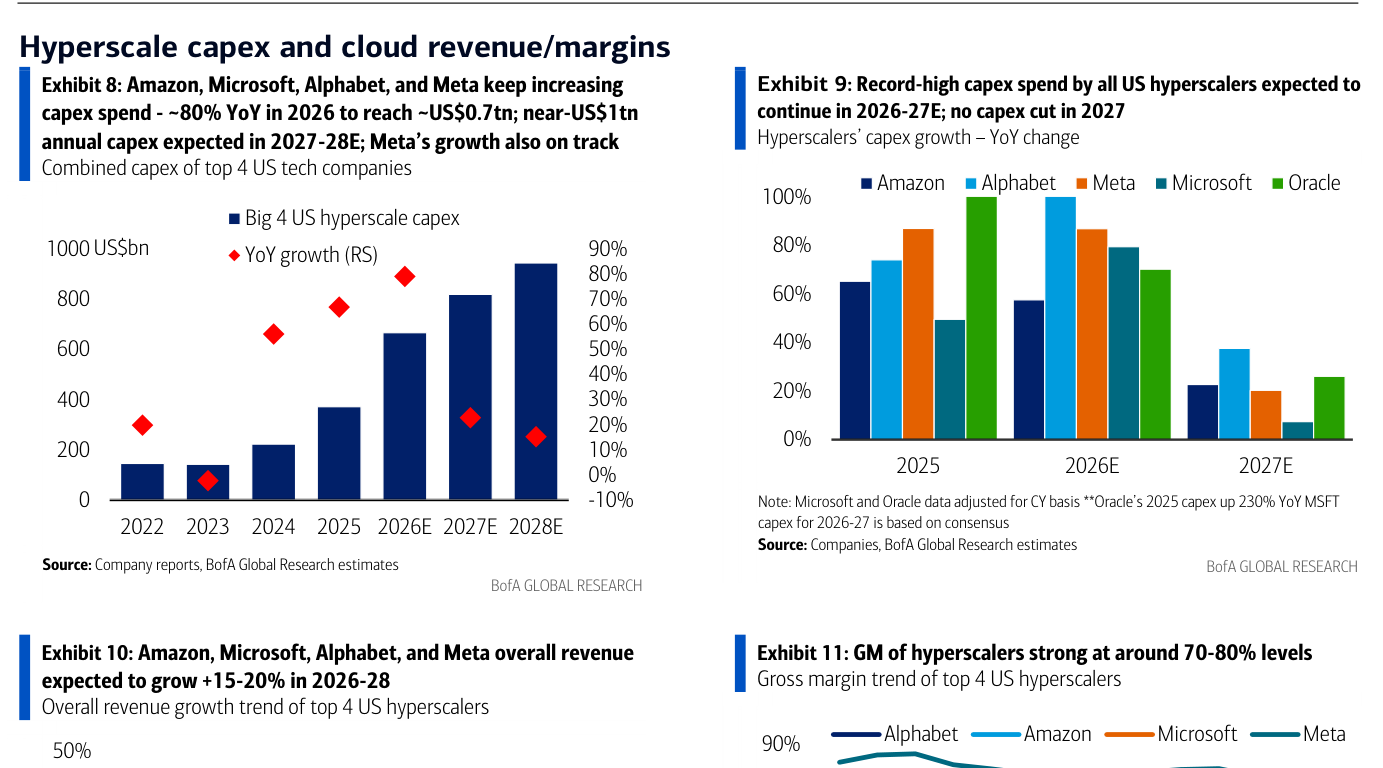
Capex, Revenue, and Gross Margin Trends for Major US Hyperscalers (Original Report Page 3)
The report estimates that from 2026 to 2028, the combined revenue of the four tech giants could grow by 15%-20%, with cloud business revenue potentially growing 35%-40% year-over-year.
Specifically, AWS operating margins are expected to remain above 35%, Azure might exceed 40%, and Google Cloud could reach 30%-35%.
As long as the cloud business maintains high revenue growth and profit margins, tech giants will have the commercial incentive to continue expanding their AI infrastructure investments.
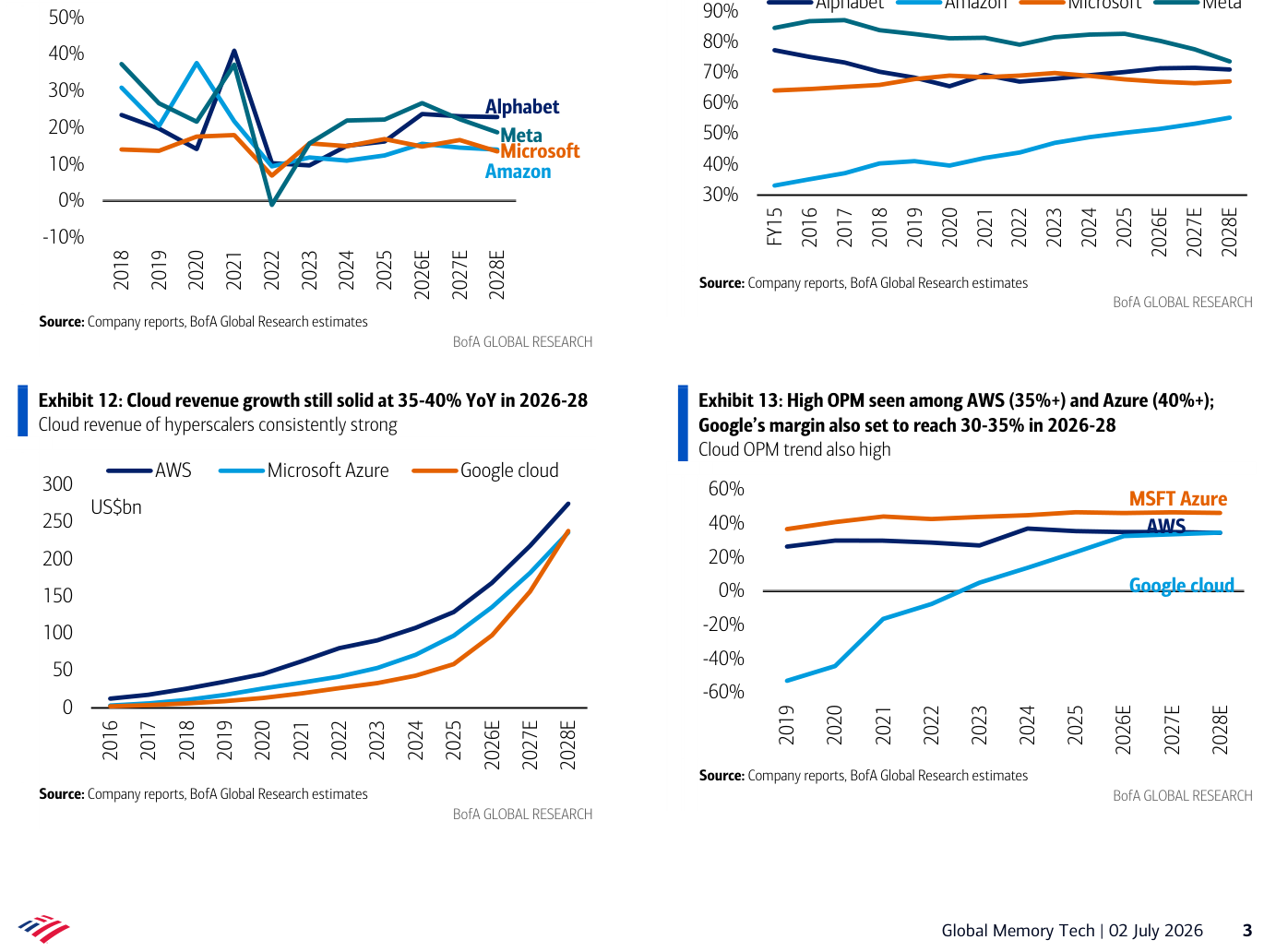
Cloud Revenue and Cloud Business Operating Margin Trends (Original Report Page 3)
2. This Cycle is No Longer Just About Consumer Electronics Restocking
The biggest difference between the current memory cycle and past ones is that demand is no longer predominantly driven by smartphone and PC inventory replenishment.
Past memory cycles were often mainly driven by inventory changes in PCs and smartphones, creating a classic cyclical pattern: rising end-user demand -> customer restocking -> memory prices rise -> manufacturers expand capacity -> inventory builds up -> prices enter a downward cycle.
However, the structure of the current memory cycle is far more complex. Demand has long since expanded beyond simple consumer electronics restocking to encompass:
- HBM;
- Server DRAM;
- Enterprise SSDs;
- AI Inference Infrastructure;
- Hyperscaler Capital Expenditure;
- Structural Shortage from DDR4 Capacity Phase-Out.
This means that simply observing PC and smartphone sales is no longer sufficient to judge the entire memory cycle. Even if some consumer electronics demand is pressured by high prices, AI servers and data centers can continue to absorb advanced capacity, keeping the overall supply tight.
However, this also implies that divergence within the sector will become increasingly pronounced. In short, companies focused on HBM, server DRAM, enterprise SSDs, and advanced packaging may continue to benefit from stronger orders and margins. Companies overly reliant on client, mobile, and consumer-grade NAND may feel the declining demand elasticity sooner.
<


