






Tokenization platform leader Securitize goes public, lists its own stock on Avalanche and Solana


- Core Thesis: RWA tokenization platform Securitize listed on the NYSE via a SPAC merger and tokenized its own shares for issuance on Avalanche and Solana, becoming the world's largest tokenized stock. This move marks its official entry into the tokenized stock market targeting retail investors.
- Key Elements:
- Securitize merged with a SPAC on July 2 and listed on the NYSE under ticker SECZ, with an opening market cap approaching $2 billion.
- SECZ is the largest tokenized stock globally, with an on-chain value exceeding $295 million on its first day; its tokenized shares represent direct ownership, distinct from the "equity certificates" commonly found in the market.
- Securitize is a leader in the RWA sector, with over $4.4 billion in on-chain RWA market cap. Its flagship product is the BUIDL fund issued for BlackRock, with a scale exceeding $2.2 billion.
- The entry barrier for purchasing the tokenized stock SECZ is extremely high, limited to qualified US investors through KYC and wallet whitelist mechanisms, making it difficult for global retail investors to participate.
- Securitize generated $55.6 million in revenue in the first nine months of 2025, with a projected full-year revenue of approximately $69 million. In Q1 2026, revenue grew 39% year-over-year.
- Compared to competitor Figure, Securitize’s static price-to-sales ratio (approximately 28x) and market cap-to-AUM ratio (approximately 0.45) are both relatively high. Nevertheless, the market remains optimistic about its leading position and future tokenized stock business.
Original | Odaily (@OdailyChina)
Author | Golem (@web3_golem)
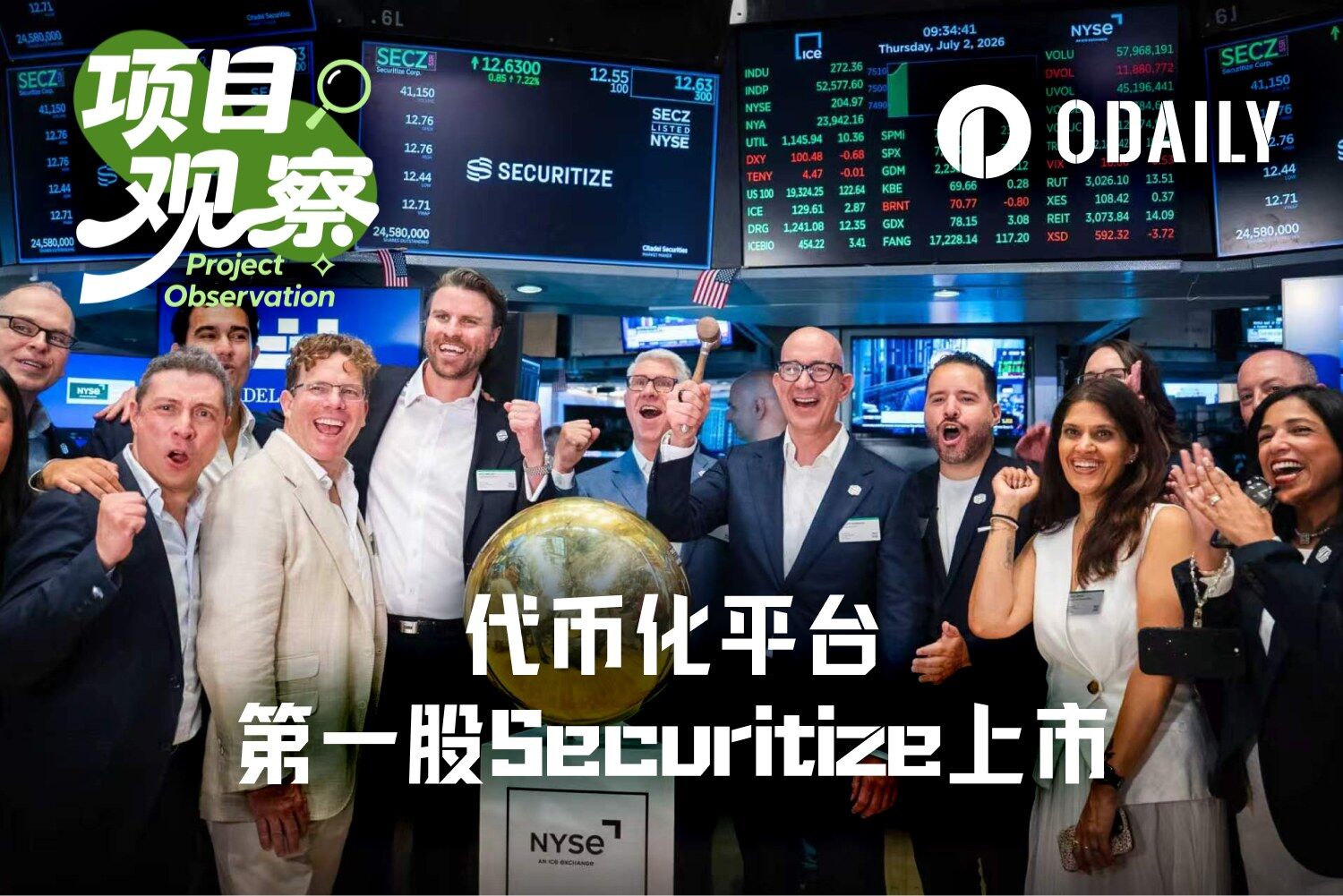
Securitize, the leading tokenization platform, has gone public through a SPAC merger.
On July 2, Securitize completed its business combination with Cantor Equity Partners II, a special purpose acquisition company (SPAC), and began trading on the New York Stock Exchange under the ticker "SECZ". SECZ opened at $12.45, peaked at $13.70 around midday (an increase of approximately 10%), and ultimately closed at $12.3, bringing its market capitalization to nearly $2 billion.
Securitize is the first company to be listed simultaneously on both the NYSE and on-chain. At the time of its listing, it tokenized its common stock, allowing eligible U.S. investors to purchase tokenized SECZ separately on Avalanche and Solana through Securitize's regulated platform. According toRWA.xyz data, on its first day of issuance, SECZ became the largest tokenized stock globally, with an on-chain value exceeding $295 million.
SECZ is also Securitize's first major tokenized stock launched on-chain. This is a signal, as it indicates that this "behemoth" dominating the RWA赛道 has begun to expand its territory.
A Tokenization Platform Committed to Selling Only the "Real Deal"
Securitize is undeniably the leader in the RWA sector. According to DeFiLlama data, the total market value of RWAs issued on-chain by Securitize exceeds $4.4 billion, far surpassing platforms like Circle, Tether, and Ondo to rank first (Odaily note: Excluding stablecoins like USDT and USDC). However, compared to platforms like Ondo, xStocks, and Binance's bStocks, Securitize is much less familiar to retail investors, and some users may have never even heard of it.

Ranking of Total On-Chain Market Cap of Tokenization Platforms
It's not that Securitize deliberately tries to stay away from the public; rather, its products are not really relevant to most retail investors, primarily targeting institutions. The 24 on-chain tokenized products it has issued, totaling over $4 billion in assets, are mostly bonds, private credit, and money market funds, with only a single tokenized stock, CURR (which has essentially no trading volume).
Securitize's most representative on-chain product is the BUIDL Money Market Fund it tokenized for BlackRock. To date, the fund's size has exceeded $2.2 billion, making it the second-largest tokenized money market fund product in the current RWA market (Odaily note: The largest is USYC issued by Circle).
However, with Securitize issuing its own stock as its first major tokenized stock on-chain, this situation might be changing.
Securitize's listing can also be seen as the true starting point for its tokenized stock business. The slogan on its website aptly summarizes the difference between Securitize and other tokenized stock platforms: "OWN THE REAL THING, NOT A SYNTHETIC VERSION."
Each tokenized stock on Securitize represents direct ownership of actual shares, and comes with the same legal and economic rights as any traditional shareholder, including dividends, voting rights, and all other entitlements. This is fundamentally different from the numerous "tokenized stocks" available in the market today, which are often merely "equity certificates." Investors in those instruments can only enjoy the economic benefits behind the stock (like dividends) but do not receive true ownership or regulatory protection. Tokenized stocks issued by Ondo, xStocks, Binance's bStocks, and Bitget's Reality all fall into this category.
However, the price Securitize pays for offering the "real deal" in tokenized stocks is that ordinary people cannot buy them.
For example, to purchase SECZ now, investors must complete KYC, pass KYC/AML checks, meet jurisdictional requirements, and comply with applicable securities laws to be eligible. If an investor does not have U.S. status, they cannot even pass KYC. Securitize adds the wallet addresses of qualified investors to a whitelist. Only whitelisted addresses can trade tokenized SECZ. Therefore, even on decentralized DEXs, ordinary people cannot buy Securitize's tokenized stocks.
When launching tokenized SECZ, Securitize posted on platform X, stating, "This means that while the U.S. traditional stock market will be closed on Friday (July 3) for Independence Day celebrations, SECZ will continue trading." This might sound somewhat ironic, as the number of people globally qualified to trade SECZ is itself very small, while at the same time, global retail investors have access to exposure through other platforms that don't sell the "real deal."
The high user barrier does not hinder Securitize's determination to develop tokenized stocks. Securitize President Brett Redfearn stated after the IPO that the company is discussing the possibility of tokenizing other IPOs within the next year.
Is Securitize Undervalued?
From an investment perspective, excluding user considerations, is Securitize's just-listed stock currently undervalued? SECZ closed at $12.3, but the company has not disclosed its current total share count, so we can only estimate its market cap.
Securitize valued itself at $1.25 billion in its S-4 filing submitted to the SEC. The subscription price for the SPAC and PIPE financing was $10 per share, corresponding to approximately 125 million shares. Adding the roughly 30 million common shares outstanding from the shell company, Cantor Equity Partners II, Securitize's total shares post-merger are likely around 160 million. Therefore, Securitize's market cap on its first trading day was approximately $1.96 billion, briefly approaching $2.2 billion intraday.
In April this year, investment bank Benchmark gave Securitize a post-listing price target of $16, believing it is poised to benefit significantly from the tokenized asset wave. Benchmark emphasized that Securitize is not just a tokenization platform but also possesses a "comprehensive regulatory license system" covering broker-dealer, transfer agency, and trading functions, positioning it to generate diversified revenue across the entire lifecycle of asset issuance, secondary trading, and custody services.
According to Securitize's S-4 filing, its revenue for the first nine months of 2025 was $55.6 million, though full-year 2025 revenue has not yet been disclosed. Management forecasts full-year revenue of approximately $69 million. Meanwhile, Securitize's Q1 2026 revenue was $19.5 million, a 39% increase year-over-year from Q1 2025, marking the highest single-quarter revenue in the company's history. It projects 2026 revenue to be around $110 million.
Based on management's expected 2025 revenue, Securitize's static price-to-sales (P/S) ratio for 2025 is approximately 28x. A comparable publicly listed company for Securitize's valuation is Figure, an RWA platform primarily focused on real estate and private credit. Figure's static P/S ratio for 2025 is approximately 15x. By comparison, Securitize's P/S ratio appears somewhat expensive. Looking at tokenized AUM, Securitize has $4.4 billion compared to Figure's $19.4 billion. The ratio of market cap to AUM for Securitize is about 0.45, while for Figure it is 0.38, meaning Securitize still trades at a premium over Figure.
Although Securitize is higher than Figure on both metrics, and its valuation is not significantly undervalued, considering the richness of its business and its leading position in the RWA sector, these figures still do not suggest it is extremely overvalued. The capital market is still anticipating Securitize's future performance, particularly in the tokenized stock space.
Undoubtedly, the tokenized stock market is one where bad money drives out good. Most investors simply want exposure to stock trading and are not very interested in the underlying ownership, voting rights, and other shareholder benefits. Therefore, Securitize, which raises trading barriers to exclusively sell "real" stocks on-chain, may find itself at a disadvantage.
This could also be a strategic move that puts Securitize dozens of steps ahead of its competitors. For example, consider the early days of the online video copyright market in China. At that time, almost all Chinese video websites were rampant with piracy. Users didn't care whether they were watching legitimate content, so many video companies considered spending money to buy legitimate libraries as being "foolish." However, LeEco persisted in purchasing and stockpiling legitimate copyrights at high cost. When relevant regulations were eventually enforced, LeEco became the biggest winner. Securitize might be waiting for that proverbial regulatory hammer to fall.
But the most ironic thing now is that for the vast majority of retail investors, even if we are optimistic about Securitize's future development and want to value-invest in SECZ, we can only wait for other tokenized stock platforms to list the "fake" version.


