






Trước thềm lên đường sang Mỹ, Hynix giảm mạnh như một con chó hoang


- Quan điểm cốt lõi: Trước thềm SK Hynix niêm yết tại Mỹ, tin tức "Meta có thể giải phóng năng lực tính toán dư thừa" đã gây ra sự hoảng loạn trên thị trường, dẫn đến sự sụt giảm mạnh của mảng bán dẫn. Bài viết cho rằng đợt điều chỉnh này là một cuộc giẫm đạp về thanh khoản do cảm xúc chi phối, chứ không phải là sự đảo chiều của xu hướng ngành, và lạc quan về giá trị dài hạn của nó.
- Các yếu tố then chốt:
- SK Hynix đã nộp hồ sơ F-1, dự định niêm yết trên Nasdaq thông qua phát hành ADR, kế hoạch huy động khoảng 29,4 tỷ USD, toàn bộ sẽ được dùng để mở rộng năng lực sản xuất tại Hàn Quốc.
- Đợt niêm yết tại Mỹ lần này nhằm tận dụng mức định giá tài sản AI cao hơn và mức bù thanh khoản của thị trường chứng khoán Mỹ, giải quyết vấn đề "chiết khấu Hàn Quốc", đồng thời chuyển đổi lợi thế vốn thành lợi thế năng lực sản xuất.
- Tin tức "Meta giải phóng năng lực tính toán" đang bị hiểu sai, thực chất đó là hành vi tối ưu hóa tỷ lệ sử dụng tài sản, không thể suy diễn trực tiếp thành tình trạng dư thừa năng lực tính toán của ngành hay sự kết thúc của chu kỳ chi tiêu vốn.
- Trước đợt sụt giảm này, mảng chip đang ở mức cao, dòng vốn đầu cơ tập trung, khiến thị trường nhạy cảm với các thông tin biên, gây ra hiệu ứng đòn bẩy và giảm vị thế bắt buộc, khuếch đại mức độ sụt giảm giá.
- ADR của SK Hynix dự kiến sẽ giao dịch vào ngày 10 tháng 7, do Bank of America, Citigroup, Goldman Sachs và Morgan Stanley đồng bảo lãnh, thị trường chú ý đến diễn biến sau khi niêm yết.
- SK Hynix nắm giữ hơn 50% thị phần trong lĩnh vực HBM, đang ở trong chu kỳ tăng trưởng lịch sử, nền tảng cơ bản vững chắc hỗ trợ cho đợt huy động vốn quy mô lớn này.
Original: Odaily Planet Daily (@OdailyChina)
Author: Azuma (@azuma_eth)

SK Hynix's US listing process has entered its final stage, but just as the South Korean memory giant is about to land on the Nasdaq, the narrative surrounding AI and the semiconductor industry has taken a sharp downturn in sentiment within a very short period.
On the evening of July 1st, news that "Meta may release excess computing power" sparked speculation that major tech firms might cut capital expenditures, leading to severe market volatility. As the narrative of AI computing power being in "absolute scarcity" began to waver, the semiconductor memory chip sector was directly impacted, resulting in a collective sharp pullback of related concept stocks in the secondary market. SK Hynix's Korean stock closed down 14.57%, losing hundreds of billions of dollars in market value in a single day.
- Odaily Note: See also Has the "Biggest Negative" for Chip Stocks Finally Arrived? Will Meta Be the First Major Firm to Cut Capital Expenditure?.
SK Hynix's Countdown to US Listing
On June 30, SK Hynix submitted its F-1 prospectus to the U.S. Securities and Exchange Commission (SEC), planning to list on the Nasdaq by issuing "American Depositary Receipts" (ADRs). The planned fundraising amount is approximately 45.45 trillion Korean Won (about $29.4 billion), making it one of the largest ADR issuances in history. All proceeds from this offering will be used for domestic capacity expansion in South Korea, including the Yongin wafer fab, the Cheongju advanced packaging production line, and investment in EUV and related equipment.
- Odaily Note: An ADR is essentially a trading vehicle for non-US companies in the US stock market. ADRs are not stocks directly issued by the company but are "substitute securities" issued in the US by a depositary bank, representing the underlying ordinary shares of a foreign company. Investors can directly trade foreign company stocks in USD on the US stock market via ADRs without needing to open accounts overseas or handle foreign exchange and settlement processes.
The transaction is jointly underwritten by Bank of America, Citigroup, Goldman Sachs, and JPMorgan Chase. A total of 17.79 million new shares will be issued (representing 2.5% of its total issued share capital), under the stock ticker SKHY. In terms of timeline, the ADRs are expected to begin trading on the Nasdaq on July 10.
SK Hynix's active pursuit of a US listing in the current cycle is fundamentally a result of the convergence of three factors: the industry cycle, the capital window, and the competitive structure.
First, SK Hynix is currently in a historically favorable business cycle. Driven by demand from AI servers, High Bandwidth Memory (HBM) has become the most critical supply bottleneck. The company holds over a 50% market share in this segment, simultaneously pushing its overall DRAM business into a phase of high profitability. This also propels its performance and stock price into an upward channel simultaneously, forming a classic "peak-cycle fundraising window" – securing large-scale expansion financing during the strongest phase of its fundamentals.
Second, looking at the capital market structure, the US market remains the primary pricing center for global AI assets. Whether it's NVIDIA, AMD, or memory chip companies like Micron, the US stock market generally grants significantly higher valuation multiples and liquidity premiums to the AI industry chain. In contrast, the South Korean market has long suffered from what is known as the "Korea Discount," where similar semiconductor assets are generally valued lower than their US counterparts.Therefore, a core significance of SK Hynix's US ADR issuance is the hope of incorporating the company into a higher valuation system for repricing.
Finally, memory giants are in fierce competition for capacity expansion, which heavily relies on sustained massive capital investment. SK Hynix's nearly $30 billion financing will be entirely used for wafer fabs, advanced packaging, and equipment expansion, essentially seeking to convert capital advantages into capacity advantages.
With the Stock Tumbling This Badly, Is Hynix Still Buyable?
Originally, SK Hynix's US listing could have been seen as a historic moment for the memory industry. However, the significant pullback that began last night has injected substantial uncertainty into its future outlook. Is it time to buy the dip, hoping for a takeoff after the US listing? Or should one decisively reduce positions to avoid a potential bursting bubble?
Disclaimer: The following section is purely personal opinion and does not constitute investment advice.
In my personal view, SK Hynix's sharp decline, along with the major pullback in the sector, is more akin to a liquidity stampede driven by emotional amplification than a substantive reversal of the industry trend.
First, let's focus on the trigger in the news flow – "Meta may release excess computing power." This news itself seems to have been subject to over-interpretation.
Bloomberg's initial headline for this news was "Meta Is Building a Cloud Business to Sell Excess AI Compute," but it was later changed to "Meta Is Planning a Cloud Business Sell AI Computing Power." However, other media outlets, including Reuters, had already reported it using the first headline.
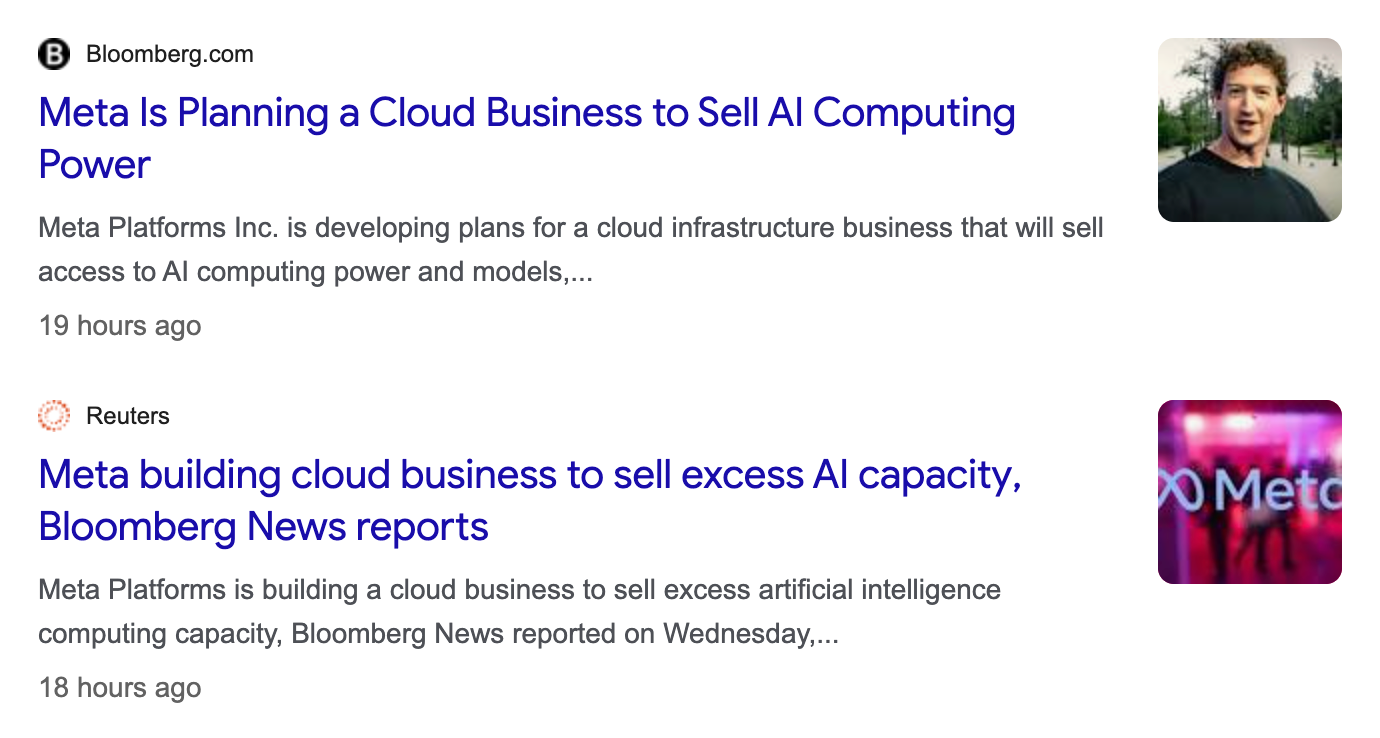
There are two key changes between the two headlines. First, "Is Building" was changed to "Is Planning," directly weakening the certainty and timeliness of the report. Second, the term "excess" was removed. However, this initial phrasing was easily interpreted by the market as "computing power is already in excess," leading to a chain of deductions from "excess computing power → capital expenditure peaking → weakening AI demand," ultimately causing market panic.
Even if we assume it's confirmed that Meta intends to sell computing power, it is still difficult to constitute a sufficient reason to declare the end of the "AI capital expenditure cycle." From an industrial logic perspective, Meta itself is relatively behind in the AI race. Its pressure regarding foundational models and computing efficiency objectively means Meta has a certain degree of need for computing power scheduling and asset optimization. In this context, externalizing or commercializing some computing resources is more akin to an asset utilization optimization behavior than a systemic contraction in demand.
Such "computing power redistribution" is not uncommon in the AI industry chain. Two months ago, SpaceX also commercialized some of its computing power externally (e.g., renting to Anthropic). Essentially, this is just a rebalancing for cost and resource efficiency, not a negation of AI demand itself. Therefore, directly extrapolating a single company's computing power scheduling behavior – the scale of which is uncertain – into "industry-wide overcapacity" represents a clear logical leap.
As for why the impact of this news was so immense, another key reason lies in the market structure. Before this decline, the semiconductor memory chip sector was already at relatively high levels, with a high concentration of trend-following capital and leveraged ETFs. Under such a structure, the market's sensitivity to marginal information increases significantly. Once a narrative shock occurs, it can easily trigger amplified deleveraging and forced position reductions, thereby magnifying a fluctuation that should have been at the "expectation adjustment level" into a retracement at the "price stampede level."
Therefore, this pullback feels more like a typical result of "emotional panic + structural deleveraging" superimposed. Personally, I am inclined to consider accumulating positions opportunistically during this decline.
After all, SK Hynix itself is in a critical window period for its US listing. With a fundraising scale of nearly $30 billion, neither the underwriters nor the institutional funds participating in the subscription would likely want the stock price to perform too poorly after the listing.


