






MiCA chuyển tiếp kết thúc, thiếu giấy phép, châu Âu chứng kiến đợt thanh lý sàn giao dịch lớn nhất lịch sử


- Quan điểm chính: Thời gian chuyển tiếp của Quy định về thị trường tài sản tiền điện tử (MiCA) của EU kết thúc vào ngày 1 tháng 7 năm 2026, dẫn đến khoảng 75% các nhà cung cấp dịch vụ tiền điện tử cũ mất tư cách hoạt động hợp pháp. Các sàn giao dịch hàng đầu như Binance, MEXC buộc phải rút lui hoặc tạm ngừng dịch vụ. Thị trường stablecoin hoàn tất quá trình tái cấu trúc, USDT rút lui, USDC trở thành xu hướng chủ đạo.
- Các yếu tố chính:
- Tính đến tháng 5 năm 2026, chỉ có khoảng 194 doanh nghiệp tiền điện tử nhận được ủy quyền MiCA chính thức, trong khi trước đó, số lượng các nhà cung cấp dịch vụ tiền điện tử đã đăng ký hoặc hoạt động tại EU ước tính từ 1.100 đến hơn 3.000.
- Các sàn giao dịch hàng đầu như Coinbase, Kraken, OKX, Bybit đã nhận được giấy phép MiCA trước đó và có thể phục vụ toàn bộ thị trường EU thông qua cơ chế "hộ chiếu" (passporting).
- Binance rút đơn xin cấp phép do cơ quan quản lý còn lo ngại về cấu trúc quản trị của sàn, tạm thời rút khỏi thị trường châu Âu và dự kiến sẽ nộp lại đơn trong vài tháng tới.
- USDT của Tether bị hủy niêm yết trên các nền tảng chính vì không đáp ứng yêu cầu dự trữ của MiCA. USDC và EURC của Circle được phê duyệt, vốn hóa thị trường tăng lên khoảng 75 tỷ USD.
- Khoảng 60% người dùng tiền điện tử châu Âu vẫn đang giao dịch trên các nền tảng chưa được ủy quyền. Cơ quan Chứng khoán và Thị trường Châu Âu (ESMA) yêu cầu các nền tảng chưa được ủy quyền thực hiện "ngừng hoạt động có trật tự".
Original by Odaily Planet Daily (@OdailyChina)
Author: jk
On July 1, 2026, the transitional grace period for the European Union's Markets in Crypto-Assets Regulation (MiCA) officially ends.
From this date onward, any institution providing crypto asset services to users within the EU must hold a formal MiCA authorization license without exception. Unlicensed operators cannot accept new deposits or conduct new business. The French regulator AMF has explicitly warned that violations can lead to up to two years imprisonment and a fine of €30,000. Regulators also retain the enforcement power to publish blacklists and apply for website blocking.
As of May 2026, approximately 194 crypto companies across the EU have obtained formal MiCA authorization. In contrast, the number of crypto service providers previously registered or operating under national regimes in Europe is estimated to be between 1,100 and 3,000. Legal firm Hogan Lovells estimates that about 75% of legacy platforms will lose their legal operating qualification after the grace period ends. Exchanges that may become inaccessible due to a lack of authorization include Binance, MEXC, and others.
What kind of regulatory test will this be for exchanges? What are the specific details within MiCA? Which exchanges will become unavailable? What actions do users need to take? Odaily Planet Daily will explain one by one.
What is MiCA?
MiCA is the EU's first comprehensive regulatory framework for the crypto asset market, officially taking effect in 2023. It covers all 27 EU member states plus three EEA member states: Norway, Iceland, and Liechtenstein.
Before MiCA was implemented, the regulation of crypto companies across Europe was highly fragmented. The same exchange needed to register with the financial regulator in Germany to serve German users and obtain a PSAN license in France for French users, with varying thresholds and inconsistent enforcement across different countries. MiCA's goal is precisely to replace this fragmentation with a single, unified set of rules. This is also the EU's typical policy-making approach.
MiCA, as a broad regulatory framework, has a wide scope. Any institution providing crypto asset-related services to clients within the EU, collectively termed "Crypto Asset Service Providers" (CASPs), must apply for authorization from the national competent authority and clearly specify the categories of services they offer.
MiCA categorizes CASP services into ten types, including: operating a trading platform (matching buyers and sellers), custody and administration of crypto assets, exchange of crypto assets for funds or other crypto assets, execution of orders on behalf of clients, portfolio management, and advisory services, among others. A single MiCA license only covers the service categories stated in the application. If an exchange intends to offer matching, custody, and transfers simultaneously, it needs to apply for authorization covering multiple service types.
MiCA also establishes a separate sub-framework specifically for stablecoins. Stablecoins pegged to fiat currency and those pegged to a basket of assets must respectively meet issuance authorization and reserve requirements. Those exceeding a certain issuance threshold face stricter regulatory constraints.
Furthermore, MiCA introduces a "Passporting" mechanism: Just as an EU passport holder can reside, work, and live in any member state, a company holding a MiCA license in any one EU member state can extend its services to other member states through a notification process, without needing to reapply in each country.
Different Transition Periods?
MiCA's stablecoin rules came into effect first in June 2024, while the CASP provisions officially took effect at the end of December 2024. To accommodate crypto companies already registered or operating within individual countries, MiCA established transitional grace periods. Each member state could determine the length of its own grace period, with a maximum of 18 months, meaning the latest possible end date was July 1, 2026.
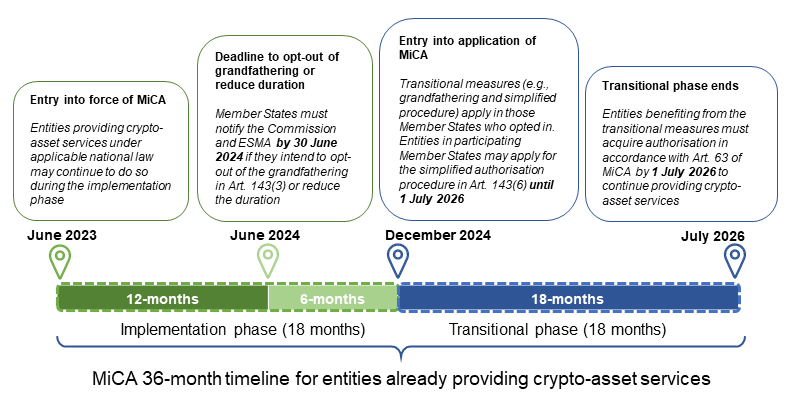
The core logic of the grace period was to give platforms already operating under national regimes time to complete the MiCA application and approval process, allowing them to continue business during this period.
Different countries handled the grace period differently. The Netherlands terminated its grace period early, on July 1, 2025, forcing some local exchanges to obtain licenses ahead of time. Germany shortened its national grace period to the end of December 2025, using this as leverage to pressure applicants and speed up the approval process. When Lithuania's transition period ended, over 240 crypto companies registered locally ceased operations. By June 2026, 20 of the 27 EU member states had ended their national transition periods before the final deadline of July 1.
On April 17, 2026, the European Securities and Markets Authority (ESMA) issued an official statement confirming July 1 as the final deadline, with no further extensions possible. For CASPs still unauthorized by the deadline, ESMA requires an "orderly wind-down": stop accepting new deposits, cease new business activities, and transfer existing users' assets to licensed platforms or assist users in transferring them to self-custodial wallets.
According to data cited by Crypto News, as of May 2026, only about 194 crypto companies within the EU had obtained formal MiCA authorization, whereas the number of crypto service providers previously registered or operating under national regimes in Europe was estimated to be between 1,100 and 3,000 or more. Legal firm Hogan Lovells estimates that about 75% of platforms operating under the old registration system will lose their legal operating qualification after the grace period ends.
How are Major Exchanges Responding?
Platforms Licensed Ahead of Time
- Coinbase x Luxembourg: In June 2025, the Luxembourg financial regulator (CSSF) granted a MiCA license to Coinbase's European subsidiary, consolidating its multiple local licenses previously held in Ireland, Germany, France, Italy, the Netherlands, and Spain. Luxembourg now serves as its single EU licensing hub, using the passporting mechanism to serve the entire EU.
- Kraken x Ireland: Kraken obtained CASP authorization from the Central Bank of Ireland, while also holding a Luxembourg entity and a MiFID derivatives license.
- OKX x Malta: OKX was the first major exchange globally to receive MiCA authorization, licensed by the Malta Financial Services Authority (MFSA), using Malta as its base to passport across the EU.
- Bybit x Austria: Received authorization from the Austrian Financial Market Authority (FMA) on May 28, 2025, with its EU headquarters in Vienna, serving 29 EEA member states.
- Crypto.com obtained its full license in Malta on January 27, 2025, and Gemini landed in Malta in August of the same year. Bitstamp also chose Luxembourg, completing CSSF authorization in May 2025 (now under Robinhood). eToro holds a CySEC license in Cyprus, while Robinhood registered in Lithuania.
Platforms with Pending Applications
Bitget is a case currently attracting attention. As of June 17, 2026, Bitget's application submitted to the Austrian FMA is still under review. Its EU headquarters is in Vienna, led by Oliver Stauber, formerly of KuCoin and Bitpanda. Until approval is granted, Bitget has suspended services for EEA users.
KuCoin's situation is more complex. It received authorization from the Austrian FMA in November 2025, but subsequently, due to vacancies in key anti-money laundering and sanctions compliance roles, the FMA prohibited it from formally commencing business. KuCoin has appealed this decision and still cannot accept new EU users.
Stablecoins: Mixed Fortunes
While the shakeout among exchanges is still underway, the shakeout in the stablecoin sector is complete. Tether's USDT, the world's largest stablecoin, never obtained MiCA authorization. CEO Paolo Ardoino publicly stated that MiCA's requirement for holding most of the EMT reserves in EU regulated bank accounts is incompatible with Tether's existing reserve model. The result: Coinbase delisted USDT in December 2024, Crypto.com followed on January 31, 2025, and Binance and Kraken delisted it in March 2025. USDT has completely exited major compliant platforms within the EU.
Circle's USDC and EURC both passed EMT authorization. As of June 2026, USDC's market cap was approximately $75 billion, making it the dominant stablecoin option in EU compliant scenarios. The Asset-Referenced Token (ART) framework represents MiCA's highest hurdle, with no issuers having obtained authorization so far.
Most Affected Platforms
Binance
Binance is the most watched name in this reshuffle. In terms of scale, with over 300 million registered users globally, it is the undisputed leader in the exchange space and should have been well-positioned to apply for MiCA.
In January 2026, Binance submitted its MiCA application through the Hellenic Capital Market Commission (HCMC), positioning Greece as the core base for its European expansion. However, on June 16, Reuters reported, citing two sources, that the HCMC is planning to reject Binance's application. Regulators from Greece, Ireland, and Latvia jointly reviewed the application, expressing concerns about Binance's historical legal record and corporate governance structure.
On June 24, Binance formally announced the withdrawal of its application, stating it would resubmit in another EU member state, expecting approval "within the coming months," but without revealing the target country. Until it obtains a license, we may see Binance temporarily exit the European market, potentially losing some market share.
In its official statement, Binance said: "Regarding user impact, Binance stated that some users may be affected, with the specific situation varying depending on the user's country and account status. The company is directly sending account-specific notifications to all EU users. These notifications will explain whether users need to take any action, available options, relevant timelines, and support channels."
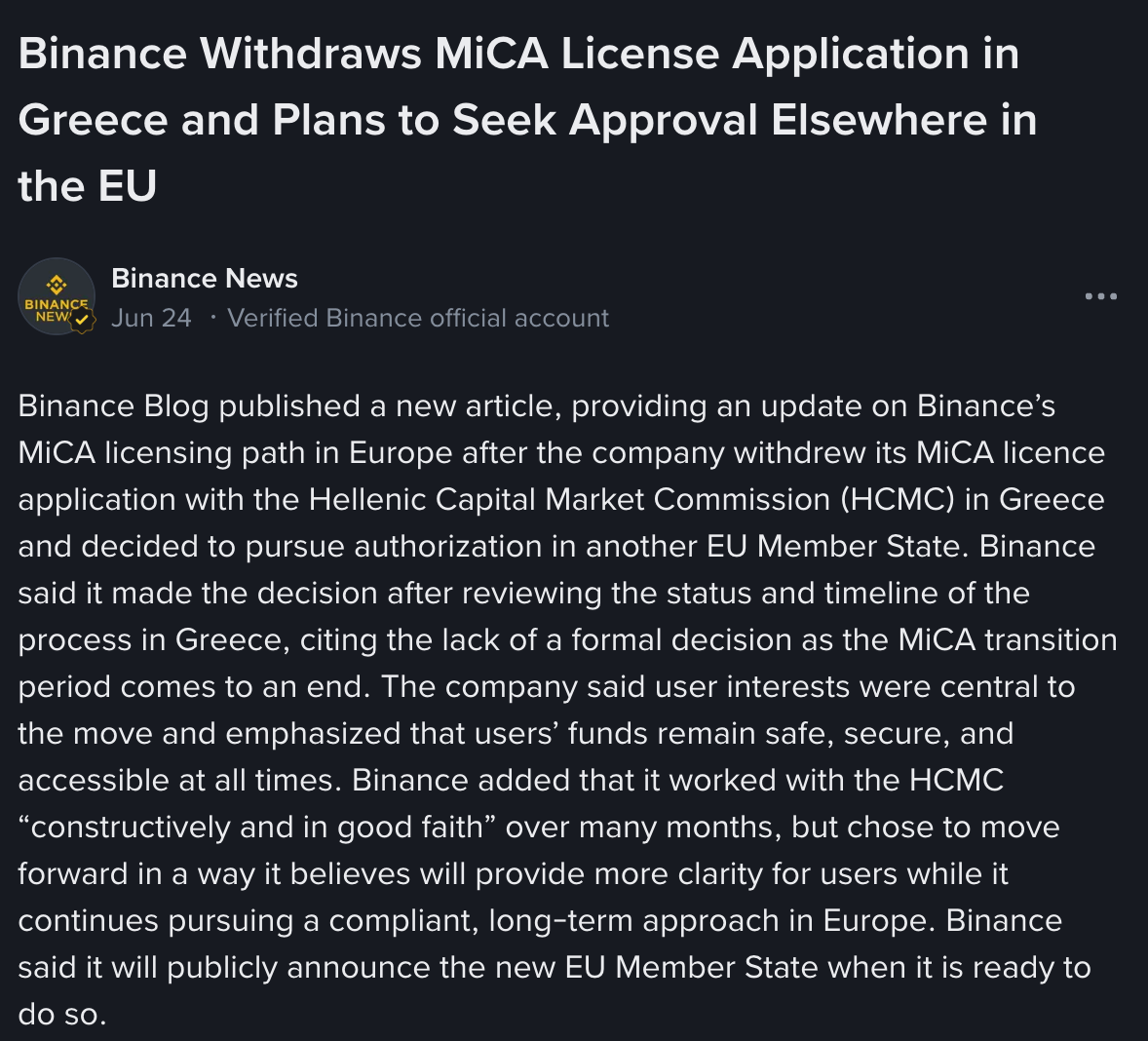
Binance's official statement, Source: Binance Square
MEXC and HTX
In contrast to the high-profile Binance situation, MEXC and HTX (formerly Huobi) have been more silent. Neither platform holds a MiCA license, nor do they have any public application records.
What Should Users Do?
For EU users, using unlicensed platforms after July 1 means facing several practical risks: the platform may stop accepting new deposits, may require users to complete withdrawals within a specified timeframe, or may restrict account operations without prior notice. An analysis by OKX Europe found that between May 2025 and May 2026, approximately 41% of total European crypto app downloads came from exchanges without MiCA authorization, suggesting that about 60% of European crypto users are currently using unauthorized platforms.
If a platform has already notified users about account migration, as experienced by some EU users of Bybit, Bitvavo, Kraken, Coinbase, and Crypto.com, this usually involves re-completing KYC identity verification and accepting updated terms of service. This is a standard procedure under MiCA's anti-money laundering requirements.
The Next Steps in Industry Regulation
MiCA is not the endpoint. On May 20, 2026, the European Commission launched a formal review consultation process for the MiCA regulation, with input accepted until August 31. A final report must be submitted to the European Parliament by June 30, 2027. The 86 questions in this consultation cover stablecoin competitiveness (especially the weak position of euro-stablecoins against dollar-stablecoins), DeFi, staking and lending, RWA tokenization, and whether ESMA should gain direct supervisory authority over major CASPs.
France, along with Austria and Italy, explicitly supports the plan for ESMA to directly supervise major CASPs to reduce standard gaps between member states. Simultaneously, the Qivalis consortium, initiated by 37 banks including BNP Paribas, ING, and UniCredit, is developing a compliant euro-pegged stablecoin, aiming to carve out a place for euro digital currencies in a market dominated by dollar-pegged stablecoins.
The industry reshuffle is still ongoing. Odaily Planet Daily will continue to follow and report on developments.


