






Bitcoin Short-Term Bullish Structure Confirmed, HYPE Dip-Buying Window Opens | Exclusive Analysis


- Core View: This week, the market is influenced by geopolitical and sentiment fluctuations, with both BTC and HYPE in a phase of key technical level battles. BTC needs to validate the support effectiveness of $65,000. If it holds, it will challenge the $70,000 area; for HYPE, after completing a four-wave adjustment, attention should be paid to its performance under the resistance zone of $62.5-$64.57, presenting short-term trading opportunities.
- Key Elements:
- After undergoing a complex 12-wave adjustment from the May 6 high of $82,850, BTC is currently in a 38-39 wave rebound. The next resistance zone after standing above $65,000 is $69,500-$70,500.
- The medium-term bearish strategy for BTC is divided into three levels: If it holds above $65,000, initiate short positions (position size below 60%) when it faces pressure at $69,500-$70,500; if it loses $65,000, establish a 30% short position accordingly; if it breaks below $59,000-$60,000, increase the position to 60%.
- Key support levels for BTC are $65,000 (first support), $59,000-$60,000 (second support), and $55,000; core resistance levels are $69,500-$70,500 and $72,500-$74,500.
- After experiencing a four-wave adjustment from its June 2 high of $75.87, HYPE has stabilized and rebounded at the $52 support level. The overhead resistance zone is $62.5-$64.57, and it is expected that a lower high is likely to form here.
- The short-term strategy for HYPE is a "dip-buying approach": when the price retests the support zone of $52-$54.5 or $47-$49, combined with model bottom signals, small long positions can be taken, with position size controlled below 30%.
- Last week's short-term HYPE operation was successful: Based on the spread trading model and momentum quantitative model, a long position was opened at $54.39 and closed at $60.85, achieving an 11.88% return.
The market environment this week is exceptionally complex—the unexpected full implementation of the US-Iran agreement and the unblocking of the Strait of Hormuz are causing a dramatic repricing of global assets. This emotional volatility is precisely when structural analysis becomes most valuable. The greater the noise, the more crucial the framework.
This week, we focus on two main narratives: After BTC broke above $65,000, the outcome of the pullback confirmation will determine the subsequent direction; and after HYPE completed its four-segment correction, whether the resistance zone between $62.5 and $64.57 holds will create new short-term opportunities.
A complete analysis of the price structure, market forecasts, and operational strategies can be found in the main text below.
Core Trading Views Summary for This Week:
• Analysis of BTC's hourly-level price structure. (See Part 1 for details)
• BTC market forecast and medium/short-term trading strategies for this week. (See Part 2 for details)
• Analysis of HYPE's hourly-level price structure. (See Part 3 for details)
• HYPE market forecast and short-term trading strategy for this week. (See Part 4 for details)
Market Validation of Last Week's Trading Strategies and Core Views:
• Result of HYPE short-term trade: Completed one short-term long trade (1x leverage) last week, yielding a profit of approximately 11.88%. (See Table 1 for details)
• Market Validation of BTC Price Forecast: Last week's article indicated that after a brief dip below the $60,000 mark, the price would find support and initiate a short-term rebound to confirm the validity of the breakdown of a key level. The current market movement validates our previous forecast.
• Market Validation of HYPE Price Forecast: Last week's article indicated that when HYPE's price retests the key support zone of $55-$57 and shows signs of stabilization, combined with bottom signals triggered by two major models, one could consider opening a small long position. The current market movement highly aligns with our forecast.
1. In-depth Analysis of Bitcoin's Hourly-Level Price Structure
Bitcoin _ 4-hour K-line Chart
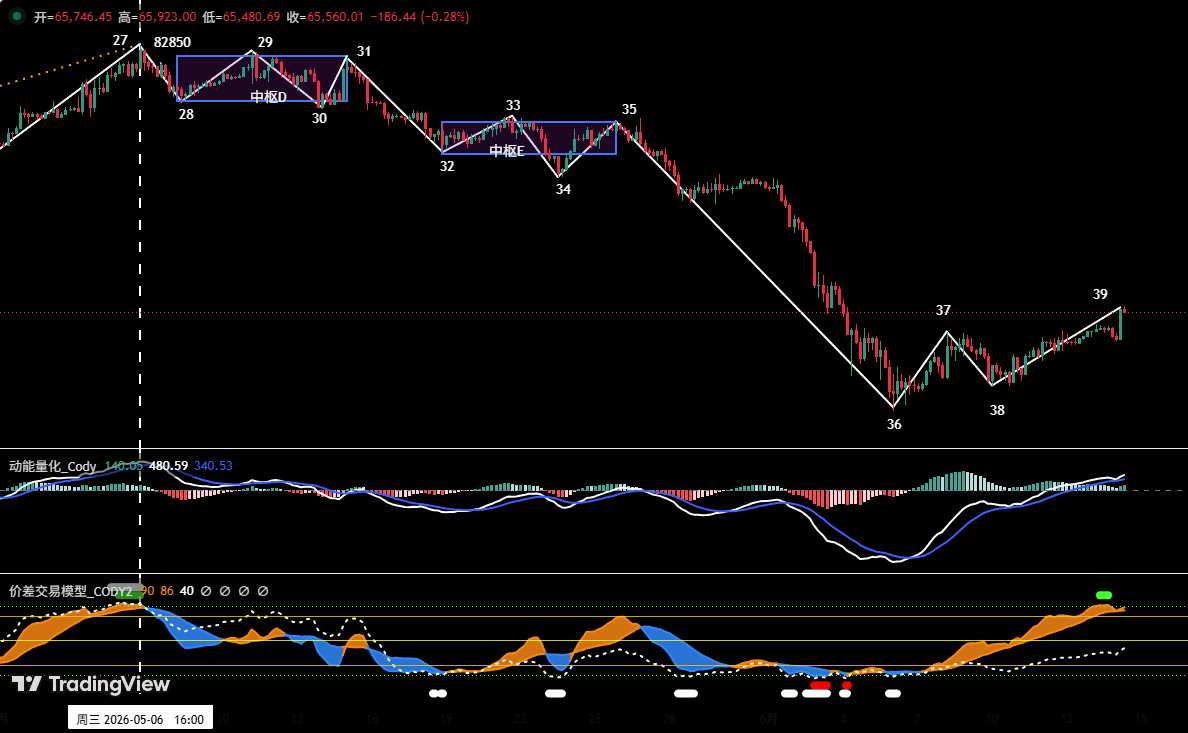
Figure 1
①、As shown in (Figure 1), since the correction from the high of $82,850 on May 6, the 4-hour chart can be subdivided into a 12-segment correction structure. This includes two descending consolidation zones: Zone D and Zone E. The overall structure is clear, exhibiting a typical complex corrective pattern.
②, From the perspective of the 4-hour structure, the market is currently executing the 38-39 segment rebound. The price has now risen above $65,000. If the breakout is subsequently confirmed as valid, the next significant resistance for the rebound lies in the $69,500 ~ $70,500 area.
2. Bitcoin Market Forecast and Trading Strategy for This Week
1. BTC Price Forecast for This Week:
Core View for This Week: Focus on the outcome of the pullback confirmation after the price broke above $65,000.
• If the pullback fails to hold, the market may retest the core support zone of $60,000 ~ $62,000.
• If the price holds effectively, it will challenge the core resistance area of $69,500 ~ $70,500. This area will be a key zone for our planned medium-term short position.
2. Core Resistance Levels:
• First Resistance Zone: $69,500 ~ $70,500 (previous high-volume area)
• Second Resistance Zone: $72,500 ~ $74,500 (previous high-volume area)
3. Core Support Levels:
• First Support Level: Near $65,000
• Second Support Zone: $59,000 ~ $60,000 (previous key support area)
• Third Support Level: Near $55,000 (previous key support area)
4. This Week's Trading Strategy (Excluding Sudden News Impact)
① Medium-term Strategy:
Bitcoin _ Daily K-line Chart: (Position Monitoring Model)
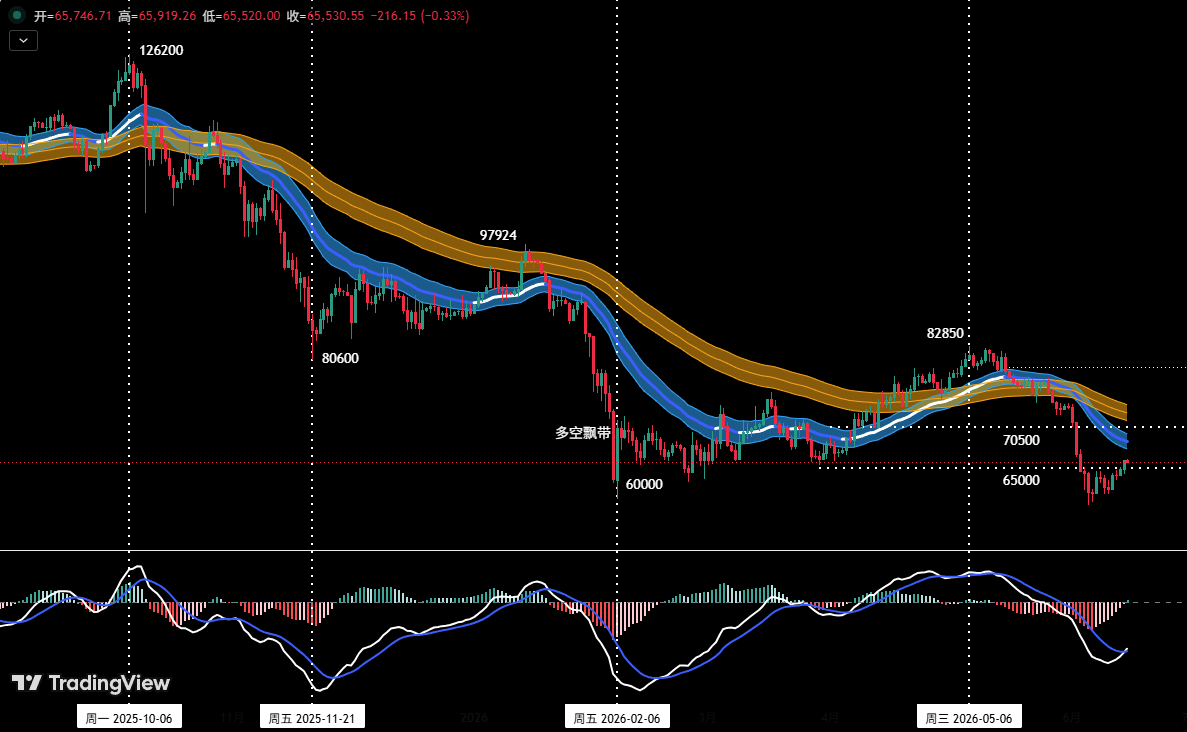
Figure 2
Position Monitoring Model: As shown in (Figure 2), the price has effectively broken below the "Bull-Bear Channel," and the technical structure has turned into a bearish-dominant pattern. Last week, the market did not meet the conditions for our planned (short) position, so the medium-term position remains empty.
This week, based on the outcome of the battle for the $65,000 level, we can build a short position gradually according to the following three-tiered strategy:
• Adding positions in strong resistance zones: If the price successfully holds the $65,000 area and subsequently rebounds to the $69,500 ~ $70,500 area showing clear signs of resistance, consider establishing medium-term (short) positions, with total position size controlled below 60%.
• Shorting on breakdown: If the price loses the $65,000 support and shows a valid breakdown signal, you can initially establish a 30% medium-term short position.
• Adding shorts on a confirmed breakdown: If the price loses the $65,000 support and effectively breaks below the $59,000 ~ $60,000 support zone, add to the short position, keeping total position size under 60%.
② Short-term Strategy: Use 30% of capital. Set stop-loss points. Based on support and resistance levels, look for "spread" trading opportunities (using the 30-minute/60-minute chart as the operating cycle).
③ For short-term trading, we have prepared two specific operation plans in advance, Plan A/B, to dynamically respond to complex market changes.
• Plan A: Build positions in the strong resistance zone.
• Entry: If the price successfully holds the $65,000 area and subsequently rallies to near $69,500 ~ $70,500 showing signs of stagnation, combined with top signals from quantitative models, open a short position with less than 30% of capital.
• Risk Management: Set an initial stop-loss.
• Exit: When the price corrects to a key support level, combined with model signals, gradually close the position and take profits.
• Plan B: Short on a confirmed breakdown of support.
• Entry: If the price loses the $65,000 support and shows a valid breakdown signal, open a short position with less than 30% of capital.
• Risk Management: Set an initial stop-loss.
• Exit: When the price declines to a key support level, combined with model signals, gradually close the position and take profits.
3. Analysis of HYPE Hourly-Level Price Structure
HYPE_4-hour K-line Chart
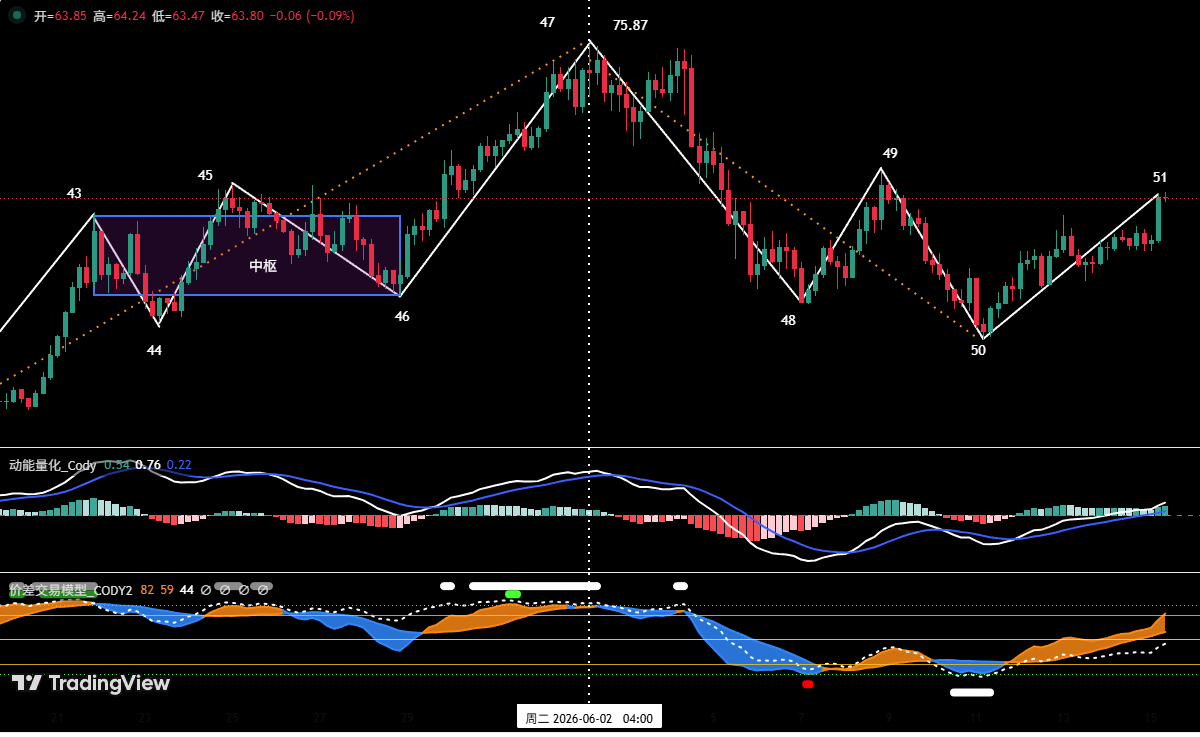
Figure 3
1、As shown in (Figure 3), on the 4-hour timeframe, since the correction from the high of $75.87 on June 2, HYPE can be broken down into a four-segment correction structure: (47-48), (48-49), (49-50), (50-51).
2、Currently, HYPE's price has stabilized and rebounded from the support zone near $52 and is in the process of the (50-51 segment) rebound. The overhead resistance lies between $62.5 and $64.57. If (Point 51) forms a high within this area (there's a high probability that the overall structure is building a "descending consolidation zone" here), the price will continue to seek strong support lower down.
4. HYPE Market Forecast and Short-term Trading Strategy
1. HYPE Price Forecast for This Week:
① Core Resistance Levels:
• First Resistance Zone: $62.5 ~ $64.57
• Second Resistance Zone: $68 ~ $70
② Core Support Levels:
• First Support Zone: $52 ~ $55.5
• Second Support Zone: $47 ~ $49
Core View for HYPE This Week:
• Observe the resistance effect of the $62.5 ~ $64.57 zone and the location where "Point 51" forms the price high.
2. HYPE Short-term Trading Strategy for This Week: (Long on Support)
HYPE short-term trading this week should follow the strategy of "buying on dips, avoiding chasing highs."
Short-term Strategy: Enter long on stabilization in support zones
When HYPE's price retests the $52 ~ $54.5 zone or the deeper $47 ~ $49 key support zone and shows signs of stabilization, combined with bottom signals triggered by the two major models, consider entering a small long position. Position size must be controlled below 30%, and strictly adhere to stop-loss discipline.
5. HYPE Trade Review
1. Short-term Trade Review: (See Table 1)
Strictly following our operational plan and based on trading signals from our proprietary "Spread Trading Model" and "Momentum Quantitative Model," we completed one short-term (long) trade last week, achieving a profit of 11.88%.
2. HYPE Short-term Trade Detail Summary: (Leverage: 1x)
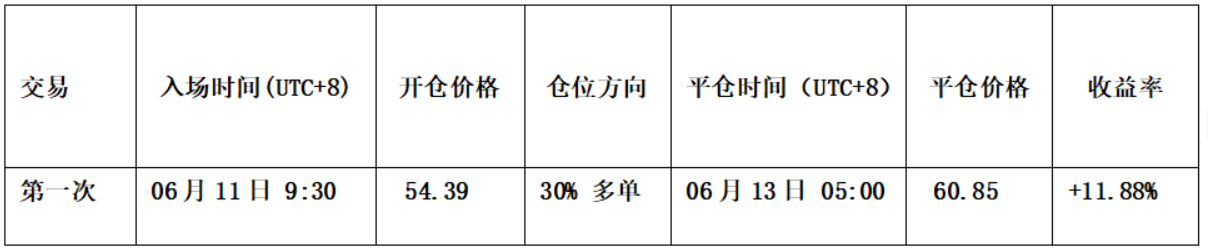
3. Short-term Trade Review: (See Figure 4)
①, Entry Strategy:
• A relatively complete downward correction structure had already unfolded previously;
• Our proprietary "Spread Trading Model" had issued a strong bottom warning signal in advance (red and white dots in the figure);
• Our proprietary "Momentum Quantitative Model" had issued a momentum divergence bottom signal;
Based on the above three factors, we opened a 30% long position near $54.39.
②, Exit Strategy:
• When the price rose to near $62.5, it showed resistance signals;
• Our proprietary "Spread Trading Model" had issued a top warning signal in advance (white dots in the figure);
• Our proprietary "Momentum Quantitative Model" had issued a momentum divergence top signal;
Therefore, we fully closed the position near $60.85.
③, Summary: This trade resulted in a successful profit of approximately 11.88%.
HYPE_30-minute K-line Chart: (Momentum Quantitative Model + Spread Trading Model)
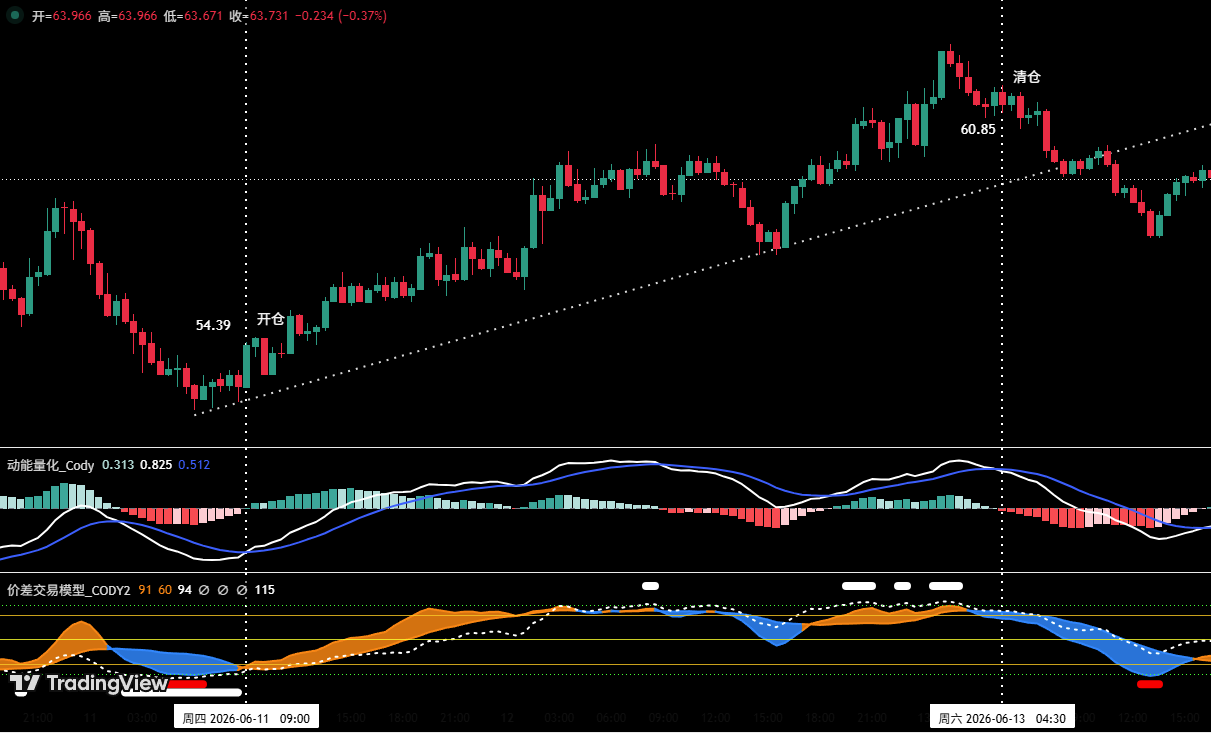
Figure 4 (Short-term Trade Illustration)
6. Special Reminder:
1. Upon entry: Immediately set an initial stop-loss.
2. When profit reaches 1%: Move the stop-loss to the entry cost price (breakeven point) to ensure capital safety.
3. When profit reaches 2%: Move the stop-loss to the 1% profit level.
4. Continuous tracking: For every subsequent 1% gain in price, move the stop-loss by 1% simultaneously to dynamically protect and lock in profits.
Financial markets are highly dynamic. All market analysis and trading strategies require adjustment in real-time. All views, analytical models, and operational strategies mentioned in this article are based on personal technical analysis, serve solely as a personal trading journal, and do not constitute any investment advice or operational basis. Markets carry risks; invest with caution. Do not make decisions based solely on this content.


