七大基金13F持仓剖析:巴菲特、段永平、李录、但斌在想什么?


- 핵심 요점: 2026년 2분기 13F 보고서에 따르면, 주요 펀드들은 AI 가치 사슬 내에서 상당한 자금 재배분을 단행했다. 과열된 하드웨어 부문에서 클라우드 컴퓨팅, 데이터 센터 및 AI 상용화 수혜주로 순환했으며, 동시에 중국 인터넷 자산은 일부 가치 투자자들의 복귀 매수로 증가했다. AI 투자 논리는 구조적 조정을 겪고 있다.
- 핵심 요소:
- 버크셔 해서웨이는 아벨 체제 하에서 구글 지분을 대폭 늘려 세 번째로 큰 보유 종목(총 약 377.6억 달러)으로 끌어올렸으며, 연속 순매도 행진을 끝내고 분기 순매수 약 200억 달러를 기록하며 기술주 비중 확대를 알렸다.
- 드러켄밀러의 Duquesne은 마이크론, 브로드컴 및 인텔을 청산했지만, TSMC와 ST마이크로일렉트로닉스는 늘리고 AMD를 신규 매수했다. 또한 데이터 센터로 전환 중인 비트코인 채굴 기업과 바이두 ADR을 매수하며 AI 하드웨어 내부 순환과 중국 주식에 대한 시험적 복귀를 보여줬다.
- 돤융핑의 H&H는 핀둬둬 지분을 26.71% 늘려 세 번째로 큰 보유 종목으로 만들고 알리바바를 다시 매수했지만, 엔비디아를 54.63%, 구글을 46.88% 축소하며 '고점 매도·저점 매수' 방식의 안전 마진 조정을 반영했다.
- 리루의 히말라야 캐피털은 핀둬둬 지분을 133.53% 대폭 늘려 두 번째로 큰 보유 종목으로 만들었고, 동시에 금융 및 에너지 6개 종목을 일시에 청산했다. 포트폴리오 집중도는 94.77%로 상승하며 능력권(컴피턴스 서클)을 크게 축소했다.
- 캐시 우드의 ARK는 스페이스X를 신규 편입해 즉시 핵심 포지션(447.8만 주)에 올렸고, 원자력 기업 X-Energy와 구글을 늘렸으며, 테슬라를 3분기 연속 축소하며 높은 회전율의 파괴적 혁신 전략을 이어갔다.
- 단빙의 오리엔트 하버 해외 펀드는 AI 하드웨어에 '포화 공격'을 감행하며 인텔, 샌디스크, AMD 등 칩·스토리지 7개 종목을 신규 매수하고, 애플과 테슬라를 청산했다. 하드웨어 비중은 70%를 넘어섰다.
- 레오폴트 아셴브레너의 Situational Awareness는 너무 일찍 풋옵션 헤지를 청산한 탓에 7월 AI 조정 국면에서 큰 손실을 입었고, 결국 할인가로 포트폴리오를 Citadel에 매각해야 했다. 이는 높은 레버리지의 위험을 부각시킨다.
Original: Odaily Planet Daily (@OdailyChina)
Author: Azuma (@azuma_eth)
In mid-August, major funds陆续 released their 13F quarterly reports, disclosing their static holdings as of June 30.
- Odaily Note: The 13F is a quarterly disclosure document mandated by the U.S. Securities and Exchange Commission (SEC) for funds with assets under management exceeding $100 million. The SEC requires funds meeting the disclosure criteria to file this document within 45 days after the end of each calendar quarter, disclosing their holdings of U.S.-listed stocks, call/put options, convertible bonds, and specific ETF positions as of the end of the previous quarter.
Although the 13F has a certain time lag in disclosure, making it unsuitable for simply copying trades, it remains the most direct window into the layouts and movements of top funds. As such, it holds significant importance for understanding the thinking of high-level market participants. In particular, the consensus and divergence among different funds may hold clues to future market trends.
Below, we will analyze the 13F reports of seven major funds: Berkshire Hathaway (Buffett, Abel), Duquesne Family Office (Stanley Druckenmiller), H&H International Investment (Duan Yongping), Himalaya Capital (Li Lu), ARK Investment (Cathie Wood), Oriental Harbor Investment Master Fund (Dan Bin), and Situational Awareness LP (Leopold Aschenbrenner), focusing on their core positions and major movements, hoping to provide insights for your investment strategy.
Berkshire Hathaway (Buffett, Abel)
Report Summary
As of June 30, Berkshire Hathaway disclosed a total of 29 holdings in its 13F report (the 13F only covers U.S.-listed securities required to be disclosed and does not represent the fund's entire asset scale), including 1 new position, 7 increases, 6 reductions, and 1 liquidation, with a nominal holdings market value of approximately $299.3 billion.
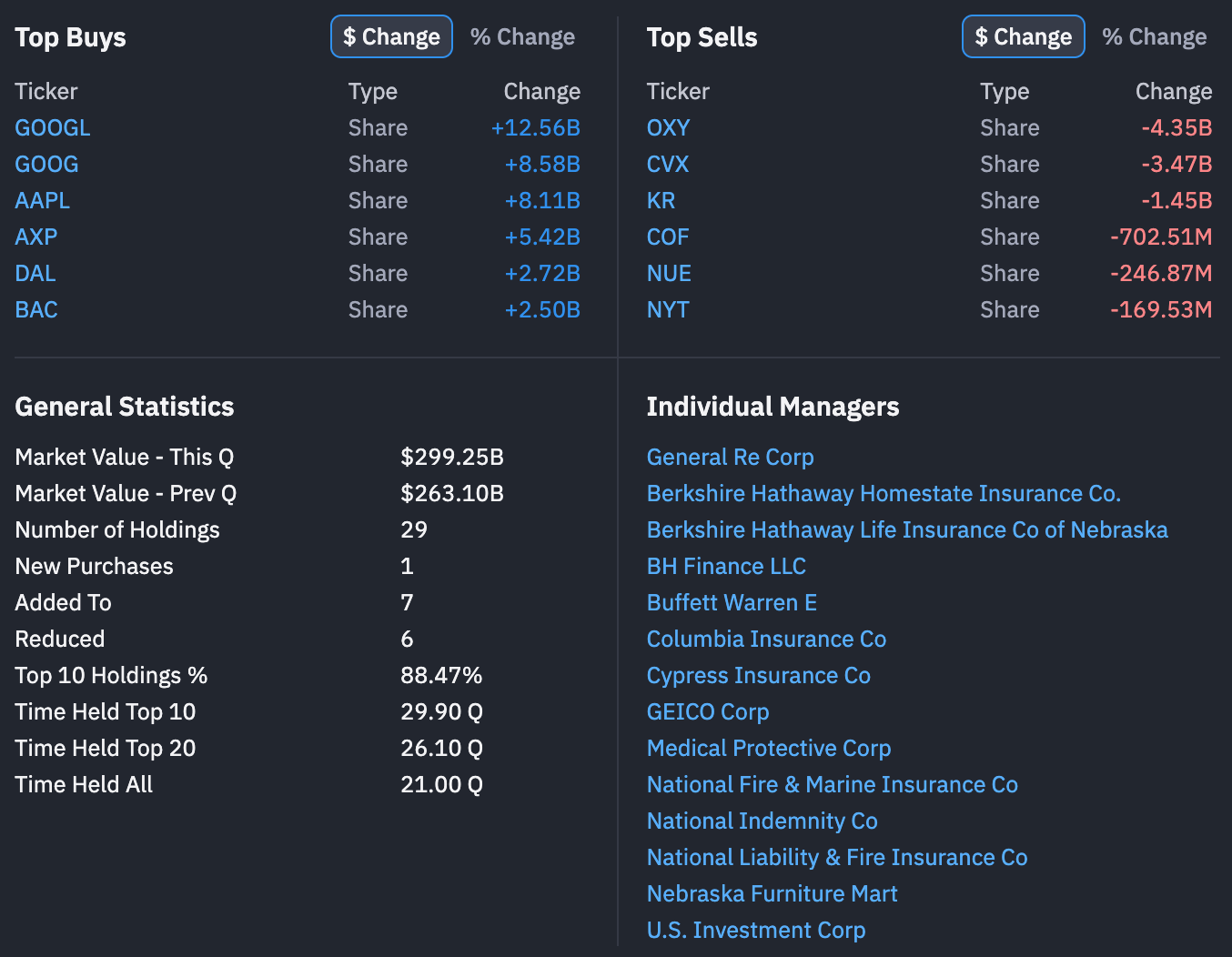
Notably, this is the second 13F report since Buffett stepped down as CEO and Greg Abel officially took the helm. It also marks the first significant net-buying quarter, ending Berkshire's previous streak of 14 consecutive quarters of net stock sales, with net stock purchases nearing $20 billion for the quarter.
Core Holdings
Berkshire's holdings remain highly concentrated, with the top ten holdings accounting for approximately 88.47% of the portfolio:
- Apple (AAPL): Approximately $65.95 billion, maintaining the top spot with a 22.0% portfolio share;
- American Express (AXP): Approximately $51.28 billion, accounting for 17.1%;
- Alphabet (Google, GOOGL + GOOG): Approximately $37.76 billion, including roughly $28.16 billion in GOOGL (Class A common stock, with voting rights) and $9.61 billion in GOOG (Class C common stock, without voting rights), rising to the third-largest position;
- Coca-Cola (KO): Approximately $32.51 billion, accounting for 10.9%;
- Bank of America (BAC): Approximately $27.54 billion, accounting for 9.2%;
- Chevron (CVX), Occidental Petroleum (OXY), Chubb (CB), Moody's (MCO), and Kraft Heinz (KHC) rank sixth through tenth, respectively.
Structurally, Berkshire has not significantly altered its previous portfolio framework centered on consumer, financial, and energy sectors, but the addition of Google has notably increased the weight of tech stocks in the portfolio.
Quarterly Changes
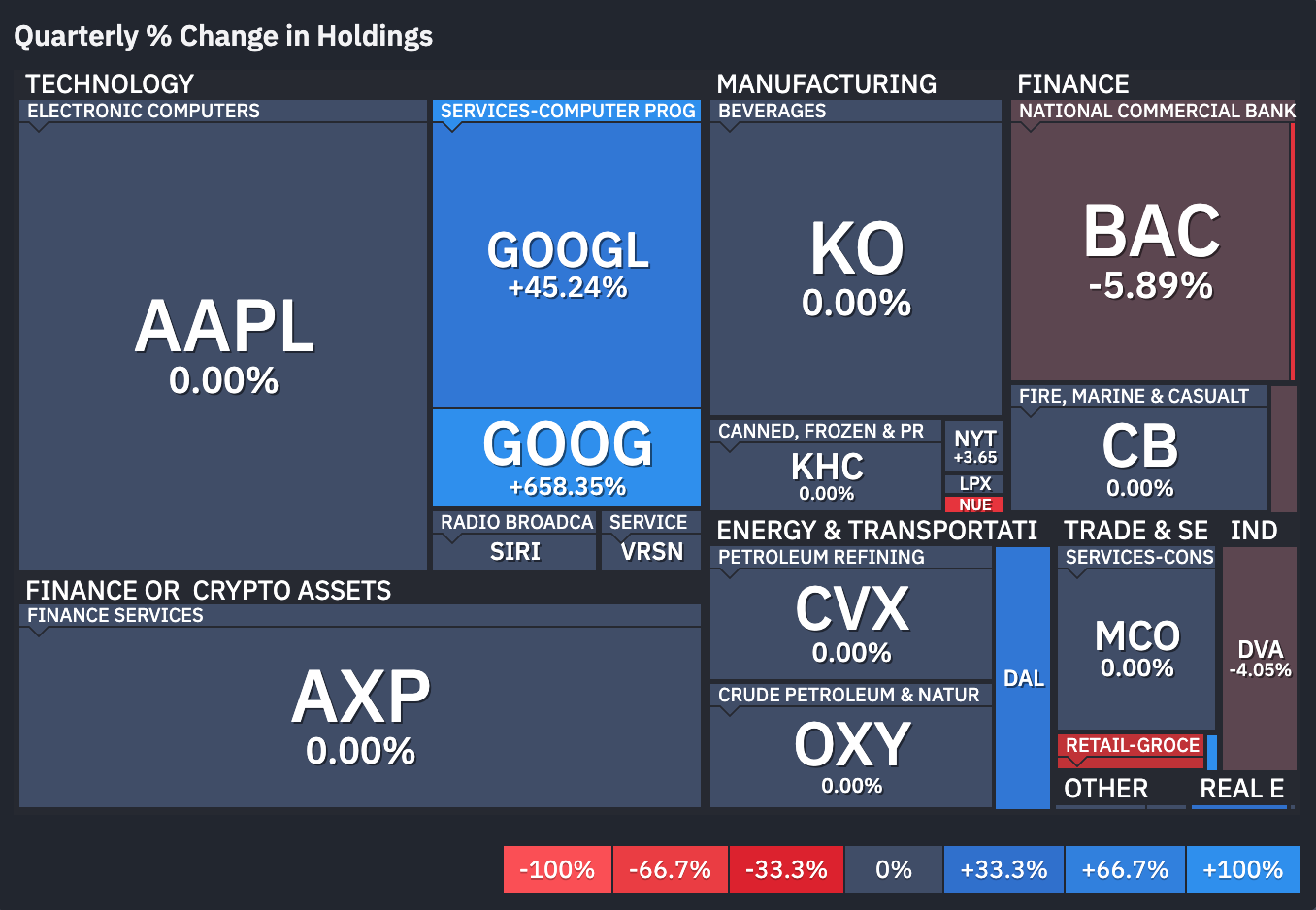
In the second quarter, Berkshire's most notable move was undoubtedly its aggressive bet on Alphabet — increasing its holdings of Alphabet Class A shares (GOOGL) by approximately 24.54 million shares, a 45.2% increase; simultaneously increasing Class C shares (GOOG) by approximately 23.6 million shares, a massive 658.3% surge — with the combined increase of approximately 48.1 million shares across both classes elevating Google to the fund's third-largest holding. Beyond Alphabet, Berkshire also noticeably increased positions in Delta Air Lines (DAL), Lennar (LEN), and Macy's (M).
On the other side, reductions were primarily concentrated in the financial, consumer, and cyclical sectors. Bank of America (BAC) was reduced by approximately 30.23 million shares, a 5.9% decrease, marking the second consecutive quarter of trimming. Capital One (COF) was reduced by approximately 58%, Kroger (KR) by approximately 22%, and Ally Financial (ALLY), DaVita (DVA), and Nucor (NUE) all saw decreases.
Summary Analysis
Berkshire under the Abel era is undergoing a subtle stylistic shift, with the clearest signal in the second quarter being a tilt from traditional finance and consumer sectors toward tech growth. The heavy position in Google not only further breaks the stereotype of Buffett "not touching tech stocks" but also reflects the new management's deep recognition of Google's moat in AI and search — essentially another typical "value confirmation" rather than trend chasing.
However, Berkshire's core character remains unchanged: the share counts of "ballast" holdings like Apple, American Express, and Coca-Cola were essentially maintained, and energy sector holdings Chevron and Occidental Petroleum were not sold off (the decline in their weight was primarily due to dilution from new positions).
Overall, this quarter's Berkshire adjustments reflect a logic of "heavy-handed accumulation of tech leaders, structural reduction of financial and consumer stocks, steadfast holding of energy core, and tentative exploration of real estate and aviation." While maintaining extremely high concentration, Abel is quietly pushing the portfolio toward a digital future, yet the Buffett hallmark of "patient holding" and "bold bets" remains clearly visible.
Duquesne Family Office (Stanley Druckenmiller)
Although less famous than Buffett and Berkshire, Stanley Druckenmiller may be the most noteworthy fund manager on Wall Street today.
Who is Druckenmiller? He is a legendary American macro hedge fund manager who served as the Chief Investment Officer of Soros's Quantum Fund from 1988 to 2000, becoming Soros's most successful trader... Most critically, his current key identity is that both the current U.S. Treasury Secretary Scott Bessent and Federal Reserve Chairman Kevin Warsh are his protégés (having had mentorship or long-term cooperative relationships with him).
Therefore, compared to Berkshire's more long-term-oriented 13F, the quarterly report of the Duquesne Family Office resembles more of a macro trading map — especially at a time when AI, interest rates, and the U.S. economic outlook are all rapidly changing.
Report Summary
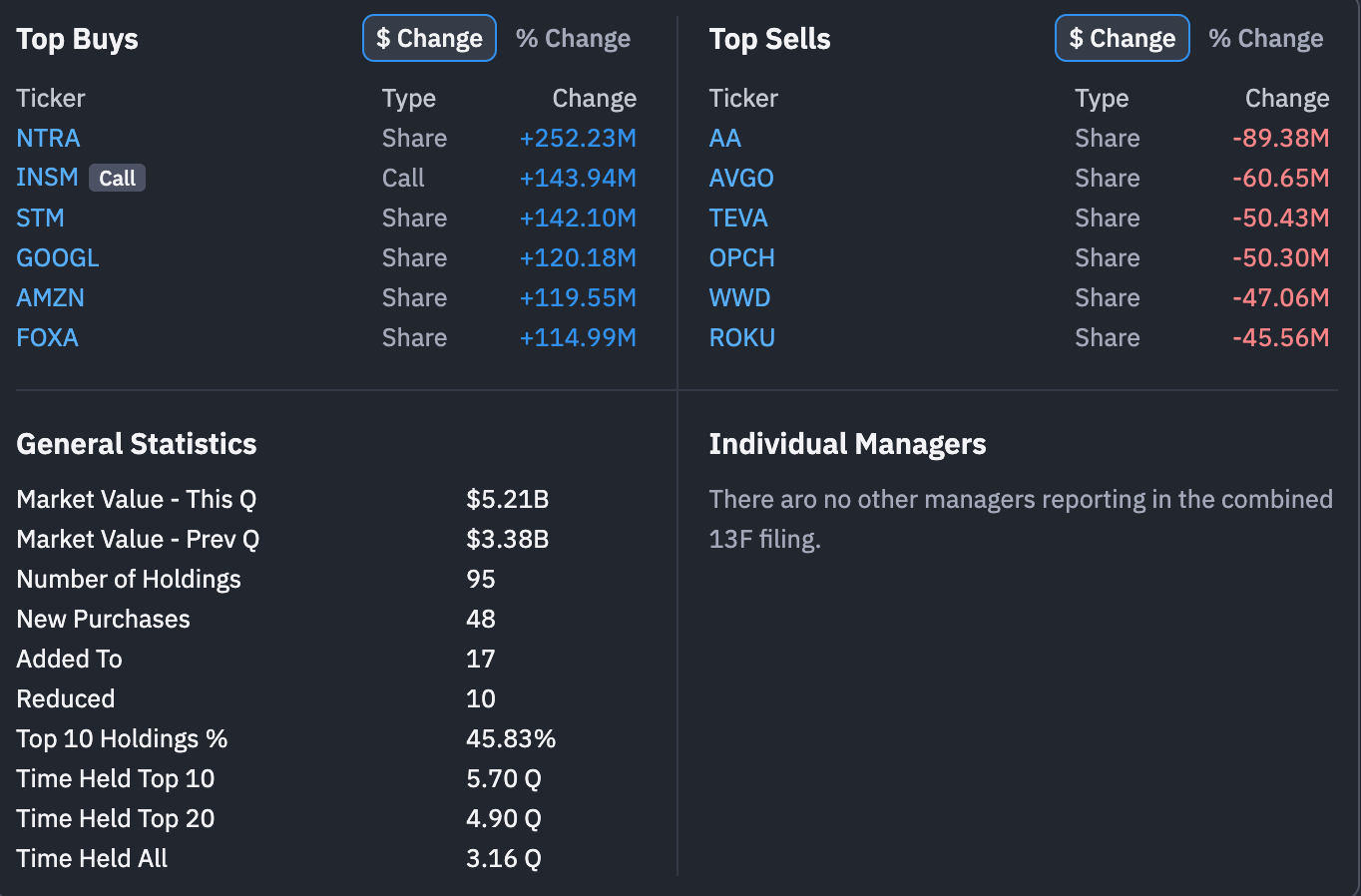
As of June 30, the Duquesne Family Office disclosed a total of 95 holdings in its 13F, with 48 new positions, 16 increases, 11 reductions, and 23 liquidations during the quarter, representing a nominal holdings market value of approximately $5.21 billion, a notable increase from $3.38 billion in the previous quarter.
Core Holdings
The 13F report shows that the top ten holdings of the Duquesne Family Office account for approximately 45.8%:
- Genetic testing company Natera (NTRA) remains the largest stock position of Duquesne Family Office, with approximately 3.19 million shares held at the end of Q2, valued at approximately $865 million, representing about 16.6% of the portfolio;
- The second and third largest holdings have become TSMC (TSM) and STMicroelectronics (STM), accounting for approximately 5.4% and 4.4% of the portfolio, respectively;
- Additionally, biopharmaceutical company Insmed (INSM, with both common stock and options held), Argentine state oil company YPF Sociedad Anónima (REPYY), and Amazon (AMZN) are among the top ten holdings.
Quarterly Changes
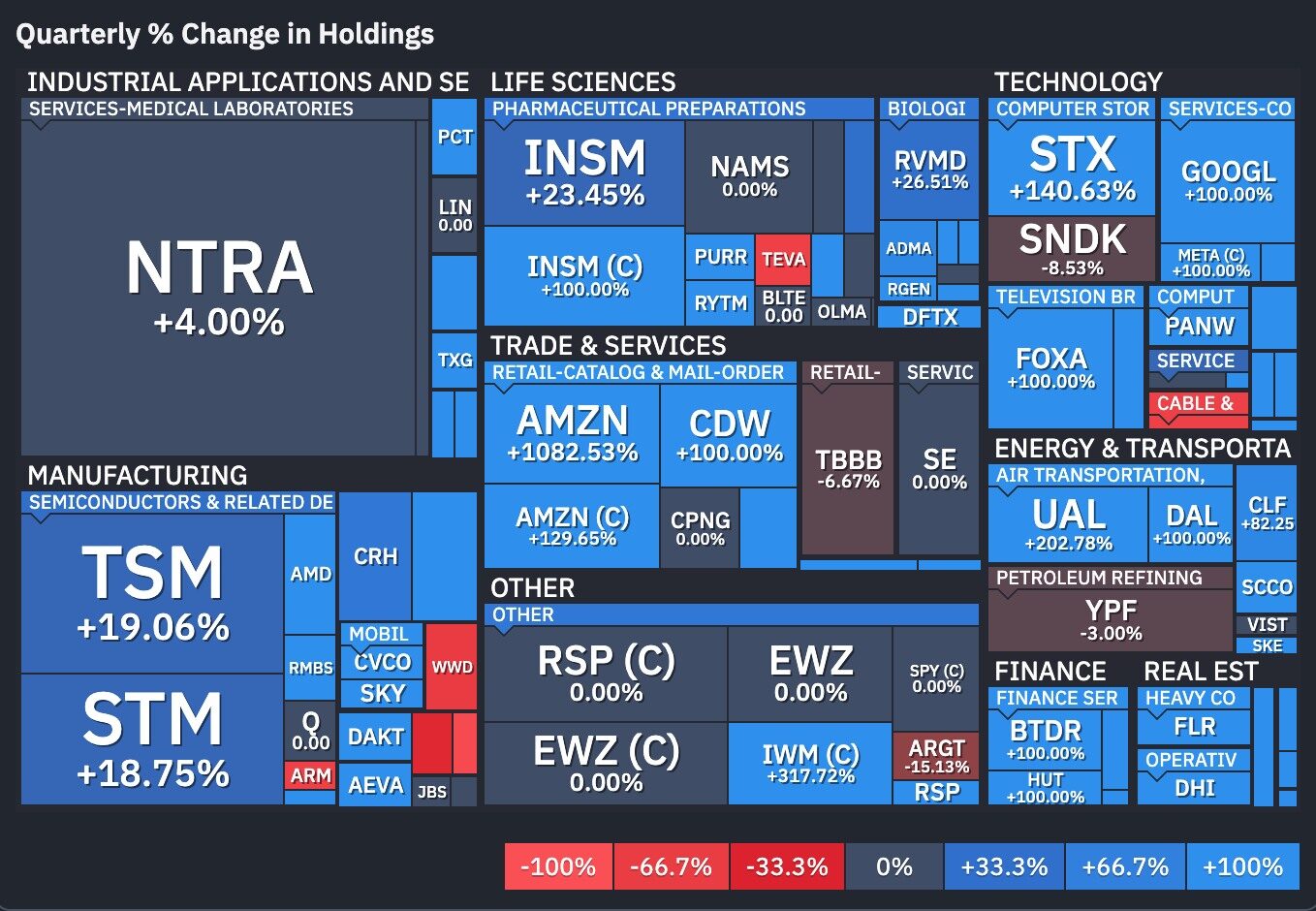
In the second quarter, the most notable change for Duquesne Family Office was the repositioning within the AI industry chain.
Duquesne Family Office completely liquidated its positions in Micron (MU), Broadcom (AVGO), and Intel (INTC), with Broadcom having only been established in the first quarter. However, this does not mean Druckenmiller has abandoned semiconductors; on the contrary, he continued to increase holdings in TSMC (TSM) and STMicroelectronics (STM), and opened a new position in AMD. Additionally, the fund has begun extending its reach to the periphery of AI infrastructure, buying into Bitcoin mining companies that have pivoted toward data centers, such as Hut 8 (HUT), Bitdeer (BTDR), and Riot Platforms (RIOT).
It appears that Druckenmiller chose to realize gains on some previously appreciated positions while shifting capital toward targets he believes offer better risk-reward profiles.
Furthermore, in the second quarter, Duquesne Family Office repurchased Alphabet (GOOGL), which it had just liquidated in the first quarter, and significantly increased its holdings of Amazon (AMZN), which had been reduced in the first quarter — possibly betting that the major tech companies that have borne heavy AI capital expenditures will gradually transition from "payers for AI infrastructure" to "beneficiaries of AI commercialization."
Beyond the aforementioned AI-related changes, Duquesne Family Office, like Berkshire, expressed bullishness on the aviation sector, opening a new position in Delta Air Lines (DAL) and increasing its United Airlines (UAL) holdings. Notably, Duquesne Family Office also re-established a position in Baidu ADR (BIDU) of approximately 88,000 shares in the second quarter — its first U.S.-listed Chinese stock holding in two and a half years, following its liquidation of Alibaba at the end of 2023.
Summary Analysis
If this 13F were condensed into one sentence: Druckenmiller hasn't left AI; he's simply reselecting the winners of AI's next phase. At least based on the end-of-Q2 holdings, Druckenmiller still maintains a fairly complete AI exposure, merely reallocating from some highly crowded hardware areas toward cloud platforms, data centers, and AI applications.
Meanwhile, the reappearance of Baidu is another signal worth noting. Although the 88,000-share position is not large, tentatively re-establishing a position after a prolonged avoidance of Chinese stocks at least indicates that his attention toward Chinese tech assets is recovering.
To reiterate, given Druckenmiller's relatively high-frequency trading adjustments, Duquesne Family Office's 13F report is even harder to simply "copy," making it more suitable for observing allocation direction.
H&H International Investment (Duan Yongping)
Next, let's turn our attention to H&H International Investment, managed by legendary Chinese investor Duan Yongping. From this 13F report, it's clear that Duan's holdings remain highly concentrated, but the second quarter has shown signs of a shift from some high-valuation tech stocks back toward Chinese internet stocks.
Report Summary
As of June 30, H&H International Investment disclosed a total of 18 holdings in its 13F, with a total nominal holding value of approximately $19.101 billion (approximately RMB 130 billion), down from approximately $20 billion at the end of Q1.
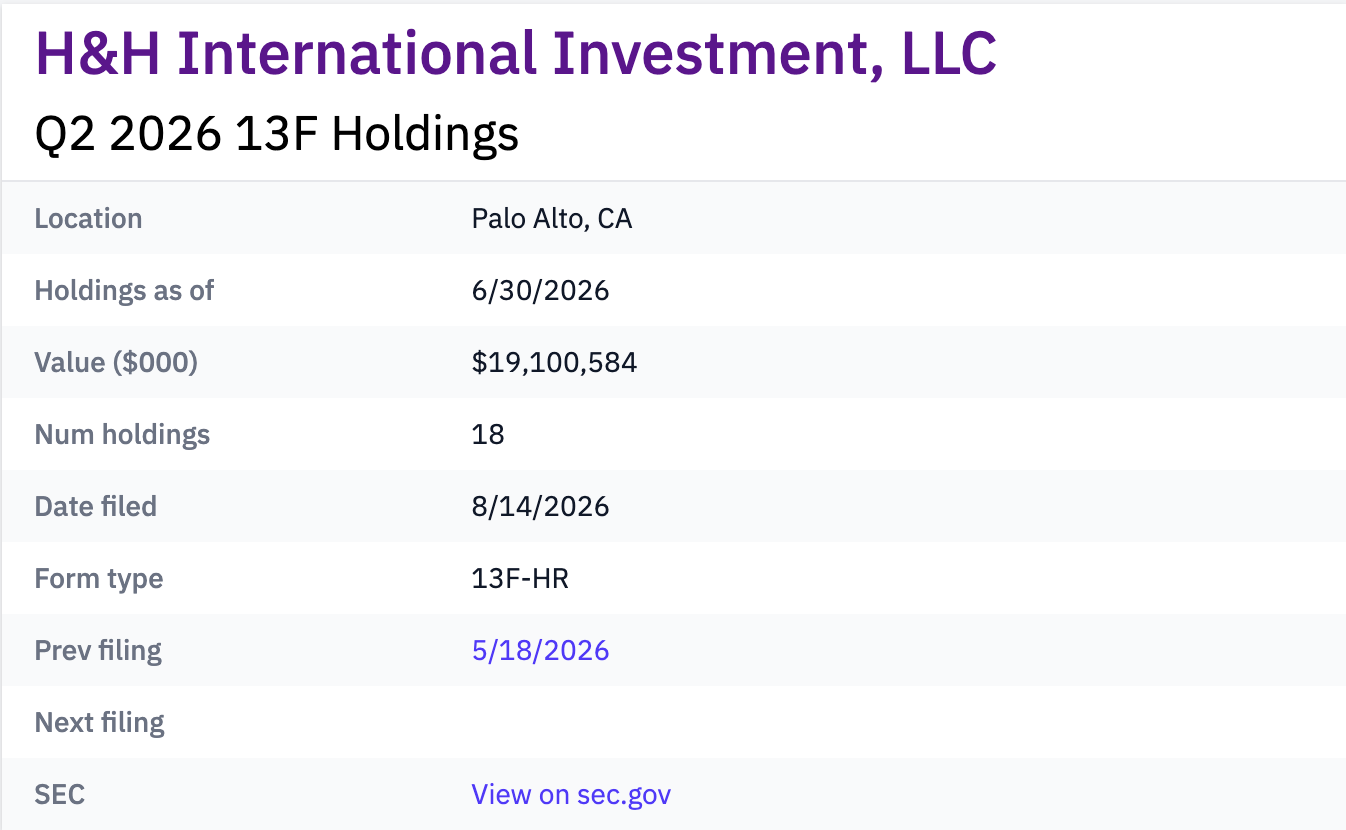
It should be noted that the 13F only discloses long positions in U.S. stocks; therefore, Duan's holdings in Tencent, Pop Mart, Kweichow Moutai, and other assets, as well as his extensive put-selling options strategies to collect premiums, are not reflected in this filing.
Core Holdings
H&H International Investment's holdings remain highly concentrated, with the top five heavy positions collectively accounting for over 88%.
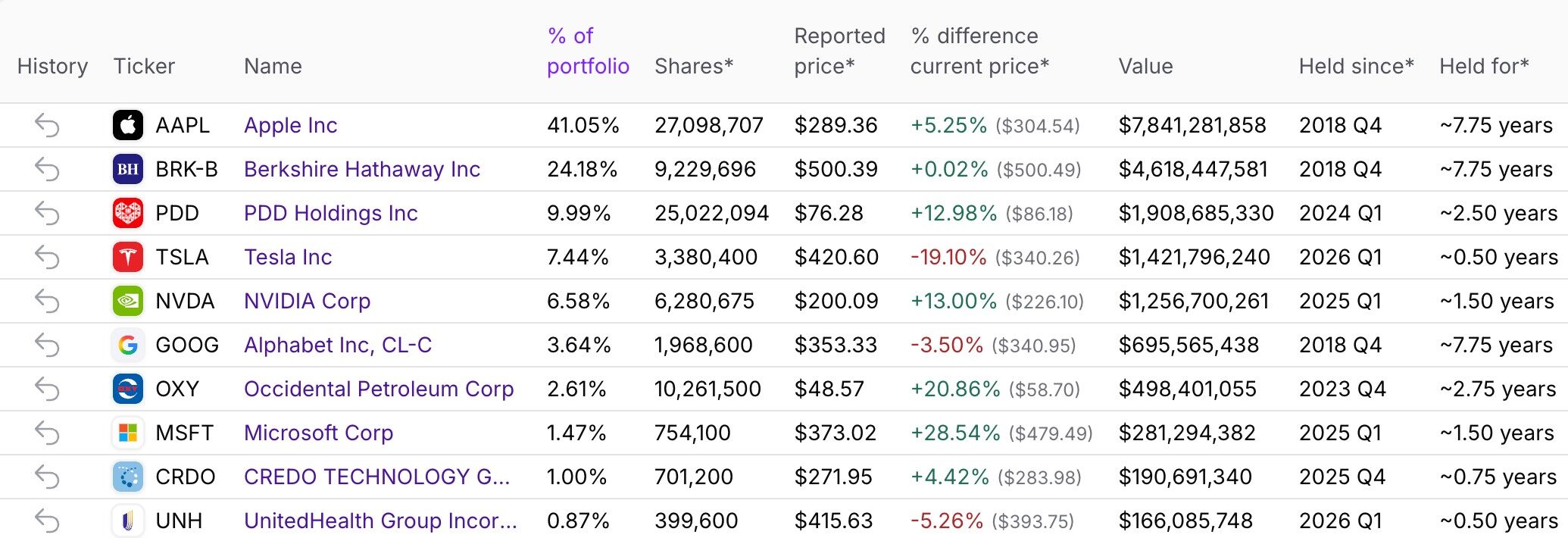
- Apple (AAPL): Approximately $7.841 billion, accounting for 41.05%, firmly holding the top position;
- Berkshire (BRK.B): Approximately $4.618 billion, accounting for 24.18%, forming a "ballast" alongside Apple;
- PDD Holdings (PDD): Approximately $1.91 billion, accounting for 9.99%, jumping to the third-largest holding, marking a significant increase in the weight of Chinese internet stocks within Duan's framework;
- Tesla (TSLA): Approximately $1.42 billion, accounting for 7.44%;
- NVIDIA (NVDA): Approximately $1.26 billion, accounting for 6.58%.
Quarterly Changes
In the second quarter, the most important move by H&H International Investment was the aggressive accumulation of PDD Holdings (PDD) — increasing by 5.2738 million shares, a 26.71% rise, elevating it to the third-largest holding. Simultaneously, it slightly increased its position in Berkshire Hathaway Class B shares (BRK-B), which can be interpreted as long-term endorsement of the value investing framework. Additionally, Alibaba (BABA), which Duan had just liquidated in the first quarter, was repurchased with 301,400 shares (approximately $28.93 million) in the second quarter.
On the reduction side, AI and tech leaders were the primary profit-taking targets for H&H International Investment in Q2. NVIDIA (NVDA) was cut by 7.5631 million shares, a substantial 54.63% reduction; Google (GOOG) was reduced by over 1.7 million shares, down 46.88%; Microsoft was reduced by 25.78%; Apple was also reduced by 1.8469 million shares — marking the second consecutive quarter of selling (341.29 million shares were reduced in Q1). Additionally, TSMC (TSM) and CrowdStrike (CRWD) were completely liquidated.
It's worth noting that Duan's reductions do not simply indicate bearishness on these tech stocks. In late July, he publicly stated he "would add more Google" and expressed intentions to continue seeking lower entry points for NVIDIA through put-selling. In other words, the reductions are more about price and margin of safety judgments than outright rejection of the companies themselves.
Summary Analysis
If this 13F were summed up in one sentence — Sell a bit when it's risen too much, buy a bit when it's cheap, and keep holding the good companies.
Overall, H&H International Investment's Q2 adjustments were relatively clear — minor fine-tuning of ballast positions, increased allocation to Chinese internet stocks, and profit-taking on high-appreciation AI targets. Apple and Berkshire remain core holdings, but after consecutive reductions, Apple's share count has declined for two consecutive quarters. Meanwhile, PDD has become the new third-largest holding, and Alibaba has returned to the portfolio. Although NVIDIA and Google were reduced, this does not reflect bearishness but rather locking in floating gains first; Duan has subsequently expressed his intention to buy them back at lower prices.
This suggests that what Duan Yongping was doing in Q2 wasn't a wholesale pivot to a new theme, but rather re-seeking margins of safety amid valuation shifts — appropriately realizing gains on AI and tech leaders that had appreciated significantly, while re-adding to Chinese internet stocks that had undergone prolonged adjustments and with which he is more familiar.
Himalaya Capital (Li Lu)
Similar to Duan Yongping, another legendary Chinese investor, Li Lu, who manages Himalaya Capital, also chose to significantly increase holdings in PDD Holdings (PDD) during the second quarter.
Report Summary
As of June 30, 2026, Himalaya Capital disclosed a total of 8 holdings in its 13F, with 2 increases and 6 liquidations. The number of positions decreased significantly from 14 in Q1, but the total nominal holding value increased from $3.201 billion in Q1 to $3.703 billion, with further contraction and concentration of positions,