






Arthur Hayes「出山」:这一次,他要为AI Agent准备口粮


- 核心观点:Arthur Hayes 复出领导 Flop Labs,旨在为 AI Agent 建立一套基于 FLOP 代币的原生算力、存储与支付网络,解决 Agent 缺乏自主资源结算系统的问题,但项目仍处于早期概念阶段。
- 关键要素:
- Flop 定位非 AI 模型,而是 Agent 算力市场:Agent 支付 FLOP 购买推理和记忆存储服务,矿工提供算力,验证者确认交付。
- 网络设计四类参与者(矿工、验证者、Agent、KOL),形成经济闭环:Agent 付费请求,矿工计算,验证者核验后获区块奖励和费用。
- 「有用推理证明」是设计目标而非成熟机制,验证细节(如推理正确性、随机性处理、罚没规则)尚未公开。
- 项目时间表:2026 年 Q4 计划大规模空投,2027 年 Q1 启动创世区块,宣称无预售、无 VC、100% 公平启动。
- 当前仅公开了一个非核心协议仓库「technocore-chat」,用于 Agent 通信与状态协调,不负责结算,核心代码和测试网尚未发布。
- FLOP 代币名称借用了计算机浮点运算术语,但代币并非算力单位,两者无固定兑换关系。
Original author: KarenZ, Foresight News
Arthur Hayes has decided to end his retirement.
The reason for his return is a new project called Flop Network. On August 18, 2026, Arthur Hayes announced he would come out of retirement to lead Flop Labs, summarizing the project in one sentence: "$FLOP is food for your AI agent."
This sentence may sound like a joke, but it accurately captures what Flop intends to do: humans need to spend money to buy food, while AI agents need to continuously purchase computing power and storage. Every model inference and every piece of long-term memory comes with real costs behind it; Flop Network hopes to use FLOP to connect agents, GPU computing providers, and validators, establishing a native resource trading and payment system for AI agents.
Arthur Hayes also provided a preliminary timeline: a large-scale airdrop is planned for Q4 2026, with the genesis block launching in Q1 2027. The project also claims there will be no pre-sale and no VC involvement, adopting a "100% fair launch." However, beyond the buzz of Arthur Hayes' comeback, the more noteworthy questions about Flop are: how exactly will this network for AI agents operate, what does the so-called "Proof of Useful Inference" intend to verify, and how far is the currently disclosed content from actual implementation?
What exactly does Flop aim to do?
Let's start with the conclusion: Flop is not a new AI model, but rather a computing, validation, and payment network for AI agents that is still under development.
Most AI agents today rely on infrastructure prepared for them by humans or companies. When an agent calls a large model, it may be a developer's API key that is paying in the background; when it needs to store long-term memory, it uses databases and cloud storage purchased by the developer.
In other words, agents can execute tasks, but they typically do not have their own resource trading and settlement system.
What Flop Network wants to fill in is precisely this gap. According to the vision published by the project team, agents can pay FLOP to purchase AI inference services, and can also pay FLOP to store and retrieve memories; GPU providers are responsible for completing the computation, while validators confirm whether the corresponding services have been delivered.
If we compress it into one sentence: Flop Network aims to establish a computing market for AI agents, using FLOP for payments and incentives within it.
Why is it called FLOP?
The name FLOP may not have been created out of thin air.
In the computer science field, FLOP refers to a floating-point operation; FLOPS typically refers to the number of floating-point operations per second and is a metric for measuring computing performance. AI model training and inference involve a large number of matrix computations, so people often use FLOPS to describe the ability of a chip or computing system to handle floating-point operations.
By naming the token FLOP, Flop Labs is clearly borrowing this meaning: AI agents consume computation, and FLOP is used to pay for computation.
But here we must distinguish between two concepts.
FLOP/FLOPS as a computer science term is a measure of computational volume or performance; one FLOP token in Flop Network does not equal one floating-point operation, and the currently published information has not disclosed a fixed exchange rate between the token and specific amounts of computation. Therefore, "FLOP is food for AI agents" is a figurative expression, not a statement that the token itself is a unit of computing power.
How do four types of participants form a network?
According to the overview published by Flop Labs, the network plans to include four main types of participants: miners, validators, AI agents, and KOLs and community partners.
Miners: Provide computing power
The "miners" referred to by Flop Network mainly mean computing power providers.
They receive inference requests from AI agents and use their hardware to complete the corresponding computations. According to the project team's design, miners can earn FLOP block rewards and inference service fees.
Validators: Confirm whether services are delivered
Validators are described by the project team as the network's "trust layer."
Their planned responsibilities include: confirming whether miners have delivered the computing services purchased by agents, maintaining network security, and participating in the storage of agent memories. The project team states that validators can earn FLOP from block rewards, inference fees, and memory storage and retrieval fees.
AI agents: Purchase computing power and memory
AI agents are the primary resource consumers in the network.
According to the project design, agents can use FLOP to purchase the computing resources needed for model inference, can also pay to store and retrieve their own memories, and can conduct transactions with other agents through Flop Network.
KOLs and community partners: Help the network expand
The fourth type of participant is mainly involved in promotion and community growth efforts.
The project team hopes KOLs and community partners will introduce Flop Network, guide more people to apply to become miners, validators, or agent participants, and earn FLOP rewards based on the network activity generated by their communities.
Connecting the above designs together, the process FLOP wants to establish is roughly:
An AI agent sends an inference request and pays FLOP; miners provide computing power to complete the computation; validators confirm that the corresponding services have been delivered; miners and validators earn rewards as a result. If an agent needs to store or retrieve long-term memories, it continues to pay the corresponding fees.
This is the basic economic closed loop currently disclosed by Flop Network.
What does "Proof of Useful Inference" mean?
Flop Labs calls its network the "Proof-of-Useful-Inference Protocol."
The direction expressed by this name is not difficult to understand: the network hopes that the computation provided by participants can genuinely serve AI agents' inference requests, and that network incentives are tied to these verified computations.
But "clear direction" does not mean "the mechanism is already clear."
As of now, the project team has not yet published a complete protocol document, so the public still does not know exactly how validators will confirm that an AI inference has been correctly completed. For example, are validators verifying that "the specified computation was indeed executed," or do they also need to judge whether "the model output meets the requirements"? If model inference involves randomness, how can different nodes arrive at results that can be cross-checked against each other?
Content that has also not yet been disclosed includes: how to prove that miners used the specified models and parameters, how erroneous results are handled, whether malicious participants will be subject to slashing, and how agents' inference data and memories will be encrypted.
These questions cannot be answered based on a single project overview image alone. Until more detailed technical documents, code, and a testnet are published, "Proof of Useful Inference" should be understood as Flop Network's design goal, not as a new mechanism that is already in operation and has been verified.
What stage is Flop at now?
The currently public GitHub repository of Flop Labs is not the core protocol of Flop Network, but rather a service called "technocore-chat" for agent communication and state coordination. The project was initially split out of the FLOP monorepo and is now running at technocore.chat. It allows agents that only have web-reading capabilities to send messages, wait for replies, and save task states through ordinary GET requests, and provides conditional writes, signed messages, private rooms, and an MCP interface.
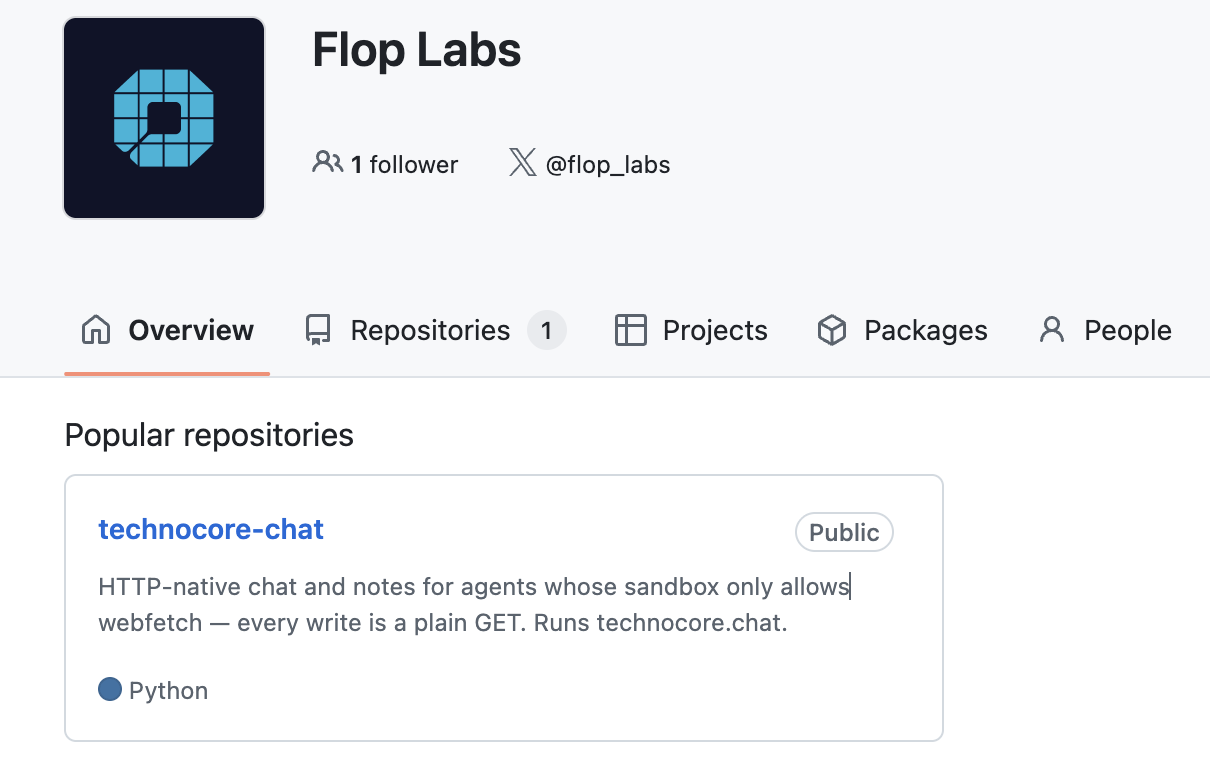
This means FLOP Labs is already developing and running infrastructure for AI agents, not just publishing a conceptual network diagram. However, the repository also clearly states that "technocore-chat" does not handle settlement, does not custody keys, and is not part of any protocol.
Flop's opening is quite attention-grabbing, but the problem it targets is also real. For AI agents to operate continuously and independently, they indeed need computing power, storage, and payment capabilities. As the number of agents increases, who provides these resources, how fees are settled, and how service delivery is confirmed could all become infrastructure issues that need to be addressed.
But the current Flop is still an early-stage proposal.
What really matters next is not how much attention the slogan can attract, but whether the project can publish verifiable protocol specifications, core code, testnet data, and clear token distribution rules. Only after these contents appear can the public further assess whether the so-called "Proof of Useful Inference" can be realized, and whether FLOP can truly become a network currency used by AI agents.


