






A股新「股王」诞生,如何合理估值长鑫?


- Quan điểm chính: Trường Tân Khoa Kỹ, với tư cách là công ty đầu ngành DRAM IDM thuần túy trên sàn A, đang trong giai đoạn bùng nổ của chu kỳ đảo chiều và gia tăng thị phần. Các công ty chứng khoán có sự khác biệt đáng kể trong định giá sau IPO của công ty, tập trung vào những đánh giá khác nhau về trần thị phần dài hạn và mức phí bảo hiểm tăng trưởng: Chứng khoán Đông Bắc định giá 3,2-5,7 nghìn tỷ nhân dân tệ, trong khi Nomura đưa ra mục tiêu giá tích cực lên tới 7,76 nghìn tỷ nhân dân tệ.
- Các yếu tố chính:
- Trường Tân Khoa Kỹ niêm yết trên Sàn giao dịch Khoa học công nghệ (STAR Market) hôm nay với giá trị vốn hóa phát hành khoảng 579,1 tỷ nhân dân tệ, nhưng sự khác biệt trong định giá giữa Chứng khoán Đông Bắc và Nomura lên tới 2 nghìn tỷ, khác biệt cốt lõi nằm ở giả định về thị phần dài hạn (17% so với 25%-30%) và bội số P/E (10-15 lần so với 20 lần).
- Chứng khoán Đông Bắc sử dụng ba phương pháp độc lập: định giá tương đối theo thị phần, định giá P/E theo lợi nhuận và định giá theo năng suất trên mỗi đơn vị, sau khi loại trừ lợi ích cổ đông thiểu số, đều hội tụ về khoảng giá trị hợp lý từ 3,2 nghìn tỷ đến 5,7 nghìn tỷ nhân dân tệ.
- Nomura đưa ra mục tiêu giá 116 nhân dân tệ (ngụ ý mức tăng 1239%), dựa trên ba luận điểm: nguồn cung lưu trữ toàn cầu thắt chặt về mặt cấu trúc, tốc độ gia tăng thị phần của Trường Tân được đẩy nhanh, và mức phí bảo hiểm tăng trưởng kép từ sự chồng chéo giữa thay thế nội địa và nhu cầu AI.
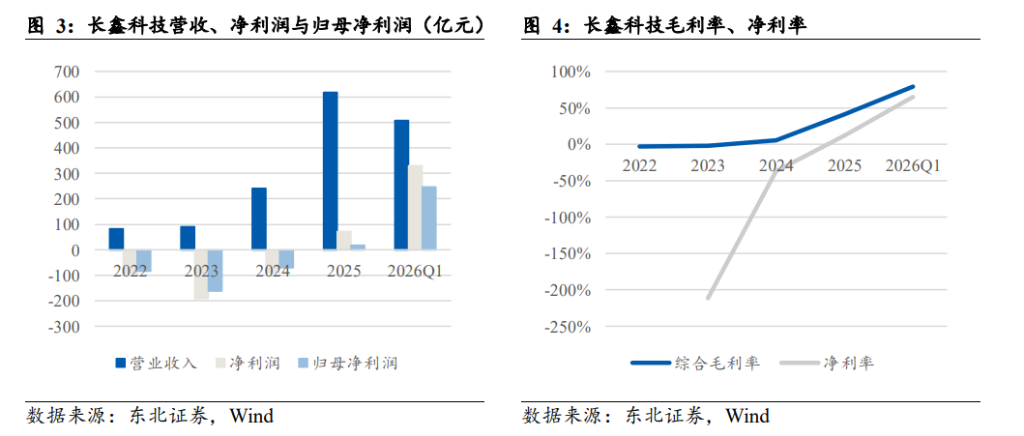
- Bước ngoặt tài chính của công ty đã xuất hiện nhờ chu kỳ tăng giá DRAM: Biên lợi nhuận gộp quý 1 năm 2026 tăng lên 79,16%, lợi nhuận ròng thuộc về công ty mẹ trong quý đạt 24,762 tỷ nhân dân tệ, ban lãnh đạo dự kiến lợi nhuận ròng thuộc về công ty mẹ nửa đầu năm 2026 đạt 50-57 tỷ nhân dân tệ.
- Thị phần DRAM toàn cầu hiện tại của Trường Tân là 7,67% (đứng thứ nhất Trung Quốc / thứ tư thế giới), kế hoạch công suất mở rộng từ 270.000 tấm/tháng vào năm 2025 lên 450.000 tấm/tháng vào năm 2027, sản phẩm đã lọt vào chuỗi cung ứng của Alibaba, Tencent, ByteDance và các nhà sản xuất điện thoại di động chính thống.
Original Author: Long Yue
Original Source: Wall Street News
ChangXin Memory Technologies (CXMT) (688825) will be listed today, becoming the largest IPO on the STAR Market. The IPO issuance price is 8.66 RMB, with a total share capital of 66.881 billion shares (before the exercise of the over-allotment option), and a total market capitalization at issuance of 579.188 billion RMB. However, the market clearly does not intend to linger at this price.
Analyst Li Jiu of Northeast Securities valued CXMT from three independent perspectives in a research report, with conclusions converging in the range of 3.2 to 5.7 trillion RMB. On the same day, Nomura initiated coverage with a Buy rating and a target price of 116 RMB, implying an upside of 1,239% and a corresponding market cap of approximately 7.76 trillion RMB—1.4 times the upper limit of Northeast Securities' estimate.The core disagreement between the two institutions lies in their judgment of CXMT's long-term market share ceiling – Northeast Securities uses a base case assumption of 17%, while Nomura is betting on a larger share space and higher growth premium.
The above valuations might not be exaggerated. CXMT is a unique presence in the A-share market to date: a pure-play DRAM IDM leader with full capabilities in both design and manufacturing, currently in a performance explosive phase driven by a "cyclical reversal + market share increase." The company's products cover DDR4/5 and LPDDR4X/5/5X, and have entered the supply chains of Alibaba, Tencent, ByteDance, and major mobile phone manufacturers. According to Omdia data, in the fourth quarter of 2025, the company held a global market share of 7.67%, ranking first in China and fourth globally. Benefiting from memory price hikes and the volume ramp-up of high-end products, the company's earnings elasticity is accelerating.
The DRAM supply-demand gap persists, and CXMT enjoys the dual dividends of "both volume and price increases + domestic substitution." The real question is not whether it is valuable, but which yardstick should be used to measure it.
Perspective 1: Relative Market Share Valuation – Target Market Cap ~3.49 Trillion RMB
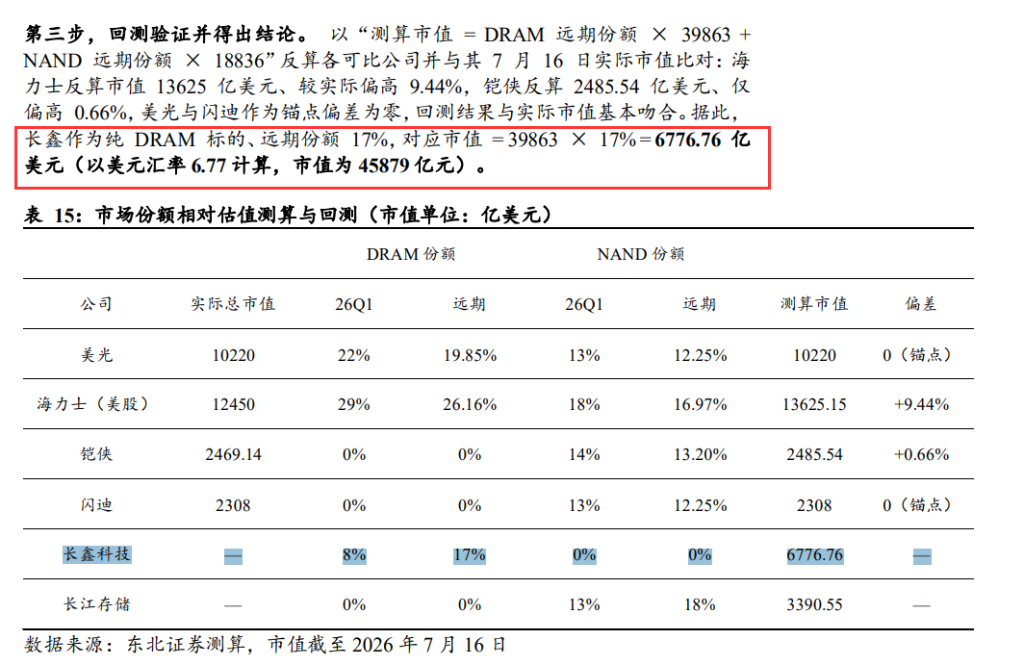
Logic: Since DRAM is a globally unified market, the market caps of overseas listed memory companies already incorporate the market's pricing for "each percentage point of share." Use the market caps of comparable US-listed companies to back-solve "how much market cap corresponds to each 1% of long-term global share," then multiply by CXMT's long-term share.
Operation: Micron and SanDisk have identical NAND shares (both at 13%). Therefore, Micron's market cap (a DRAM and NAND company) minus SanDisk's market cap (a pure NAND company) equals the market cap corresponding to Micron's DRAM business – $1,022 billion - $230.8 billion = $791.2 billion. Dividing this by Micron's 19.85% long-term DRAM share yields approximately $39.86 billion for each 1% of long-term DRAM share.
Conclusion: CXMT, as a pure DRAM entity with a long-term share of 17% (currently ~8%), corresponds to a market cap of approximately $677.676 billion, equivalent to about 4.58 trillion RMB (at an exchange rate of 6.77). After deducting the minority interest portion of ~24%, the parent company basis is approximately 3.49 trillion RMB.
Backtesting: The back-calculated market cap for SK Hynix was only 9.44% higher than the actual value, and for Kioxia, only 0.66% higher, indicating a strong alignment with actual market caps.
Perspective 2: Profit Decomposition PE Valuation – Target Market Cap 2.85 Trillion to 4.27 Trillion RMB
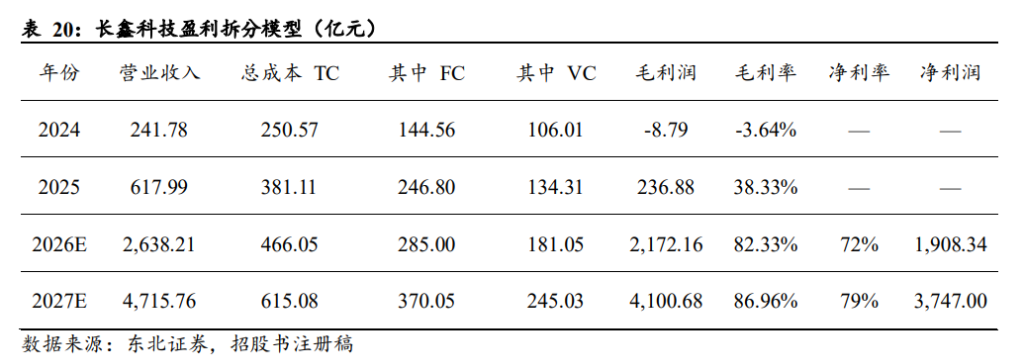
The second method is more fundamental: without relying on external anchors, it directly predicts CXMT's own profits. The cost structure of memory fabs is highly standardized, with fixed costs dominated by depreciation, determined by capital expenditure scale; variable costs vary linearly with shipment volume. As the prospectus did not disclose actual wafer capacity data, the calculation uses the original value of fixed assets as a proxy for capacity, multiplies by utilization rate and sell-through rate to estimate sales volume, and then combines with ASP to derive revenue.
Logic: Decompose revenue (capacity × utilization rate × sell-through rate × ASP) and costs (fixed cost depreciation + variable costs), forecast net profit, and apply a PE multiple.
Key Forecasts:
- 2027 Revenue: 471.6 billion RMB, Gross Margin: 86.96%, Net Profit: 374.7 billion RMB (total basis)
- Deducting minority interests (assumed constant at 24%), Net Profit Attributable to Parent: ~284.8 billion RMB
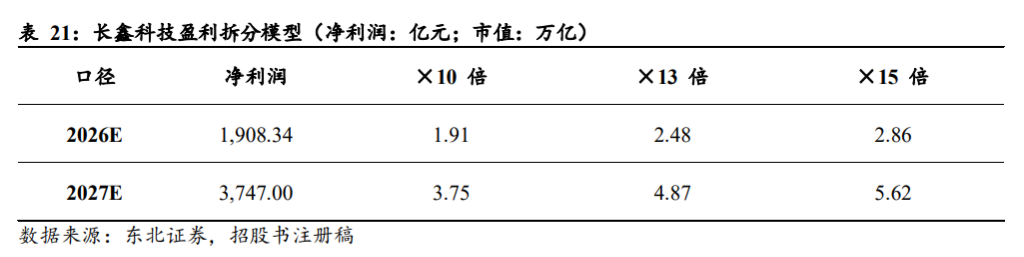
Valuation: Northeast Securities notes that Micron and SK Hynix trade at 7.51x and 7.94x 2027 P/E respectively. However, as CXMT is in a rapid market share increase phase (with a projected long-term share of ~30%), they apply a growth premium. Using a 10-15x P/E multiple, after deducting minority interests, the implied market cap on a parent-company net profit basis is approximately 2.85 trillion to 4.27 trillion RMB.
Perspective 3: Relative Capacity Valuation – Target Market Cap 3.22 Trillion to 3.99 Trillion RMB
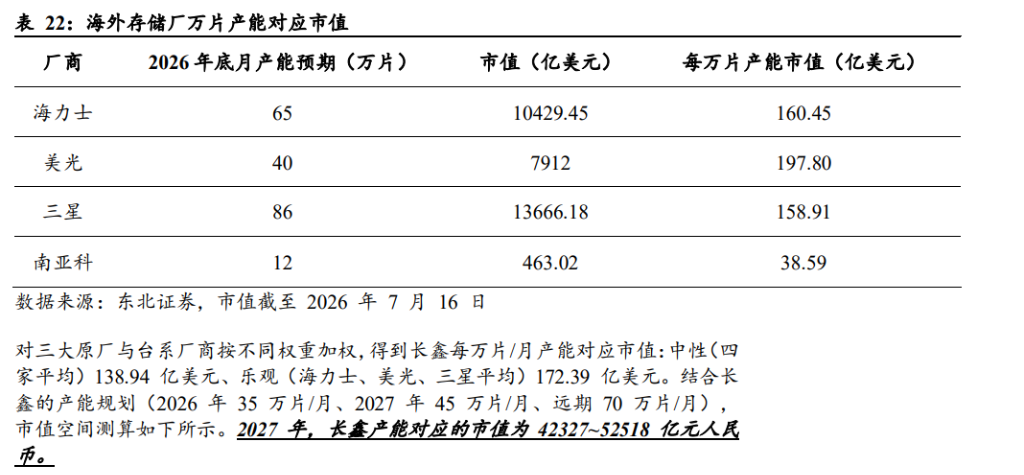
Logic: Divide the market caps of overseas memory fabs by their monthly capacity to derive "market cap per 10k wafers/month of capacity," then multiply by CXMT's capacity plan.
Reference Frame: The market cap per 10k wafers/month for the three major incumbents ranges from $15.8 billion to $19.8 billion – SK Hynix $16.045 billion, Micron $19.78 billion, Samsung $15.891 billion.
Conclusion: With CXMT's capacity projected at 450k wafers/month in 2027, the corresponding market cap would be:
- Bullish scenario (average of three majors at $17.2 billion/10k wafers): 5,251.8 billion RMB
- Neutral scenario (including Taiwan-based manufacturers average at $13.9 billion/10k wafers): 4,232.7 billion RMB
After deducting minority interests, this corresponds to approximately 3.22 trillion to 3.99 trillion RMB.
Summary of Three Methods: Converging on 3.2 Trillion to 5.7 Trillion RMB
Northeast Securities points out that CXMT's minority interest portion of net profit was as high as 73.76% in 2025, much higher than Samsung, SK Hynix, and Micron (all below 1%), so valuations must exclude this impact.
Assuming the minority interest portion remains at 24% in 2026 and 2027, the conclusions from the three methods are as follows: Reasonable valuation after excluding minority interests is 3.2~5.7 trillion RMB.
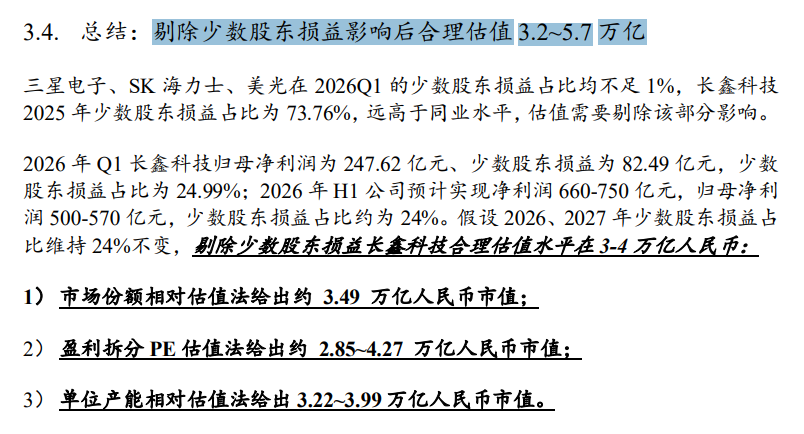
The three perspectives use different data and different logical chains, yet the final intervals on a parent-company basis all fall around 3 to 4.3 trillion RMB. This convergence itself is a signal: under the current share and capacity assumptions, pricing at this magnitude has strong self-consistency.
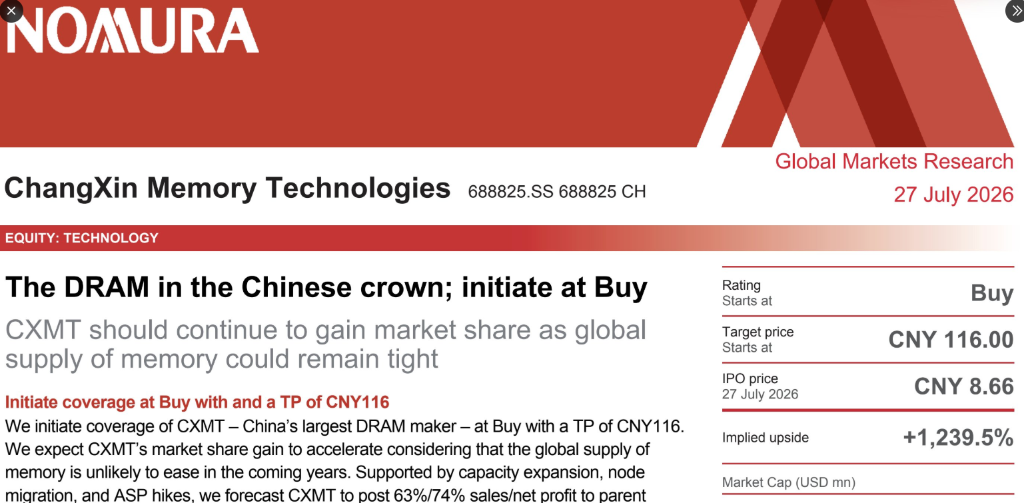
Nomura: Target Price 116 RMB, Implied Upside of 1,239%
On July 27, Nomura also initiated coverage on ChangXin Memory Technologies, offering a more aggressive view.
The bank initiated coverage with a "Buy" rating and a target price of 116 RMB, corresponding to approximately 20x P/E – fully double Micron's current valuation (~10x), and more than double SK Hynix's current valuation.
Based on the IPO price of 8.66 RMB, the 116 RMB target price implies an implied upside of 1,239.5%, corresponding to a market cap of approximately 7.76 trillion RMB.
This figure far exceeds Northeast Securities' upper valuation limit of 5.7 trillion RMB. The roughly 2 trillion RMB gap between them essentially represents different bets on two core variables: where CXMT's market share ceiling lies, and how much growth premium the market should assign to this company.
2026 is Just the Starting Point! Domestic Substitution Plus AI Demand: Nomura Gives CXMT a Dual Growth Premium
Nomura's rationale for a 20x P/E premium is built on three core judgments.
First, structural tightening on the supply side will persist for several years. The bank's central thesis is: "Global memory supply is unlikely to be loose for several years." The capital expenditures of Samsung, SK Hynix, and Micron have largely shifted towards HBM and advanced process nodes, structurally constraining new supply of general-purpose DRAM. This means CXMT's target market, general-purpose DRAM, will maintain an undersupplied state for a considerable period, not the traditional memory cycle of "rising for two years, falling for two years."
Second, CXMT's market share growth logic is "accelerating," not "linear." The bank believes that as CXMT's capacity continues to expand and its process technology migrates from the 4th to the 5th generation, its market share growth in the global general-purpose DRAM market will exceed market expectations. The current share of ~8%, in Nomura's model, corresponds to a long-term potential far exceeding Northeast Securities' assumed 17% upper limit.Back-calculating from the 7.76 trillion RMB target market cap, Nomura's implied long-term share assumption likely falls in the 25% to 30% range, or even higher.
Third, domestic substitution combined with AI demand creates a dual growth premium. The bank argues that CXMT is not just a memory cycle play, but also a "domestic substitution" thematic play. Chinese cloud and mobile phone manufacturers' willingness to purchase domestic DRAM is continuously rising, providing CXMT with additional incremental demand independent of the global cycle. Concurrently, AI servers are driving exponential growth in DRAM demand, with server DRAM content per unit being nearly 80 times that of a smartphone. This shift in demand structure will support a structural upward move in the ASP floor.With these two logics superimposed, Nomura believes CXMT should command a higher valuation premium over its overseas counterparts, not a discount.
In other words, Nomura does not see 2026 as a peak, but merely as a starting point.
In its specific financial forecasts, Nomura projects CXMT's sales and net profit attributable to parent to grow by 63% and 74%, respectively.Key drivers include: capacity expansion from 270k wafers/month in 2025 to 450k wafers/month in 2027, increased value per wafer from process node migration, and the continued upward movement in average DRAM prices amidst tightening supply.Nomura's absolute earnings forecasts are more aggressive than Northeast Securities', and the 20x P/E multiple assumption further amplifies the final valuation result.
Supporting this more aggressive assumption is supply-demand data: global general-purpose DRAM capacity calculations indicate a persistent gap in 2027; DRAM contract prices surged 93% to 98% quarter-over-quarter in Q1 2026, far exceeding previous expectations; CXMT's gross margin in Q1 2026 had already risen to 79.16%, with a single-quarter net profit attributable to parent of 24.762 billion RMB.
The magnitude of the price upcycle is constantly correcting the input assumptions of all models.
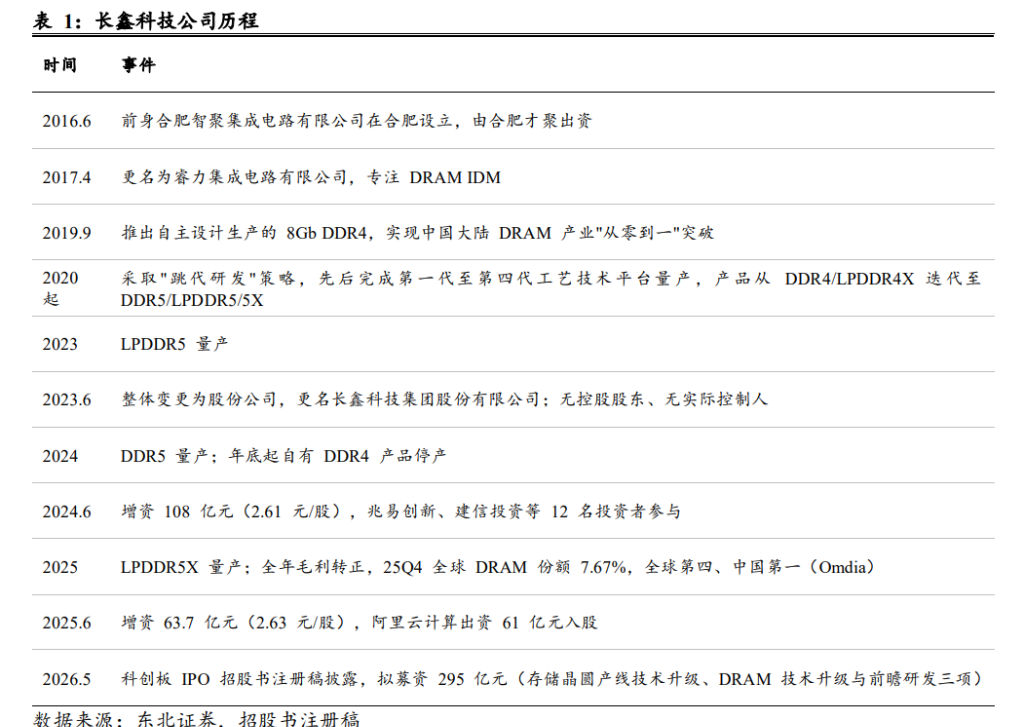
From Zero to Global Number Four: CXMT's Seven-Year Journey
In 2019, ChangXin Memory Technologies (formerly known as Innotron Memory) launched Mainland China's first mass-produced 8Gb DDR4, achieving a breakthrough for domestic DRAM from zero to one.
Seven years later, the company is China's number one and the world's fourth-largest DRAM manufacturer. According to Omdia data, CXMT held a global market share of 7.67% in Q4 2025.
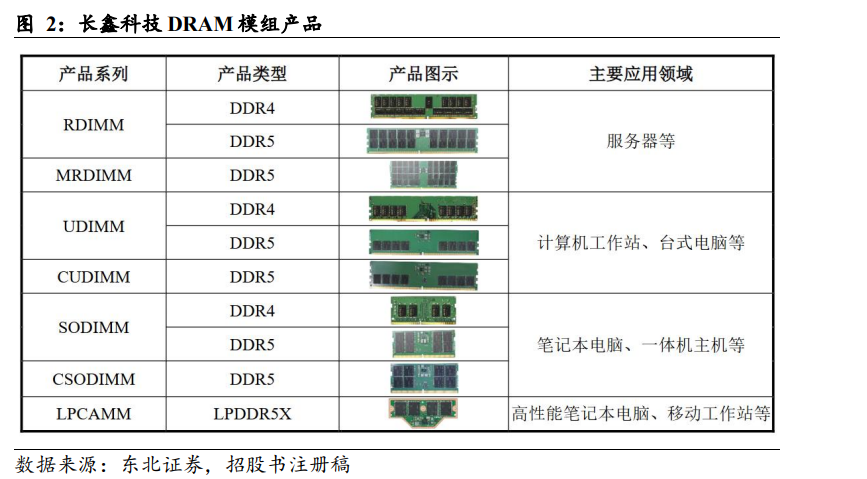
On its product line, CXMT covers the full generational spectrum of DDR4/5 and LPDDR4X/5/5X. It stopped production of its proprietary DDR4 at the end of 2024, shifting capacity entirely towards high-value products like DDR5 and LPDDR5/5X. Its customers include Alibaba, Tencent, ByteDance, and major mobile phone supply chains.
In terms of capacity, the company operates three 12-inch wafer fabs—two in Hefei and one in Beijing. Northeast Securities forecasts capacity will expand from 270k wafers/month in 2025 to 450k wafers/month in 2027, with its global share rising from 14% to 17%.
Financial Inflection Point: Stunning Profit Elasticity in an Upcycle
CXMT's financial trajectory follows the classic script for a heavy-asset memory fab – fixed costs are front-loaded, causing losses in a downcycle, and profits are rapidly released in an upcycle.
Key milestones are as follows:
- 2025: Net profit attributable to parent swung from a loss of 16.340 billion RMB to a profit of 1.875 billion RMB; comprehensive gross margin rose to 40.99%, essentially in line with Samsung's 39.38%.
- Q1 2026: Single-quarter revenue of 50.8 billion RMB (+719% YoY), gross margin of 79.16%, net profit attributable to parent of 24.762 billion RMB.
- H1 2026: Management expects revenue of 110-120 billion RMB and net profit attributable to parent of 50-57 billion RMB.
The core driver of the profit explosion is price. According to TrendForce's latest survey in June 2026, general-purpose DRAM contract prices surged approximately 93%-98% quarter-over-quarter in Q1 2026, far exceeding the previous double-digit forecast range.
Northeast Securities also lists four main risks:
- Demand Falling Short of Expectations: Slowdown in AI server build-out or sluggish recovery in consumer electronics.
- Cyclical Price Downturn: The 2022-2023 period saw a deep downturn with prices falling by up to 50% from cycle highs.
- Capacity and Technology Iteration Falling Short of Expectations: Delays in the R&D of the 5th generation process platform could affect volume and price realization.
- International Trade Friction and Supply Chain Constraints: Escalating geopolitical tensions could exacerbate instability in the industrial chain.


