SpaceX Listing Core Window: July 7 Nasdaq Inclusion Date and Post-Q2 Earnings Lock-Up Expiry


- Key View: SpaceX is about to conduct its IPO at an offering price of $135, with an initial market capitalization of $1.75 trillion. Due to the extremely low initial free float (4.3%), compounded by passive buying from rapid index fund inclusion, the early listing period could create a "supply vacuum," potentially doubling the stock price. Simultaneously, the market speculates that Musk might use this opportunity to push for a merger of equals between SpaceX and Tesla to resolve his personal tax issues and build a capital empire.
- Key Factors:
- The extremely low free float (4.3%), combined with the fast-inclusion rules of indices like Nasdaq and FTSE Russell, is expected to generate $8-18 billion in passive buying on July 7, creating strong upward price momentum.
- The lock-up expiry for early shares is precisely tied to the Q2 earnings call. However, excluding the founder Musk's strict lock-up period, the actual selling pressure is only 10%-15%, lower than the market's expected 30%.
- There is market speculation about a "merger of equals": Between the stock price peak on July 7 and the earnings lock-up expiry in late July, SpaceX might announce a "stock-for-stock" merger with Tesla to address the $7 billion tax liability Musk faces from needing to exercise options before August.
- SpaceX's IPO has brought in investment banks like Schwab and Morgan Stanley, which have previously been at odds with Musk. This is seen as a move to buy their support in future Tesla merger votes through significant economic incentives.
- SpaceX's governance structure (super-voting rights, mandatory arbitration) provides the founder with absolute control. This makes it a superior vehicle for acquiring Tesla, aiming to fundamentally resolve the issue of founder control.
Original Author: Xu Chao
Original Source: Wall Street News
SpaceX is set to have a historic IPO this Friday, with the offering price set at $135, giving it an initial paper market value of $1.75 trillion. As a super unicorn of a scale rarely seen on Wall Street, the trajectory of its stock price post-listing and the associated chip games are attracting fervent attention from global investors.
Tesla community thought leader and former Wall Street analyst Alexandra Mertz (known online as Tesla Boomer Mama) recently engaged in an in-depth conversation with host Herbert. Mertz believes that due to the extremely low initial public float (only 4.3%), SpaceX could experience an unprecedented chip vacuum period in the early days of trading.
According to a Bloomberg report on Wednesday, index rebalancing forecaster Intropic estimates that because Nasdaq, FTSE Russell, and MSCI all plan to quickly include SpaceX in their indices, passive investors are expected to hold approximately 30% of SpaceX’s outstanding shares just 15 trading days after its listing. In contrast, under the previous, slower inclusion rules, this proportion would only be about 4%.
Academics and market observers warn that this scale of mechanical demand, coupled with market euphoria surrounding Musk, SpaceX, and artificial intelligence, could form a self-reinforcing feedback loop, driving the stock price continuously higher.
Mertz believes investors need to closely watch two critical, highly tradeable time points: the peak passive buying wave triggered by the "official inclusion in the Nasdaq 100 on July 7th," and the "two days after the Q2 earnings call in the second half of July," which coincides with the expiration of early shareholder lock-ups and potential merger announcements. Hidden behind this meticulously engineered IPO is a vast capital chess game involving Musk solving his own $7 billion tax event and leveraging Wall Street investment banks for quid pro quo interests.

Key Takeaways
July 7th Nasdaq Inclusion Day: Nationwide passive fund building will collide head-on with historically low public float. Market estimates for this passive buying range from $8 billion to $18 billion (closer to $15 billion). Since old shareholders cannot sell their shares at this time, the market's public float drops to its lowest point.
Two Days Post-Q2 Earnings Lock-up Expiry: The initial unlocking amount appears to be 30%, but after deducting the absolute 1-year lock-up period for Musk's own 50% stake, the actual selling pressure is only 10%-15%.
July "Merger of Equals" Speculation: Musk faces a $7 billion tax pressure from exercising his Tesla stock options before August 15th. Announcing a "stock-for-stock" merger of equals between the two companies in the window between the July 7th SpaceX stock price peak and the late July earnings lock-up expiry is a highly clever capital move consistent with Musk's style.
Wall Street Banks' Quid Pro Quo: Schwab, Morgan Stanley, and JPMorgan, former major institutional "adversaries" of Tesla, have rarely been allocated a fat slice of the SpaceX IPO quota. This could be Musk's way of locking in their institutional "yes votes" for the merger vote at the November shareholder meeting.
I. Extremely Low Public Float (4.3%): Grok Model Predicts Stock Price Could Double by July 7th
SpaceX (tentative ticker SPCX) priced its IPO at $135, giving it an initial paper market cap of $1.75 trillion. The planned offering is 555 million Class A common shares (amounting to approximately $7.5 billion in proceeds). With current subscription interest already exceeding the offering by up to 2 times, it is highly probable that underwriters will fully exercise the "greenshoe option" (over-allotment option) within 30 days, increasing total proceeds to $8.6 billion.
Despite the large fundraising scale, the issued Class A shares represent only 4.3% of the total market value. This means SpaceX's public float will be extremely tight in the early days of listing, leading to a strong chip vacuum period within the first 15 trading days.
First Key Time Point: July 7th This day is the first trading day after the Independence Day weekend and the 15th trading day post-IPO. The Nasdaq 100 index will officially include SpaceX.
On this day, major index funds like Vanguard's CRSP and FTSE Russell must passively build positions unconditionally in the open market based on a float-adjusted mechanism.
Market estimates for this passive buying range from $8 billion to $18 billion (closer to $15 billion). Since old shareholders cannot sell their shares at this time, the market's public float drops to its lowest point.
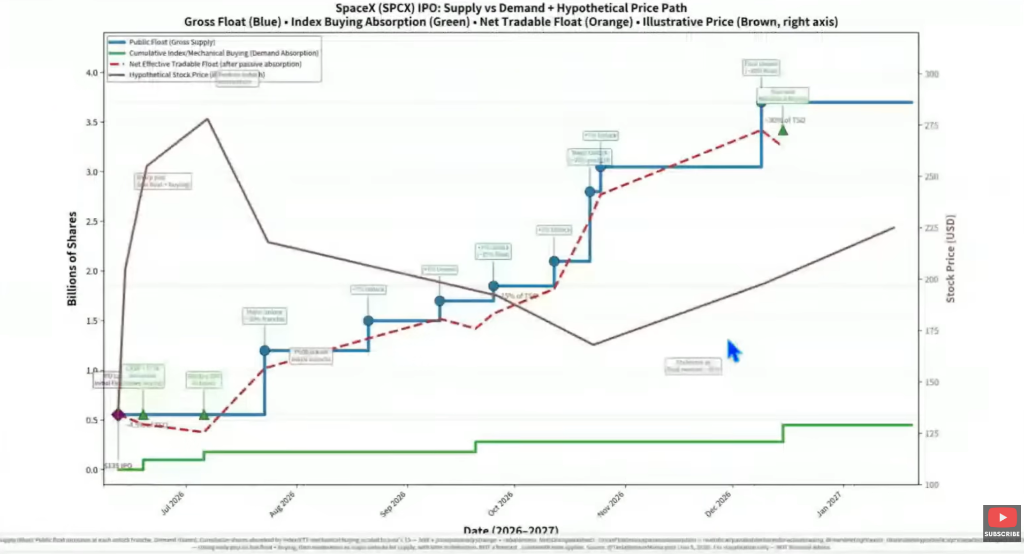
II. A "Precision Unlocking" Tied to Earnings: Halving the Selling Pressure, Building a Solid Floor at $135
Conventional IPO lock-up periods are usually a simple one-size-fits-all (e.g., 180 days). However, SpaceX's lock-up expiry schedule is precisely tied to the Q2 earnings conference call.
Second Key Time Point: Two Business Days After the Q2 Earnings Call (Estimated around July 22nd or 29th)
Market rumors suggest that following the Q2 earnings call, early insider shareholders will face the first large-scale unlocking of up to 30%, causing panic over selling pressure.
However, Alexandra clarified in the conversation that analysts in the market have ignored the core equity structure: A major portion (about 50%) of the early insider shareholders is Musk himself. And Musk, as the founder, has a strict 366-day lock-up period for his shares.
Therefore, the new unlocked shares potentially flowing to the public market two days after the Q2 earnings call is not 30%, but actually only 10% to 15%.
Furthermore, the intentions of the major early shareholders are highly aligned:
Ron Baron has clearly stated he "won't sell a single share and will buy another $1 billion in the open market";
BlackRock has publicly expressed a strong intention to buy between $5 billion and $10 billion at the IPO, which exceeds the available supply in the market;
Ark Invest (ARC), while limited by the 10% single-stock holding cap and may selectively sell old shares, plans to increase its SpaceX position in other new open funds.
III. The July "Goldilocks" Scenario: The $7 Billion Tax Event and the "Merger of Equals" Speculation
Sharp money on Wall Street is piecing together all the breadcrumbs. Alexandra points out that Musk faces a significant personal timeline: He must exercise his stock options from the 2018 Tesla compensation plan by August 15th of this year. This will trigger a massive personal tax event of $7 billion (due in January 2028).
In the days leading up to and including the option exercise on August 15th, the higher Tesla's stock price, the more favorable it is for Musk's personal net share settlement or collateralized loans. This isn't pocket change; this is a massive multi-billion dollar game.
Therefore, the most plausible "Goldilocks scenario" being whispered on Wall Street is emerging:
- Timing: During the power vacuum between the completion of the Nasdaq inclusion on July 7th (when SpaceX's stock price is potentially double, pushing market cap to a peak) and the late July earnings lock-up expiry (when new shares flood in).
- Strategic Move: SpaceX and Tesla announce a merger of equals conducted via a "stock-for-stock" exchange.
This type of merger would force the stock prices of both companies into a perfectly synchronized "lock step" driven by market arbitrage funds. This strategy, using positive news from both companies to boost valuations driven by "non-sellers" in the public market, would perfectly solve Musk's tax funding pressure.
IV. Wall Street Banks' "Political Arbitrage": Trading IPO Fat for November Election Yes Votes
The biggest suspense in the merger script lies in the November shareholder vote.
According to Alexandra's precise calculations: After exercising his options, Musk will hold approximately 17.5% voting power in Tesla. Passing the merger requires an absolute majority of "50% plus one vote" of all outstanding shares. This means Musk still needs to secure 32.5% of the votes.
Currently, the retail shareholder percentage in Tesla has dropped from over half in the past to 31%, while institutional big whales have been aggressively accumulating shares in Q1 of this year. To succeed, support from big whales like Vanguard and BlackRock (together holding over 15%) is essential. BlackRock CEO Larry Fink has already been mending fences with Musk at events like Davos. The institutional base (~35%) seems tentatively secure. The remaining 15% gap requires mobilizing half of the 31% retail base.
Interestingly, SpaceX's IPO unusually features Charles Schwab, Morgan Stanley, and JPMorgan as lead underwriters and distributors. These three institutions were the leading "adversaries" who cast dissenting votes in the past Tesla compensation case and the Texas relocation case:
Wall Street's Political Bet: As perhaps the most profitable and prestigious IPO quota in Wall Street history, no investment bank can resist the billions in fees and client prestige.
By handing this "fat" to these three banks, Musk's implicit leverage is clear: take the SpaceX money, and in turn, manipulate your custodial shares to vote "yes" for the merger at the November Tesla shareholder meeting.
Wall Street is profit-driven. Faced with overwhelming economic interests, they will unhesitatingly compromise.
V. "The Perfect Fortress": Why Must It Be SpaceX Acquiring Tesla?
Addressing some technical questions from investors, the interview provides an answer with deep legal and corporate governance insights:
1. SpaceX doesn't have $100 billion in cash on its books. How can it complete the acquisition?
This is definitely not a cash deal; it's 100% pure equity swap. SpaceX currently has an authorized share capital limit of up to 36 billion shares. After the IPO, only about 13 billion shares are issued, leaving massive room for issuance. It can directly issue new shares in exchange for all Tesla shares.
2. Why can't it be the other way around, with Tesla acquiring SpaceX?
Because SpaceX's S-1 prospectus establishes a perfect "founder's fortress."
Musk suffered greatly at Tesla from malicious short-sellers, activist investors, and Delaware judges. SpaceX's governance structure was meticulously designed from the ground up to prevent this:
Super Voting Rights: SpaceX's Class B shares carry 10x super voting rights, and 97% are firmly controlled by Musk himself;
Judicial Firewall: All shareholder lawsuits are forced into private arbitration, preventing public court filings and effectively disarming malicious litigation lawyers;
Succession Clause: Even if Musk unfortunately passes away, the super control of his Class B shares would be directly transferred to his family.
Tesla's current governance structure has inherent flaws, preventing Musk from gaining absolute control. Therefore, only by integrating Tesla entirely under SpaceX's legal framework can Musk permanently protect his absolute control over the entire business empire, shielding it from activist investors and local courts.
The following is the full text of the interview, translated with AI assistance.
Herbert:
Alright, welcome everyone. Thank you for joining us today. We have Alexandra Mertz, also known as Tesla Boomer Mama, with us. I think today will be a very special episode; she will share the most authoritative guide to the SpaceX IPO. We also have several very important slides to share, and I want to give you a sneak peek now.
First, Alexandra has done a lot of work mapping out the step-by-step process everyone can expect if a merger is announced. Then, she will detail, step-by-step, what happens on IPO day, when the Nasdaq inclusion occurs, and when shareholders can sell after their lock-up expires. So, thank you so much for all this work, Alexandra. I know the IPO is this Friday, so many people have been asking about it. Tell us, what are you ready to share with us today?
Alexandra:
Hi Herbert, thanks for having me. Well, it all started with — I mean, obviously for weeks and months, we've been exploring the idea of a merger. I am a firm believer in this merger. I want to start by saying nothing that follows is financial advice.
But personally, I bought a significant number of call options for August this year because I firmly believe in this. I didn't get into Tesla — wait, exactly Tesla, I didn't get into the SpaceX IPO because, in my predicted scenario, the merger will be announced sometime in July or early August.
The timing of the SpaceX IPO actually gives me a lot of confidence, which is why I wanted to do this episode. We've discussed before why this is very important for those investing in SpaceX, those staying in Tesla, and those investing in both. I think there are several key dates you absolutely must watch because SpaceX's stock price could jump all over the place, and no one knows what will happen, not even Elon. So, Herbert, let's go slide by slide. Which one do you want to start with?
Herbert:
Yes, this one looks like the most important. First, thanks to Aurelius for putting this together, right?
Alexandra:
Exactly. Aurelius read my article on the details of the SpaceX IPO, which is pinned to my X profile. You can go check it out, and then you'll see his comment below, saying: "I fed all your data into Grok."
Then Grok gave me this chart, which is highly interesting. You might need to zoom in a bit so everyone can see. Well, maybe they don't need to see us anymore, I don't know. Move it a bit to the left, if you can, to the left — I can't operate that. Okay, it all starts with the IPO this Friday, represented by the brown dot. The IPO price is 135, that's the inverted brown square, right.
Then you see this blue line, which represents early investors who currently cannot sell. As you can see, this continues until the Q2 earnings call, where they will get their first potentially large unlock, up to 30%. That's the blue line; I'll detail what happens after that shortly. The green line below represents the demand from index funds buying SpaceX stock.
This is relative to the Float. The first wave of dilution they