






Dài văn dài: Bắt đầu từ năm 1996, ai đang lát nền tảng cho thị trường vốn thế hệ tiếp theo


- Quan điểm cốt lõi: Cơ sở hạ tầng nền tảng của nền tài chính truyền thống trị giá hàng trăm nghìn tỷ đô la – các hệ thống thanh toán bù trừ, thanh toán và chuyển tiền – đang được tái cấu trúc bởi blockchain, điều này mang tính cách mạng hơn nhiều so với việc token hóa tài sản đơn thuần. Cơ sở hạ tầng cấp tổ chức dựa trên Canton Network đã được vận hành thực tế trong các thị trường cốt lõi như repo, thanh toán chứng khoán và huy động vốn. Tiêu chuẩn hóa và hiệu ứng mạng lưới đang hình thành, và những người đi đầu sẽ giành được lợi thế cấu trúc.
- Các yếu tố chính:
- Các trường hợp thực tế cho thấy tài chính trên chuỗi không còn là thử nghiệm: Broadridge DLR xử lý 7,7 nghìn tỷ đô la repo hàng tháng; Chính phủ Hồng Kông phát hành 6 tỷ đô la Hồng Kông trái phiếu kỹ thuật số thông qua HSBC Orion và ngay lập tức sử dụng làm tài sản thế chấp repo.
- Cơ sở hạ tầng trên chuỗi giải quyết các điểm kém hiệu quả mang tính cấu trúc của tài chính truyền thống: Loại bỏ rủi ro đối tác và sự chậm trễ thanh toán thông qua thanh toán nguyên tử và DvP; Cắt giảm chi phí đối chiếu khổng lồ thông qua sổ cái chia sẻ.
- Tiền đề cốt lõi cho sự tham gia của tổ chức là đáp ứng đồng thời quyền riêng tư cấp giao dịch, khả năng tương tác thanh toán nguyên tử và cấu trúc được phép công khai. Canton Network đã đạt được thiết kế này thông qua ngôn ngữ Daml và kiến trúc mạng con.
- Ủy ban Giám sát Ngân hàng Basel phân loại tài sản trên chuỗi không cần cấp phép vào Nhóm 2 (tỷ trọng rủi ro 1250%), trong khi cấu trúc được phép của Canton đáp ứng yêu cầu của Nhóm 1, cho phép các ngân hàng được quản lý nắm giữ tài sản đã được token hóa một cách tuân thủ.
- Các dấu hiệu tăng tốc của thị trường rất rõ ràng: Tài sản phát hành trên chuỗi đạt 34 tỷ đô la (tăng 20 lần trong 5 năm), Các cơ sở hạ tầng cốt lõi như DTCC, LSEG đã nhận được sự chấp thuận của cơ quan quản lý và bắt đầu di chuyển, Việc bố trí quản lý và tổ chức ở châu Á (Hàn Quốc, Nhật Bản, Hồng Kông) cũng đang theo kịp.
Introduction: The Part of the Iceberg Below the Surface
This article is from Tiger Research. What the market calls asset tokenization is merely the tip of the iceberg above the water. The real transformation is happening beneath the surface, where the multi-trillion-dollar underlying rails of traditional finance are being reconstructed.
Many observers see the tokenization of U.S. Treasury bonds as the entirety of the RWA market, only looking at the surface layer. The true transformation lies not in the visible part of asset digitization, but in the comprehensive rebuilding of the financial infrastructure long hidden underwater: the underlying rails that support every transaction—clearing systems, settlement layers, and liquidity networks.
The scale is already undeniable. According to Broadridge, its DLR platform processes approximately $7.7 trillion in on-chain repo transactions monthly; DTCC has also entered the Treasury tokenization space. Neither is a pilot experiment; they are operational components within the financial market structure. The Hong Kong government issued HKD 6 billion in digital green bonds through HSBC Orion, immediately deploying them as repo collateral, showcasing a future where issuance and circulation merge into a single, uninterrupted process.
The infrastructure layer for new financial standards is being assembled right now. Institutions joining at this moment will participate in defining the architecture itself before latecomers arrive.
1. The Internet of 1996 and the RWA Market
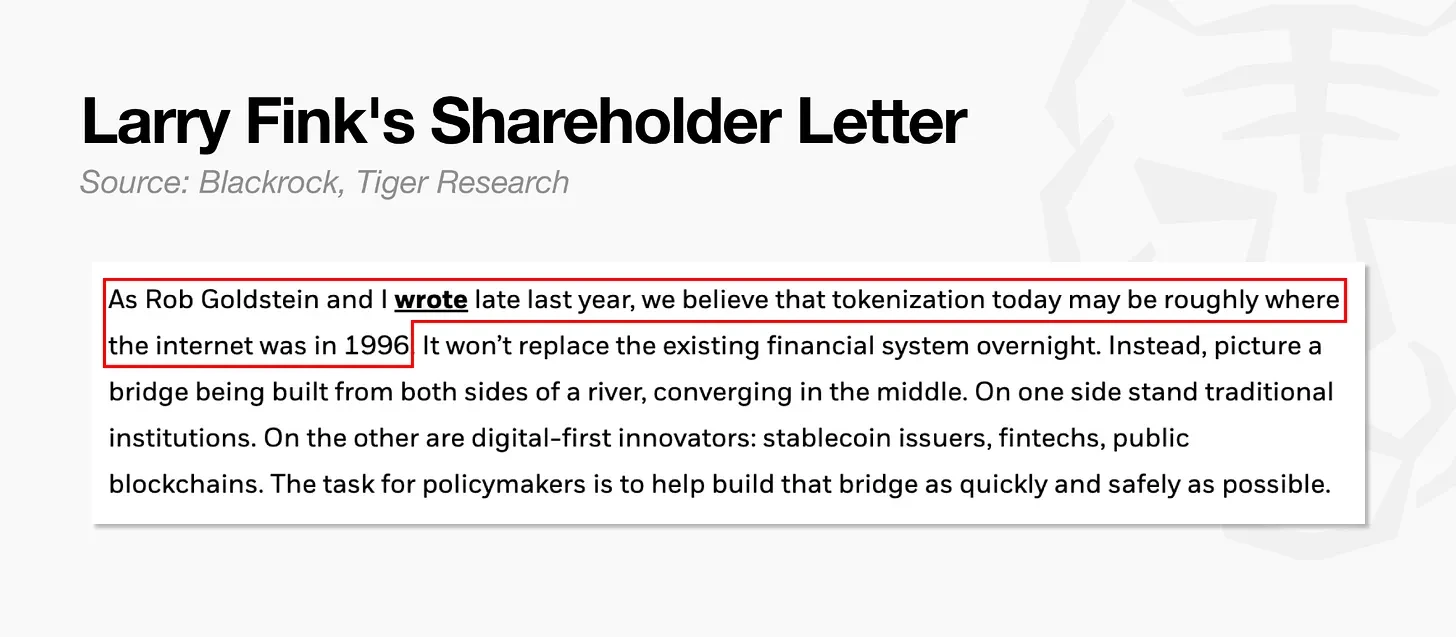
BlackRock CEO Larry Fink wrote in his 2026 shareholder letter: “We believe tokenization today is roughly where the internet was in 1996.”
1996 was an inflection point. The internet existed, but most businesses stood still. Only 26% of Fortune 500 companies had integrated online operations. When early adopters demonstrated success, others rushed in, but by then, the pioneers had already secured their positions.
The RWA tokenization market is at a similar juncture. Many institutions are still watching, but leading cases have already emerged. The most prominent is BlackRock's BUIDL (BlackRock USD Institutional Digital Liquidity Fund), an on-chain tokenized fund holding U.S. Treasury bonds. Launched in March 2024, it expanded to seven blockchains within 18 months. According to rwa.xyz data, the fund's market capitalization grew to approximately $2.5 billion.
Scale alone does not capture this shift. The market has moved beyond simply putting real-world Treasury bonds on-chain. New financial services are layering on top of issued assets. Multiple DeFi protocols use BUIDL as a base asset, and Binance officially accepts BUIDL as trading collateral.
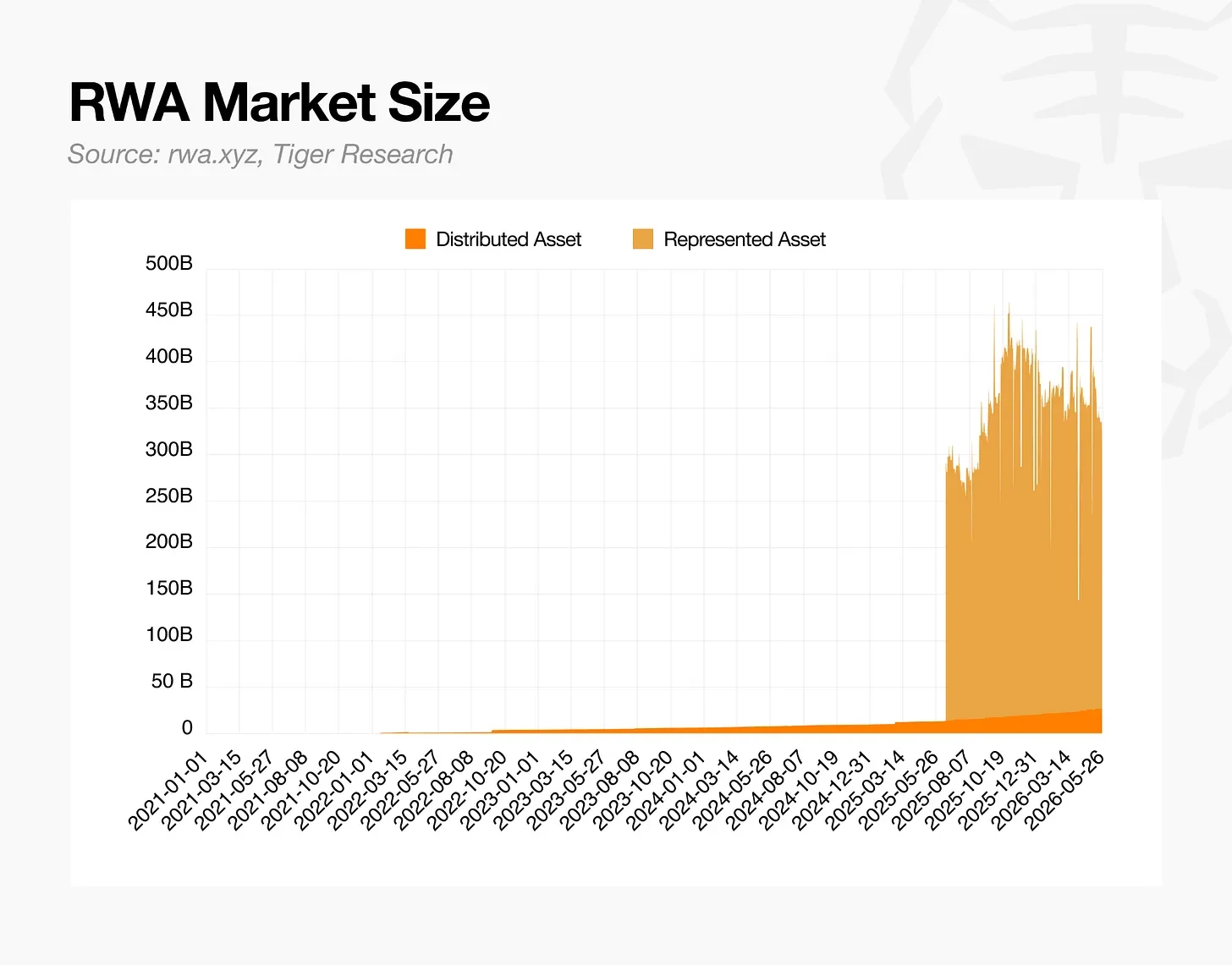
According to rwa.xyz, as of May 2026, Distributed Assets (on-chain issued assets) stood at approximately $34 billion, over 20 times the $1.5 billion at the beginning of 2020. Including Represented Assets—where physical assets are custodied and ownership recorded on-chain—the total scale reaches approximately $360 billion.
2. The RWA Market Has Already Launched
Asset tokenization is not just converting existing financial products into digital forms. It changes the fundamental way products operate, including settlement speed, post-trade infrastructure, and the entire processing flow from start to finish. This method doesn't aim to replace old systems but to build faster, more precise new rails on top of them.
Most discussions on RWA tokenization stop at BlackRock's BUIDL. BUIDL is indeed a landmark case for the RWA market, but a single sample cannot answer why tokenization matters.
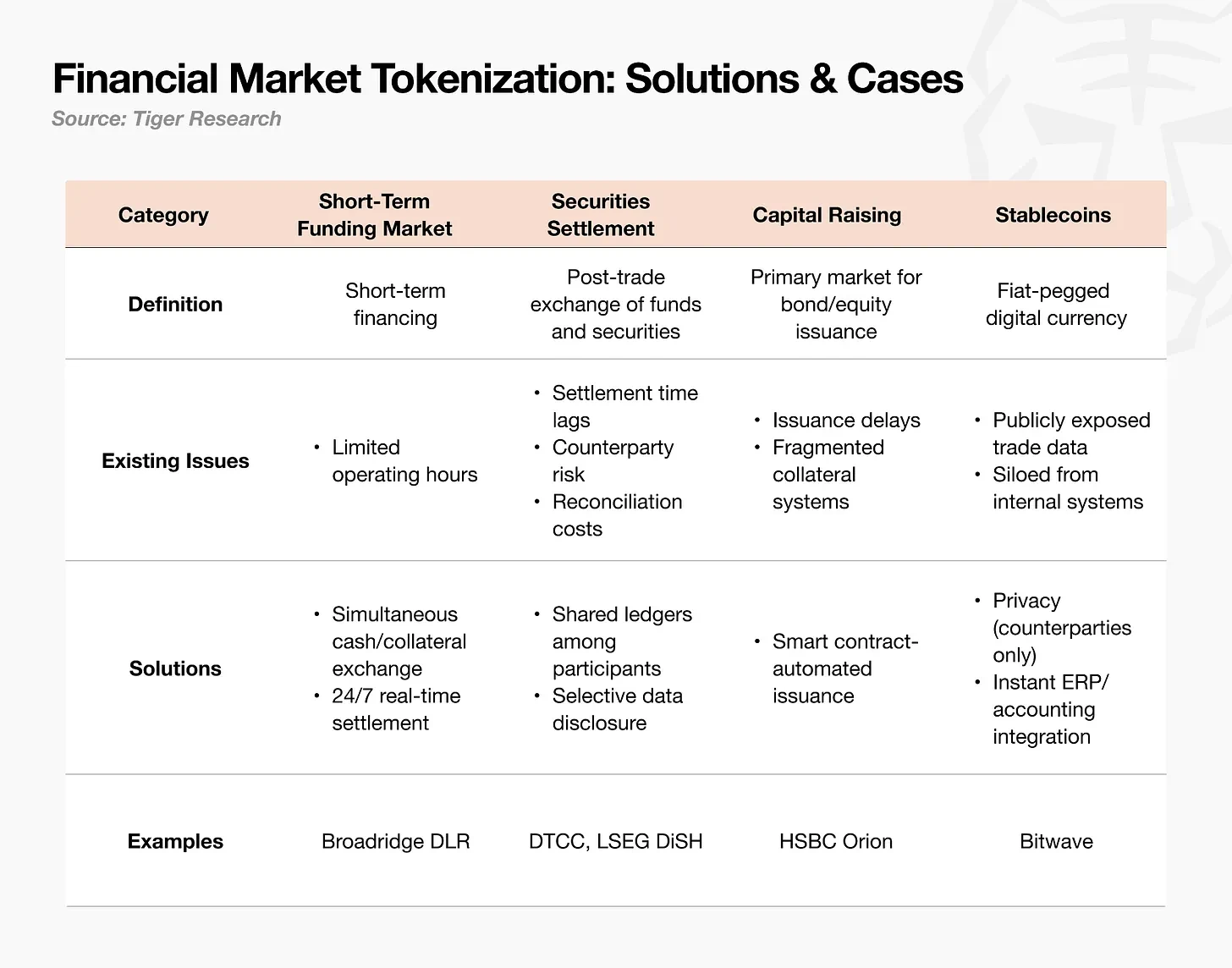
Finance is far more than bond issuance. The repo market, securities settlement, and capital raising each bear different structural inefficiencies, and the value tokenization can unlock varies accordingly. To understand why tokenization matters, we need to examine these sub-markets individually within their own contexts.
2.1 Short-Term Funding Market (Repos)
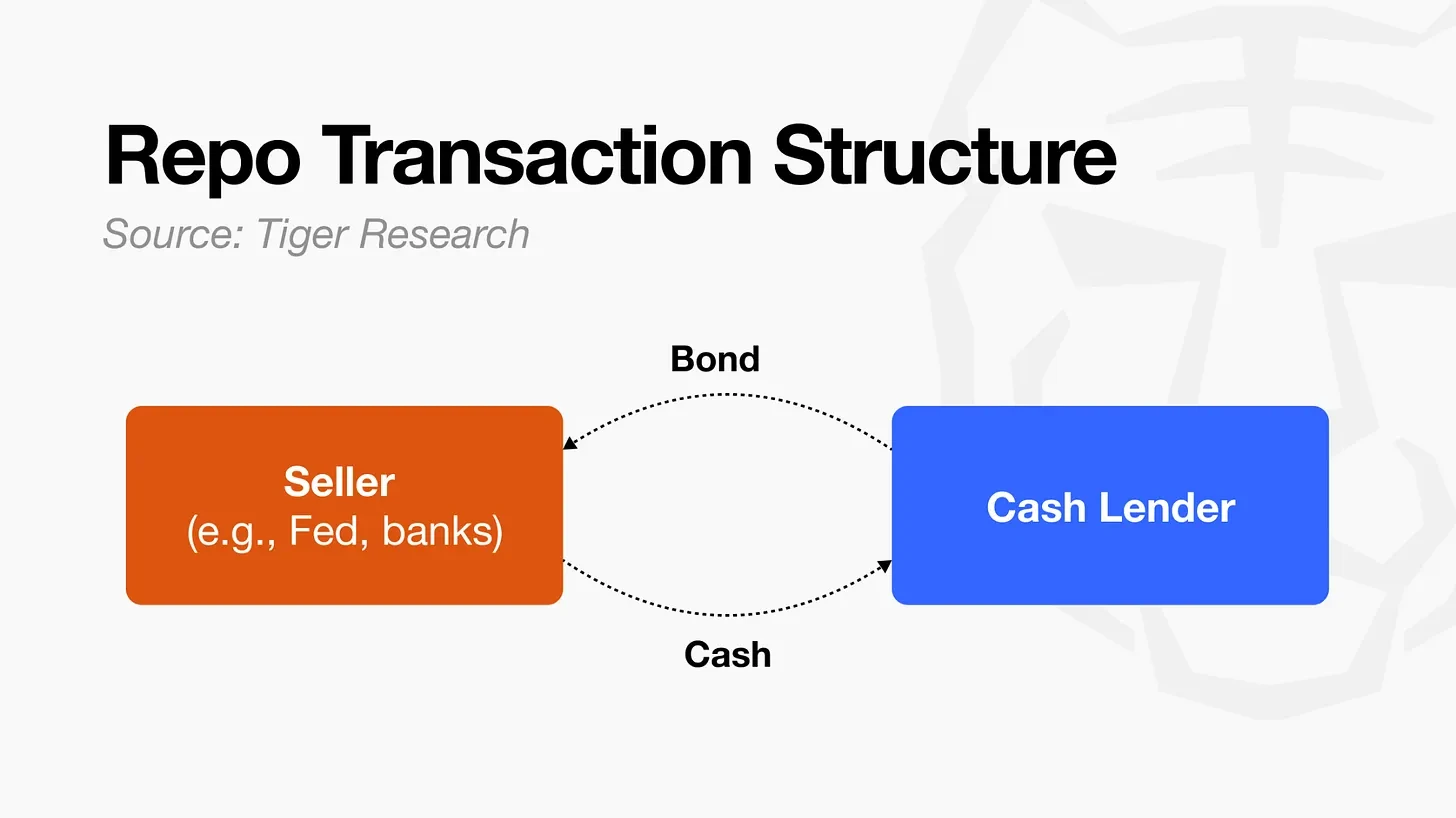
Repurchase agreements (repos) are the defining transaction of the short-term funding market. An institution lends cash against bonds as collateral, repaying principal plus interest at maturity to reclaim the bonds. Most contracts are overnight, collateral is safe, interest rates are low, and the trades are routine operations.
Problem: Limited Operating Hours. The repo market operates only during system working hours. Settlements happen once a day on business days, and completely stop on weekends and holidays. But risk never sleeps. If adverse news emerges over a weekend, mark-to-market losses accumulate while settlement is impossible. When Monday opens, the entire weekend's accumulated exposure hits as a single margin call. Responding immediately is unrealistic: selling bonds or raising cash via repos takes time. The only solution is pre-positioning cash reserves, capital forced to sit idle precisely because the settlement infrastructure cannot operate continuously.
Solution: DvP Mechanism for On-Chain Repos. On-chain repos solve this problem structurally, with the core being the DvP (Delivery versus Payment) mechanism. It works like paying at a cash register: collateral and cash are exchanged simultaneously, making it structurally impossible for one party to transfer first.
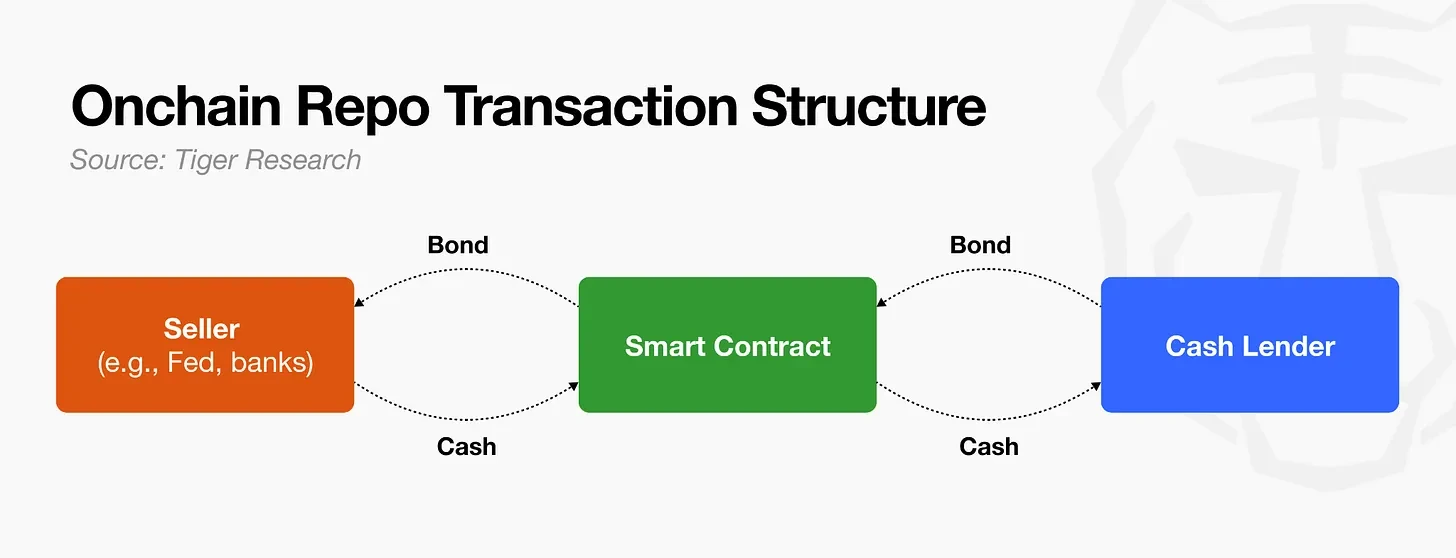
In practice, the party seeking funds posts the amount, interest rate, and maturity conditions; a counterparty accepts. Both parties deposit their assets into a smart contract—a digital program that executes automatically when conditions are met. The borrower deposits tokenized bonds, the lender deposits tokenized cash. When both confirm receipt, the exchange completes automatically.
Tokenized bonds and stablecoins move on-chain 24/7. Since they don't rely on old settlement infrastructure, collateral can move on Friday afternoon or Sunday morning; the constraint of system operating hours disappears. Settlement frequency also changes. Under the old system, manual confirmation limits settlement to once daily; smart contracts automatically trigger margin calls and settlement the moment a position incurs a loss. Without time gaps, there's no need to pre-position excess cash.
Case: Broadridge DLR.
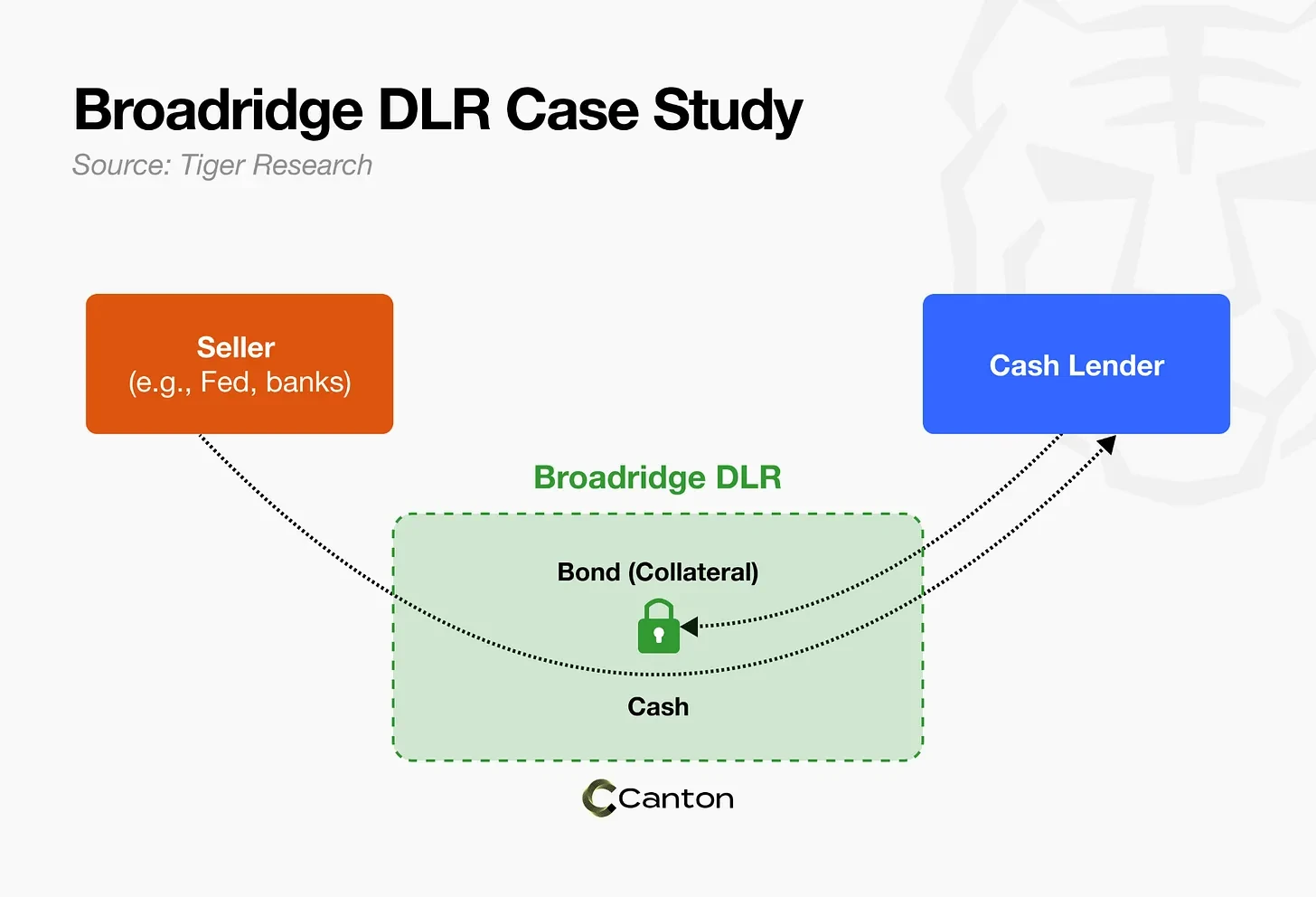
Broadridge is a global capital markets infrastructure company, processing settlement and clearing for banks and brokers through technology. Its DLR (Distributed Ledger Repo) platform is a distributed ledger repo trading platform built on the Canton Network's underlying blockchain.
Being blockchain-based, DLR is free from the operating hour constraints of old settlement infrastructure. Collateral moves and settles on weekends and public holidays. Repo transactions can be initiated and closed at any time of day, structurally mitigating risks stemming from limited operating hours. Smart contracts also automate the entire repo lifecycle, reducing settlement failures and disputes while improving collateral re-use efficiency.
As of April 2026, DLR's monthly settlement volume reached $7.7 trillion, with an average daily volume of $368 billion. Global banks including HSBC, UBS, and Société Générale participate in the platform.
2.2 Securities Settlement Infrastructure
Securities settlement is the post-trade phase where the buyer delivers funds and the seller delivers securities. T stands for Trade Date. Standard practice settles on T+1 or T+2, meaning funds move at least one to two days after the trade.
Problem 1: Settlement Delay and Counterparty Risk. A real estate transaction is a useful analogy. Signing a purchase contract doesn't immediately transfer the deed or complete the final payment; these happen days later. The trade and asset transfer occur at different times.
Similarly, existing securities settlement infrastructure creates a time gap between trade execution and asset transfer. If a counterparty defaults within this window, significant losses can occur. Central Counterparty Clearing Houses (CCPs) exist to prevent such events. A CCP sits between buyer and seller, so if one party defaults, the other doesn't bear the loss directly. In the US, NSCC plays this role; in Korea, it's the clearing and settlement division of the Korea Exchange (KRX).
Historically, no CCP has fully defaulted because the systemic consequences of a CCP failure are severe enough that member institutions and governments intervene beforehand. However, CCPs have been pushed to their limits under extreme market conditions. On Black Monday 1987, the Hong Kong Futures Exchange clearing house faced bankruptcy due to massive margin call failures, resolved only after the Hong Kong government injected capital and suspended trading for four days. During the 2008 Lehman bankruptcy and the 2018 Nasdaq clearing crisis, parts of loss absorption funds were indeed depleted.
Problem 2: Fragmented Ledgers and Reconciliation Costs. When an equity trade executes, the issuer, custodian, clearing house, and settlement institution each record it on their own ledgers. The same trade is entered four times across four institutions. Since these ledgers aren't synchronized in real-time, they must be matched later using standardized message formats. This process is called reconciliation.
Ledgers don't always match. Each institution processes the same trade at different times, and differences in internal system formats can cause data loss or alteration during message conversion. When records are inconsistent, staff must manually identify and correct discrepancies. While some steps are automated, errors remain frequent. This is why personnel and system costs for reconciliation and position difference handling persist. Corporate actions (events affecting company structure or shareholder rights, like dividends, stock splits, M&A) add further complexity; each institution must independently update its ledger and re-reconcile, multiplying the workload.
Solution: Shared Ledger + Atomic Settlement. Moving securities settlement infrastructure on-chain changes two things: all participants see the same ledger, and trade execution and asset transfer happen simultaneously.
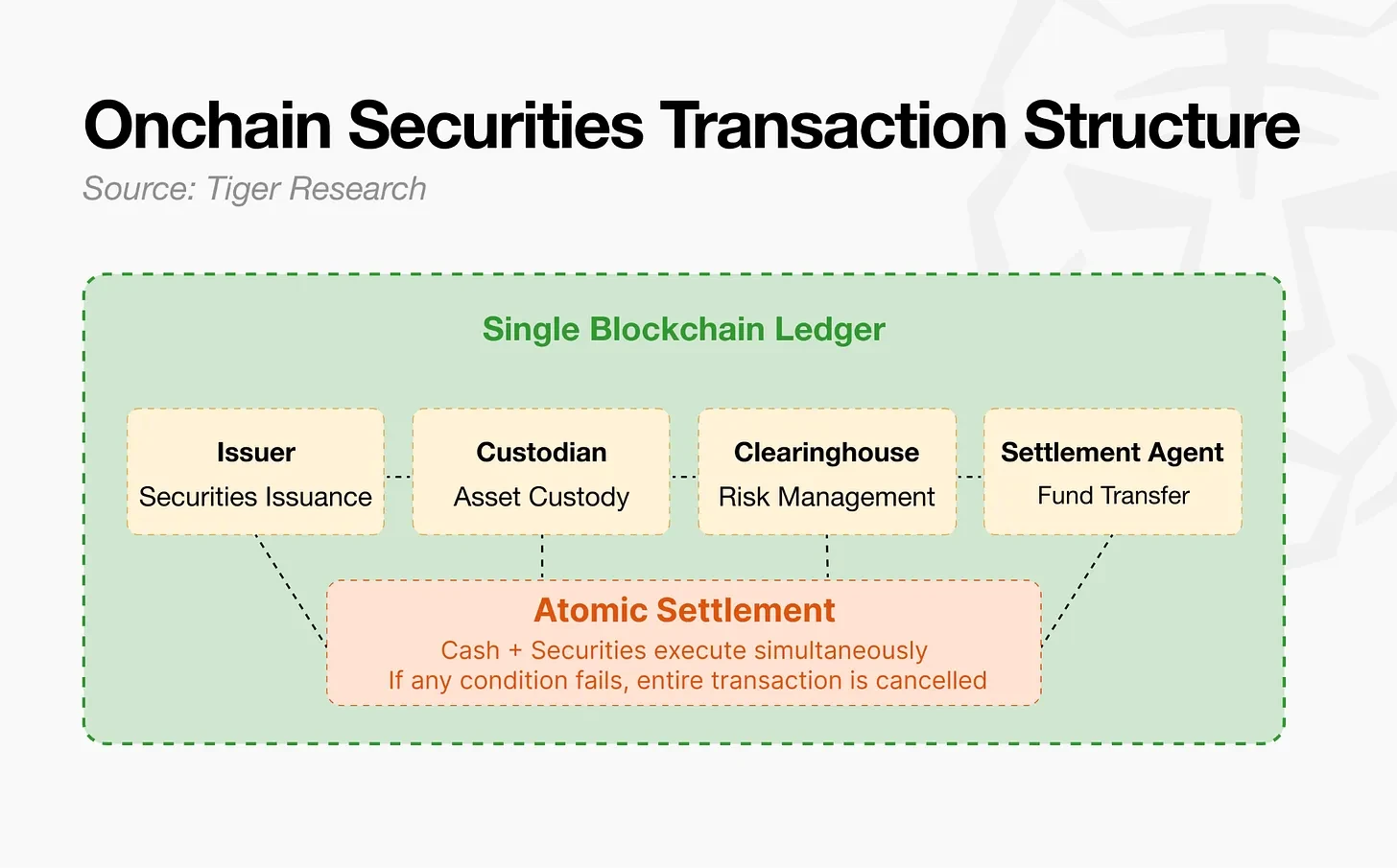
A shared ledger means each participant's data updates simultaneously when a trade is recorded, eliminating post-trade reconciliation. Placing cash and securities in the same environment removes the settlement delay that creates counterparty exposure. When both cash and securities are on-chain, trade execution and asset transfer can be bundled into a single transaction. Currently, cash flows through the banking system and securities through central securities depositories, separate from each other. On-chain, both exist in the same environment and execute simultaneously.
This is atomic settlement: either all conditions are met and the entire transaction succeeds, or any condition fails and the entire transaction cancels.
Case: DTCC.
On-chain securities settlement is already running in live trading. The London Stock Exchange Group (LSEG) deployed its digital settlement platform DiSH on Canton for securities settlement. Lloyds Bank completed a transaction using tokenized deposits to purchase tokenized UK government bonds, with the entire process from issuance to settlement handled on-chain.
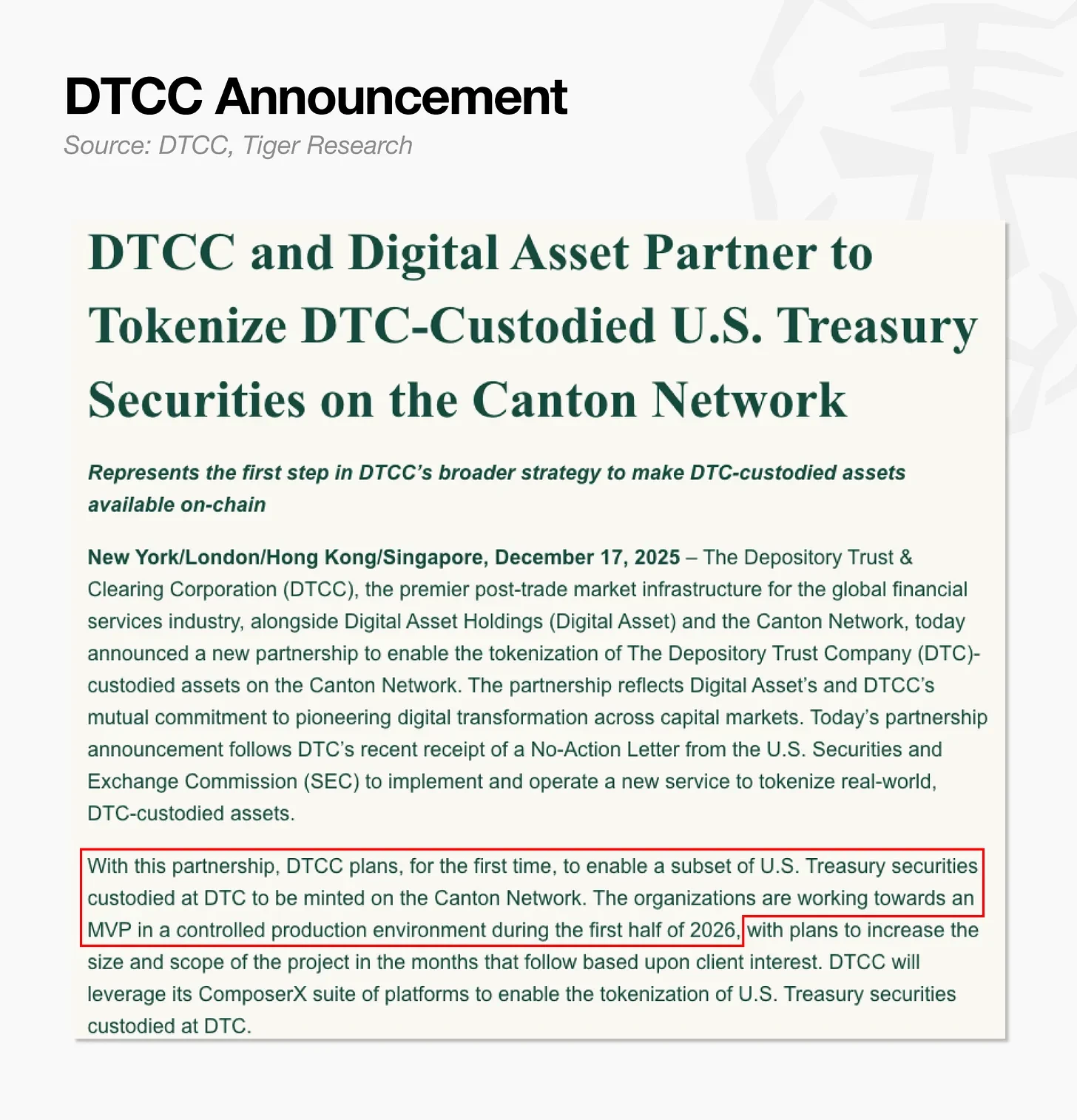
The most important case is DTCC. The Depository Trust & Clearing Corporation is the core infrastructure for US securities settlement, handling clearing and settlement for most US-traded securities. DTCC, in collaboration with Digital Asset (the company behind Canton Network), received a no-action letter from the SEC in December 2025—a prior commitment from the regulator not to take action regarding specific activities. The goal is to launch an MVP (Minimum Viable Product) in the first half of 2026.
DTCC is an institution that could lose its license with a single settlement failure. Its decision to adopt on-chain infrastructure is by no means a casual experiment. It reflects a deliberate judgment: the risks embedded in the current settlement architecture have surpassed the operational risks of migrating to new rails.
2.3 Capital Raising Market
The capital raising market is where governments and companies issue bonds and equities to raise funds. It comprises the primary market (issuance of new securities) and the secondary market (trading and utilization of issued securities among investors). Bonds represent a promise to repay principal plus interest; equities grant the holder ownership shares in the issuing company.
Problem 1: Issuance Process Delays. The longer the preparation period, the more variables beyond the issuer's control accumulate. Hedging costs rise, investor demand may shift, and in the worst case, the deal collapses entirely. Every additional week in the timeline exposes the issuer to an extra week of market conditions beyond their control.
Problem 2: Fragmented Collateral System. Institutional investors buy assets for yield, but the real challenge comes after. If purchased assets can be deployed in repos, used as collateral, or linked to other transactions, capital keeps working. The smoother these connections, the more transactions the same asset can support, making the asset more valuable from the issuer's perspective.
However, even when counterparties agree on collateral use, execution is difficult. Collateral transactions require sequential steps: eligibility verification, haircut calculation, and title transfer. Each step involves different institutions whose systems are not interconnected. At each stage, staff must send messages and wait for confirmation. Under this structure, a vast gap exists between the scale of issued assets and the amount practically deployable.
Solution: On-Chain Issuance.
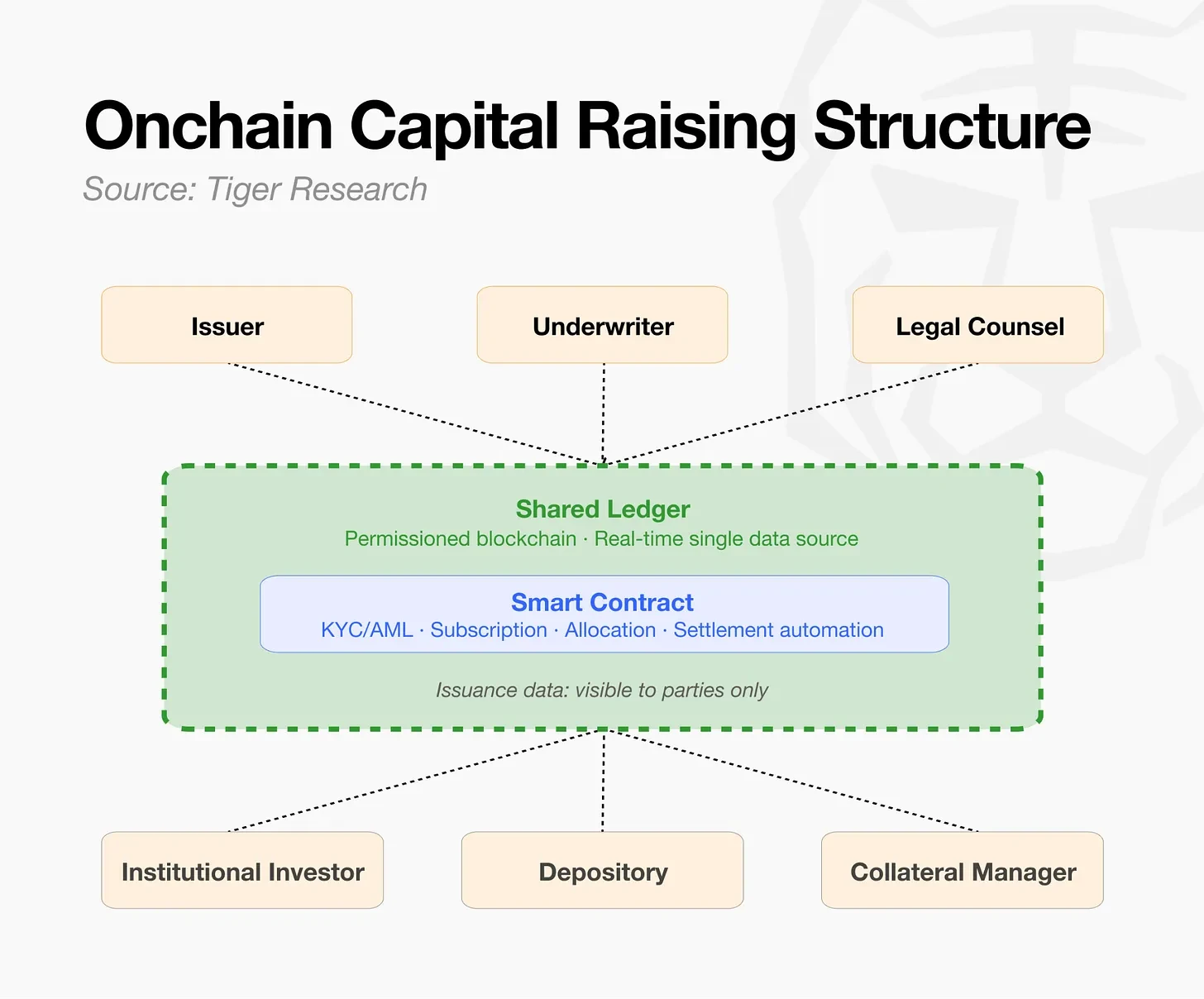
The entire issuance process runs on smart contracts. Within regulatory parameters, agreed issuance terms are defined in code. After KYC and AML verification, subscription registration, allocation, and payment settlement are automated. This eliminates manual confirmations and message conversions, significantly compressing the issuance cycle.
The post-issuance utilization structure also changes. Tokenized assets exist in an environment where all participating institutions share the same data in real-time on the same network. Collateral transaction steps—eligibility verification, haircut calculation, title transfer—are processed in a single workflow, without shuttling between independent systems. The ledgers once maintained separately by issuers, underwriters, custodians, and collateral managers merge into one. Once an asset is issued and adopted, it can immediately serve as collateral or base asset for other transactions.
This model requires issuance privacy. Issuance terms, underwriter allocations, subscription prices, and investor lists are data that cannot be public. If such information leaks, market prices move prematurely, and the issuer bears higher costs. Existing public permissionless blockchains only hide wallet addresses but expose all transaction data to everyone. For on-chain issuance to scale, it must operate on permissioned infrastructure where transaction data is visible only to relevant parties.
Case: HSBC Orion. HSBC, a global bank headquartered in the UK with $3 trillion in assets, is a leader in bond underwriting and issuance. It launched its own digital asset platform, HSBC Orion, as a digital bond issuance infrastructure in 2023. HSBC Orion runs on the Canton Network.
In February 2024, the Hong Kong government issued HKD 6 billion (approximately $770 million) in digital green bonds via HSBC Orion. This was the first multi-currency digital bond issuance by a government, covering HKD, offshore RMB, EUR, and USD. Over 50 global investors from eight nationalities participated—an exceptionally large base for an early digital bond issuance. The settlement cycle was compressed from T+5 to T+1.
The significance of this issuance wasn't the issuance itself, but what followed. Within days of issuance, HSBC executed a repo transaction with Bank of East Asia (BEA) using the digital green bond as collateral. The moment the bond went live on the market, it was directly used as collateral on the same network. This was the first confirmed case of issuance and utilization connecting without interruption.
The structure is as follows: When HSBC Orion issues a digital green bond, the bond is recorded as a token in the Bond Registry on Canton. When HSBC and BEA execute the repo transaction, another application on the same Canton network takes that token as collateral and settles the payment simultaneously.
The Hong Kong government did not treat this issuance as a one-off event. The Hong Kong Monetary Authority subsequently launched a digital bond subsidy scheme, pledging to subsidize half the issuance costs for issuers of digital bonds, transforming a single experiment into a market infrastructure standard.
2.4 Stablecoins and Payments
Stablecoins are digital currencies pegged 1:1 to the US dollar. Unlike regular cryptocurrencies, their value is largely stable, allowing them to function like money circulating on a blockchain. USDC and USDT are the most typical examples.
Problem 1: Fully Public Transaction Data. On public blockchains, all transactions are visible to anyone. Who sent how much to whom and when, and their balances, can be instantly retrieved by searching a wallet address on a block explorer. Analyzing a company's stablecoin payment history can reveal unit prices negotiated with counterparties, seasonal revenue patterns, timing of new market entries, M&A fund flows,


