Tiger Research: Moving RWA Tokenization Offshore First


- Core Insight: In jurisdictions where regulation is not yet mature, financial institutions should proactively choose to enter overseas markets or adopt on-chain native platforms to accumulate operational experience early, rather than passively waiting for domestic legislation.
- Key Elements:
- As of the first half of 2026, the RWA tokenization market has reached a scale of $25 billion to $36 billion, with significant efficiency improvements, yet many regions lack frameworks that grant legal validity to distributed ledgers.
- Financial institutions face three strategic choices: waiting for legislation (low risk but potential to miss opportunities), using regulatory sandboxes (limited experimentation), or entering mature overseas markets (enables building a first-mover advantage).
- Cross-border RWA operations require preparation in six areas: establishing overseas bases, obtaining licensing compliance, defining assets, determining investor scope, settling currencies and payments, and arranging operations (such as custody and on-chain governance).
- Hong Kong, Singapore, and the United States are the primary first-mover markets: Hong Kong offers a complete regulatory chain and policy subsidies; Singapore has strict but clear regulations; the US allows efficient issuance through platforms like Securitize.
- The on-chain native path (e.g., Ondo, Plume) allows institutions to bypass specific jurisdictions and quickly access markets through compliant platforms, but the structural design is more complex and depends on platform differences.
- Using Hong Kong as an example, a mid-sized securities firm, by leveraging an existing subsidiary, choosing the DigiFT platform, and utilizing the Regulation S exemption, can complete the entire process from evaluation to issuance within 6 to 12 months.
Key Takeaways
This article is from Tiger Research. The RWA market is growing rapidly, but many jurisdictions still lack a supporting regulatory framework. Financial institutions in these regions face a strategic choice between three options: waiting for domestic legislation, using regulatory sandboxes, or directly entering overseas markets.
Cross-border RWA business requires extreme precision. Before entry, institutions must be fully prepared in six core areas, covering jurisdiction selection, licensing, asset definition, investor scope, and the design of settlement and operational arrangements.
The core goal is to accumulate real operational experience by choosing a path that fits one's own circumstances. The two main paths are: directly entering jurisdictions with mature regulations, and adopting the technical path of on-chain native platforms.
1. Wait, Experiment, or Go Abroad
As of the first half of 2026, the tokenized Real World Assets (RWA) market has grown to approximately $25-36 billion. Its clear efficiency improvements, including automated interest payments and redemptions, shorter settlement cycles, and broader customer reach, continue to attract institutional investor attention.
However, financial institutions still face real obstacles within a regulatory vacuum. While tokenization is not explicitly prohibited, the legal framework needed to grant legal效力 to distributed ledger records has not yet taken shape, leaving investor rights without adequate protection. In response, financial institutions choose between three broad directions: Waiting for domestic legislation benefits risk management but carries significant risk of missing early market positioning; Using regulatory sandboxes allows for limited experimentation, but is often confined to areas like fragmented investments and cannot be extended to the issuance of standardized securities; Entering overseas markets first means issuing digital bonds in jurisdictions where regulations are already in place, building a track record locally, and using the experience gained abroad to secure an early competitive position.
The RWA market is inherently a global business, making it crucial to build operational capabilities across different regulatory environments. While overseas expansion does have practical constraints, it is precisely those financial institutions whose home regulations are still in a vacuum that have more reason to gain first-hand experience in overseas markets before their competitors.
2. Tokenization is Not Magic
Cross-border RWA business is not a product of a series of isolated decisions. The choices involved are interconnected, with the outcome of one step determining the options available for the next. Tokenization is not magic; it is the process of migrating existing financial instruments to a new type of infrastructure, and this process demands greater precision than traditional issuance, not less.
Before deciding to enter the market, financial institutions should honestly assess their readiness based on the following six requirements.
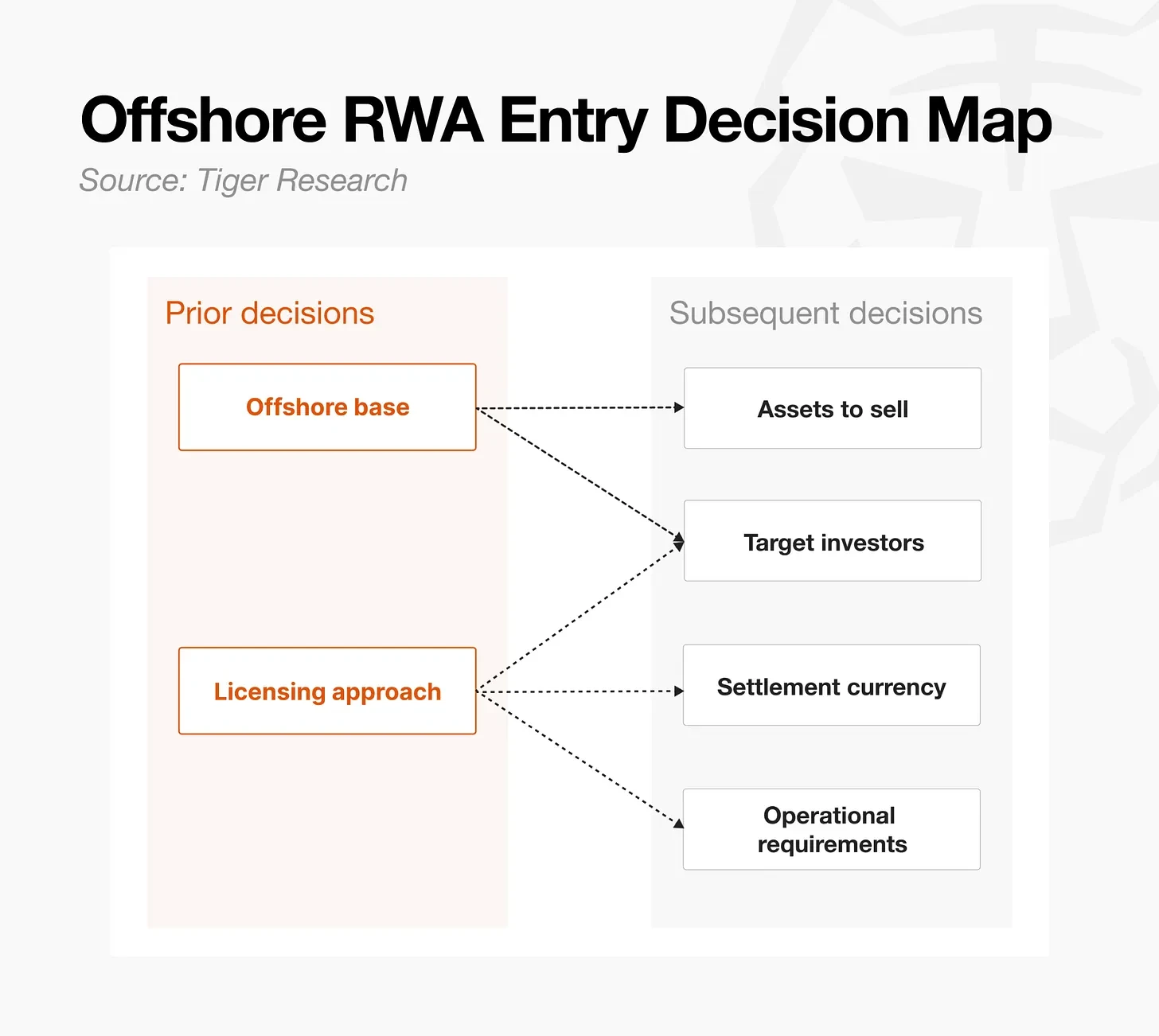
First, Establish an Overseas Base. Institutions must determine how to engage key jurisdictions like Hong Kong, Singapore, or the US, specifically whether through an existing entity, a newly established entity, or a partnership with a local institution. Establishing a new entity offers more control but requires significant resources; partnerships allow for faster market entry but limit the depth to which core capabilities can be internalized.
Second, Licensing. Institutions must meet the licensing requirements of the intended sales jurisdiction. The choice typically lies between obtaining a license directly (time-consuming and costly) and leveraging the platform license of an existing issuer (faster, but requires building the issuance structure according to that platform's specifications).
Third, Asset Definition. The choice of which asset to tokenize directly determines the barrier to entry. Standardized securities like bonds have mature structures and are relatively easier to bring to market; non-standard assets like real estate or trade receivables require significantly more time for legal review and structural design.
Fourth, Defining Target Investors. A typical approach is to cover all jurisdictions except the United States. Selling only to non-US investors allows reliance on the overseas exemption of Regulation S; including US investors triggers additional requirements like Regulation D, significantly increasing structural complexity. Furthermore, many STO and RWA platforms restrict sales to accredited or institutional investors, so the sales strategy must be determined concurrently with the investor scope.
Fifth, Settlement Currency and Payment Process. Institutions must decide whether to accept settlements in fiat currency, USD, stablecoins, or wholesale CBDCs. This is not just a currency choice; it is a key variable determining investor accessibility, custody structure, and ultimately, revenue. For example, accepting stablecoins introduces exchange needs and potential additional costs.
Sixth, Other Operational Requirements. Depending on the structure, there are additional considerations including blockchain selection, custody, on-chain operations, and post-issuance governance. Institutions must specifically confirm who controls the payment of interest and redemptions, registry management, and the ability to force transfers or freeze tokens in the event of an event. These matters correspond to the operational requirements of traditional financial instruments.
Tokenization is not magic. The work is not finished when the structure is designed; the business only truly takes off once the securities are sold and investors are in place.
3. Where to Operate
Jurisdiction selection is a strategic decision that requires balancing regulatory fit and operational efficiency.
For institutions with an existing overseas presence, the most efficient starting point is to evaluate their current jurisdictions. If the primary goal of an overseas tokenization strategy is to accumulate first-hand experience as early as possible, starting anew in an unfamiliar jurisdiction will involve significant time and capital barriers.
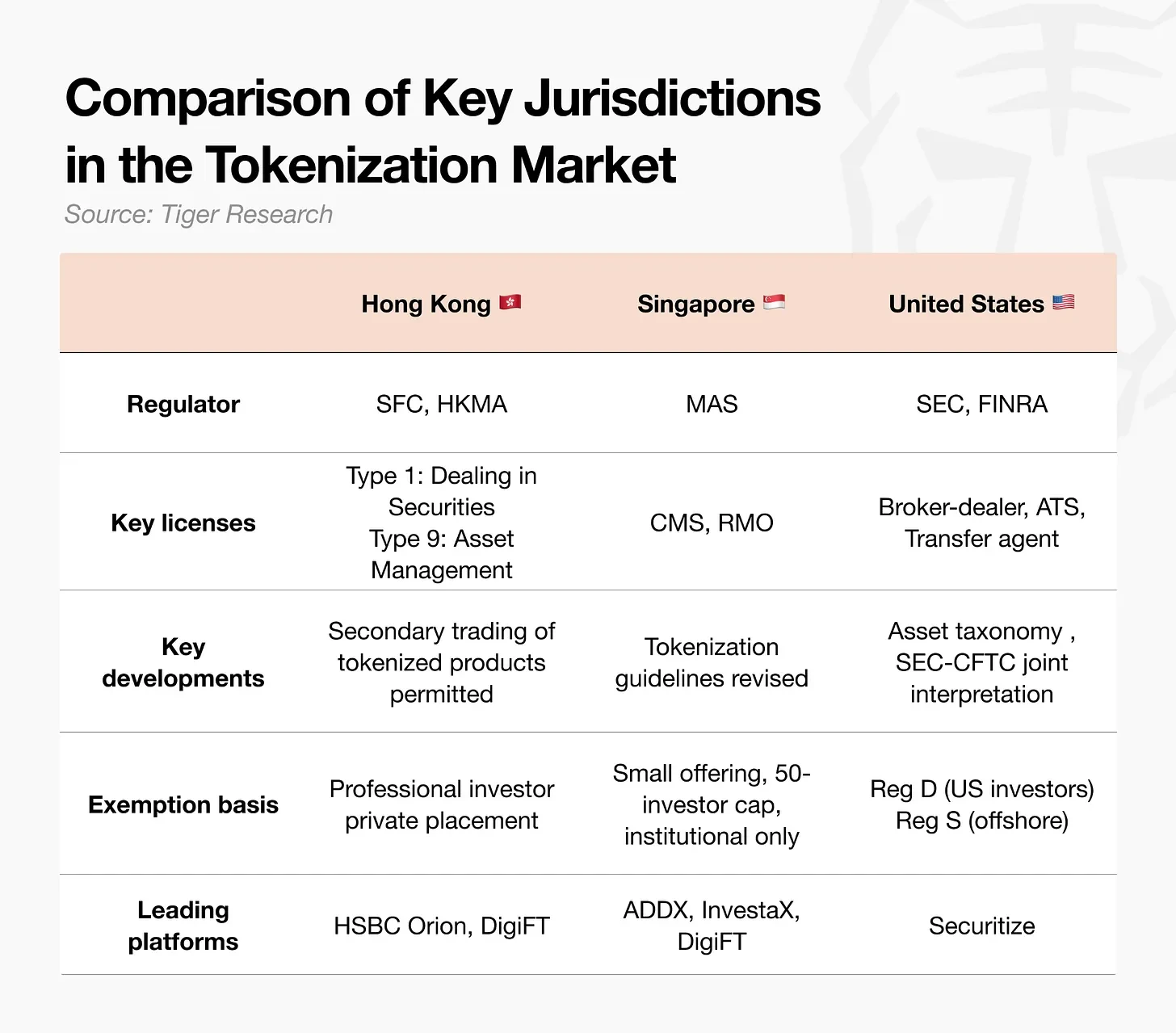
Hong Kong: Regulatory Completeness and Enforceability
Hong Kong is the most advanced first-mover market for implementation. Security tokens are regulated under the existing Securities and Futures Ordinance (SFO). In April 2026, a circular from the Securities and Futures Commission (SFC) allowed licensed virtual asset exchanges to conduct secondary trading, completing the full chain from issuance to circulation. Infrastructure like HSBC Orion is already live, and policy support is relatively strong, including subsidies from the Hong Kong Monetary Authority (HKMA) for issuance costs. Institutions should note that if the legislation introducing new licenses for virtual asset dealers and custodians progresses as planned in 2026, attention must be paid to transitional provisions for compliance.
Singapore: Precise Framework and Regulatory Clarity
Singapore strictly applies the Securities and Futures Act under the principle of "same activity, same risk, same regulation." The Monetary Authority of Singapore (MAS) revised its tokenization guidelines in December 2025, providing clearer direction; the Variable Capital Company (VCC) structure facilitates asset segregation and is particularly suitable for fund structures. However, Singapore imposes stringent licensing requirements even for services to overseas clients, resulting in a high barrier to entry.
United States: Regulatory Clarity and Efficient Listing Paths
A joint interpretation released by the SEC and CFTC in 2026 clarified the asset classification framework. The cost of directly applying for a license as an issuer remains high, but efficient issuance is possible through vertically integrated platforms like Securitize: using the Regulation D exemption for US accredited investors and the Regulation S exemption for overseas investors. BlackRock's BUIDL fund is the most representative example of this path.
Each of these jurisdictions has mature platforms capable of accelerating local entry. These platforms are licensed operators offering a suite of services, including regulatory coordination, fundraising access through their in-platform investor networks, and the operational infrastructure covering the entire lifecycle from issuance to settlement. When evaluating entry into a specific jurisdiction, directly engaging with leading local platforms to test business feasibility is strategically more efficient than reviewing a large volume of regulatory documents first.
4. Bypassing Jurisdictions
The previous section discussed the direct path: establishing a legal and physical presence in a specific jurisdiction and obtaining the necessary licenses. This section discusses a fundamentally different approach: the on-chain native path, which designs issuance and circulation around the on-chain environment from the outset.
Instead of investing the time and capital required to establish a physical base, this path partners with on-chain platforms that have embedded compliance capabilities, or leverages their structural logic, to lower the barrier to entry through such infrastructure. While the territorial path in the previous section answers "where to operate," the on-chain native path answers "how to structure the transaction."
Representative examples are as follows. Ondo Global tokenizes US securities through a bankruptcy-remote Special Purpose Vehicle (SPV) incorporated in the British Virgin Islands, minimizing friction with US securities regulation by leveraging the overseas exemption under Regulation S. Ondo also operates its own secondary market, Ondo Global Markets, directly handling the trading of the issued tokens. Plume Nest, through Plume's Bermuda subsidiary KDAB (Kimber Digital Assets Bermuda), holds a Class M DABA license from the Bermuda Monetary Authority and operates a regulated on-chain treasury. Access to the Plume Nest platform is limited to investors who have passed KYB and KYC checks. Additionally, an affiliated company is registered with the US SEC as a transfer agent, providing a second layer of assurance for ownership record management and distribution. Thanks to the platform's decentralized design, tokenization outside this regulated structure is also possible, but this path is not suitable for regulated financial institutions.
The on-chain native strategy is substantively similar to territorial tokenization but differs significantly in execution. Its primary advantages are speed to market and breadth of coverage: institutions are no longer limited to a single base and can reach the market faster using proven infrastructure. Another advantage is particularly prominent when compared to territorial platforms: the closed ecosystems of territorial platforms may limit secondary market liquidity, whereas on-chain native platforms designed for scalability can organically connect with DeFi liquidity pools.
However, the complexity of structural design is a risk that needs careful consideration. The open nature of these platforms allows for a wider range of products, but lacks the mature regulatory guidance available in territorial paths for core structural decisions like issuance design. The structural differences between these platforms vary by platform rather than by jurisdiction, potentially creating an operational burden for traditional financial institutions. Therefore, assessing whether local counterparts for these platforms exist in the target region is a necessary preparatory step.
5. Don't Wait for Regulation; the Market Won't Wait
Large financial institutions in the US are already leading the market, either building their own platforms or accumulating experience directly on Canton, Solana, and Ethereum. For financial institutions still in regions with regulatory gaps, launching an overseas RWA business means redesigning the entire value chain locally, from establishing a base to issuance and distribution, with a preparation period typically requiring six months to over a year.
The following hypothetical case illustrates this process: a mid-sized brokerage, "Company A," which already has a presence in Hong Kong, tokenizes short-term investment-grade bonds and sells them to overseas institutional investors.
Step 1: Assess Existing Base and Licensing Status. Company A uses its existing entity (its Hong Kong subsidiary) to avoid the time and cost of setting up a new one. Whether its existing license covers tokenization activities is a separate issue. Local legal counsel assesses the scope of the existing authorization. If necessary, Company A makes a preliminary inquiry to the regulator (in this case, the Hong Kong SFC) to confirm whether a variation of license conditions or additional filings are required.
Step 2: Select Platform and Infrastructure. To shorten the time required for its own license application, Company A considers conducting business through an established platform like DigiFT. Vendor due diligence covers the platform's license validity, supported asset types, custody partners, and investor restrictions. During the contracting phase, legal review covers the issuance structure designed to fit the platform's specifications, allocation of responsibilities, and governing law.
Step 3: Compliance and Product Design. This phase finalizes the product structure for the bond to be tokenized, including the underlying asset, investor rights, and applicable law. The standard approach uses the Regulation S exemption to sell to overseas institutional investors outside the US. Legal opinions on compliance with local securities laws are required for each target jurisdiction. Company A must also confirm the legal basis under securities law for excluding its domestic investors before proceeding to the drafting and approval of issuance documents.
Step 4: Design Custody Structure and On-Chain Operations. Company A establishes a dual custody arrangement, with a global custodian bank holding the underlying assets and specialized infrastructure handling the on-chain tokens, with relevant legal opinions obtained from external counsel. Operational details are also finalized, including the interest payment schedule, settlement currency (USD or stablecoin), and redemption mechanism.
Step 5: Issuance, Execution, and Validation. Company A executes the actual issuance and sale according to the finalized structure, and subsequently confirms that operational processes like interest payments and redemptions function as designed. Structure is just the starting point; the business is only completed when investors are in place and sales are finalized.
The overseas tokenization strategy described is not limited to the direct path of "establishing a base in a specific jurisdiction." Paths like the on-chain native approach, which can more flexibly bypass jurisdictional boundaries, mean the space of feasible solutions is effectively open. Legal review will be the most time-consuming and costly hurdle on any path. However, waiting for a complete regulatory framework is not the only answer. The ability to quickly outline a feasible path and accumulate experience through execution is more critical than any other factor. The reason is this: the essence of a tokenization business lies not in the technical design, but in the successful completion of the entire sales process.
No one can predict when regulation will finally be established, and the market will not wait. The time to act is now.