






Before Walsh’s debut: More important than a rate cut is how the Fed reshapes expectations.


- Core View: The focus of this week’s FOMC meeting is not whether to raise rates in June (likely a hold), but rather how new Chair Kevin Walsh redefines the Fed's reaction function. Key aspects include whether the dot plot shifts upward, the characterization of inflation, and the balance sheet reduction strategy. This will determine the market's adjustment in expectations for the interest rate path in the second half of the year.
- Key Elements:
- Market expectations for holding rates at 3.50%-3.75% in June stand at 96.6%. The focus has shifted to whether the dot plot for the second half of the year will be revised upward, reflecting a change in the path that no longer assumes rate cuts.
- May CPI rose 4.2% year-over-year (energy +23.5%), and core CPI at 2.9% remains above the 2% target. Inflationary pressures are becoming more complex. Walsh needs to characterize this as a short-term shock or a risk of secondary inflation spreading.
- Walsh tends to reduce reliance on forward guidance and the dot plot, emphasizing a data-driven approach. This weakens the valuation anchor for high-valuation assets (e.g., AI, tech stocks) that depend on rate cut expectations.
- Balance sheet reduction could be Walsh’s “middle path” tool. While keeping rates unchanged, it can signal a tightening stance through balance sheet normalization, prompting a reassessment of the liquidity discount for high-valuation assets.
- The worst risk is not a failure to cut rates in June, but the formal end of the Fed’s rate-cut narrative, forcing the market to reprice interest rate uncertainty.
Original Author: Jim, Frank, MSX Maitong
This week's most important macro event for the US stock market is undoubtedly the June FOMC meeting.
But this time, the market's real concern is no longer a simple question of "hike or cut."
Based on current market expectations, the Fed is highly likely to hold steady at this meeting, maintaining the federal funds rate in the 3.50%–3.75% range. In other words, the fact that rates won't move in June is not surprising in itself and has already been priced in by the market.
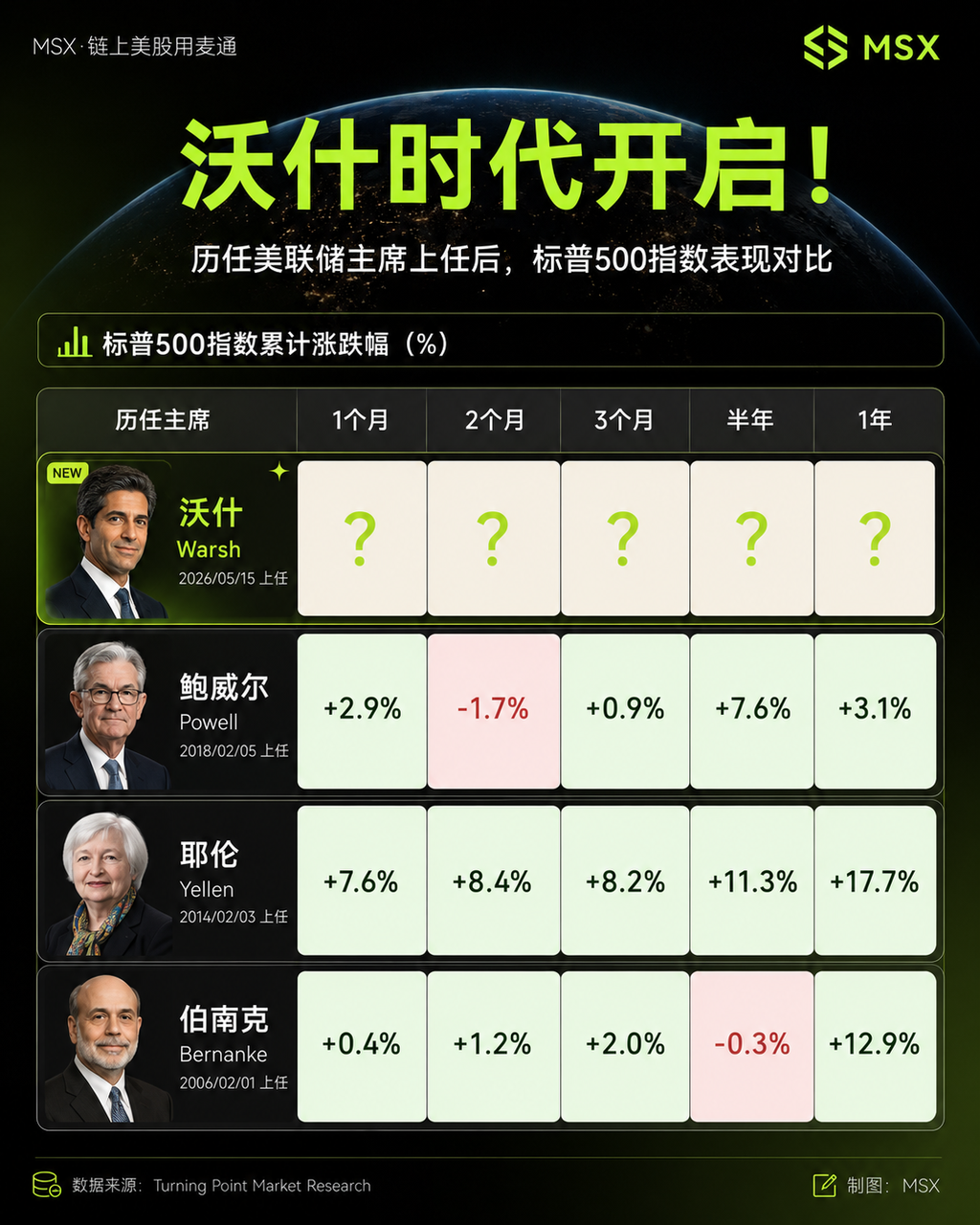
What truly matters is that this is the first full interest rate meeting chaired by Kevin Warsh since he became Fed Chair.
More critically, this meeting also includes the Summary of Economic Projections (SEP), meaning the market will simultaneously see the rate decision, policy statement, dot plot, and economic forecasts. For investors, this is not a routine meeting; it is the first complete unveiling of the Warsh-era Fed.
So, the core question for this week's FOMC isn't whether Warsh is a hawk or a dove, but what should investors really be watching?
I. June Likely a Pause, But the Market Trades on 'What's Next'
Let's start with the conclusion: The Fed is highly likely to hold steady this week.
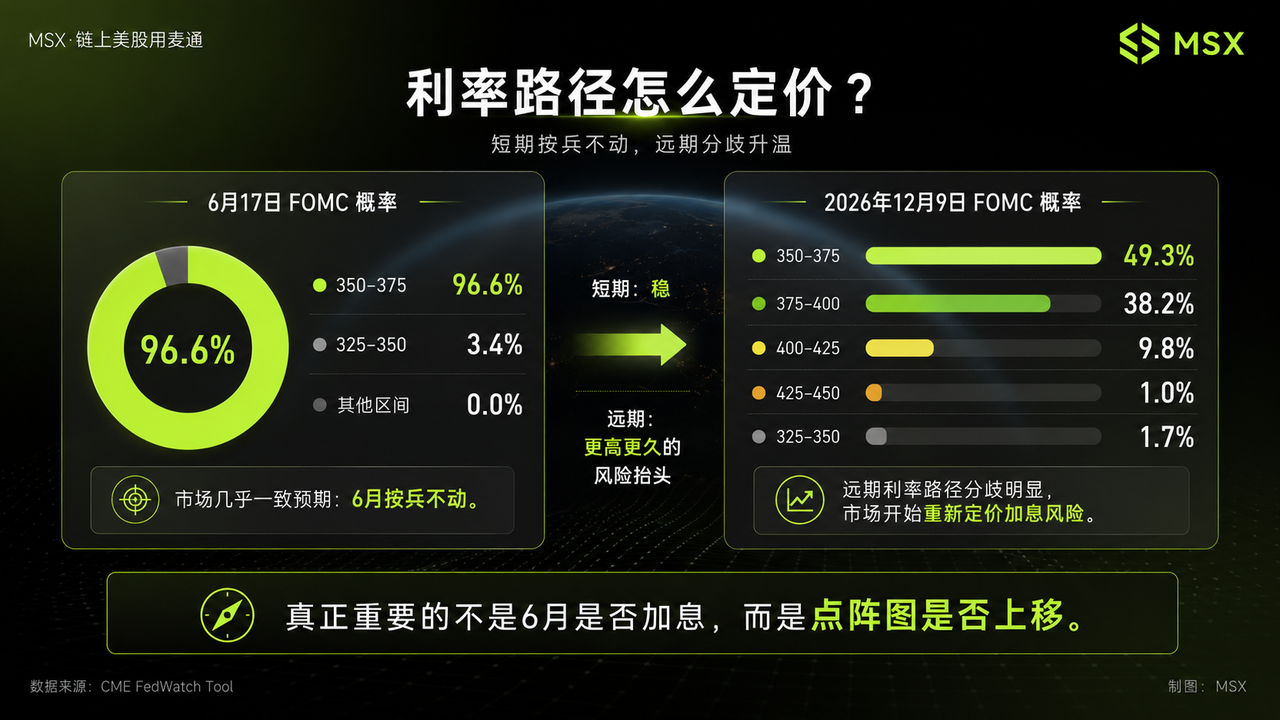
Based on interest rate futures pricing and mainstream institutional expectations, there is little suspense that the Fed will keep rates unchanged in June. For instance, the market broadly expects the Fed to maintain the benchmark rate in the 3.50%–3.75% range. The CME FedWatch Tool also shows a 96.6% probability of the rate remaining in this range after the June 17 meeting.
Therefore, the real divergence in market opinion isn't about June, but about the several meetings in the second half of this year. This is also where the FOMC is most likely to be misinterpreted.
If one only looks at the June rate decision, it's easy to jump to a simple conclusion: Since there's no rate hike, is that bullish for US stocks?
Not necessarily.
Why? Because what US stocks truly fear isn't the lack of a rate cut this time, but the potential overturning of the "rate cut path" that the market has already priced in.
Recently, risk assets, especially AI, semiconductors, software, and small-cap growth stocks, have been benefiting from two layers of expectations: one is that the economy isn't clearly heading into a recession; the other is that the Fed still has room to cut rates in the future. As long as both expectations hold, high-valuation assets can maintain a higher risk appetite.
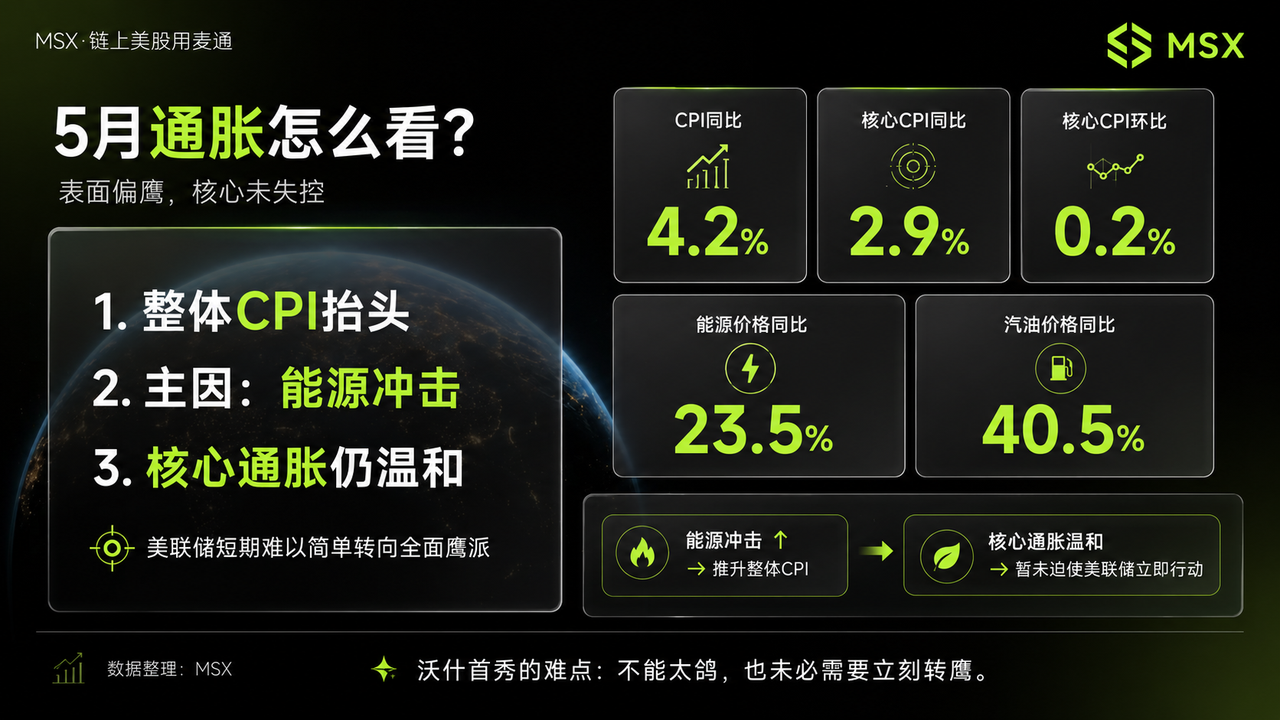
But the situation has become more complex. The US CPI in May rose again year-over-year to 4.2%, with energy prices up 23.5% year-over-year and gasoline prices surging 40.5% year-over-year. This means that Middle East tensions, oil price volatility, and supply chain disruptions are now feeding into inflation data. Meanwhile, core CPI rose 0.2% month-over-month and 2.9% year-over-year. While not completely out of control, this is still above the Fed's 2% target.
This set of data puts the Fed in an awkward position.
If Warsh continues to emphasize room for rate cuts, the market might question whether the Fed is underestimating the rebound in inflation. However, if he directly signals a potential rate hike, high-valuation assets could immediately face valuation pressure.
Therefore, the most likely outcome of this meeting is not a clearly dovish stance or a direct hawkish turn, but the Fed shifting from "rates are more likely to go down next" to "keeping options open."
But here's the key point: While this sounds moderate, it is not moderate for market pricing.
Once rate cuts are no longer the default path, the valuation anchor for US stocks needs to be recalculated. Especially for growth stocks that have already seen significant gains and are trading at stretched valuations, what they fear most isn't whether the rate changes today, but the market suddenly realizing: "Hey, the second half of the year isn't about waiting for rate cuts; it's about reassessing the risk of rate hikes."
So, the real thing to watch this week isn't whether the June rate changes, but whether the Fed officials' projections for the rate path over the next 12 months have shifted upwards.
The dot plot is the first card on the table for this meeting.
II. Warsh Can't Easily Lean Dovish; Watch How He Explains Inflation
Warsh is in a delicate position.
On one hand, his past policy inclinations were closer to the Trump administration, and the market once thought he might be more supportive of low rates than Jerome Powell. On the other hand, he must establish his own policy credibility in his debut meeting, especially against the backdrop of resurgent inflation.
This makes it very difficult for him to start with a heavily dovish tone.
The complexity of the current inflation cycle also lies in the fact that it involves both the short-term disruption of an energy shock and the potential risk of it spreading to other prices.
If you look only at core CPI, the market could argue that underlying inflation isn't out of control. But looking at headline CPI and energy prices makes it hard for the Fed to completely ignore inflationary pressures. More troublesome, recent Beige Book reports indicate that several regions have noted rising cost and selling price pressures, with energy-related costs spilling over into transportation, packaging, food, and fertilizers. Non-labor input costs are rising faster than selling prices.
This means Warsh can't just focus on the 0.2% month-over-month core CPI figure. The real question he needs to answer is whether current inflation is merely an energy disturbance or is it evolving into a broader secondary inflation pressure?
If Warsh believes the oil price shock and tariff disruptions are largely one-off events and core inflation remains manageable, the market will interpret that the Fed isn't in a hurry to hike, giving risk assets some breathing room.
But if he emphasizes that energy prices are transmitting to transportation, food, wages, and service prices, or explicitly mentions the risk of inflation diffusion, the market will read this press conference as a hawkish turn.
Therefore, the importance of the press conference is no less than the rate decision itself.
The market isn't waiting to hear Warsh say "inflation is high or low." It's waiting to see how he characterizes this inflation cycle.
If he defines it as a "short-term shock," it's a friendly signal. If he defines it as "potential spreading pressure," it means the Fed needs to maintain a tighter policy stance. If he further emphasizes that the Fed must re-anchor inflation expectations, the market will start worrying about the subsequent dot plot, balance sheet runoff, and rate path turning hawkish in tandem.
For US stocks, this distinction is enormous.
The former means valuations can continue to be supported by liquidity and risk appetite. The latter means Treasury yields could rise again, and high-valuation tech stocks would be the first to be repriced by the market.
Because of this, the real focal point of this FOMC isn't whether Warsh personally is "hawkish" or "dovish," but whether he will lower the Fed's tolerance for inflation.
That is the signal the market cares about most.
III. More Important Than Rates: Balance Sheet, Communication, and Liquidity Expectations
The biggest difference between Warsh and Powell might not be about rates, but about the balance sheet and communication style.
In recent years, the market has become accustomed to the high transparency of the Powell era: press conferences after every meeting, frequent speeches by officials, and the dot plot providing a policy path reference. The market could repeatedly trade "rate cut expectations" and "tightening expectations" around these communications.
But Warsh has long been cautious about excessive forward guidance. He prefers the Fed to make fewer explicit commitments about the future rate path and doesn't want the market to rely heavily on central bank statements to bet on asset prices.
This could bring a very important change: In the future, trading the Fed might not just be about watching for a single phrase like "will it cut rates?" but rather returning to focus on the data itself.
In the short term, Warsh is unlikely to completely scrap the dot plot immediately or plunge the Fed into a so-called "communication black box." However, he could easily reduce the impact of the dot plot and forward guidance on the market by offering fewer commitments, fewer path hints, and emphasizing a data-dependent approach.
This may not necessarily be friendly for risk assets. In the past few years, the valuation support for many high-valuation assets came from the market's forward-looking imagination of the liquidity environment. As long as the market believed the Fed would eventually cut rates, long-duration growth stocks would react in advance. But if Warsh makes the Fed less committal, the market must bear greater interest rate uncertainty.
Another key line is the balance sheet. As of June 10, the Fed's total assets stood at approximately $6.725 trillion. For Warsh, balance sheet reduction (QT) could offer a "middle path": keep rates steady for now but signal a tighter stance through balance sheet normalization.
The market impact here is subtle.
If Warsh merely says the balance sheet will continue to normalize gradually, the market can probably accept it. But if he hints that QT can play a larger role in curbing inflation and reducing liquidity dependence in the future, then US stocks will need to reassess their liquidity discount.
Especially for AI, semiconductors, software, and high-quality growth stocks, the core trade recently hasn't just been about earnings growth, but also about the coordination of interest rates and the liquidity environment. Once the market begins to interpret the situation as "the Warsh Fed is in no hurry to cut rates and doesn't want the market to rely on central bank support," high-valuation sectors will likely face valuation pressure first.
So, for US stocks, the three most important signals this week are very clear:
- First, has the dot plot shifted higher? Specifically, has the outlook for the rest of the year moved from "still room for cuts" to "no cuts or even risk of a hike"?
- Second, how does Warsh explain inflation? Does he treat the energy shock as a short-term disturbance, or does he emphasize secondary inflation and cost pass-through risks?
- Third, will QT and communication style be given more prominence, serving as the starting point for Warsh to reshape the Fed's policy framework?
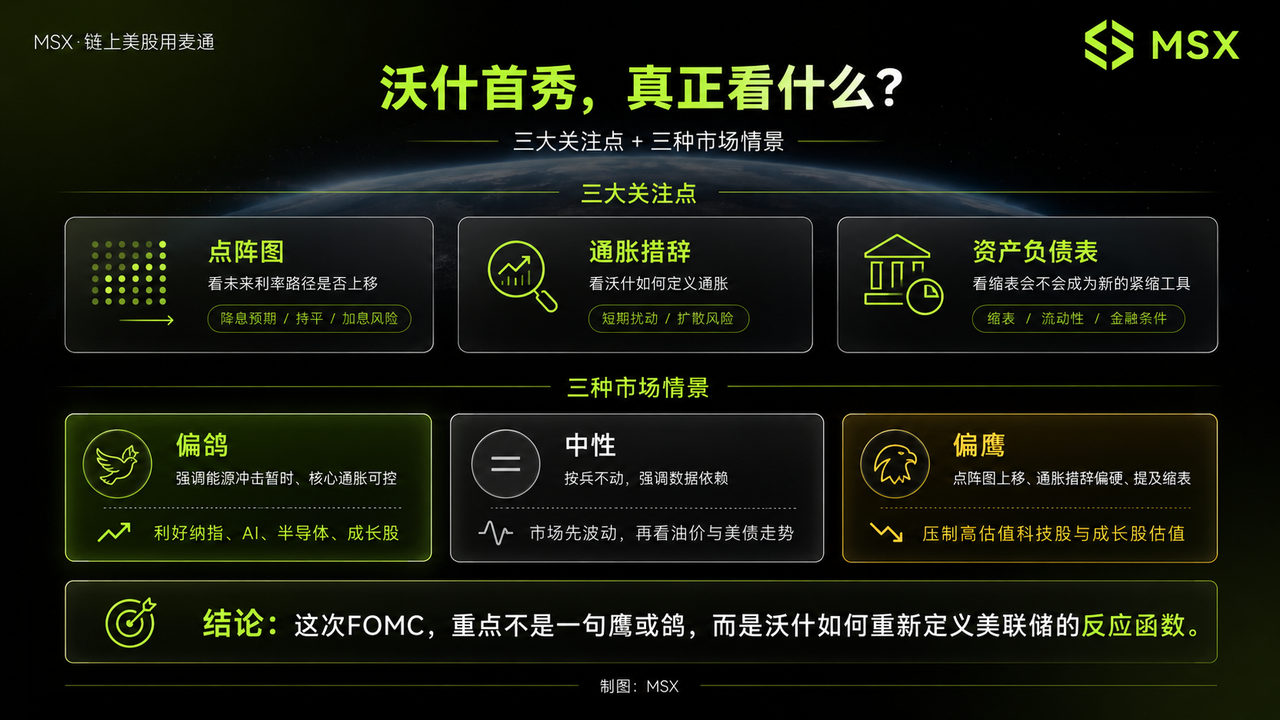
If the final outcome is a hold steady, a moderately higher dot plot, and Warsh emphasizing data dependence without rushing to hike, the market might be volatile in the short term, but it won't necessarily break the main trend for AI and tech stocks. As long as oil prices continue to fall and the 10-year Treasury yield doesn't surge higher, high-quality tech stocks still have a chance to continue their recovery.
But if the dot plot shifts significantly higher, Warsh emphasizes the risk of inflation diffusion, or elevates QT as a more important tightening tool, then US stocks need to be wary of short-term valuation compression – and the most pressure will still fall on high-valuation tech stocks, small-cap growth stocks, and long-duration assets most sensitive to interest rates.
In other words, the best outcome for this FOMC isn't Warsh sounding extremely dovish, but rather him acknowledging inflation risks without rushing to tighten. The worst outcome isn't the failure to cut rates in June, but the market discovering that the Fed's rate-cut narrative is officially over.
Therefore, from a strategy perspective this week, it's not advisable to blindly bet on direction before the FOMC.
Conclusion: Don't Guess the Answer; Wait for the Market to Signal the Direction
Therefore, from a strategy perspective this week, it's not advisable to blindly bet on direction before the FOMC.
Around the meeting, the market is prone to whipsawing – first rallying then selling off, or vice versa. A more prudent approach is to wait until the three signals – the dot plot, the press conference, and the Treasury yield reaction – are clear before deciding whether to increase positions.
In a nutshell, this FOMC is not about whether Warsh utters a single hawkish or dovish sentence, but whether he will redefine the Fed's reaction function.
If the answer is "no," the risk-on trade has room to continue. If the answer is "yes," then the market must learn how to price a Fed that offers fewer commitments, places more weight on inflation, and emphasizes liquidity discipline.
Let's wait and see.


