






跑路、被盗、被骗?Neutrl突然暂停一切协议功能


- 核心观点:山寨币期现套利协议Neutrl于8月13日突然宣布暂停铸币及赎回功能,因“协议储备受到影响”。具体原因未明,社区猜测集中于交易对手违约或团队撤资跑路,事件同时暴露了链上偿付能力验证工具的局限性。
- 关键要素:
- Neutrl定位为山寨币版Ethena,通过折价买入锁仓山寨币并使用永续合约对冲,以捕捉价差和资金费率收益,核心产品包括NLP流动性池。
- 事件发生前14分钟,疑似团队地址从Curve的NUSD-USDC池撤出约350万美元流动性,且官方关闭X评论区、删除Discord频道,加剧跑路猜测。
- Neutrl于去年4月完成500万美元种子融资,由STIX和Accomplice领投,曾吸引超2亿美元存款,但如今TVL已缩水至约5330万美元。
- 社区推测可能因OTC代币交易对手违约,导致协议仅剩对冲仓位;但近一年山寨币下跌,裸空头理论上应盈利,与储备受损报告存在矛盾。
- 协议曾接入的偿付能力验证工具Accountable已无法正常显示其验证页面,过去三个月内三个同类协议均出现暂停提款情况,引发对该类工具实际有效性的质疑。
- 专家指出,ProofofSolvency仅验证链上NAV,对依赖链下OTC资产和锁仓代币的协议存在天然盲区,无法证明资产实际流动性及交易对手履约能力。
Original: Odaily Planet Daily (@OdailyChina)
Author: Azuma (@azuma_eth)
On the evening of August 13, Beijing time, Neutrl, a spot-futures arbitrage protocol focused on altcoins, suddenly announced that it had temporarily suspended minting, redemptions, and other protocol functions due to its protocol reserves being affected.
Neutrl did not elaborate on the specific cause of the so-called "affected reserves," only emphasizing that the move was taken after consulting legal counsel to protect user interests and maintain orderly processes during the impact assessment. Neutrl also stated that the team will provide users with processing instructions in due course, and more information regarding the timeline and next steps will be announced once confirmed.
Because this announcement came abruptly and the official channels disclosed no valid clues, community sentiment quickly turned to panic, with various speculations spreading across social media.
Neutrl's Positioning and Unique Risks
Simply put, Neutrl is an arbitrage protocol built around altcoins, which can be understood as an altcoin version of Ethena.
Specifically, Neutrl purchases locked altcoins at a discount in the private market and then hedges the exposure using perpetual contracts, capturing the spread and funding rates between the two.
Subsequently, Neutrl packages the above returns into structured products on-chain and opens deposits to users, allowing them to directly participate in its arbitrage strategies — Neutrl's core products previously launched include NLP (Neutrl Liquidity Pool). After users deposit assets, the protocol allocates funds to corresponding arbitrage strategies and mints protocol tokens to give users exposure to strategy returns.
In April last year, Neutrl announced the completion of a $5 million seed funding round, led by STIX, a digital asset private market platform, and venture capital firm Accomplice, with participation from Amber Group, SCB Limited, Figment Capital, Nascent and numerous crypto angel investors, including Ethena founder Guy Young and Joshua Lim, a derivatives trader at Arbelos Markets (recently acquired by FalconX).
Due to the high similarity in model with Ethena, Neutrl also faces underlying exchange risks, contract liquidity risks, and funding rate volatility risks similar to Ethena. Moreover, since Neutrl focuses on altcoins that are subject to lock-up restrictions and greater volatility, the above risks are relatively higher, and there is an additional layer of unpredictable counterparty risk (i.e., the possibility of default by the counterparty of the locked altcoins).
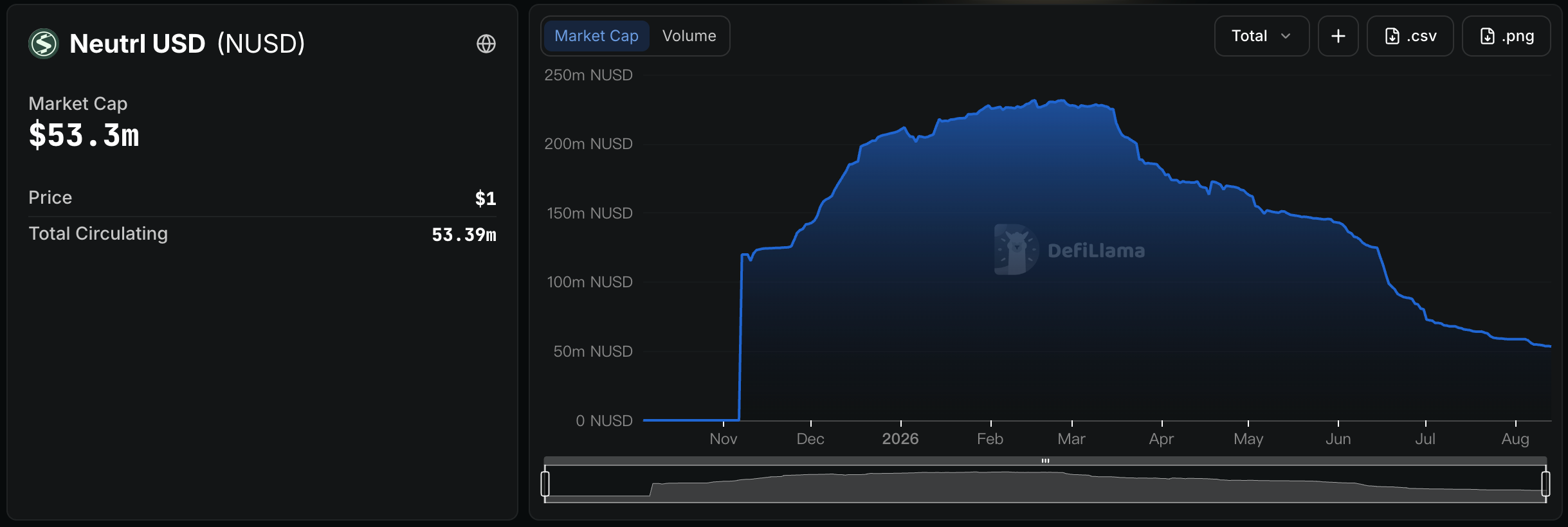
When Neutrl launched in November last year, the protocol attracted over $200 million in deposits, driven by relatively high protocol yields and the airdrop expectations from its points program. However, as risk appetite in the DeFi sector continued to contract, Neutrl's TVL has now shrunk to approximately $53.3 million.
Possible Cause Speculation: Counterparty Default?
As of writing, Neutrl has not disclosed the specific reason behind the "affected protocol reserves," but it is certain that legal counsel has become involved. Additionally, no clear signs of an attack on the protocol or hacker transfer of funds have been observed on-chain. Therefore, the community is currently speculating on possible risk sources based on Neutrl's business model.
Among these, the most discussed possibility is the counterparty default mentioned above.
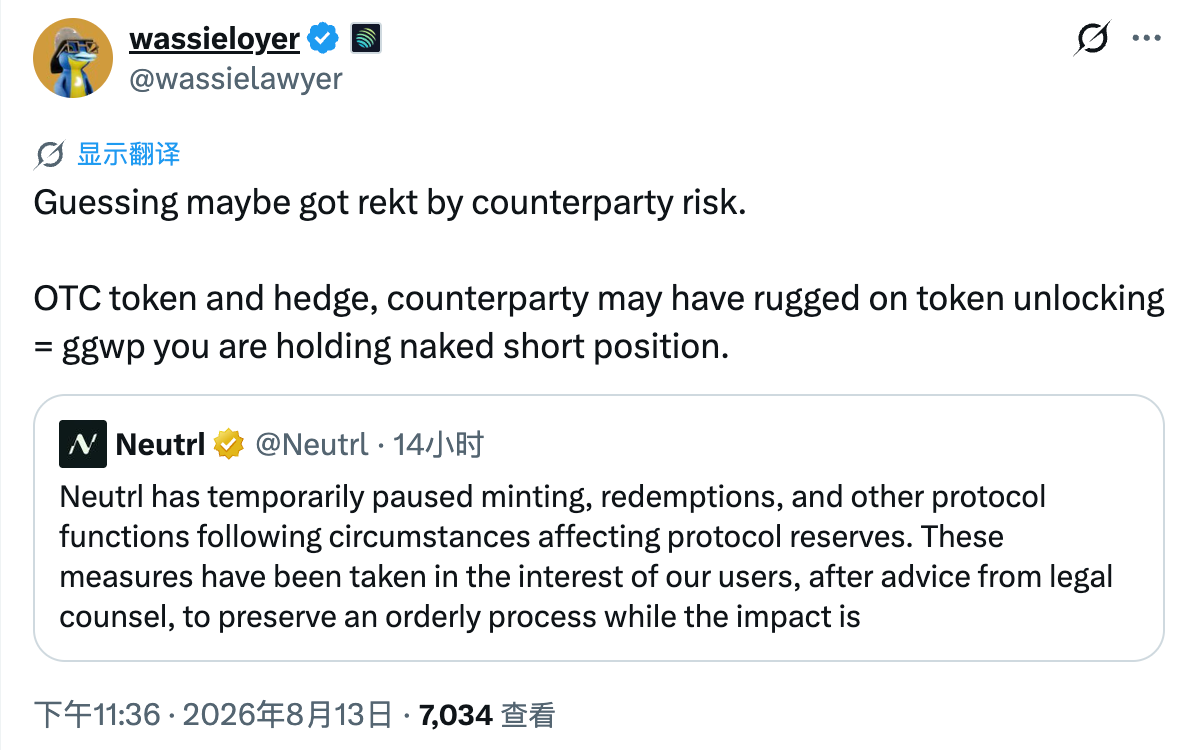
Cryptocurrency legal practitioner wassieloyer(@wassielawyer) also offered a similar guess on X. Neutrl may have suffered a forced default by an OTC token trading counterparty. Neutrl typically buys locked tokens at a discount while hedging with perpetual contracts; if the counterparty responsible for providing or delivering these locked tokens suddenly defaults, Neutrl could be left with only one side of the hedge position.
However, this speculation also presents a seemingly counterintuitive issue: If Neutrl ends up with only short perpetual positions due to counterparty default, and given that the altcoin market has generally been in decline over the past year, this "naked short" would theoretically be more likely to generate profits rather than cause "losses to protocol reserves"...
Community Fears Team Has Fled
Compared with "counterparty default," another more aggressive speculation is: "Has the Neutrl team already withdrawn liquidity in advance, or even prepared to exit scam?"
The rapid spread of this speculation is linked to the on-chain timeline around the incident.
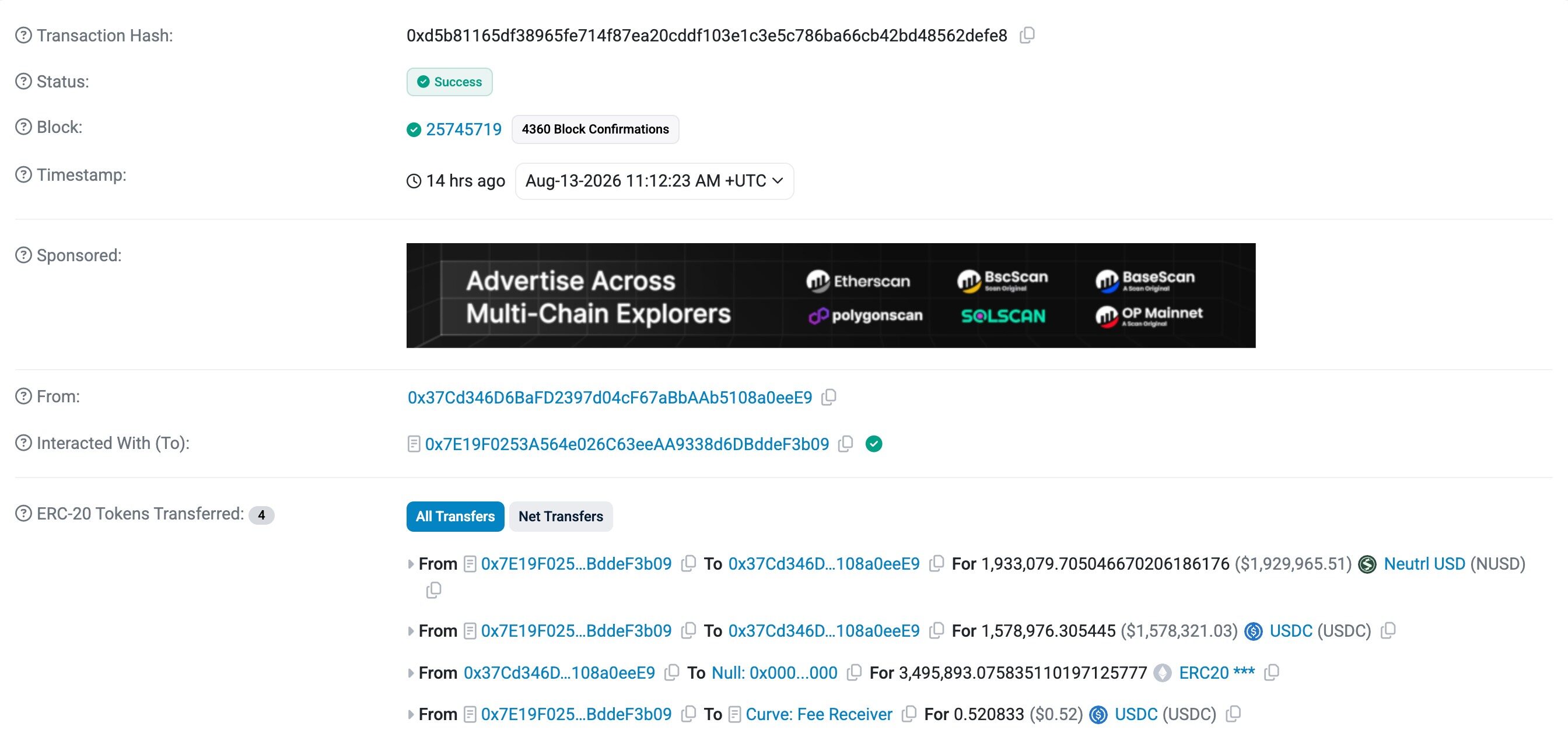
DeFi researcher Petro D. | Research(@PDmytriiev)found that at 19:12:23 Beijing time on August 13, a suspected Neutrl team address withdrew approximately $3.5 million in liquidity from the NUSD-USDC pool on Curve. Just 14 minutes later, Neutrl's official X account posted an announcement declaring the suspension of minting, redemptions, and other protocol functions due to "affected protocol reserves."
Meanwhile, Neutrl's community operations also exhibited some anomalous behavior — the comment section on the official X post was closed to replies, and Discord chat channels were deleted. These anomalies further amplified community speculation that the team had "run away."
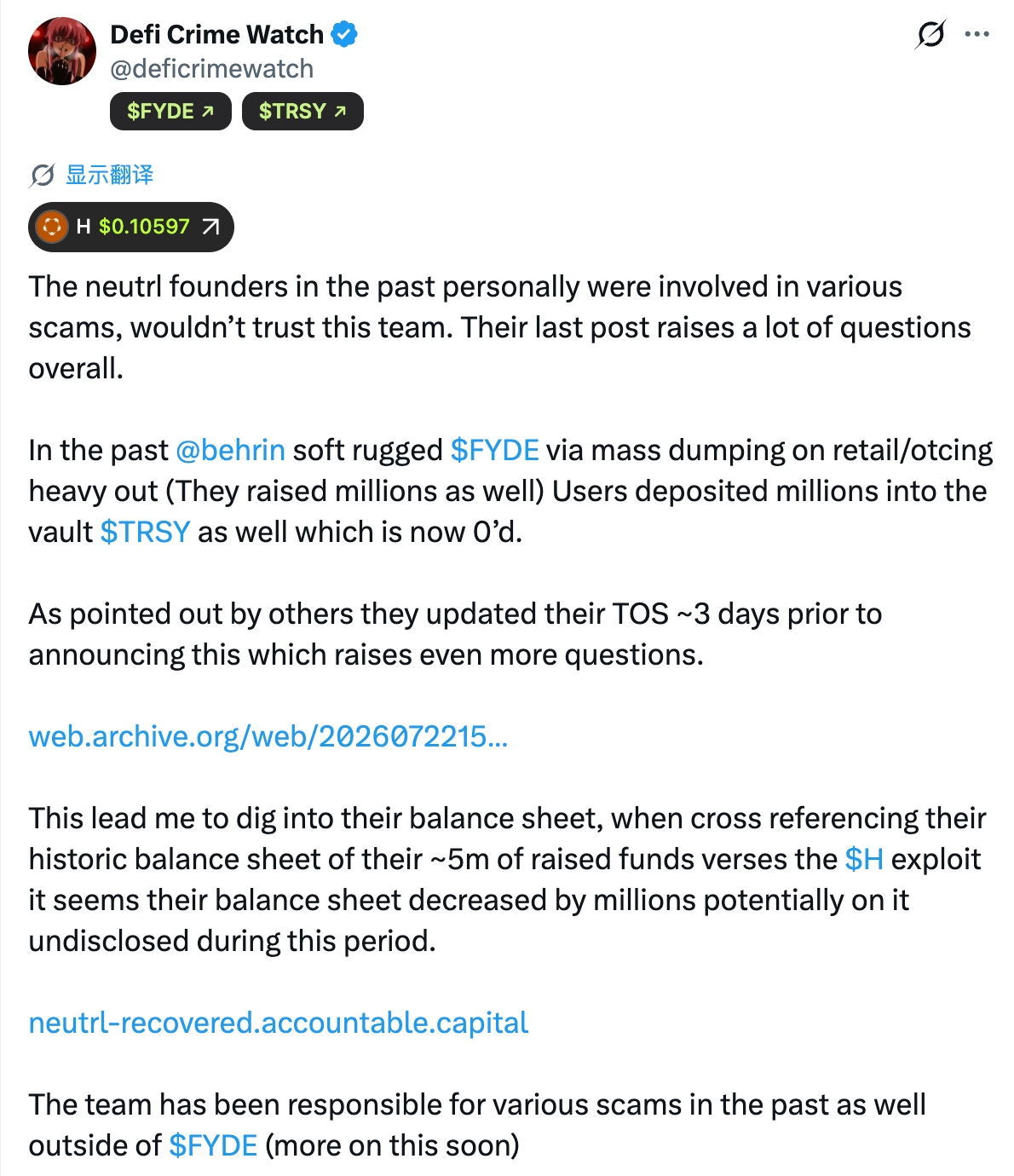
Additionally, some community members unearthed the prior involvement of Neutrl team members in other projects and questioned the team's historical credibility based on that. For example, users accused team members of having participated in projects such as FYDE and TRSY, and claimed that those projects had sold large amounts of tokens to retail investors before ultimately going to zero.
However, these accusations currently stem primarily from community discussions and are not yet sufficient as direct evidence to determine the nature of this Neutrl incident.
Validation Protocol: A Mere Decoration
Another issue exposed by this incident is that Accountable, an on-chain verification tool intended to assess Neutrl's asset security, failed to provide any early warning.
Neutrl had previously integrated Accountable's "Proof of Solvency" verification service to display the protocol's assets and liabilities, theoretically helping users determine whether the protocol had sufficient solvency. However, after this incident, DeFi researcher Ethan DeFi(@EthanDeFi_)discovered that Accountable's solvency verification page for Neutrl had also stopped working. This directly triggered user skepticism about the practical value of such "reserve proof" tools.
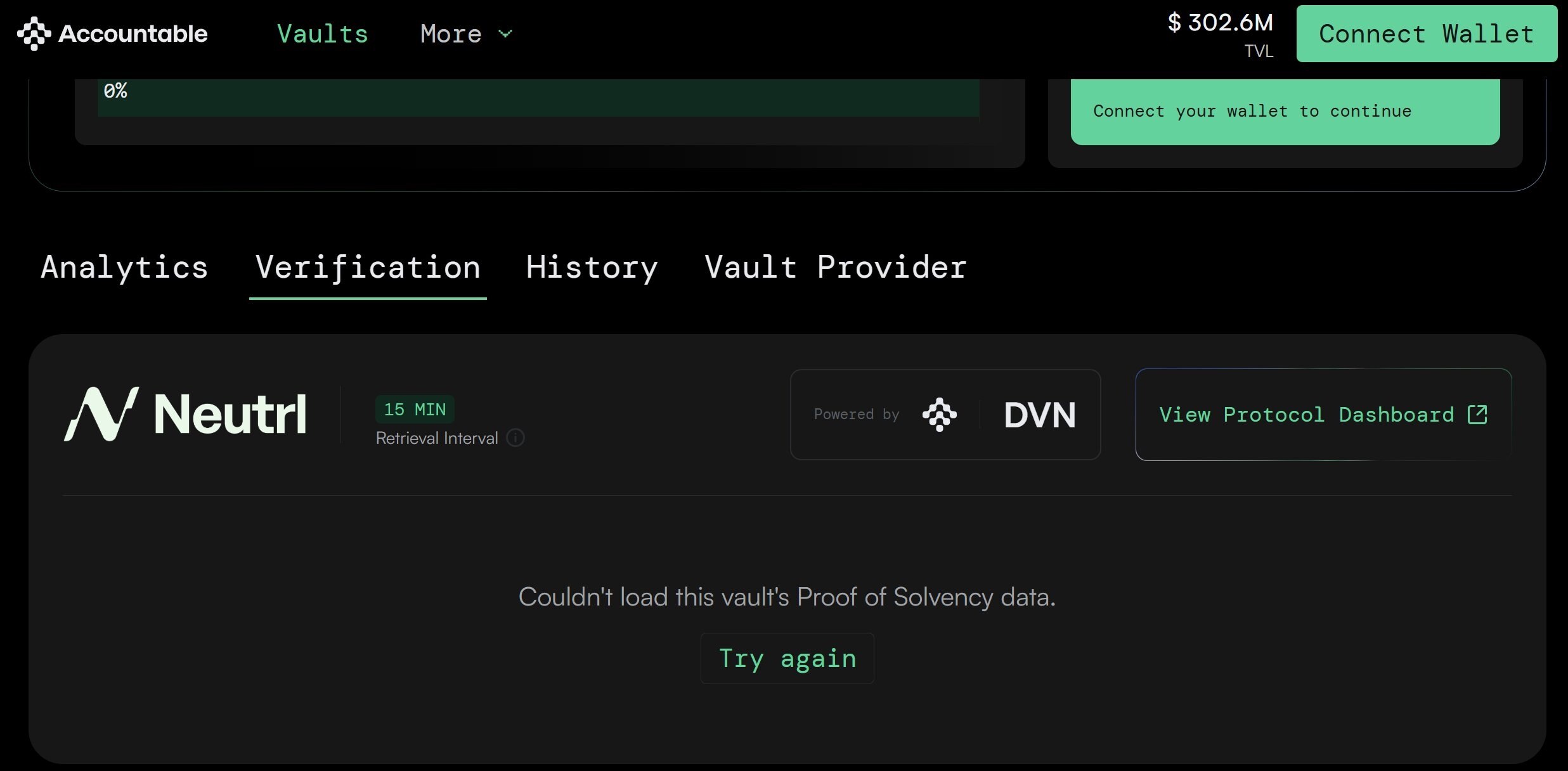
Ethan DeFi added that over the past three months, three protocols — Neutrl, Altura, and Main Street — which had been shown on Accountable's dashboard as having normal asset conditions, subsequently experienced suspension of withdrawals.
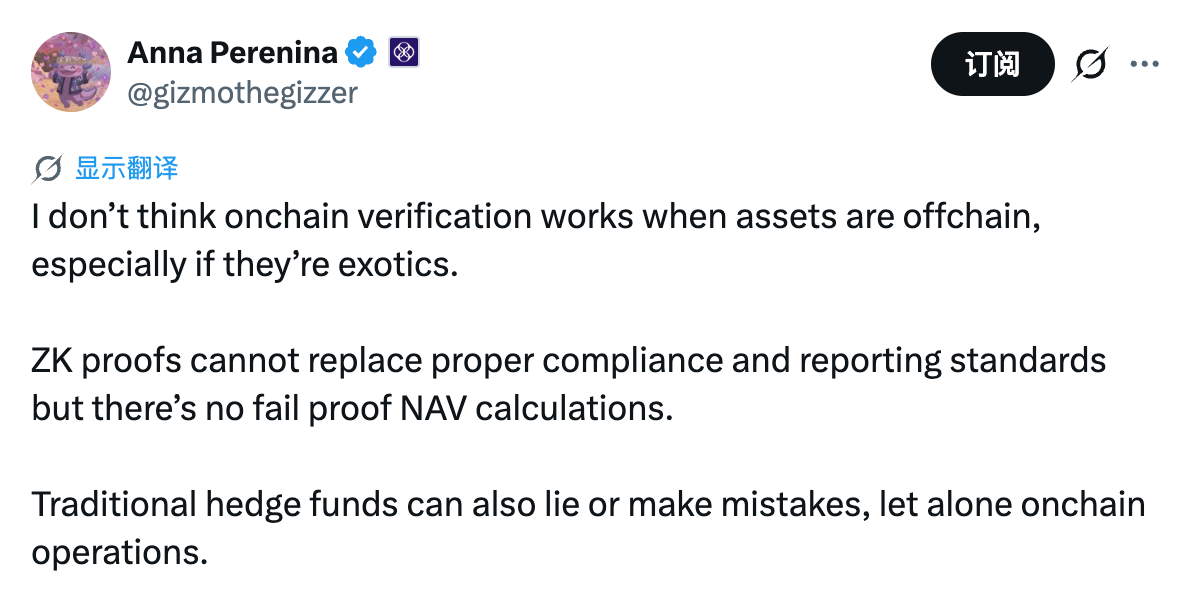
In response to this situation, Perena founder Anna Perenina(@gizmothegizzer)joined the discussion, stating that merely verifying a protocol's NAV (net asset value) is not sufficient to prove user funds are genuinely safe — if a large portion of the protocol's assets are off-chain, especially complex OTC assets, locked tokens, or other non-standardized assets, on-chain verification inherently has blind spots.
In other words, Proof of Solvency can only prove "how much money is on the books," but it does not necessarily prove "where these assets actually are, whether they can be liquidated in time, and whether counterparties will perform." For yield protocols like Neutrl that rely on OTC trades, locked tokens, and derivatives hedging, the latter information may be more important than a real-time NAV figure — when the protocol's core assets are themselves off-chain, merely proving on-chain balances does not truly address the solvency risk users care most about.
The Truth Remains Murky
As of press time, the Neutrl team has still not disclosed the specific reasons behind the impact on protocol reserves, nor have they responded further to the many speculations in the community.
Whether it is counterparty default, mismanagement of funds, or other undisclosed circumstances, we still await official clarification. Odaily Planet Daily will continue to monitor the progress of this event and provide timely follow-up coverage once Neutrl releases more details.


