STRC deviates by 11% from its anchor – can Strategy's perpetual motion machine keep running?


- Core Thesis: Strategy's preferred stock STRC has "de-anchored" by over 11% after persistently breaking below the target par value of $100. This undermines its capital flywheel model as a core corporate funding tool and triggers deep market confidence crisis regarding its liquidity and Bitcoin reserve strategy.
- Key Elements:
- STRC De-anchoring Status: STRC price has fallen approximately 11% below the $100 par value, losing its pegged function, thereby rendering the core design of unlimited fundraising via the ATM mechanism ineffective.
- Capital Flywheel Stalled: STRC is the core engine for Strategy to raise funds to purchase Bitcoin without diluting equity or facing maturity pressure. De-anchoring will directly block this funding channel.
- Dividend Adjustment Failure: Although Strategy has raised the dividend yield to 11.5% and switched to semi-monthly payments, it has still failed to repair the STRC de-anchoring, indicating market concerns extend beyond the yield itself.
- Liquidity Concerns: JPMorgan points out that Strategy's cash only covers approximately 6.3 months of dividends, while the company claims its Bitcoin reserves could cover 32 years. This divergence in evaluation standards exacerbates market uncertainty.
- Impact of First-Ever Sale: Strategy's recent first-time sale of 32 Bitcoins has shaken its core narrative of "Bitcoin as a long-term reserve asset, not for sale," sparking concerns that it may be forced to sell more coins under funding pressure.
Original: Odaily Planet Daily (@OdailyChina)
Author: Azuma (@azuma_eth)

Strategy's preferred stock STRC is experiencing a sustained "de-peg."
US stock market data shows that since May 15, STRC has gradually deviated from its target par value of $100. The discount has widened significantly in recent days, with the price hitting a low of $83.26 during intraday trading yesterday before closing at $88.59, representing a "de-peg" of over 11% from the target par value.
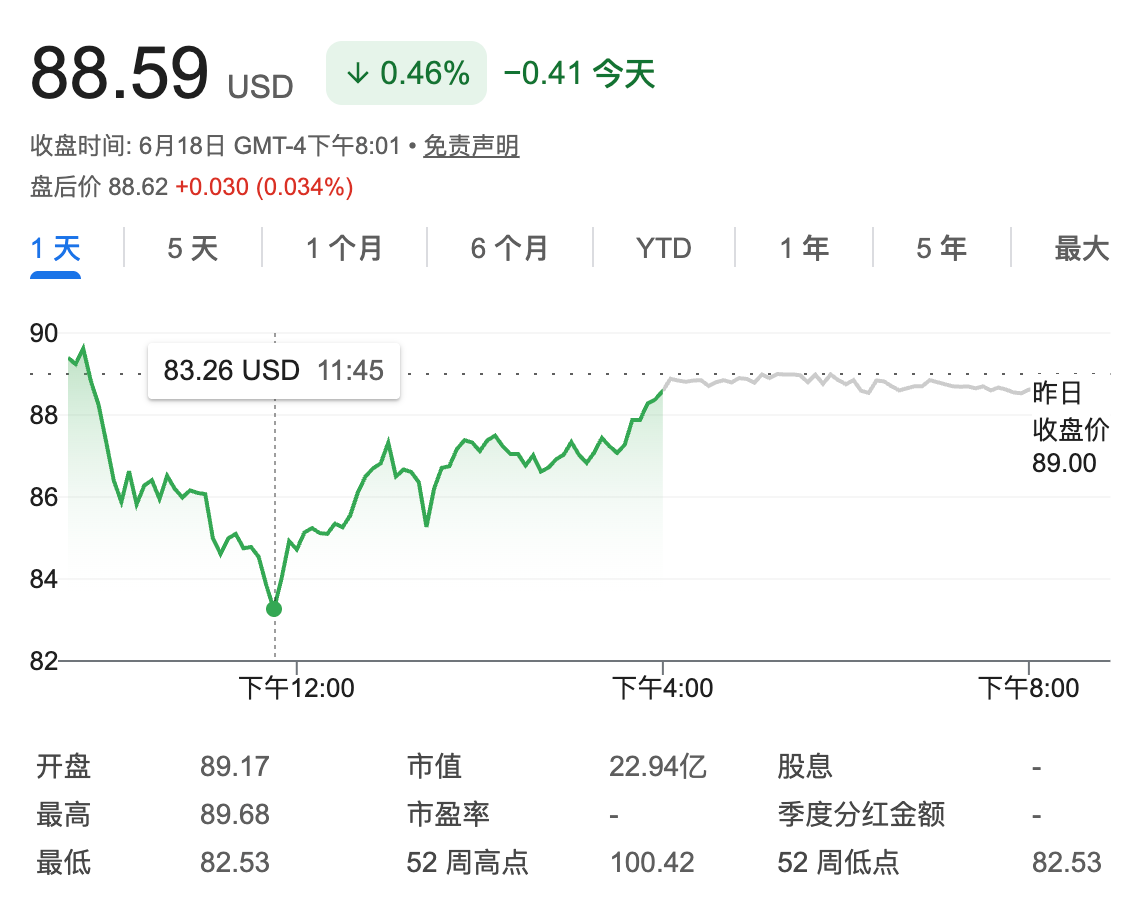
For an ordinary stock, an 11% decline might not be a major event. However, for STRC, the persistent deviation from its $100 target par value indicates that the core design objective of this product is facing a severe challenge.
This is because, in Strategy's original design, STRC was intended to be an income-generating security trading around its $100 par value, not a highly volatile speculative asset. The growing divergence between market price and target value has led an increasing number of investors to reassess the logic behind this product.
More importantly, as Strategy continues to expand its bitcoin reserve, STRC has gradually become the company's most critical financing channel. In a sense, the market's pricing of STRC not only reflects investors' attitude towards a preferred stock but also signals the market's confidence in Strategy's entire capital operation model.
STRC: The Engine of Strategy's Capital Flywheel
To understand the severity of this de-peg, we must first clarify STRC's product structure and its unique pegging mechanism.
STRC is an innovative financial instrument launched by Strategy in 2025. Unlike Strategy's common stock (MSTR), STRC is positioned as a perpetual preferred stock with a fixed target par value ($100) and relatively stable dividend yields. Its nature is closer to a fixed-income security.
- Odaily Note: Strategy founder Michael Saylor recently revealed that STRC was designed with the assistance of AI.
Within Strategy's balance sheet expansion loop, STRC is not just an ordinary financing tool; it is the most powerful engine of Strategy's current capital flywheel.
Before launching STRC, Strategy primarily relied on issuing convertible notes and directly issuing common stock to raise funds for purchasing bitcoin. However, both methods have limitations – convertible notes are constrained by maturity dates and debt leverage caps, while frequent issuance of common stock dilutes existing shareholders' equity.
STRC perfectly addresses this pain point. Its core utility within Strategy's strategy is mainly reflected in two dimensions:
- Unlimited "At-the-Market" (ATM) Issuance Program: As long as STRC's market price stabilizes at $100 or above, Strategy can continuously issue new STRC shares through the ATM mechanism in the secondary market and raise fiat currency.
- Zero Equity Dilution Purchasing Power: As a perpetual preferred stock, STRC has no mandatory principal repayment upon maturity and does not carry voting rights or residual asset distribution rights. This means Strategy can create billions of dollars in fiat purchasing power out of thin air – without diluting MSTR shareholder equity or increasing rigid debt interest – and deploy it entirely into bitcoin accumulation.
Through the closed loop of "issue STRC ➡️ raise fiat ➡️ buy BTC ➡️ boost company net asset value ➡️ enhance STRC credibility," Strategy has successfully constructed a seemingly infinite capital flywheel.
However, the key prerequisite for this flywheel to operate smoothly is that STRC must maintain a price near its $100 par value. If the market price falls significantly below $100, Strategy will be unable to effectively absorb funds from the market via discounted preferred stock under ATM terms and market arbitrage logic, causing its entire capital magic to effectively stall.
During the initial design phase, to ensure STRC's secondary market price remained consistently aligned with the $100 target par value, Strategy introduced a "monthly dynamic dividend rate adjustment" mechanism. Simply put, when STRC's market price falls below $100, Strategy can increase the dividend rate to enhance the product's attractiveness; when the price rises above $100, it can lower the rate. Theoretically, by continuously adjusting the dividend rate, STRC should be able to trade around $100 over the long term.
But now, even though Strategy has raised the dividend to a high 11.5% and shifted the payment frequency from monthly to semi-monthly, STRC's "de-peg" state has not been effectively repaired... Why?
Reasons for the De-peg: Confidence, Confidence, and Confidence
The failure of dividend adjustments to correct the price means the risk being priced by the market has exceeded STRC's yield itself. Based on current market discussions, the market's risk concerns are primarily reflected in two aspects.
First, there are superficial technical factors. Some market participants believe that the recent decline is largely due to a concentrated stampede as arbitrage funds deleverage.
Over the past year, STRC has traded steadily around $100, attracting a significant amount of yield-seeking arbitrage capital. Such capital often uses leverage to amplify returns, collecting dividend income while exploiting the arbitrage opportunity created by prices reverting to par value. However, as STRC weakened after breaking below $100, some leveraged accounts triggered risk controls, forcing selling of positions. The price decline then triggered further liquidations among more leveraged funds, creating a chain reaction. During this process, selling pressure continuously self-reinforced, causing STRC's decline to far exceed normal supply-demand changes.
Yet, attributing the current market performance solely to leveraged stampedes seems insufficient. For many investors, the deeper concern lies in Strategy's liquidity reserve situation.
Earlier this month, JPMorgan released a research report stating that Strategy has an annual dividend payment obligation of approximately $1.7 billion. Based on current cash reserve levels, its book cash is only enough to cover about 6.3 months of preferred stock dividend payments. This has sparked market concerns about Strategy's ability to meet its promised future liquidity coverage.
In response, Strategy offered a vastly different explanation. The company's official X (formerly Twitter) account emphasized that, considering its massive bitcoin reserves, it could cover dividend payments for 32 years.
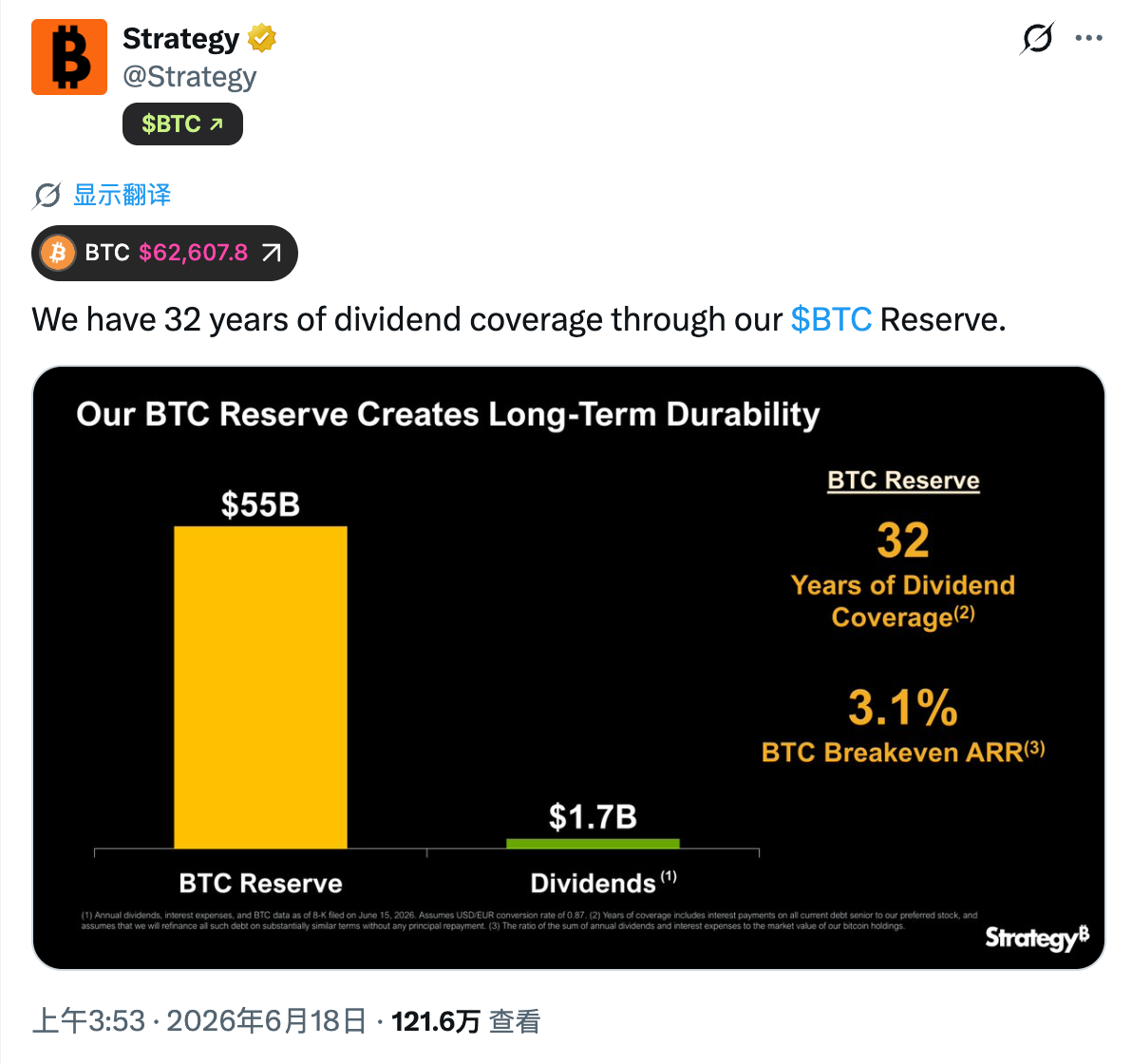
However, the issue is that these two statements are based on different premises. JPMorgan focused on Strategy's cash liquidity, while Strategy's calculation implicitly assumes a key condition – the company can sell bitcoins to generate funds if necessary.
This precisely touches upon the market's most sensitive nerve. Earlier this month, Strategy sold a portion of its bitcoin holdings for the first time. Although the sale was only 32 BTC and the company publicly framed it as a "proactive market desensitization test," mentioning it would "buy more back later," the move still caused significant shock to the market. The reason is that, over the past few years, Strategy and its founder Michael Saylor have consistently conveyed a core narrative to the market: bitcoin is a long-term strategic reserve asset, and the company will raise operating funds through capital markets rather than by selling bitcoins.
Therefore, when the market witnessed Strategy actually selling bitcoins for the first time, it inevitably triggered greater concerns – If the financing environment tightens in the future, would Strategy need to rely further on selling bitcoins to fulfill dividend obligations? If the answer is not an absolute 'no,' then investors must reassess the risk level of the related securities.
From this perspective, the sustained "de-peg" of STRC is essentially the market reassessing the robustness of Strategy's entire capital structure.
Strategy's Buying Power May Turn into Selling Pressure
For Strategy, the most significant impact of STRC's sustained de-peg is the weakening of its financing function.
Over the past few years, Strategy was able to continuously expand its bitcoin reserve, with the core logic being to raise funds from the capital market by issuing securities like common stock, convertible bonds, and preferred stock, then deploying those funds to accumulate bitcoin. STRC is Strategy's most important financing tool. When it trades persistently below its $100 target par value, it signals that the market is demanding higher risk compensation, thereby temporarily crippling Strategy's financing capacity.
Going forward, the status of STRC's re-pegging may become a key indicator for the market to observe Strategy's risk profile. If STRC remains in a discounted state for an extended period, leading to persistently limited financing capacity while Strategy's cash reserves dwindle, market concerns that Strategy might need to sell more bitcoins to meet dividend payment obligations are bound to intensify.
Once this expectation strengthens, its impact will no longer be confined to STRC itself. As one of the most important marginal buyers in the bitcoin market over the past few years, Strategy's financing ability and accumulation pace have always profoundly influenced market supply-demand expectations. If Strategy's buying power turns into selling pressure, it could exert unimaginable downward pressure on bitcoin.