






ASML กำลังขยายกำลังการผลิต TSMC เพิ่มการลงทุน: 'คลื่นลูกที่สอง' ของชิป AI เหตุใดตลาดยังมองว่าไม่เพียงพอ?


- มุมมองหลัก: รายงานผลประกอบการของ ASML และ TSMC ยืนยันร่วมกันว่าวงจรการขยายกำลังการผลิตเซมิคอนดักเตอร์ AI กำลังเร่งตัวขึ้น แต่ความคาดหวังของตลาดนั้นสูงมากอยู่แล้ว โดยไม่พอใจกับ 'อุปสงค์ที่แข็งแกร่ง' อีกต่อไป แต่เปลี่ยนไปสนใจว่าการใช้จ่ายด้านทุนมหาศาลจะสามารถแปลงเป็นกำไรและกระแสเงินสดได้หรือไม่ ซึ่งหมายความว่ากระแสชิป AI กำลังเปลี่ยนจากภาวะที่ทุกอย่างปรับตัวขึ้นทั่วไป ไปสู่ระยะแห่งการแบ่งแยกโครงสร้าง
- ปัจจัยสำคัญ:
- ASML ปรับเพิ่มคาดการณ์ยอดขายปี 2026 ขึ้นอย่างมีนัยสำคัญเป็น 43,000-45,000 ล้านยูโร และวางแผนเพิ่มกำลังการผลิต EUV และ DUV อีก 30% สำหรับปี 2027-2028 ซึ่งพิสูจน์ให้เห็นว่าลูกค้าได้จองกำลังการผลิตกระบวนการผลิตขั้นสูงล่วงหน้าเป็นเวลา 2-3 ปีข้างหน้า
- TSMC มีรายได้ในไตรมาสที่ 2 อยู่ที่ 40,200 ล้านดอลลาร์สหรัฐ (เพิ่มขึ้น 12% เมื่อเทียบเป็นรายปี) และปรับเพิ่มการใช้จ่ายด้านทุนทั้งปีขึ้นอย่างมีนัยสำคัญเป็น 60,000-64,000 ล้านดอลลาร์สหรัฐ โดย 70-80% ใช้ไปกับกระบวนการผลิตขั้นสูง ความต้องการที่เกี่ยวข้องกับ AI ถูกอธิบายว่า 'แข็งแกร่งอย่างยิ่ง'
- แรงกดดันด้านอัตรากำไรขั้นต้นปรากฏชัด: TSMC คาดว่าการผลิตกระบวนการ 2 นาโนเมตรเชิงปริมาณและการขยายโรงงานในต่างประเทศจะลดทอนอัตรากำไรขั้นต้นลงประมาณ 3-4 จุดเปอร์เซ็นต์ในช่วงครึ่งปีหลัง โดยบริษัทระบุชัดเจนว่าไม่แสวงหาการเพิ่มผลกำไรสูงสุดในระยะสั้น แต่ให้ความสำคัญกับการรักษาการขยายตัวในระยะยาวและความสัมพันธ์กับลูกค้าเป็นอันดับแรก
- ปฏิกิริยาของตลาดค่อนข้างเย็น เนื่องจากอัตรากำไรขั้นต้นสอดคล้องกับความคาดหวังที่ปรับเพิ่มขึ้นแล้วเท่านั้น ไม่เป็นไปตามความคาดหวังที่สูงกว่าของนักลงทุนบางราย (ประมาณ 69%) ผลประกอบการที่แข็งแกร่งกลายเป็น 'เงื่อนไขจำเป็น' สำหรับการประเมินมูลค่า ไม่ใช่ 'ตัวเร่งปฏิกิริยาใหม่'
- ความต้องการ AI กำลังขยายวงกว้างจาก GPU ไปสู่ชิปประเภทอื่นๆ เช่น CPU, ชิปเครือข่าย และการประกอบขั้นสูง (CoWoS) ซึ่งกำลังการผลิตประกอบขั้นสูงในปัจจุบันได้กลายเป็นอุปสรรคสำคัญที่จำกัดการเติบโตของลูกค้า
- TSMC มองว่าความต้องการ AI จะยังคงแข็งแกร่งจนถึงปี 2029-2030 แต่อาจมีความผันผวนเป็นระยะ บริษัทยังคงยืนยันการประมาณการอัตราการเติบโตแบบทบต้นของธุรกิจที่เกี่ยวข้องกับ AI ที่ระดับสูงถึง 50% แต่ไม่ได้อัปเดตตัวเลขที่แน่นอน
- การตรวจสอบ验证ในขั้นตอนต่อไปที่สำคัญจะมาจากผู้ให้บริการคลาวด์ (Microsoft, Amazon, Google, Meta) ซึ่งจำเป็นต้องพิสูจน์ว่าการใช้จ่ายด้านทุน AI ที่เพิ่มขึ้นอย่างต่อเนื่องสามารถแปลงเป็นการเรียกใช้โมเดล รายได้ และผลตอบแทนจากกระแสเงินสดที่แท้จริงได้
In the past week, the beleaguered AI hardware sector has been waiting for a much-needed shot in the arm to reverse market sentiment.
The subsequent earnings reports from ASML and TSMC both showed strong fundamentals, yet failed to fully meet lofty expectations: The former significantly raised its full-year revenue and gross margin guidance and began increasing production capacity for lithography machines for 2027-2028; the latter maintained its revenue, gross margin, and operating profit margin at historical highs, while simultaneously lifting its full-year capital expenditure to a range of $60 billion to $64 billion.
Logically, this should be an ideal combination for AI semiconductors – equipment companies proving customers are still placing orders, and the leading foundry demonstrating that orders are converting into revenue, with a willingness to continue investing heavily in expanding capacity.
However, the market's response has not perfectly matched the strength of these results.
The reason is not a deterioration in the fundamentals of the two companies, but rather that expectations for the AI supply chain have been pushed to an exceptionally high level. The market is no longer satisfied with "demand remains strong"; instead, it expects every earnings report to show upward revisions, every margin to break limits, and all massive capital expenditures to immediately translate into higher profits.
This has caused the earnings reports from ASML and TSMC to convey two seemingly contradictory yet simultaneously valid signals: the capacity expansion cycle for AI semiconductors continues, with some critical areas even accelerating; but the capital market's pricing of this cycle has shifted from validating demand to validating returns.
1. ASML and TSMC Simultaneously Increase Investment: The Capacity Expansion Cycle Is Far From Over
ASML kicked off this earnings season with its results.
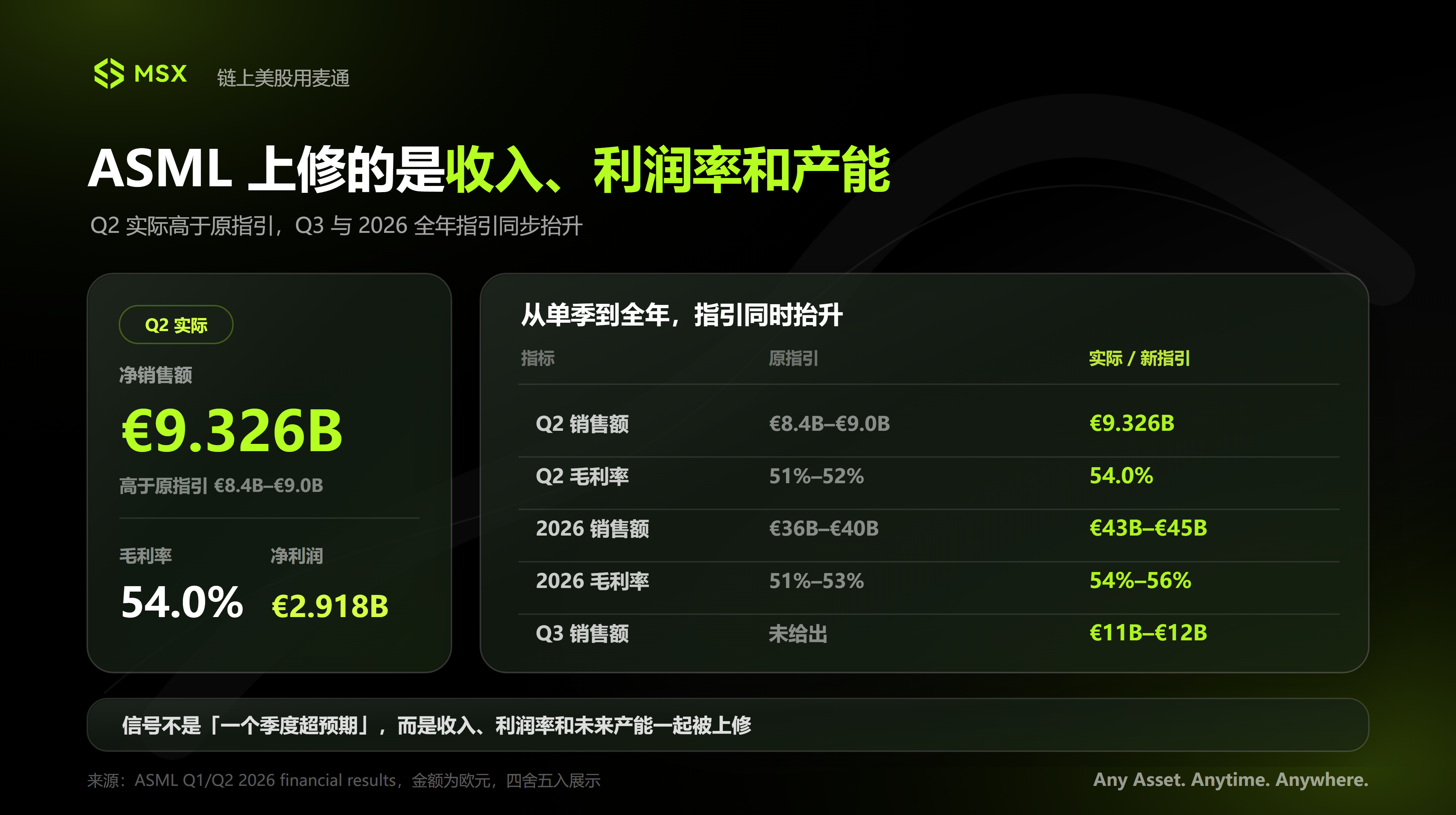
The company reported net sales of €9.326 billion in the second quarter, exceeding its previous guidance of €8.4 billion to €9.0 billion; gross margin was 54%, and net profit was €2.918 billion. The company subsequently raised its third-quarter sales guidance to €11.0 billion to €12.0 billion and significantly increased its full-year 2026 sales forecast from €36.0-€40.0 billion to €43.0-€45.0 billion.
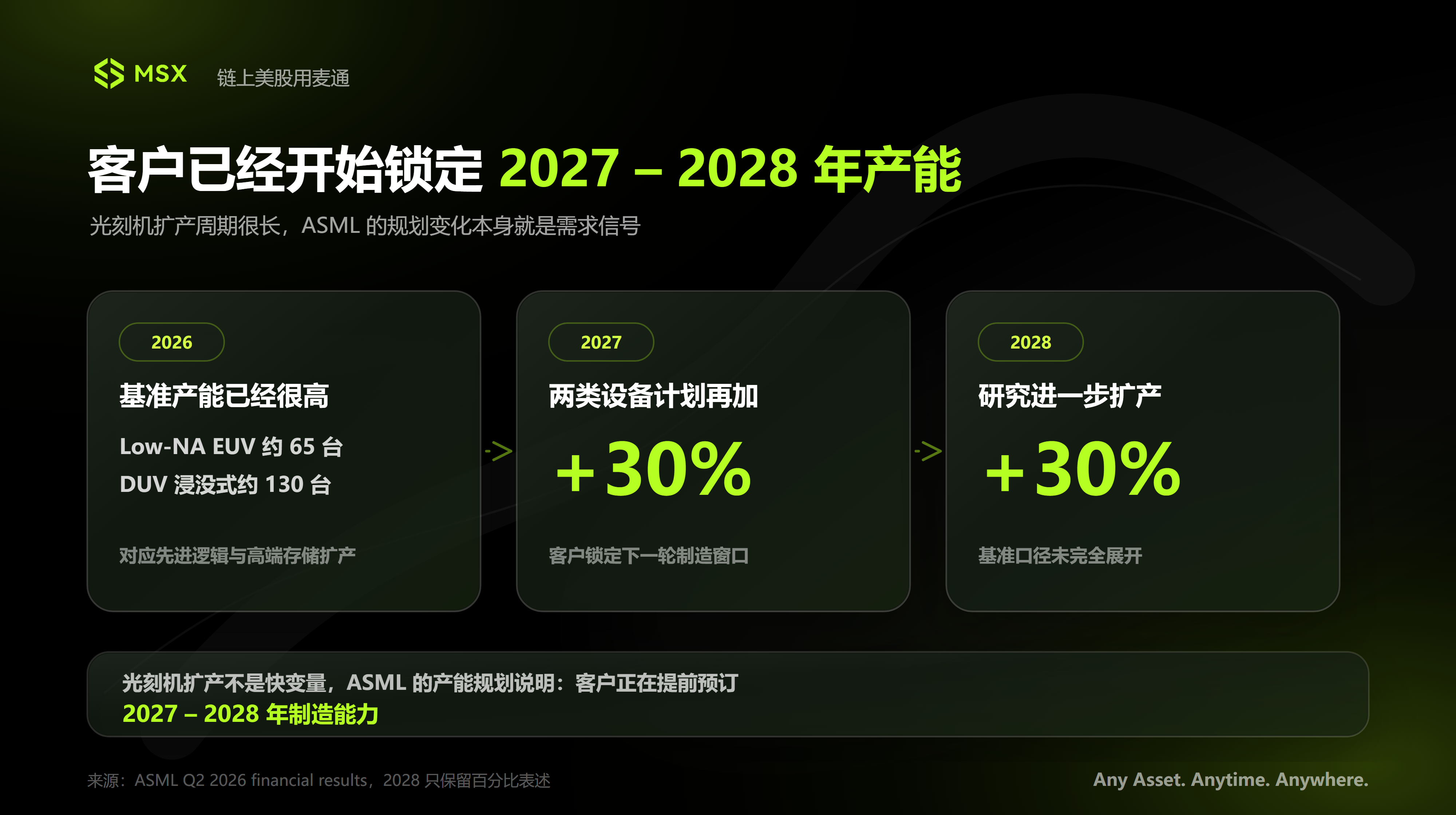
More important than the quarterly data is ASML's decision to adjust its equipment production capacity for the next two years. The company plans to increase low numerical aperture EUV production capacity by 30% in 2027 compared to the approximately 65 units planned for 2026, and DUV immersion equipment will also increase by 30% from around 130 units; meanwhile, ASML is also studying the possibility of further capacity expansion in 2028.
The lithography machine supply chain is complex with long lead times; ASML would not rashly increase production capacity two years out based on just a quarter or two of order fluctuations. Such expansion plans imply that foundry customers are locking in advanced process and high-end memory capacity for 2027-2028 well in advance.
A day later, TSMC provided the corresponding validation from the wafer manufacturing side.
The company reported Q2 revenue of $40.2 billion, up 12% quarter-over-quarter, at the upper end of its guidance range of $39.0 billion to $40.2 billion; gross margin reached 67.7%, slightly above the top end of guidance, and operating margin hit 60.3% for the first time. Net profit was NT$706.56 billion, a year-over-year increase of 77.4%, with earnings per share of NT$27.25.
The revenue structure continued to tilt towards AI and advanced processes. In the second quarter, high-performance computing business revenue grew 20% sequentially, accounting for 66% of total revenue; advanced processes of 7nm and below represented 77% of wafer revenue, with 3nm and 5nm contributing 30% and 33% respectively, while 2nm, in its early production ramp-up phase, contributed 3% of wafer revenue for the first time.
Even more significant was the capital expenditure announcement. TSMC raised its 2026 capital expenditure plan from $52 billion to $56 billion to a significantly higher $60 billion to $64 billion. Of this, approximately 70% to 80% will be allocated to advanced process technologies, and about 10% to 20% for advanced packaging, testing, and mask manufacturing.
The company also increased its full-year dollar revenue growth forecast from "slightly above 30%" to the mid-40% range. Management stated that AI-related demand remains extremely strong, with positive demand signals from cloud service providers and downstream customers.
ASML is preparing to increase lithography equipment production capacity, while TSMC is expanding wafer fabrication and advanced packaging capabilities through higher capital expenditure.
Therefore, when the equipment leader and the world's largest foundry simultaneously raise their future investments, at least one thing is certain: capital expenditure in AI semiconductors has not entered a contraction cycle; the supply chain is even accelerating preparations for capacity to meet demand in the coming years.
2. Performance Is So Strong, Why Does the Market Still Consider It Insufficient?
The problem is that the market is no longer simply waiting for an earnings report that "meets targets."
Since TSMC reports its revenue monthly, the $40.2 billion Q2 figure was largely priced into the market beforehand. Therefore, leading up to the earnings release, the real areas of potential surprise were gross margin, the third-quarter guidance, and the extent to which capital expenditure would be raised.
From this perspective, TSMC's Q2 gross margin of 67.7%, while above its own guidance range of 65.5% to 67.5%, was roughly in line with the consensus post-upgrade expectations. It did not meet the more aggressive forecasts of some investors who anticipated figures closer to 69% or even higher.
For the third quarter, the company expects revenue of $44.6 billion to $45.8 billion, representing roughly another 12% sequential growth at the midpoint; however, the gross margin guidance declines to 65% to 67%, with a midpoint around 66%.
This decline in gross margin does not signify weakening demand.
TSMC expects the rapid production ramp-up of its 2nm process to dilute gross margin by approximately 3 to 4 percentage points in the second half of the year; overseas fab expansion will also continue to increase depreciation and manufacturing costs. Strong demand for advanced processes, high capacity utilization, and manufacturing efficiency improvements can only partially offset these pressures.
In other words, TSMC is facing a classic high-demand expansion paradox – the stronger the demand, the more the company needs to procure equipment early, build fabs, and introduce new processes; and the higher the capital expenditure, the sooner the pressures from depreciation, overseas production costs, and new node ramping will reflect in profit margins.
This is the most crucial aspect to understand in this earnings report.
Based on management's comments on pricing strategy during the earnings call, TSMC is not pursuing maximizing short-term gross margins during the tightest supply period. The company emphasizes its role as a long-term partner to customers and avoids squeezing clients through sudden, significant price hikes, preferring to maintain a profitability level sufficient to support long-term expansion.
This means TSMC currently prefers to strike a balance between pricing power, customer relationships, and sustained capacity expansion, rather than cashing in on all scarcity premiums at once. From an industry perspective, this is undoubtedly a positive signal, but from a short-term trading perspective, it means investors must accept a reality: while AI demand remains strong, it does not guarantee that every incremental dollar of new revenue will instantly translate into higher margins.
Therefore, the relatively cool market reaction to TSMC's results cannot be simply interpreted as AI demand peaking. A more accurate explanation is that in an environment of exceptionally high expectations, strong performance is becoming a prerequisite for valuation but no longer automatically serves as a new catalyst for upward movement.
The fact that the strong results did not immediately lead to a sustained sector rally post-announcement also reflects investors digesting margin pressures and overly optimistic expectations.
3. Combining ASML and TSMC's Reports Reveals the AI Chip "Second Wave"
Looking at the earnings reports from ASML and TSMC together, the outline of the so-called AI chip "second wave" is becoming clearer than before.
It is not a return to the broad shortage where "all chips are insufficient," nor is it a simple replay of the past two years' narrative centered on Nvidia GPUs. Instead, supply bottlenecks are spreading across the entire AI system.
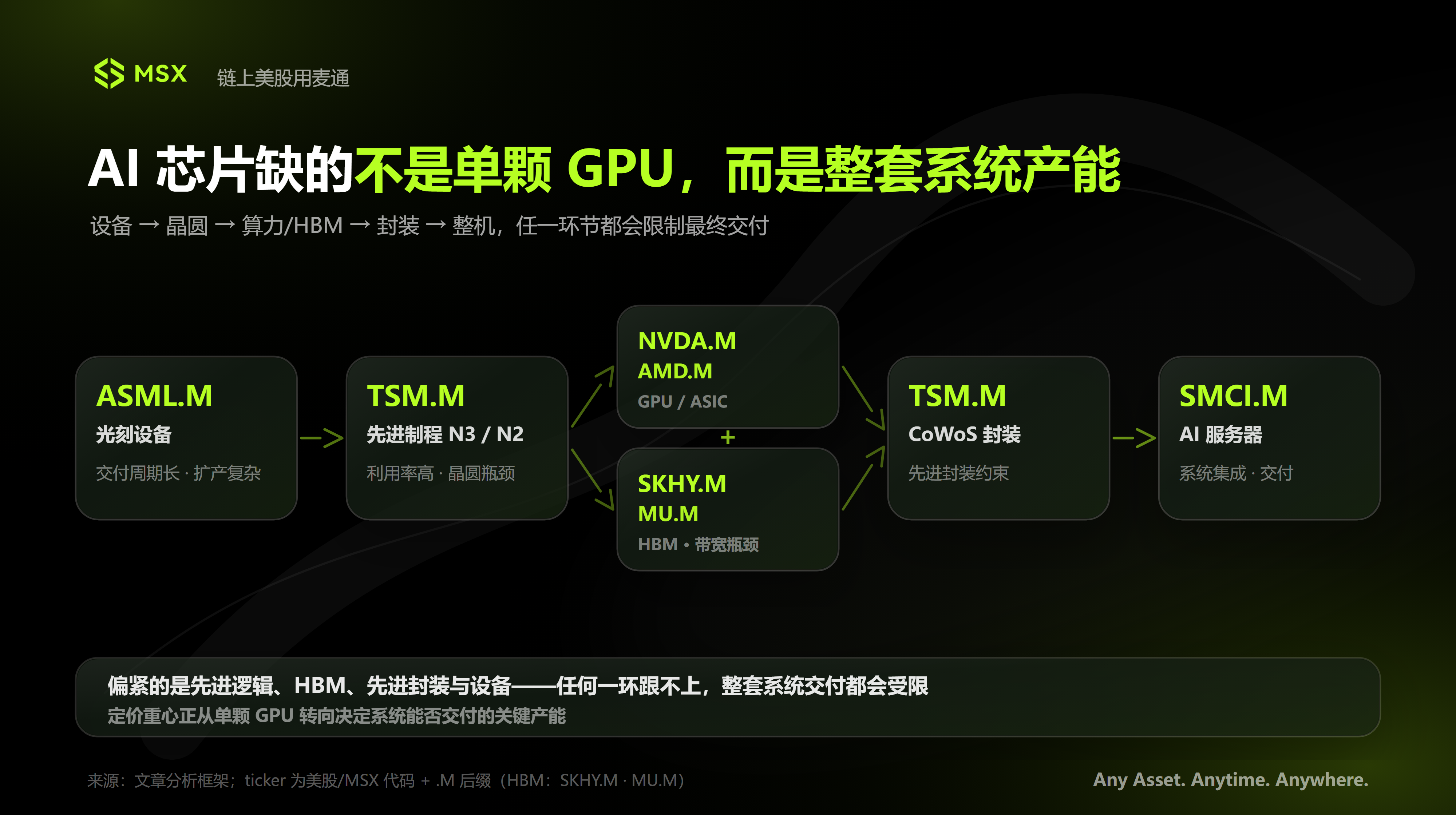
ASML's EUV and DUV equipment determines how fast advanced processes can expand; TSMC's 3nm and 2nm nodes determine how much wafer capacity is available for GPUs, CPUs, and custom ASICs; HBM determines memory bandwidth; and advanced packaging like CoWoS determines whether computing chips, memory, and high-speed interconnects can ultimately be combined into deliverable data center products.
A bottleneck in any single link can slow the entire output of AI systems.
TSMC management even explicitly stated that current advanced packaging capacity is so tight it is constraining customer growth. The company is working hard to bridge the gap between demand and capacity while welcoming alternative packaging solutions to provide customers with additional options.
At the same time, AI demand is diversifying from a single accelerator type to a broader range of chips.
TSMC believes the development of Agentic AI is re-elevating the importance of CPUs in data centers. Whether customers use x86, Arm, or RISC-V architectures, the advanced chips behind them will largely still need to be manufactured by TSMC. This implies future AI capital expenditure will not only flow to GPUs but will also continue to drive demand for CPUs, networking chips, memory, and advanced packaging.
Management's expression on long-term demand was also positive. TSMC believes AI-related trends will remain strong through 2029-2030, with potential periodic fluctuations along the way, but the long-term direction is unchanged. Regarding the previously provided growth rate of the mid-50s CAGR for its AI-related business, management did not offer new specific figures, only stating that demand trends are stronger than previously expected.
However, this does not mean all semiconductor companies will benefit equally.
- ASML (ASML.M) directly benefits from demand for lithography equipment and advanced process capacity expansion.
- Applied Materials (AMAT.M), Lam Research (LRCX.M), and KLA Corporation (KLAC.M) benefit from demand for deposition, etching, and inspection equipment respectively, but the timing of order fulfillment may vary.
- TSMC (TSM.M) controls advanced wafer manufacturing and packaging capabilities and is the core beneficiary of AI chip capacity expansion.
- SK Hynix (SKHY.M), Micron (MU.M), and Samsung Electronics supply HBM and high-end memory.
- Nvidia (NVDA.M), AMD (AMD.M), Broadcom (AVGO.M), as well as cloud providers with in-house chip capabilities like Amazon (AMZN.M), Alphabet (GOOGL.M), Microsoft (MSFT.M), and Meta (META.M), collectively determine how fast end-user demand can ultimately grow.
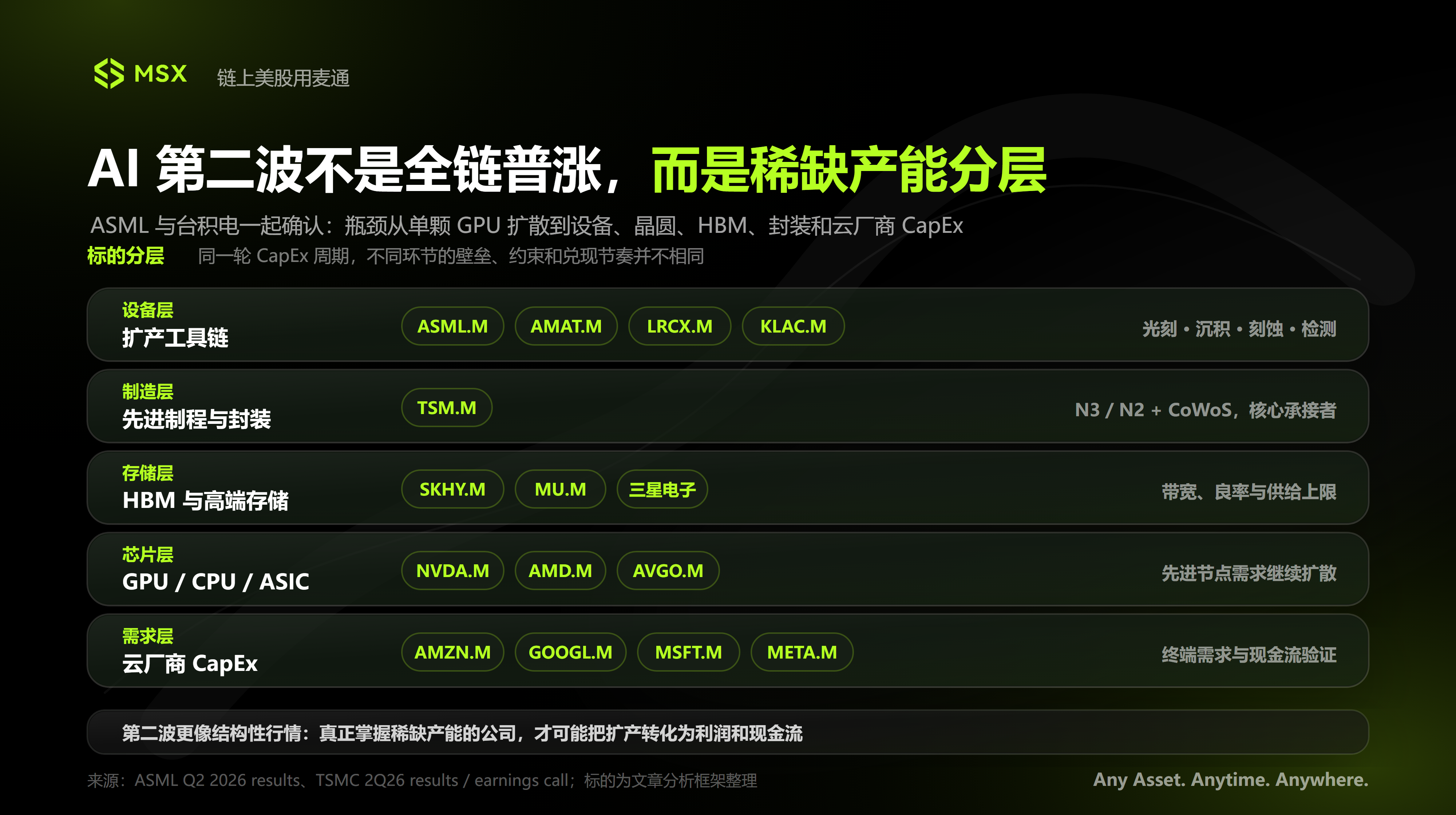
These companies are in the same capital expenditure cycle but possess vastly different technological moats, capacity constraints, profit structures, and valuation levels. Therefore, the AI "second wave" is more likely to be a structural market trend rather than a synchronized re-rating of the entire hardware supply chain.
In the next phase, the market will focus more on which companies truly possess scarce, hard-to-replicate production capacity, which are merely following customer demand by increasing capital expenditure, and which can sustainably improve free cash flow and return on capital after expanding capacity.
After ASML and TSMC, the next key validation point will fall back on cloud service providers like Microsoft, Amazon, Google, and Meta. After all, equipment companies are willing to expand capacity, foundries are willing to invest, but ultimately, cloud providers must continue to increase their capital expenditure and prove that the increasingly massive AI infrastructure can generate real model usage, corporate revenue, and cash flow returns.
Final Thoughts
Objectively speaking, ASML answered whether foundries are still willing to purchase equipment, while TSMC further demonstrated that customer orders are sufficient to drive the company to continue increasing wafer and advanced packaging capacity.
From this perspective, the industrial cycle for AI semiconductors has not peaked.
After all, equipment capacity is expanding, advanced packaging remains tight, and TSMC has even raised its annual capital expenditure to a maximum of $64 billion – these are not signals an industry about to contract would send.
But the reason the market still feels it's not enough is that the questions for the next phase have changed. Previously, investors needed to confirm if AI demand was real; now, demand is difficult to deny. The market now wants to know how much capital is required to meet this demand and how much profit and cash flow that capital can ultimately generate.
Therefore, the "second wave" of AI chips may have already begun, but it will not be a simple repeat of the first cycle.
What is truly scarce is no longer just the companies that can supply more chips, but those that can command key production capacity while maintaining pricing power, profit margins, and returns on capital even after massive expansion.


