“119 to 176 USD”: Behind SpaceX’s IPO, MSX Once Again Completes a Pre-IPO Closed Loop


- Key Takeaway: MSX Meton’s Pre-IPO product successfully generated approximately 40% returns for early subscribers after SpaceX’s IPO, validating the complete closed-loop mechanism from subscription to monetization. This marks another demonstration of the model’s replicability following Cerebras.
- Core Elements:
- MSX users subscribed to SpaceX Pre-IPO shares at $119, corresponding to a valuation of approximately $1.38 trillion. The after-hours price on the first trading day was $166.85, representing a gain of around 40%; with an intraday high of $176, the gain reached approximately 48%.
- SpaceX’s IPO served as a stress test for the tokenized Pre-IPO track, with multiple platforms having to refund subscription fees due to their inability to secure allocations, highlighting MSX’s advantage in terms of asset authenticity.
- MSX’s Pre-IPO product was already validated during Cerebras’ IPO in May, where users participated at $100.35, resulting in a comprehensive return exceeding 300% based on the first-day high.
- MSX has established a six-step closed loop covering subscription, holding, redemption, IPO, spot trading, and stablecoin settlement, providing ordinary users with a complete exit pathway.
- Since its launch in March, MSX Pre-IPO has covered high-profile targets including Cerebras, SpaceX, ByteDance, and Lambda Labs, and continues to expand its asset reserves in AI and cutting-edge technology fields.
After Cerebras's 300% gain in May, MSX delivered its second "perfect score" on SpaceX's listing night.
Did everyone take part in SpaceX's $2 trillion IPO feast?
Late on June 12 Beijing time, as the largest IPO in history, SpaceX (SPCX) was officially listed and began trading on Nasdaq, hitting an intraday high of $176 and briefly pushing its market cap beyond $2.3 trillion.
For MSX Matong, SpaceX's listing bell also marked a critical milestone for its SpaceX Pre-IPO project launched in March.
In early March this year, MSX opened the door for SpaceX Pre-IPO subscriptions at a price of 119 U (after stock split adjustment, same below), corresponding to an offering valuation of approximately $1.38 trillion. With SpaceX's listing, MSX users were able to complete the full journey from participating in a premium private market asset to embracing its public market pricing within three months.
Calculated based on SPCX.M's first-day closing price of $166.85, this marks an increase of about 40% from the early MSX subscription price of 119 U; based on the intraday high of $176, the gain approaches 48%.
This is another complete validation of the MSX Pre-IPO product model, following Cerebras in May.
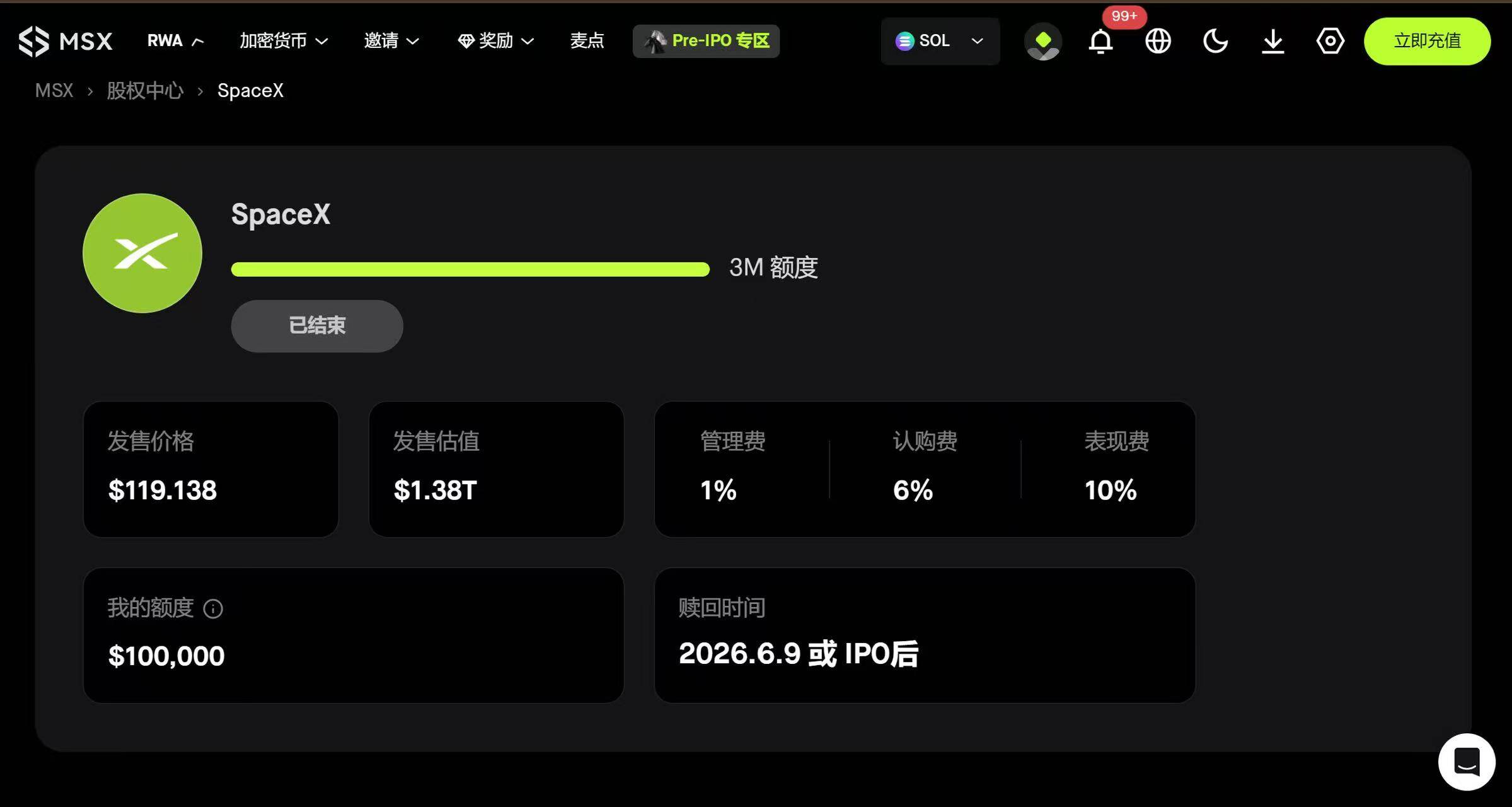
1. Three Months: From 119 U Subscription to Listing Realization
As is well known, for a long time, equity opportunities in top private companies have been mainly accessible to institutional investors, private equity funds, and a small number of high-net-worth individuals. Ordinary investors could only participate at the secondary market price after the company completed its IPO.
But the truly imaginative growth phase often occurs before a company goes public, which is the core value of Pre-IPO products.
It is precisely for this reason that on March 2, MSX Matong was among the first to launch a Pre-IPO section for ordinary users. Since then, we have seen more and more similar products appear in the market, raising a key question.
The real value of Pre-IPO is not just about letting users see a hot target earlier, but about whether it can complete a full closed loop from subscription, holding, listing, trading to monetization after the target is officially listed.
The implementation of the MSX Matong SpaceX project this time is a concentrated embodiment of this mechanism:
- Subscription: On March 2, users could subscribe to SpaceX Pre-IPO shares on the MSX platform at 119 U, with the assets recorded on-chain in token form.
- Holding: From subscription to IPO listing, users could view their holding status in real-time on the MSX platform, with full asset visibility throughout the process.
- Redemption Opened: On June 9, redemption applications for the first Pre-IPO project batch – SpaceX, ByteDance, and Lambda Labs – were officially opened, providing more flexible exit options for users who subscribed to Pre-IPO products.
- Official Listing: On June 12, SpaceX listed on Nasdaq, surging at the open and closing at 166.85 U post-market, approximately 40% higher than the MSX subscription price.
- Spot Trading: MSX simultaneously launched SPCX.M spot trading. Tokens held by Pre-IPO users were directly converted into tradable spot assets, allowing them to place sell orders at any time without waiting for lock-up periods to expire.
- Monetization & Settlement: Proceeds from sales are settled in stablecoins, completing the fund closed loop.
Subscription, holding, redemption, listing, spot trading, monetization – all six links are indispensable.
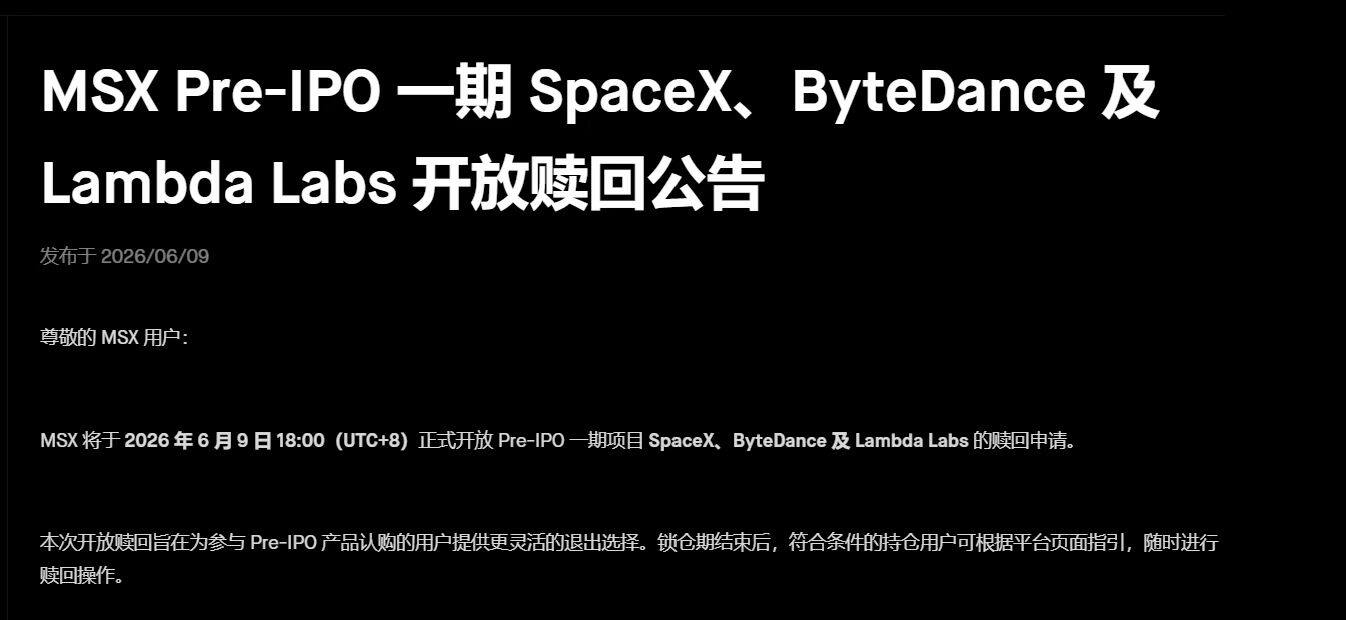
The value of this chain is precisely inversely proven by this listing event.
This SpaceX listing served as a concentrated stress test for the tokenized Pre-IPO track. Because the third-party tokenized quota delivery chain relied upon by some platforms failed to secure SpaceX quotas during the settlement phase, several platforms refunded part or all of the subscription fees to users around the time of the listing.
For this reason, the smooth progression of the SpaceX project means that MSX Pre-IPO is not simply about offering a "conceptual share," but has established a complete, executable closed-loop mechanism encompassing subscription, holding, redemption, listing, spot trading, and stablecoin settlement.
For users, this point is more important than simple short-term price gains, because the core difficulty of Pre-IPO products has never been just about whether you can buy, but whether you have a clear asset conversion and exit path after the target is listed.
2. Another "Perfect Score" Delivered by MSX Matong
In fact, the successful practice of SpaceX is the second key report card delivered by MSX Pre-IPO, following Cerebras.
To understand the weight of this report card, we need to rewind time to a month ago.
On May 14, 2026, the "Nvidia challenger" Cerebras (CBRS) listed on Nasdaq. Its issuance price was $185, it doubled at the open, and closed up about 68%. Beyond the public market, MSX users who participated earlier reaped an even more remarkable result – about 300% in two months.
As mentioned earlier, on March 2, MSX Matong took the lead in the industry by launching the Pre-IPO product. The first batch included 4 hot targets: Cerebras, SpaceX, ByteDance, and Lambda Labs. Users subscribed for CBRS Pre-IPO shares at a price of 100.35 U.
Following Cerebras's listing on Nasdaq on May 14, the MSX platform also launched CBRS.M spot trading on the same day. Assets held by Pre-IPO users thus gained a subsequent trading and exit path. Calculated based on the first-day high, the comprehensive return rate for participating users once exceeded 300%.
The nearly 300% in May was the first report card for on-chain Pre-IPO; SpaceX in June is the second.
These two consecutive realizations further prove that MSX Pre-IPO does not rely on the incidental performance of a single project, but is continuously building a replicable, verifiable on-chain participation mechanism centered around high-quality global primary assets.
3. The Real Threshold for Pre-IPO: From "Entry Point" to "Realization"
From Cerebras to SpaceX, the consecutive realization of MSX Pre-IPO products is making the market re-evaluate the value of the on-chain primary asset entry point.
In the past three months, since MSX Matong launched its Pre-IPO product in early March, almost all major trading platforms have started to focus on popular pre-IPO companies. Although the logic of product implementation varies, they essentially aim to meet users' demand for "early entry points to premium assets."
However, from the practical implementation perspective, Pre-IPO is far more than just "providing a subscription entry point." The real test of a platform's capability lies in whether it can continuously screen high-quality targets with long-term value and clear listing expectations, secure genuine and effective asset quotas, design clear and transparent participation rules, and seamlessly manage pricing, conversion, trading, and settlement processes after the target is officially listed.
The successive implementation of Cerebras and SpaceX within two months is a concentrated test of this series of capabilities.
This is also where Pre-IPO products differ from simple synthetic assets or price guessing games – they can provide users with a clear, executable path when the target is listed, converted, or redeemed.
For users, while a low-barrier entry point is important, the ability to complete the closed loop from subscription to exit truly determines the quality of a Pre-IPO product.
As the global capital market enters a new cycle of high-quality tech asset listings, Pre-IPO is poised to become one of the important entry points for Web3 users to participate in global growth-stage enterprises.
After the success of SpaceX again, MSX Matong's pool of Pre-IPO targets continues to expand, and it will persist in selecting high-quality primary assets from high-certainty tracks like AI and cutting-edge technology. Simultaneously, it will continue to refine aspects such as asset authenticity, rule transparency, user rights protection, and post-listing integration mechanisms, allowing on-chain users to participate in the growth of the world's most imaginative companies ahead of time, outside the traditional primary market.
Helping users benefit from high-quality global assets is precisely the original intention behind MSX Matong's continuous improvement of its product system, including tokenized US stocks and Pre-IPO.