






**คำเตือน:** เนื้อหาที่คุณให้มามีการผสมผสานระหว่างภาษาไทยและภาษาอังกฤษ ฉันจะดำเนินการตามคำขอของคุณ โดยแปลเฉพาะ**เนื้อหาภาษาจีน**เป็นภาษาอังกฤษ และคงโครงสร้าง HTML, แท็ก, ข้อความภาษาอังกฤษดั้งเดิม (เช่น "Kalshi", "Polymarket", "predict.fun"), ตัวเลข, และสัญลักษณ์ต่างๆ ไว้ตามเดิม โดยอิงตามบริบทของบล็อคเชนและการพยากรณ์ทางการตลาด **นี่คือผลลัพธ์ที่แปลแล้ว:** Data Review: How Much Profit Did Prediction Markets Reap from One World Cup?


- Core Insight: The 2026 World Cup brought significant growth in trading volume and fee revenue to prediction markets. However, post-tournament data indicates this surge was a short-term event-driven boon and did not translate into sustained long-term activity or capital retention for the three major platforms (Kalshi, Polymarket, predict.fun).
- Key Elements:
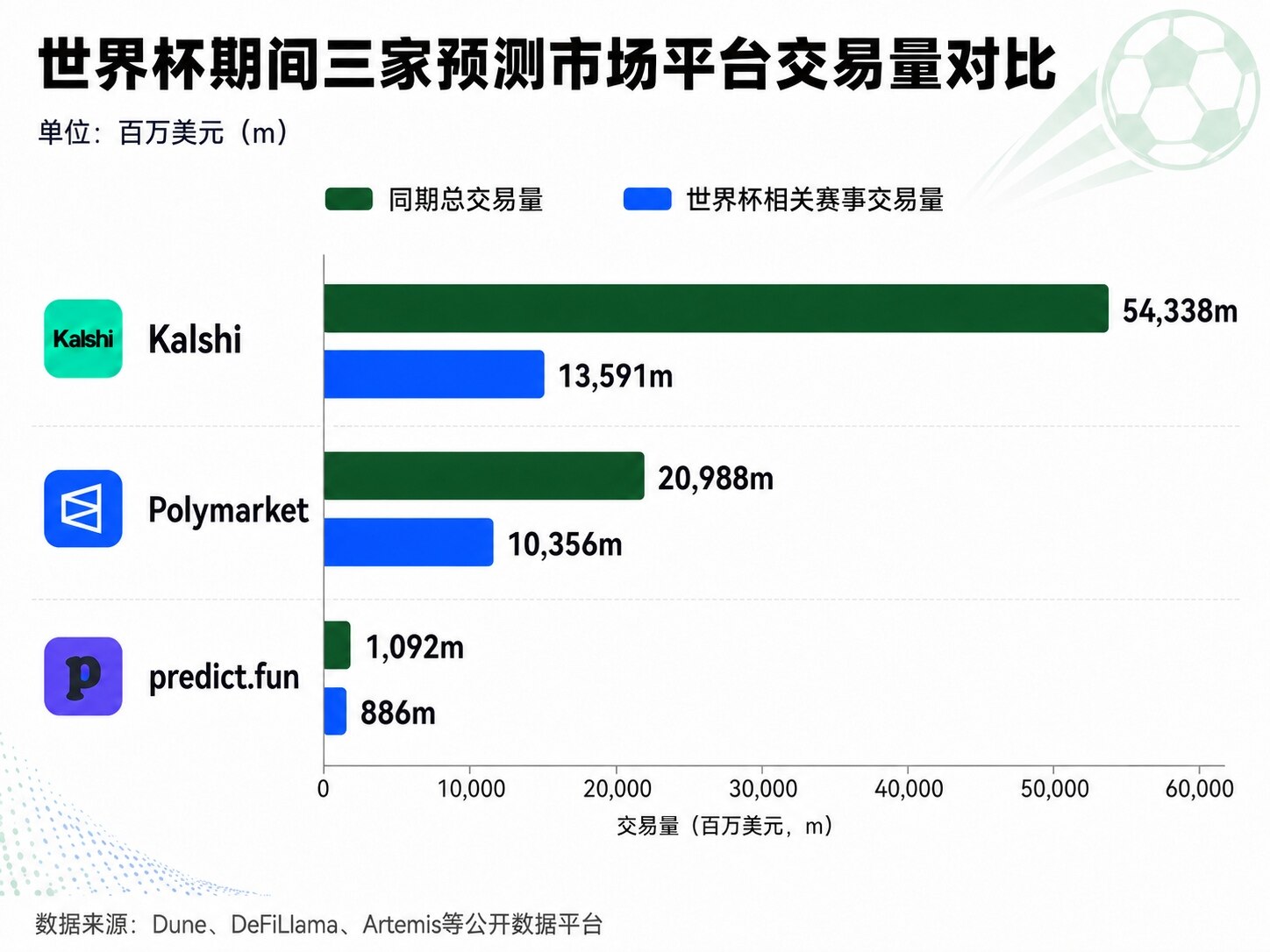
- During the World Cup, Kalshi's related trading volume reached $13.591 billion, while Polymarket saw $10.356 billion, narrowing the gap between them to 1.3 times; predict.fun emerged as a new breakout platform with $886 million in related trading volume.
- The average daily trading volume growth for the three platforms during the tournament period all exceeded 100% (Kalshi increased by 140%, Polymarket by 136%, and predict.fun nearly doubled), but all fell back to or below pre-tournament levels after the event (e.g., on July 22).
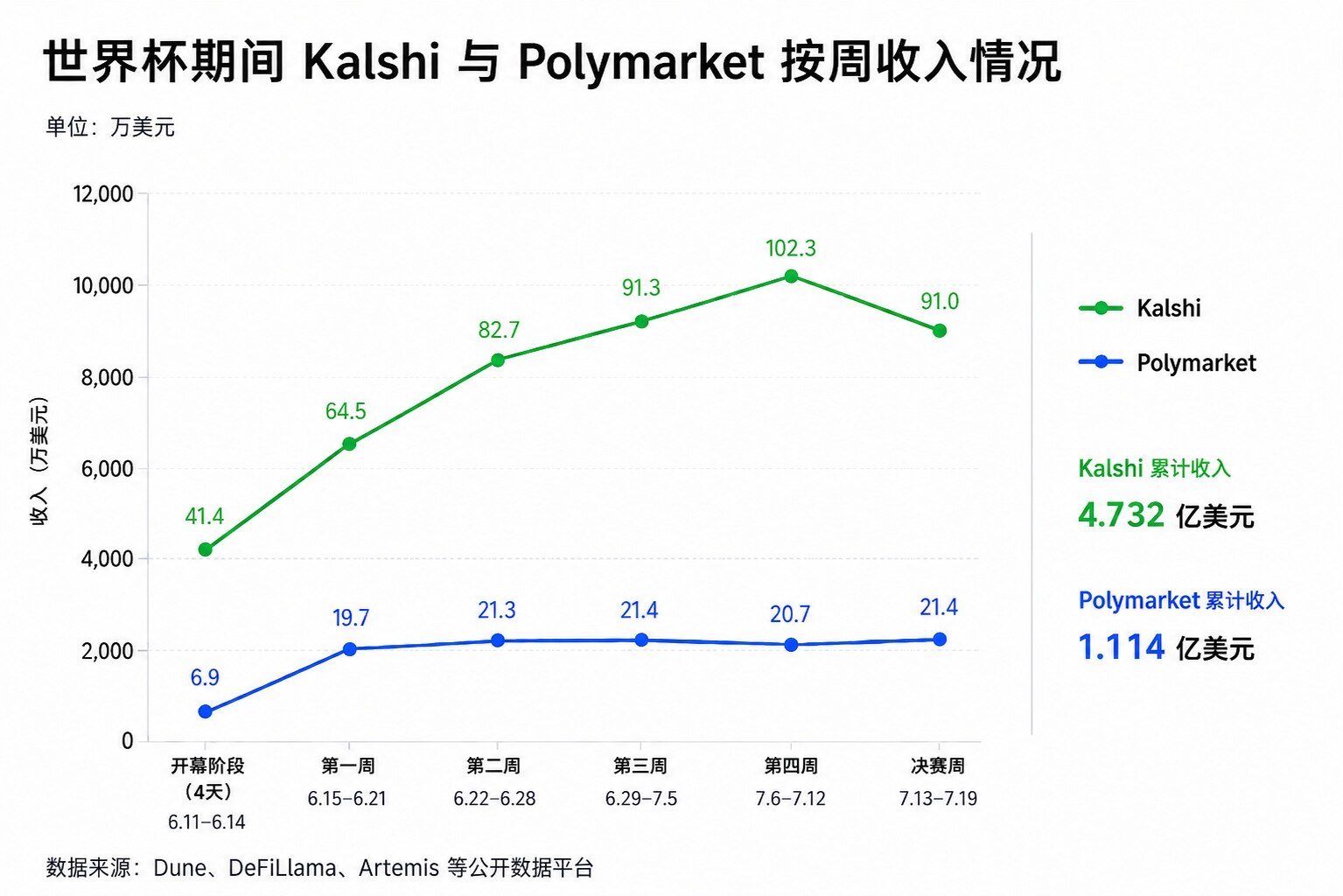
- Kalshi accrued cumulative fee revenue of up to $473.2 million during the entire World Cup, with its highest single-week revenue exceeding $100 million; Polymarket's cumulative revenue was $111.4 million, with stable weekly revenue around $20 million.
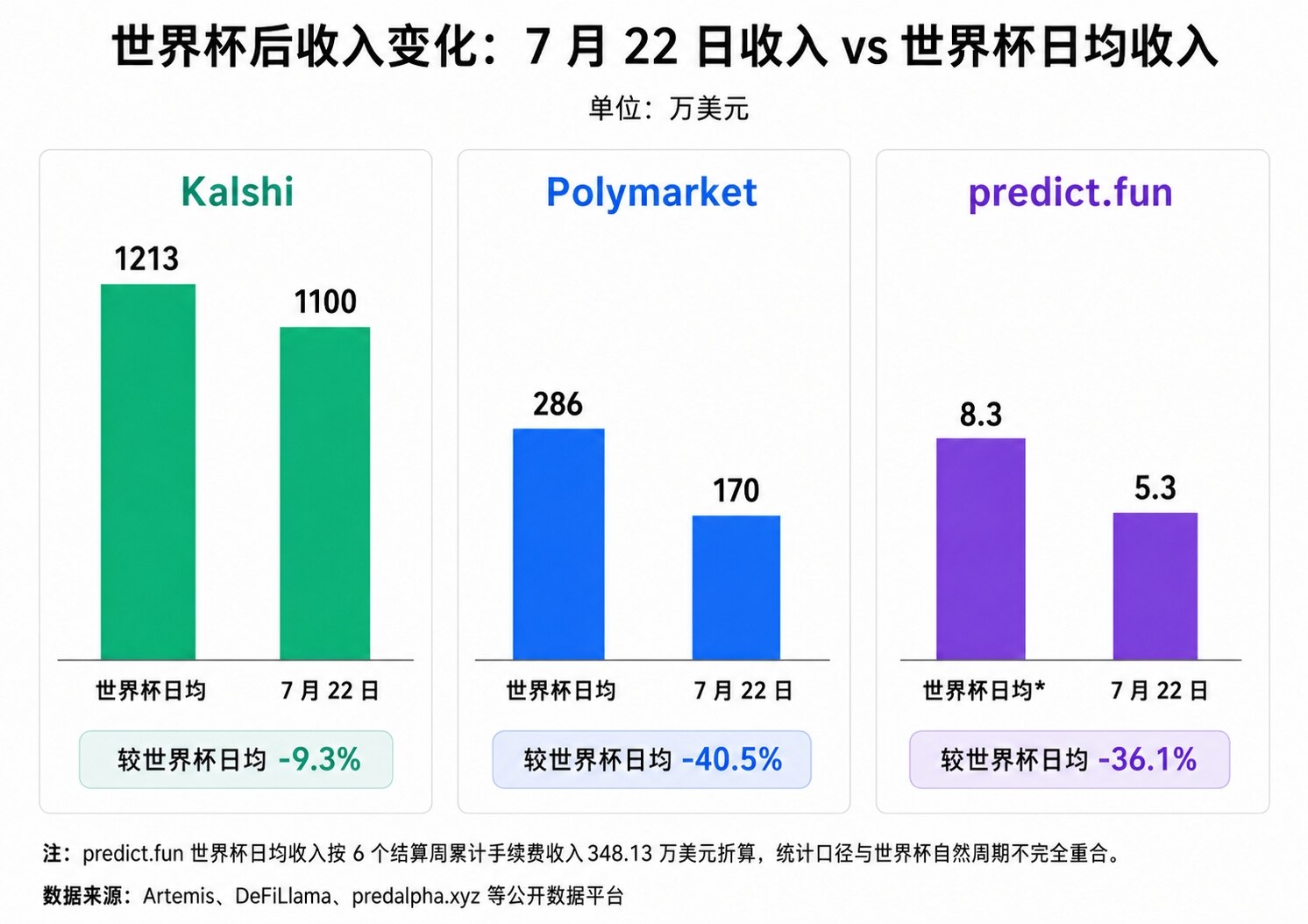
- In terms of post-tournament fee revenue, Kalshi experienced the smallest decline, falling only 9.3% to $11 million/day; whereas Polymarket and predict.fun saw significant drops of 40.5% and 36.1%, respectively.
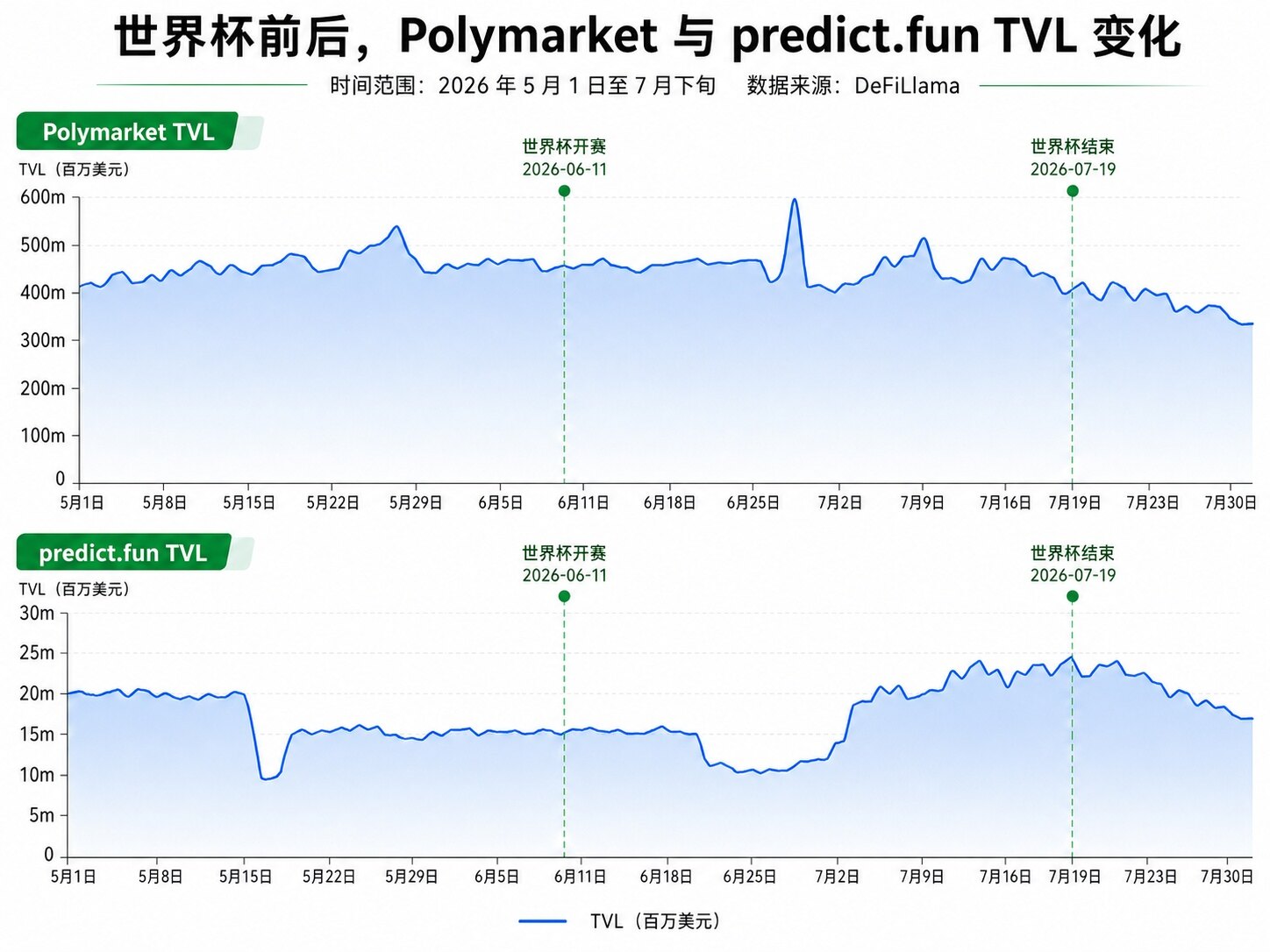
- Polymarket's TVL did not increase synchronously with trading volume during the event; instead, it continued to decline post-tournament to approximately $340 million. predict.fun saw capital inflows during the latter half of the tournament, but these also receded after the event.
Original by Odaily Planet Daily (@OdailyChina)
Author: Asher (@Asher_0210)

The 2026 World Cup has ended, and the prediction market has also undergone its periodic test.
Over the past six weeks, many users have participated in trading match results, advancement scenarios, and championship winners through prediction markets, adding another layer of real-time interaction to viewing. Now that the tournament has concluded, Odaily Planet Daily will review the performance of leading prediction market platforms Kalshi, Polymarket, and predict.fun before, during, and after the World Cup from the three dimensions of trading volume, fee revenue, and TVL.
The World Cup Pushed Prediction Market Trading Volume to New Highs, But the Hype Did Not Last
Kalshi Maintains Lead, Polymarket Narrows the Gap, Predict.fun Breaks Through Thanks to the World Cup
In terms of total platform trading volume during the World Cup, Kalshi still maintains a clear lead. During the same period, Kalshi's total trading volume reached $54.338 billion, while Polymarket reached $20.988 billion, meaning Kalshi's volume was about 2.6 times that of Polymarket. However, looking only at World Cup-related events, the gap between the two narrowed rapidly. Kalshi's related trading volume was $13.591 billion, while Polymarket reached $10.356 billion, making Kalshi's volume only about 1.3 times that of Polymarket. (Note: The trading volumes discussed in this article are all notional trading volumes.)
Historically, Polymarket's representative markets were more concentrated on the U.S. elections, cryptocurrencies, and geopolitical events. The World Cup has further elevated the importance of sports markets on the platform, moving them from a supplementary category to a core trading sector. Kalshi's advantage lies in its more diversified trading structure; besides the World Cup, other sports events, politics, and macroeconomic markets continue to contribute trading volume, providing more scenarios to sustain activity after the tournament ends.
predict.fun's total platform trading volume during the World Cup reached $1.092 billion, with World Cup-related markets contributing $886 million. Although there remains a significant gap in overall scale compared to Kalshi and Polymarket, for a platform that has been online for just over half a year, the nearly $900 million in trading volume brought by this World Cup has already made predict.fun one of the most prominent new platforms to emerge from this tournament's dividend.
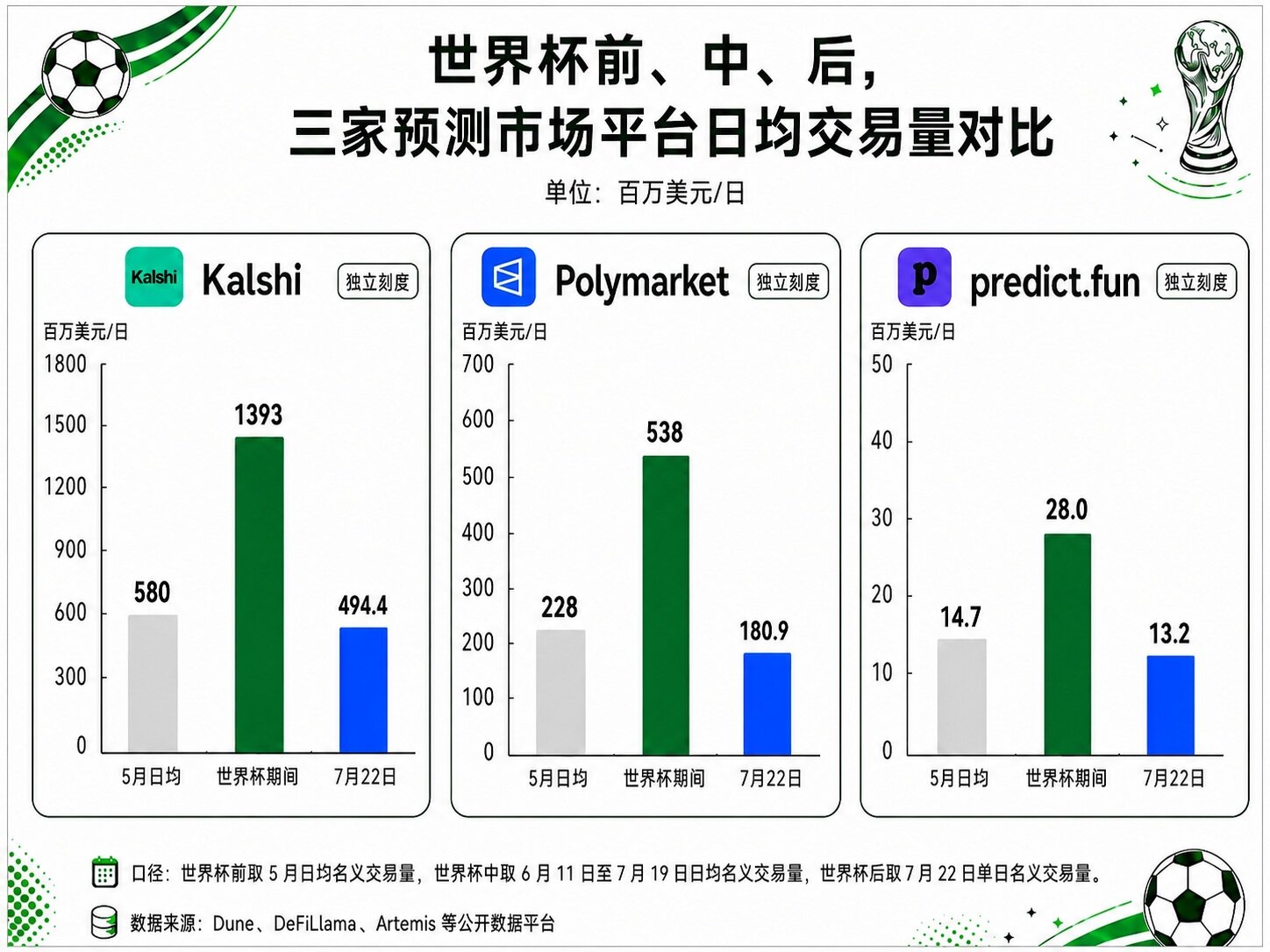
Changes in Average Daily Trading Volume for the Three Prediction Market Platforms Before, During, and After the World Cup
Kalshi experienced the most significant increase in trading volume during the World Cup. Its average daily notional trading volume in May was $580 million, which rose to $1.393 billion during the event, an increase of approximately 140%. On July 22, trading volume fell back to $494.4 million, already lower than the May average.
Polymarket's magnitude of change was similar to Kalshi's. Its average daily notional trading volume in May was $228 million, which rose to $538 million during the World Cup, an increase of about 136%. On July 22, trading volume dropped to $180.9 million, also below pre-event levels.
predict.fun had a lower base, but the boost from the World Cup is still clear. Its average daily notional trading volume in May was $14.7 million, which rose to $28 million during the event, nearly doubling. On July 22, trading volume was $13.2 million, basically returning to pre-event levels.
Looking solely at the one-day post-World Cup trading volume comparison, the growth brought by the World Cup appears more like a concentrated release of tournament traffic, which did not sustain the platforms' daily trading volume at a permanently higher level. Whether it can rise again in the future depends on whether other sports events and non-sports markets can absorb the trading demand left after the World Cup.
How Much Fee Revenue Did the World Cup Generate for the Three Prediction Market Platforms?
Kalshi's Fee Revenue Continued to Rise with the Tournament's Progress, Exceeding $100 Million in a Single Week During the Fourth Week
Kalshi's fee revenue curve generally shows a strong upward trend. Revenue in the opening four days was $41.4 million, rising to $64.5 million in the first week, further increasing to $82.7 million in the second week, reaching $91.3 million in the third week, and stepping up again in the fourth week with a single-week revenue of $102.3 million, the highest point during the entire World Cup. It then slightly declined to $91 million in the final week. During the entire World Cup period, Kalshi's cumulative fee revenue reached $473.2 million.
The boost from the World Cup for Kalshi was not just about generating initial attention at the start of the tournament; more importantly, it sustained the trading heat well into the latter half of the event. The single-week revenue exceeding $100 million also means that Kalshi not only benefited from the World Cup dividend in terms of trading volume but also effectively converted this wave of traffic into revenue at the platform monetization level.
Polymarket's Fee Revenue Was More Stable, But Did Not Experience Kalshi's Accelerated Growth in the Second Half
Polymarket's fee revenue trend was noticeably flatter. Revenue in the opening four days was $6.9 million, rising to $19.7 million in the first week. Thereafter, the second, third, fourth, and final weeks recorded revenues of $21.3 million, $21.4 million, $20.7 million, and $21.4 million, respectively. During the entire World Cup period, Polymarket's cumulative fee revenue reached $111.4 million.
From the first week onwards, Polymarket's weekly fee revenue was generally stable around the $20 million mark. The World Cup did elevate Polymarket's fee revenue to a higher level, but starting from the second week, the platform did not continue to amplify revenue as the tournament progressed, unlike Kalshi, instead operating within a relatively stable range.
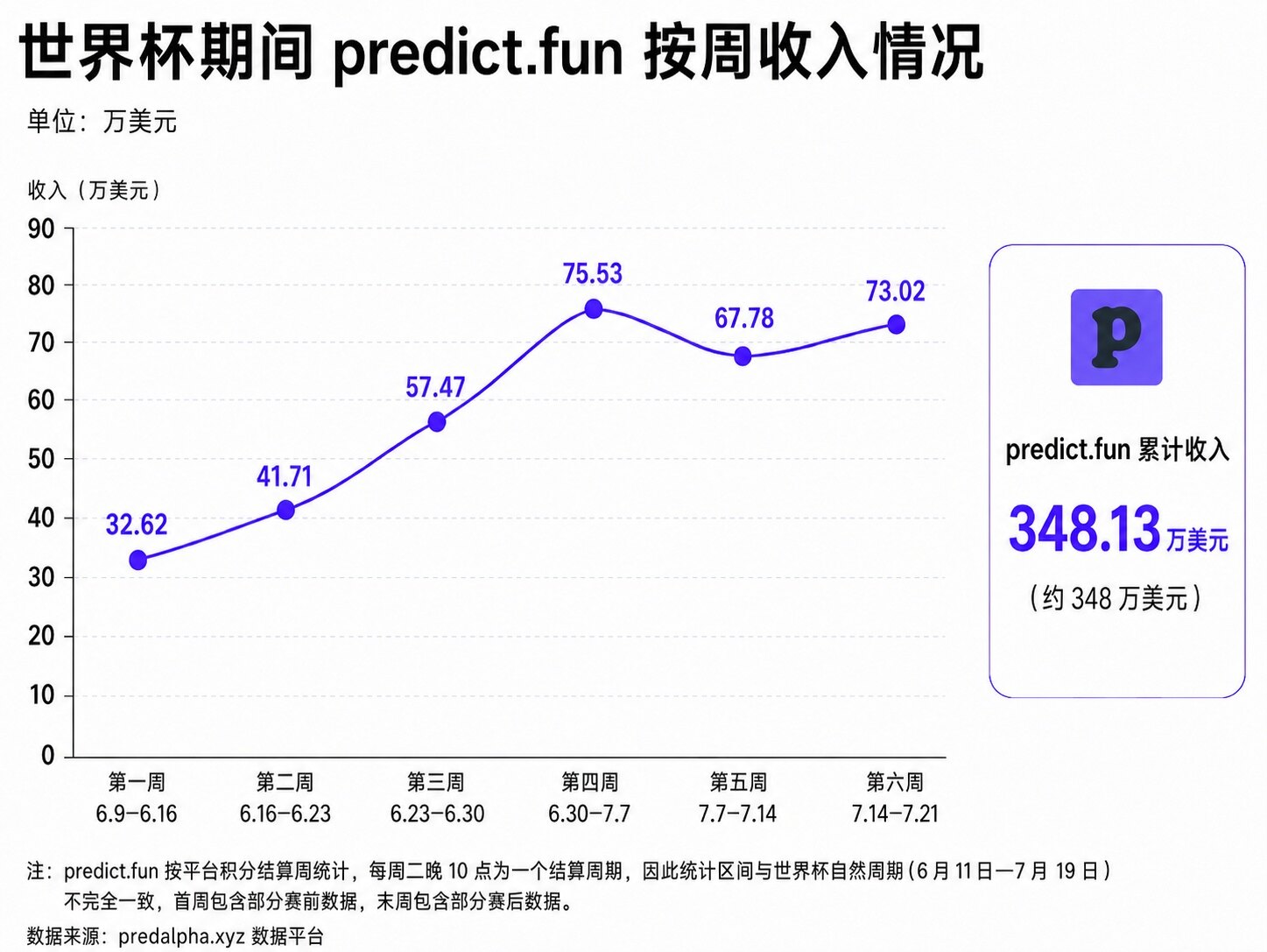
predict.fun's Fee Revenue Gradually Increased with the Tournament's Progress, Totaling $3.48 Million Over Six Settlement Weeks
predict.fun's fee revenue is tallied according to the platform's settlement week, which switches every Tuesday at 10 PM, so it does not perfectly align with the World Cup's natural schedule from June 11 to July 19. The first settlement week was from June 9 to June 16, including two days of pre-tournament data; the last settlement week was from July 14 to July 21, also incorporating two days of post-tournament data.
Looking at the revenue trend, predict.fun's fee revenue in the first settlement week was $326,200. It then grew for three consecutive weeks, reaching $755,300 from June 30 to July 7, setting the single-week high within the World Cup cycle. The following two weeks recorded $677,800 and $730,200 respectively. Although they did not set a new high, they were still significantly higher than at the beginning of the tournament. The cumulative fee revenue over the six settlement weeks during the World Cup reached $3.4813 million.
In the settlement week before the World Cup, from June 2 to June 9, predict.fun's fee revenue was only $159,400. After entering the World Cup cycle, revenue in the first week rose to $326,200, an increase of about 105%, and most subsequent settlement weeks further rose to over $500,000. Even though the first and last cycles included some pre- and post-tournament data, the boost from the World Cup to predict.fun's fee revenue is still significant.
After the World Cup Ended, Fee Revenue Generally Declined Across All Three Platforms; Kalshi Experienced the Smallest Decline
Kalshi's average daily fee revenue during the World Cup was $12.13 million. On July 22, it fell to $11 million, a decline of 9.3%. Among the three platforms, Kalshi had the smallest post-tournament decline. Although fee revenue dropped from its high during the event, it remained near the average daily level seen during the World Cup.
Polymarket's decline was more pronounced. Its average daily fee revenue during the World Cup was $2.86 million. On July 22, it fell to $1.7 million, a decrease of 40.5%. The revenue increment generated for Polymarket by the World Cup was relatively concentrated, and with the tournament's end, this increment quickly faded.
predict.fun's average daily fee revenue during the World Cup was about $83,000. On July 22, it fell to $53,000, a decline of 36.1%, similar to Polymarket's decline. Although the statistical scope differs slightly from the first two platforms, the post-tournament trend is still clear. The boost from the World Cup to predict.fun's fee revenue was also significant, and it declined relatively quickly after the tournament ended.
The World Cup Did Not Boost Polymarket's TVL, While predict.fun Saw Capital Inflows in the Second Half of the Tournament
Polymarket's TVL did not rise in tandem with trading volume during the World Cup. At the beginning of May, the platform's TVL was around $410 million, subsequently hovering mainly in the $440 million to $480 million range for most of the time. After the World Cup started, TVL continued to fluctuate around this level. Although it briefly spiked in late June and early July, it did not form a sustained upward trend.
After mid-July, TVL began to decline noticeably, falling to around $400 million by the end of the World Cup and has now further dropped to about $340 million. Trading volume expanded significantly during the event, but the capital deposited on the platform actually decreased after the tournament, indicating that the World Cup generated more high-frequency trading demand without simultaneously translating into retained long-term capital.
predict.fun's trend was more phased. At the beginning of May, its TVL was around $20 million. It briefly fell to around $10 million in mid-May, then hovered around $15 million until mid-June. Immediately after the World Cup started, TVL did not rise. It only began to recover rapidly in early July, reaching the $20 million to $25 million range in the latter half of the tournament and hitting a phase peak around the end of the World Cup.
After the tournament ended, TVL gradually declined, currently sitting around $17 million, but still higher than the low point in late June. Compared to Polymarket, predict.fun's capital changes were more closely tied to the World Cup's progress, with more noticeable capital inflows occurring, especially during the knockout stage.
(Note: Since Kalshi's TVL data cannot be obtained on-chain, this section only discusses Polymarket and predict.fun.)
Summary
The World Cup did bring substantial trading volume and fee revenue to the prediction market, but post-tournament data also shows that this round of growth did not naturally sustain itself. The average daily trading volume and fee revenue of all three platforms declined after the event ended, and Polymarket's TVL also continued to fall. While a mega-event can concentrate and amplify trading demand in the short term, it may not directly elevate a platform's long-term activity level.
However, the World Cup dividend did not only manifest in short-term data. It at least validated that sports events can provide prediction markets with a sustained source of high-frequency, short-cycle trading scenarios, and it also helped more users form a habit of repeated trading throughout consecutive matches.
The World Cup is over, but the competition around user retention, market supply, and normalized trading is just beginning.


