






华尔街重估DeFi:渣打研报为何押注UNI四年40倍?比起40倍的涨幅,4年的等待才是更考验信仰的地方。- 核心观点:渣打银行预测Uniswap治理代币UNI价格将在2030年底前飙升至100美元(约40倍涨幅),核心逻辑在于RWA代币化资产指数级扩容将推动DeFi渗透率跃升,使Uniswap成为传统资金链上首选接口,而费用开关则为UNI注入通缩属性。
- 关键要素:
- 渣打银行预测全球链上代币化资产规模将从3,400亿美元增至2028年底的4万亿美元,为DeFi提供巨大蓄水池。
- 预计代币化资产中投入DeFi的比例将从3.5%升至2030年的30%,推动DeFi TVL增长37倍至约2.7万亿美元。
- Uniswap已激活费用开关并销毁超过1亿枚UNI,将代币从纯治理工具转变为具有通缩属性的生产性资产。
- 贝莱德和富达等传统资管巨头已将其代币化产品(如BUIDL、FIDD)部署至Uniswap,将其作为合规资产链上首选入口。
- 面临新兴DEX(如Jupiter、Raydium)和聚合器(如1inch)从Solana生态及前端截流竞争,以及RWA代币化落地可能因立法滞后或安全事件而延迟的宏观风险。
- 核心观点:渣打银行预测Uniswap治理代币UNI价格将在2030年底前飙升至100美元(约40倍涨幅),核心逻辑在于RWA代币化资产指数级扩容将推动DeFi渗透率跃升,使Uniswap成为传统资金链上首选接口,而费用开关则为UNI注入通缩属性。
- 关键要素:
- 渣打银行预测全球链上代币化资产规模将从3,400亿美元增至2028年底的4万亿美元,为DeFi提供巨大蓄水池。
- 预计代币化资产中投入DeFi的比例将从3.5%升至2030年的30%,推动DeFi TVL增长37倍至约2.7万亿美元。
- Uniswap已激活费用开关并销毁超过1亿枚UNI,将代币从纯治理工具转变为具有通缩属性的生产性资产。
- 贝莱德和富达等传统资管巨头已将其代币化产品(如BUIDL、FIDD)部署至Uniswap,将其作为合规资产链上首选入口。
- 面临新兴DEX(如Jupiter、Raydium)和聚合器(如1inch)从Solana生态及前端截流竞争,以及RWA代币化落地可能因立法滞后或安全事件而延迟的宏观风险。


- 核心观点:渣打银行预测Uniswap治理代币UNI价格将在2030年底前飙升至100美元(约40倍涨幅),核心逻辑在于RWA代币化资产指数级扩容将推动DeFi渗透率跃升,使Uniswap成为传统资金链上首选接口,而费用开关则为UNI注入通缩属性。
- 关键要素:
- 渣打银行预测全球链上代币化资产规模将从3,400亿美元增至2028年底的4万亿美元,为DeFi提供巨大蓄水池。
- 预计代币化资产中投入DeFi的比例将从3.5%升至2030年的30%,推动DeFi TVL增长37倍至约2.7万亿美元。
- Uniswap已激活费用开关并销毁超过1亿枚UNI,将代币从纯治理工具转变为具有通缩属性的生产性资产。
- 贝莱德和富达等传统资管巨头已将其代币化产品(如BUIDL、FIDD)部署至Uniswap,将其作为合规资产链上首选入口。
- 面临新兴DEX(如Jupiter、Raydium)和聚合器(如1inch)从Solana生态及前端截流竞争,以及RWA代币化落地可能因立法滞后或安全事件而延迟的宏观风险。
Original author: Jae, PANews
A research report from a traditional bank has ignited the somewhat quiet DeFi sector.
On June 15, Geoff Kendrick, Head of Global Digital Assets Research at Standard Chartered Bank, published his first coverage report on the decentralized exchange (DEX) Uniswap. Within it, he presented a bold prediction that caught the crypto market's attention: the price of UNI, Uniswap's governance token, could surge approximately 40-fold by the end of 2030, hitting the $100 mark.
At that time, UNI was trading at just around $2.6.
Once derided as a "useless governance token," UNI is now being revalued by Wall Street as a productive asset with network effects. While the 40x long-term narrative is certainly enticing, the journey toward that destination may not be entirely smooth.
Wall Street's Script for UNI's 40x Growth: Four Numbers, One Main Theme
In Standard Chartered's analytical framework, Uniswap is being positioned within a valuation model that reflects the deep integration of traditional finance and the on-chain world.
Exponential Growth of RWA Tokenization ($340 Billion → $4 Trillion)
The starting point for this growth is the wave of real-world asset (RWA) tokenization on-chain. Standard Chartered forecasts that the global scale of tokenized on-chain assets will experience exponential growth, skyrocketing from approximately $340 billion today to $4 trillion by the end of 2028. Asset management giants like Fidelity and BlackRock are moving traditional assets such as stocks, treasuries, and money market funds onto blockchains en masse. The liquidity of tokenized on-chain assets will expand at a pace far exceeding industry expectations.
This effectively builds a larger reservoir for the DeFi sector: the asset base must first be established to provide sufficient underlying instruments for subsequent financial activities like trading, lending, and staking.
DeFi Penetration Rate Surge (3.5% → 30%) Boosts TVL (37x)
Asset tokenization is only the first step; the idle capital must be put to work. Simply put, assets need to flow into DeFi protocols to generate protocol revenues and value. Standard Chartered estimates that currently only about 3.5% of tokenized assets are deployed in the DeFi ecosystem. This ratio is projected to increase to 30% by 2030.
Driven by the dual engines of native crypto asset growth and RWA on-chain integration, the total DeFi TVL (Total Value Locked) is expected to surge 37-fold from current levels by 2030, reaching approximately $2.7 trillion.
Fee Switch Provides Price Support (40x)
As the primary hub for on-chain liquidity, Uniswap stands to be the greatest beneficiary of this influx of capital. Its token, UNI, is projected to rise from $2.6 to $100, achieving nearly a 40-fold increase.
Standard Chartered outlines the following long-term price trajectory for UNI: $6.5 by end of 2026 → $20 by end of 2027 → $40 by end of 2028 → $65 by end of 2029 → $100 by end of 2030.
Previously, UNI was often dismissed by the market as a "governance-only" token with no ability to capture cash flow, earning it the nickname "air coin." Late last year, Uniswap activated its fee switch, officially ushering UNI into a deflationary era.
The report notes that on December 28 last year, Uniswap conducted a one-time burn of 100 million UNI tokens, along with an additional 5 million UNI, reducing the total supply from 1 billion to 895 million. Consequently, the circulating supply decreased to 622 million. This contraction in supply is expected to provide support for UNI's price.
Furthermore, Uniswap has generated approximately $21 million in protocol fees. The linear relationship between fees and trading volume implies that as more tokenized assets flow into the protocol, the fee switch will automatically trigger greater token burns. This signifies UNI's transformation from a "pure governance tool" to a "productive asset with deflationary characteristics," directly narrowing the valuation multiple gap between Uniswap and publicly traded exchanges like Coinbase.
Notably, Geoffrey Kendrick also proposed an insightful business analogy in the report, comparing Uniswap to YouTube and Coinbase to Netflix.
- Coinbase (Netflix Model): A centralized operation with significant capital investment, requiring high capital expenditure. Listing new assets and navigating compliance involve rigorous screening. Expansion has high marginal costs, and the range of assets covered can be easily limited.
- Uniswap (YouTube Model): An open, permissionless liquidity pool architecture where any user can be a "content creator" (liquidity provider). The platform incurs minimal costs for asset listings. In scenarios involving stablecoin trading, liquid staking derivatives, and niche tokens, the network effects and long-tail advantages of this open model are difficult for centralized exchanges (CEXs) to match.
This self-reinforcing, usage-driven network effect is the moat that allows Uniswap to maintain its dominant position over the long term.
More importantly, Standard Chartered believes Uniswap is far more than a simple "retail DEX application." It is fundamentally a piece of integrable market infrastructure. Once the scale of RWAs expands, traditional financial institutions can directly "plug" their assets into Uniswap's liquidity pools for trading. This is a functionality that traditional financial markets cannot replicate on their own.
Uniswap: The Preferred On-Ramp for Traditional Capital, Yet Squeezed by Emerging DEXs and Aggregators
Wall Street's long-term narrative is undoubtedly compelling, but returning to the reality of the crypto market, Uniswap's actual situation is not as linear and smooth as the research report suggests.
Since its inception in 2018, Uniswap has facilitated cumulative trading volume exceeding $3.7 trillion, generated over $5.6 billion in cumulative fees, and currently holds a TVL of approximately $2.88 billion.
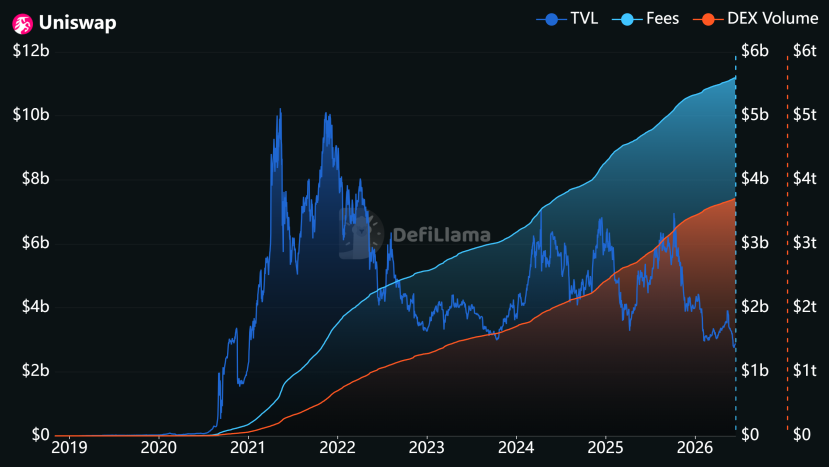
From a market share perspective, Uniswap's reign as the DEX king remains secure. Whether on Ethereum mainnet or within various L2 ecosystems, Uniswap's trading volume and liquidity depth are dominant. No competitor poses a substantial threat.
A more significant signal comes from the institutional side. In February of this year, BlackRock's tokenized money market fund, BUIDL, was deployed for trading on UniswapX, accompanied by a strategic purchase of UNI tokens. With the adoption of UniswapX, features like off-chain routing, gasless transactions, and MEV (Miner Extractable Value) resistance are significantly leveling the playing field between DEXs and CEXs, making it the preferred on-ramp for traditional capital entering the on-chain world.
Similarly, last Friday (June 12), Fidelity deployed liquidity for its stablecoin, FIDD, on Uniswap. The protocol's concentrated liquidity model represents the most efficient on-chain pricing mechanism currently available. Once compliant RWA assets are tokenized at scale, Uniswap could potentially become the on-chain "New York Stock Exchange," holding the power to price these assets.
Wall Street's capital is flowing on-chain. And Uniswap is the faucet. Wall Street institutions are leveraging Uniswap as the on-chain interface for compliant assets, and UNI is increasingly being valued based on the logic of an "on-chain routing infrastructure."
Despite the enticing vision of a $100 destination, two significant hurdles stand in the way of Uniswap's ascent, which could significantly delay or even derail this long-term projection.
- Traffic Hijacking by Emerging DEXs and Aggregators (Competition Risk): Solana-based DEXs like Jupiter and Raydium, fueled by the meme coin craze and extremely low transaction costs, have captured vast retail user flows. Meanwhile, aggregators like 1inch and CowSwap intercept users at the frontend, potentially reducing Uniswap to a mere "backend liquidity pool" in certain ecosystems, diluting its brand premium and user mindshare.
- Delayed Tokenization Progress (Macro Risk): Standard Chartered's valuation heavily depends on the assumption that "DeFi TVL will reach $2.7 trillion by 2030." If global legislative progress on tokenization falls short of expectations, or if a major security incident or systemic risk occurs, the penetration rate of RWAs could slow significantly, severely postponing the realization of this grand narrative.
Returning to the most straightforward price perspective, UNI is currently trading below $3, representing a decline of over 92% from its all-time high in May 2021.
The fee switch has introduced deflation but has not triggered a price reversal. The market's冷淡 sentiment towards the DeFi narrative, the drying up of liquidity, and persistently high macroeconomic interest rates are all exerting significant downward pressure on UNI's valuation.
However, this might precisely be the source of the "40x potential" in Standard Chartered's view: starting from a low base.
Standard Chartered's first coverage of UNI with a $100 price target carries more significance as a bellwether than as a precise price prediction. In reality, the accuracy of the prediction isn't the main point. What matters is that Wall Street's perception of DeFi is undergoing a transformation: moving away from the "wild west, speculative bubble" view of the early years towards a rational business assessment focused on "capital efficiency, network effects, and cash flow value."
It is important to note that Wall Street research reports often excel in macro logic but can be short on micro risks. For investors involved, the 40x endpoint is undeniably tempting, but the road to 2030 is also sure to be fraught with challenges.
Whether UNI can truly capture the benefits of the $4 trillion tokenization dividend depends on how skillfully it navigates the intricate dance between the principles of decentralization and the global regulatory compliance demands of the real world.
More than the 40x price increase, the four-year wait is the true test of conviction.


