Why should Intel take advantage of its rising stock price to issue additional shares?


- Core Thesis: Intel's most urgent task right now is not stock buybacks, but rather equity financing while its stock price is strong. The goal is to raise approximately $25 billion to secure critical capital for its advanced process foundry capacity build-out and transformation narrative, preventing it from missing a strategic window due to funding shortages.
- Key Elements:
- Intel has already raised about $20 billion through strategic investments from the U.S. government, SoftBank, Nvidia, and others. These investors' entry prices (around $20-$23) are all below the current stock price, meaning a secondary offering would yield them a paper profit, not a "punishment."
- Past "Smart Capital" strategies, such as selling assets and bringing in joint venture partners (e.g., Apollo, Brookfield), have been costly. The company's recent $14.2 billion buyback of Apollo's stake in a wafer fab confirms the high expense of ceding asset returns.
- With approximately $45 billion in debt pressure, the room for further debt or asset sales is limited. At its current market cap of around $498 billion, diluting only 4%-5% of equity could raise about $25 billion, making it the cheapest source of funding.
- Market demand is already in place: commitments from Nvidia, Google, and potential anchor customers like SpaceX and Tesla provide a better pricing logic for equity financing based on contracted demand.
- Projects like Intel's Terafab could cost up to $119 billion. Even if partners provide some capital, Intel would still need to contribute tens of billions of dollars, far exceeding what its operating cash flow can sustain.
- The current window for equity issuance is the widest in recent times. Recent successful funding rounds, such as Cerebras' IPO, indicate strong market sentiment. Intel should seize this opportunity to execute a "reverse buyback."
Original Title: Intel Should Raise Capital
Original Author: Semianalysis
Original Translation: Peggy, BlockBeats
Editor's Note: Since breaking out in early April, Intel's stock price has continued to recover, experiencing two key catalysts in June. First, market rumors that Google placed an AI chip order with Intel drove the stock up sharply in a single day. Second, Bank of America made a rare direct upgrade of Intel's rating from "Underperform" to "Buy," raising the price target from $96 to $135. Behind this rebound, the market is repricing not just Intel's short-term performance, but its strategic position in AI CPUs, advanced process foundry, and the US domestic chip supply chain.
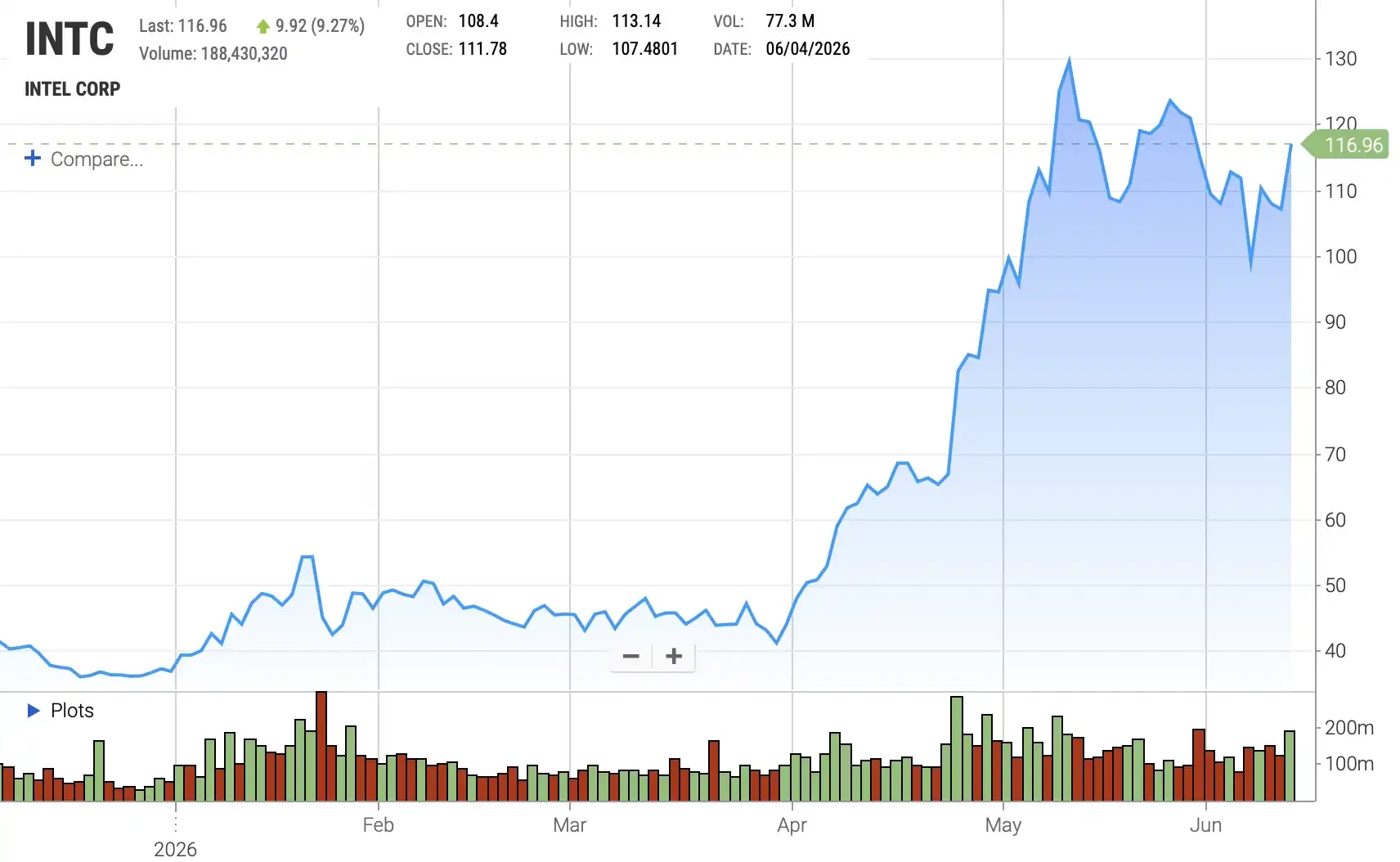
INTC Stock Price Trend
Today, Intel's transformation narrative is shifting from "self-rescue" to a "re-expansion" phase. With Lip-Bu Tan taking over as CEO, a refreshed board, and strategic capital from the US government, SoftBank, and Nvidia entering the scene, market expectations for Intel have clearly improved. However, this article reminds us that what truly determines whether Intel can return to the core table of advanced manufacturing isn't just customer commitments or a stock price rebound, but whether it has enough capital to actually build out its foundry capacity.
The author argues that Intel's problems over the past decade have largely stemmed from financial engineering: selling assets, bringing in joint venture partners, alleviating cash flow pressure through "Smart Capital" (reducing CapEx pressure via joint ventures and asset disposals), while simultaneously ceding the long-term earnings of core assets like fabs.
Now, the most prudent move for Intel is not a stock buyback, but an equity raise while its share price is strong. The reasoning is straightforward: on one hand, the current valuation is already high, and a dilution of 4% to 5% could raise approximately $250 billion, significantly bolstering Intel's ability to build advanced process capacity. On the other hand, the US government, SoftBank, and Nvidia all entered at prices lower than the current stock price. A secondary offering wouldn't necessarily "punish" new shareholders; instead, it could increase book value per share and provide these strategic investors with paper gains.
More importantly, alternative financing methods Intel has previously attempted have proven costly. Whether it was selling its NAND business, reducing its stake in Mobileye, ceding control of Altera, or bringing in partners like Apollo and Brookfield through SCIP (Semiconductor Co-Investment Program, exchanging long-term fab revenue rights for external capital), these essentially traded assets and future earnings for cash. Intel's recent $14.2 billion buyback of Apollo's stake in Fab 34 precisely demonstrates that giving up the economic benefits of fabs was not cheap. Continued debt would strain the balance sheet, and further asset sales have limited scope. Equity, conversely, has become the cheapest and cleanest source of funding available.
Therefore, the core thesis of this article is: Intel no longer lacks a "comeback story"; what it truly lacks is the capital needed to execute that story. Demand for Agentic CPUs (a new type of CPU for the AI agent era), potential major clients like SpaceX and Tesla, and orders from Nvidia and Google provide Intel with a demand base it can present to the capital markets. For Intel, issuing shares isn't merely dilution; it's about seizing the market window to trade cheap capital for the execution power behind advanced process capacity, its foundry business, and the Silicon Sovereignty narrative. Missing this window could prove more costly than the financing itself.
Below is the original text (edited for readability):
We've written a lot about Intel. This company holds a special significance for us; it's almost the starting point of the semiconductor industry. Saying we simply love Intel and believe in its role in the world still feels insufficient. In the past, when Intel's early products faltered, we didn't hesitate to point out the problems. We have also been supportive and hopeful for its transformation. One of our strongest convictions is that Intel's board was a major factor in its decline, and recently, we have finally seen the changes we've been waiting for.
Frank Yeary just stepped down after 17 years on the board. The new board is now composed of people who truly understand the industry, not just financial engineering. The new chairman previously served at Qualcomm. Lip-Bu Tan is the CEO. Steve Sanghi from Microchip, Stacey Smith, and Eric Meurice from ASML are also on the board. In other words, this board finally understands the technology.
However, although Intel's transformation has partially begun, the road to fully revitalizing the company remains long. We believe now is the time for this new board to make a major strategic bet: not a stock buyback, but an equity issuance large enough to fix Intel's financial position once and for all.
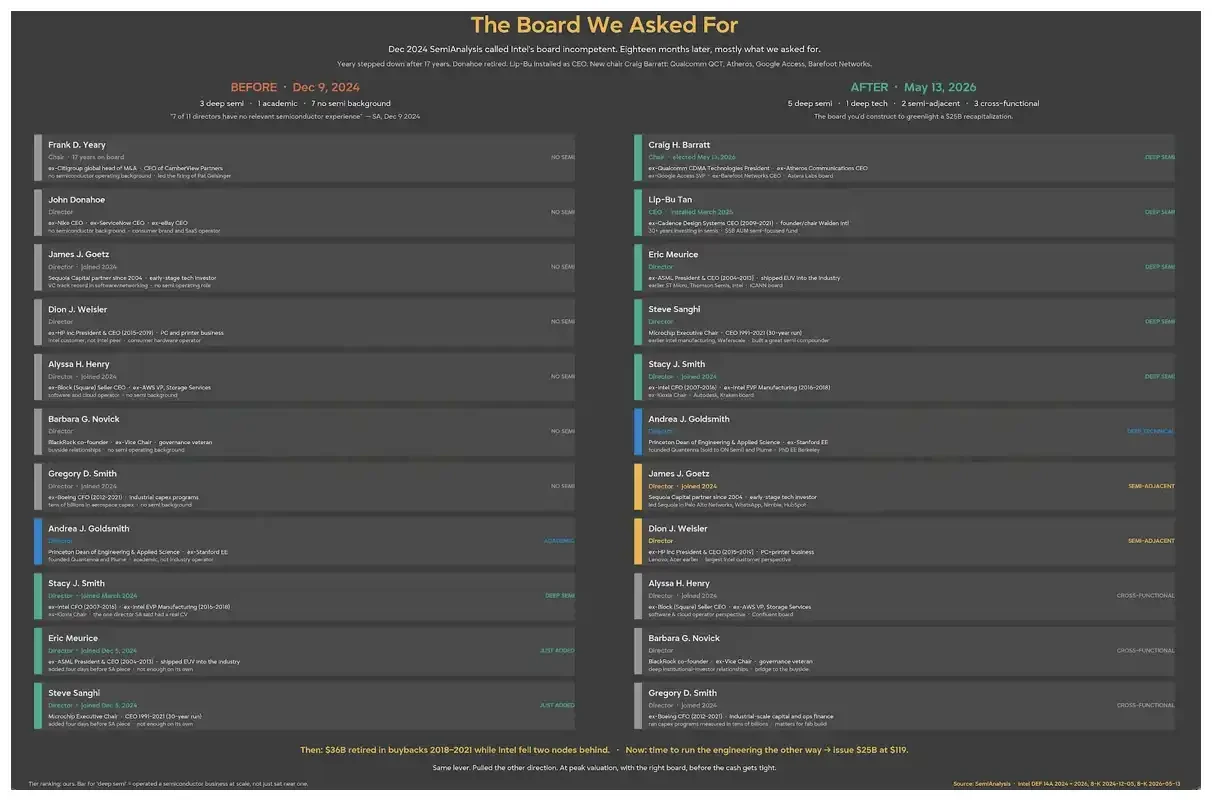
Lip-Bu Tan has already pulled Intel back from the brink, raising approximately $200 billion through investments from the US government, SoftBank, Altera, and a strategic investment from Nvidia. Intel should not stop halfway. It should capitalize on the current strength of its stock price. In the past awful years, the company was a net buyer of its own stock; now is the time to issue equity while the stock is strong. If done correctly, this will make Intel's transformation much easier to achieve.
Note: Lip-Bu Tan is Intel's CEO, appointed in March 2025, and also joined the board.
Equity Dilution Now Rewards the Investors Who Already Bet
Look at the prices at which this capital came in. The US government subscribed for up to 433 million shares at a price of $20.47 per share, representing a ~9.9% stake at signing; as of the end of Q1, 149 million shares remained in escrow. SoftBank's entry price was $23.00, and Nvidia's was $23.28. Today, all these holders are sitting on unrealized gains.
Thus, the intuition that a capital raise punishes recent investors is misguided. Issuing stock at today's price, far above these entry points, will increase book value per share and generate paper gains for the US government, SoftBank, and Nvidia. The anchor of ~10% sovereign capital is also a key reason Intel can execute a large issuance at a lower cost. Intel is one of the few companies globally that can sell a massive amount of stock during a hot market while having the US government as a backstop. As long as this leverage exists, it's worth utilizing.
Intel Needs Capital to Execute Its Transformation
Based on trailing twelve-month performance, Intel has rarely been as expensive as it is now since the 2000 dot-com bubble. We believe in the company's bright future, but capital is one of the most critical elements to achieve it, and the current stock price does not fully reflect the real execution risk.
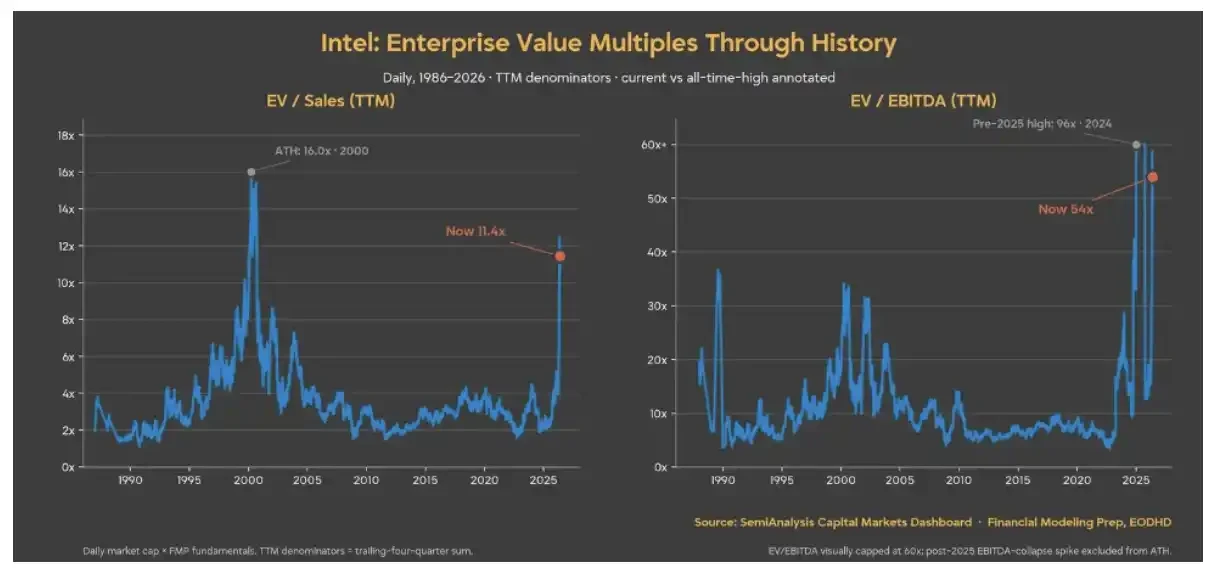
More importantly, even in the most optimistic scenario with renewed demand for Agentic CPUs, Intel cannot single-handedly fund all the necessary investments to capture the upside. We believe it's time for a "reverse buyback": issuing equity while the market still has appetite for stock offerings.
Equity is Now the Cheapest Capital Intel Can Get
Detractors might argue that Intel has other ways to finance its fabs. But it has tried them all, and its recent actions tell the market these methods aren't great.
Apollo invested $11.2 billion for a 49% stake in the Fab 34 joint venture. Brookfield structured financing for the Arizona fab project. Silver Lake acquired 51% of Altera at an $8.75 billion enterprise value, bringing Intel roughly $4.3 billion in net cash. Intel also sold its NAND business to SK Hynix in stages and continues to sell down its Mobileye stake. "Smart Capital" (capital strategies using joint ventures and asset sales to lower CapEx pressure) was once Intel's core narrative.
Then, on March 31, 2026, Intel agreed to buy back Apollo's 49% stake in Fab 34, completing the transaction on April 8th for a total of $14.2 billion, consisting of approximately $7.7 billion in cash and a $6.5 billion bridge loan. Management stated this buyback would be accretive to earnings, and they are right, which is precisely the point. If buying back fab equity is accretive, then selling the economic interest in those fabs to partners in the first place was essentially an expensive form of financing. SCIP effectively exchanges a portion of the long-term earnings rights of Intel's best assets to external capital providers in return for funds that appear lower cost but are actually more expensive. Intel has now proven with its own checkbook that it prefers to own its fabs and take on the associated debt rather than continuing to cede fab earnings.
So, cross off the other options. Doing more SCIPs is exactly the kind of choice management just spent $14.2 billion to reverse. Adding more debt would pile on top of the existing $45 billion in balance sheet debt; including the Apollo bridge loan, debt reaches approximately $51.5 billion. Major asset sales are largely done—Mobileye and Altera have been sold or had control ceded. What remains is equity financing. And at current valuation levels, equity is the cheapest capital Intel has.
With the announcement of the massive Terafab project and spillover demand from severe N3 shortages, Intel's foundry business is just getting started. To truly capture this unique window, Intel must become the industry's key supplier amidst the shortage of advanced process wafer capacity. The funds required for this enormous bet far exceed what Intel can currently afford from its operating cash flow.
Equity dilution of just 4% to 5% could raise approximately $25 billion, enough to make the most optimistic supply capacity narrative a reality at this critical juncture.
Agentic CPU Demand Alone Won't Pay for Terafab
Customer commitments represented by SpaceX, Tesla, and the Terafab project are key to solving the 14A capacity issue. The initial goal is to reach 100k wafer starts per month (WSPM), then scale to 1 million WSPM—this will be very difficult and impose extremely heavy capital pressure. But it must happen. Lip-Bu Tan has publicly told the market he will close the foundry business if there are no customers. Customers have arrived, so now is the time to build.
Beyond Terafab partners, Intel's order book is also filling up. Nvidia's DGX Rubin NVL8 configuration lists dual Intel Xeon 6 host CPUs. Google signed a multi-year agreement covering Xeon and custom IPUs. SambaNova has also joined for inference workloads. The wafer volumes behind these orders are not all disclosed, but the cost of capital for a visible order book is much lower than funding a turnaround story. Intel finally has orders to show the market. The pricing logic for equity financing secured by signed demand is completely different from financing based on a promise.
Due to lower-than-expected CPU demand, Intel has been doing everything possible to delay CapEx. But now, it's time to go all-in again, like in the Gelsinger era. This is a critical moment for Silicon Sovereignty, and Intel must double down.
Intel's complete multi-phase project could ultimately cost up to $119 billion. While SpaceX will provide initial capital, Intel must also make a meaningful contribution. Even marginal capital matching implies billions in new funding needs, which were not even in Intel's CapEx decision matrix a month ago.
Now is the time to end the decade of financial engineering and issue stock immediately. Because, while the capacity ramp is exciting, it will be extremely expensive. The current window for equity issuance is the widest it has been in some time. If Cerebras can raise $5.55 billion, Intel can easily raise $25 billion. This argument is even more compelling given Intel's approximate $498 billion market capitalization, which can easily support much larger follow-on offerings. Based on our observations, this window appears to be fully open. Below is data from some recent issuance cases.
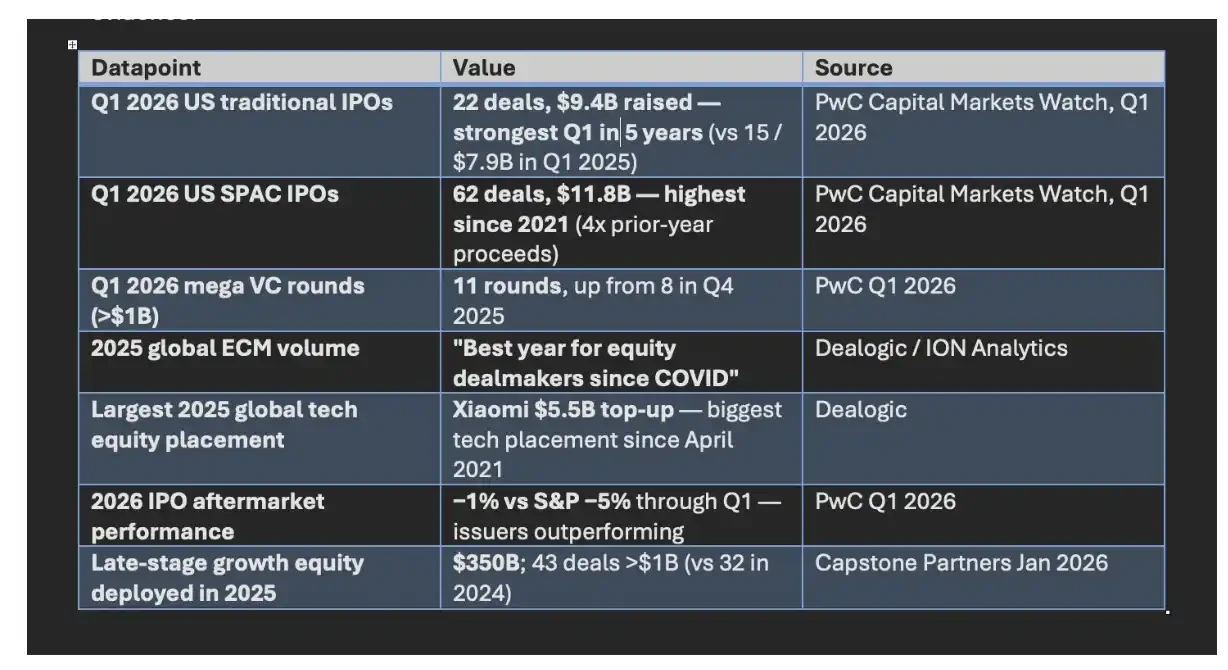
The deal window is open
In other words, Intel's real problem is no longer "does it have a story," but "does it have enough capital to turn the story into capacity." With strategic capital from the US government, SoftBank, and Nvidia already in place, and the advanced process supply in a tight window, equity financing is no longer just a defensive move that dilutes shareholders. It can be an offensive play to reboot Intel's foundry ambitions and bet on Silicon Sovereignty. For Intel, missing this financing window could be far more expensive than the dilution itself.