






Bernstein Analysis: Behind the $700 Billion Cooperation, AI's Biggest Shortage May Not Be GPUs


- Key Point: SK Group with NVIDIA, and Samsung with Broadcom, have recently announced AI supply chain cooperation frameworks totaling over $700 billion. The core focus is on securing HBM memory and advanced packaging resources in advance, rather than being direct procurement orders. This signals that the AI supply chain is extending from vying for GPUs to seizing high-end memory and packaging segments.
- Key Elements:
- SK Group and NVIDIA announced a comprehensive cooperation exceeding $500 billion, covering AI factories (SK Telecom targeting 2GW scale, with the first project planned for 2027) and next-generation memory like HBM4.
- Samsung and Broadcom signed an MoU worth over $200 billion, encompassing HBM memory, 2nm foundry services, and 2.3D/2.5D advanced packaging, aiming to provide an integrated "memory + foundry + packaging" solution.
- Both frameworks are primarily MoUs and partnerships, without disclosed specific procurement volumes, prices, or delivery schedules, and do not constitute firm orders.
- A Bernstein report indicates AI customers are using long-term frameworks to lock in memory supply like HBM early, because its capacity flexibility is low and qualification cycles are long, making it a bottleneck for AI server deliveries.
- The annual revenue of the global memory market is estimated to be around $1.3 trillion in 2027-2028, but the contribution of these framework amounts to incremental growth is difficult to quantify.
- The cooperation between Samsung and Broadcom has limited impact on TSMC's market share, as demand for advanced capacity remains strong; Samsung faces a test of its delivery capabilities, needing to ensure stable coordination among HBM, logic chips, and packaging.
- Bernstein maintains an "Outperform" rating on Samsung, SK Hynix, Micron, NVIDIA, and Broadcom, but clearly states that MoUs are not orders. Risks include competition from Chinese memory manufacturers and capacity execution.
TL;DR
- SK Group, NVIDIA, Samsung, and Broadcom have successively announced AI supply chain partnerships, with total frameworks exceeding $700 billion.
- Collaboration covers HBM4, AI factories, sub-2nm foundry, and advanced packaging, with the core goal of securing AI server supply in advance.
- These arrangements are primarily based on partnerships and MOUs; actual purchase volumes, pricing, and delivery schedules have not yet been disclosed.
The AI supply chain is extending from securing GPUs to securing memory and advanced packaging in advance.
On July 24, SK Group and NVIDIA announced an expanded comprehensive partnership at the AI Summit in San Francisco, with a total scale exceeding $500 billion, covering AI factories and next-generation memory. Subsequently, Samsung Electronics signed an MOU with Broadcom, anticipating collaboration in memory and foundry exceeding $200 billion over the next five years until 2030.
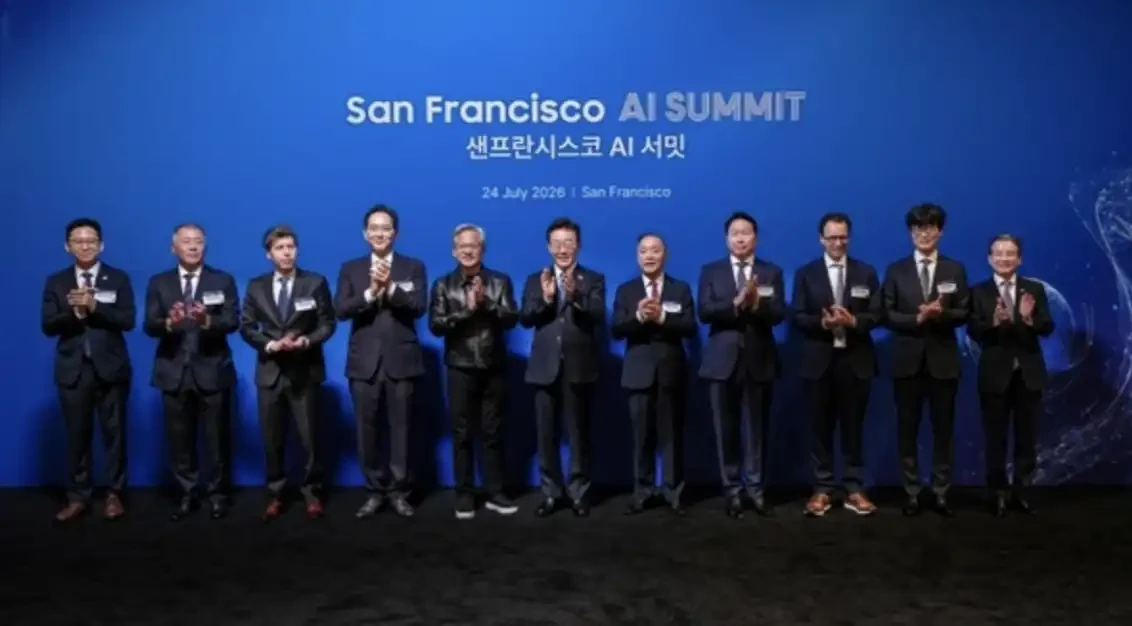
In a report on July 27, Bernstein focused on memory, rather than another round of AI chip orders. AI server expansion isn't solely reliant on GPU growth. For computing chips like GPUs and ASICs to truly enter data centers, they require HBM, DRAM, NAND, advanced packaging, and stable delivery. If these links fall behind, shipments from AI chip companies like NVIDIA and Broadcom will also be delayed.
The two massive figures also need to be examined closely. The over $500 billion figure is not a memory procurement contract won solely by SK hynix; rather, it's a comprehensive partnership between SK Group and NVIDIA. Within this, SK hynix handles the HBM4 and next-generation memory collaboration, while SK Telecom is the main entity for the AI factory. Samsung and Broadcom's $200 billion MOU covers a more defined scope, encompassing memory like HBM, support for next-gen AI accelerators, 2nm-related manufacturing, and 2.3D/2.5D integration.
NVIDIA Secures HBM4, Broadcom Bundles Memory, Foundry, and Packaging
The collaboration between SK Group and NVIDIA places AI data centers and next-generation memory within a single framework.
According to information from NVIDIA and SK hynix, the partnership includes an up to 2GW AI factory from SK Telecom, NVIDIA DSX and Vera Rubin platforms, and SK hynix HBM4. The first AI factory is planned to launch in 2027.
The market implication is straightforward. AI systems post-Vera Rubin continue to increase demands on HBM and system-level supply. Memory is no longer just a standardized procurement item but an integral part of whether an AI chip platform can be delivered on schedule.
Samsung and Broadcom's MOU is more akin to a bundled supply chain solution. Samsung official stated the collaboration scale over the next five years until 2030 exceeds $200 billion, covering memory and foundry, supporting Broadcom's next-gen AI accelerators, and involving advanced packaging related to the 2nm process, as well as 2.3D and 2.5D integration.
This goes beyond whether Broadcom will entrust some of its AI ASICs to Samsung for foundry. Samsung aims to package memory, advanced processes, and advanced packaging together for AI chip customers, seeking to offer an alternative deliverable solution outside of TSMC.
In technical terms, Samsung's Cube-S, Cube-E/R fall under 2.5D/2.3D Cube packaging. Bernstein draws an analogy with TSMC's CoWoS-S/L/R, with the core objective being to achieve high-bandwidth connections and multi-chip integration between logic chips and HBM.
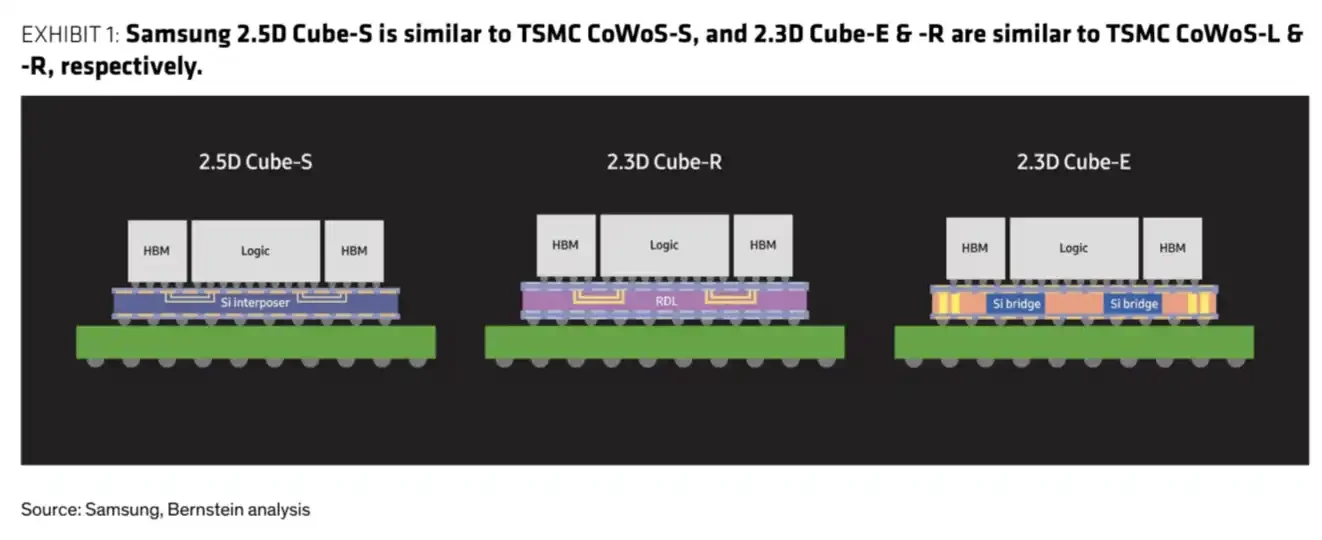
Comparison of Samsung's Cube-S, Cube-E, Cube-R with TSMC CoWoS-S/L/R, illustrating how 2.5D and 2.3D packaging connect HBM with logic chips.
Memory Industry Annual Revenue Could Reach ~$1.3 Trillion; AI Customers Begin Queuing Up Early
Bernstein believes the most noteworthy aspect of these announcements is that memory supply is being locked in ahead of time.
In the expansion of AI servers, computing chips themselves are certainly important, but the supply elasticity for HBM and high-end memory is even lower, customer qualification cycles are longer, and advanced packaging can become a bottleneck for complete system delivery. Major customers are unwilling to wait until capacity is tight to enter the spot market; instead, they secure future supply through multi-year frameworks.
Market consensus estimates cited in the report indicate global memory industry annual revenue was approximately $0.9 trillion in 2026, and is projected to be around $1.3 trillion in both 2027 and 2028. TrendForce's previous public forecasts also suggest the global memory market size will be about $1.28 trillion in 2027. Participants include Samsung, SK hynix, Micron, KIOXIA, and Chinese memory manufacturers.

Bar chart of consensus revenue for global memory suppliers: approximately $0.9 trillion in 2026, and around $1.3 trillion in both 2027 and 2028.
These figures cannot be directly equated to the incremental revenue generated by the collaborations between SK Group, NVIDIA, Samsung, and Broadcom. The announcements did not disclose specific purchase quantities, product mix, pricing formulas, delivery schedules, nor how much of the framework value comes from new capacity versus simply extending existing cooperation long-term.
However, the signal is clear enough. AI customers are treating HBM and advanced packaging as strategic resources, and the bargaining power of leading memory manufacturers is consequently attracting sustained market attention. Traditional memory cycles are more influenced by PC, mobile, and server inventory. Under the AI cycle, HBM is deeply integrated with advanced packaging, making supply-demand dynamics more easily determined by a handful of major customers and suppliers.
Samsung Aims for Packaging and Foundry; Impact on TSMC Viewed with Restraint
With the inclusion of sub-2nm processes, advanced packaging, and AI accelerators in the Samsung-Broadcom MOU, the market naturally questions whether TSMC's market share will be affected.
Bernstein's assessment is relatively restrained. Even if Broadcom shifts some AI ASICs to Samsung in the future, the near-term profit impact on TSMC may be limited, as demand for advanced capacity remains fully booked. Samsung gaining more qualification opportunities with AI customers does not immediately translate into order losses for TSMC.
The real test for Samsung is delivery capability. AI chip customers require not just point manufacturing capabilities, but simultaneous stability in HBM, logic chips, packaging, substrates, yield rates, and delivery timelines. If any link is delayed, the technical roadmap in the MOU will struggle to translate into actual shipments.
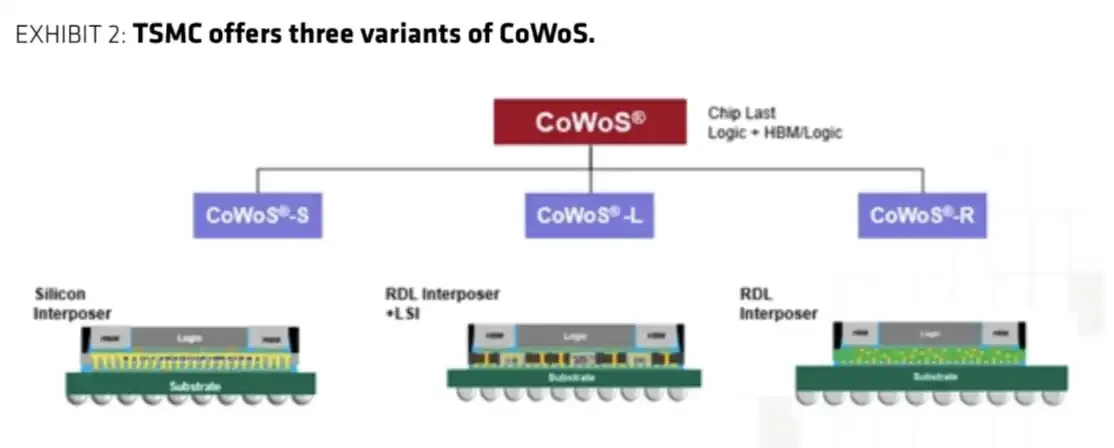
Structural diagram of TSMC CoWoS variants, showing the differences in interposers, RDL, and HBM stacking for CoWoS-S, CoWoS-L, and CoWoS-R.
For Samsung, this presents an opportunity to extend its memory advantages into the AI system-level supply chain. Samsung has scale in the memory domain, but regarding HBM leadership and advanced foundry customer trust, the market has historically focused more on SK hynix and TSMC. If the long-term framework with Broadcom is executed smoothly, Samsung can re-emphasize its combined "Memory + Foundry + Packaging" capability.
Ratings are Bullish, but MOUs are not Orders
In its report, Bernstein maintained Outperform ratings for Samsung Electronics, SK hynix, Micron, NVIDIA, and Broadcom, with KIOXIA rated Underperform. In terms of target prices, Samsung common stock is set at 440,000 KRW, SK hynix at 3,300,000 KRW, NVIDIA at $315, and Broadcom at $550. Relevant ratings and target prices are based on the source report.
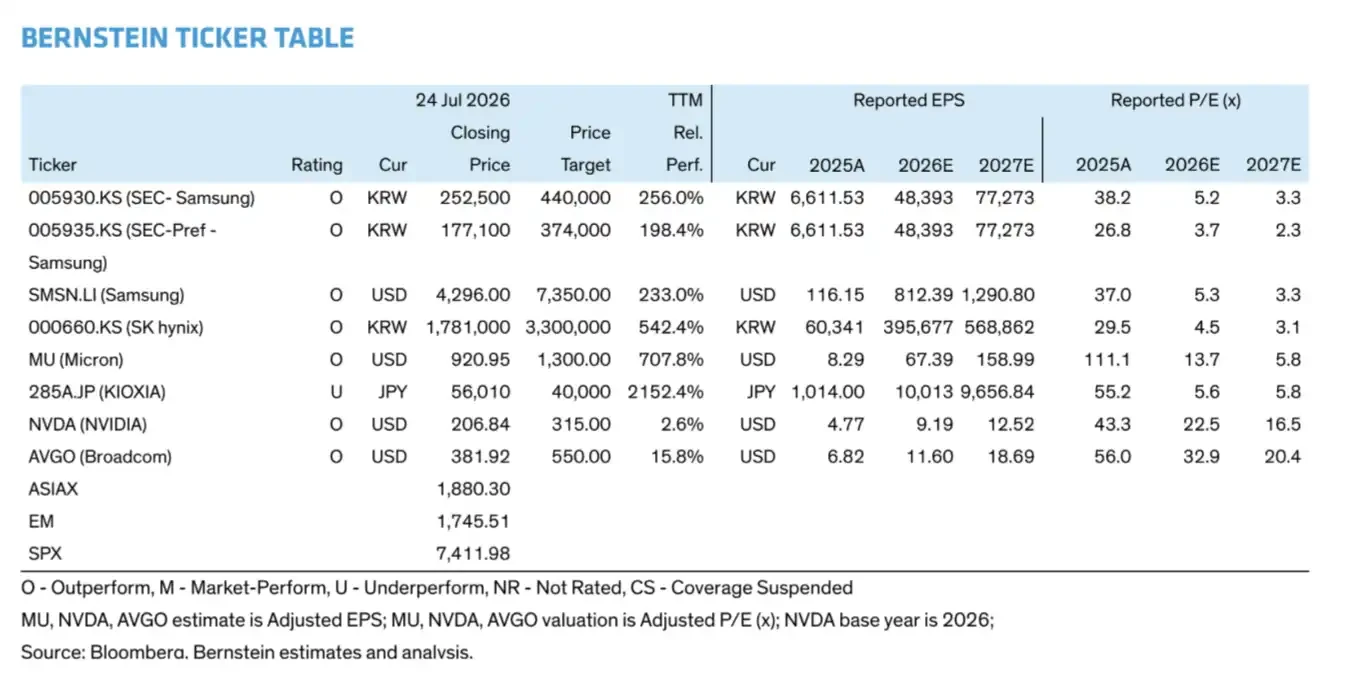
Table of major stock ratings and target prices: Samsung 440,000 KRW, SK hynix 3,300,000 KRW, NVIDIA $315, Broadcom $550, all rated Outperform.
This set of ratings does not imply that all collaborations have translated into confirmed performance. A safer interpretation is that AI memory supply is becoming more strategic, with both leading memory manufacturers and major AI chip customers using long-term arrangements to mitigate future supply risks.
Risks are also clear. MOUs and partnerships are not final procurement contracts; prices, volumes, and delivery timelines remain undisclosed. Whether the Samsung-Broadcom collaboration yields substantial AI ASIC foundry or advanced packaging share will depend on customer qualification, yield rates, and capacity allocation. Even if the collaboration value is enormous, it is difficult to assess the incremental contribution relative to the approximately $1.3 trillion annual memory market projected around 2027.
Longer-term pressure stems from competition in the storage industry. Progress in China's storage sector, particularly competition in NAND, could impact industry profit margins. Due to higher barriers in EUV, process technology, and customer qualification for DRAM and HBM, short-term pressure is relatively smaller, but current supply tightness cannot be simply extrapolated as a permanent advantage.
The most definitive signal from these collaborations is not that "$700 billion in orders have been secured," but that AI giants are beginning to use multi-year frameworks to lock in memory and packaging resources. Whether this materializes ultimately depends on capital expenditures, HBM shipments, customer prepayments, capacity expansion, and actual delivery schedules reflected in financial reports.


