






谷歌财报足够亮眼,但华尔街为什么不买账?


- 核心观点:谷歌母公司Alphabet 2026年Q2财报显示营收与利润双增,Google Cloud表现超预期,但市场因担忧其AI基础设施巨额资本开支(Capex)对现金流的压力及AI模型竞争力而反应消极,股价盘后下跌,核心矛盾在于AI投资的价值兑现速度。
- 关键要素:
- Alphabet Q2营收1198亿美元,同比增长24%,营业利润408亿美元,同比增长30%,但剔除Anthropic股权估值收益后EPS低于预期。
- Google Cloud收入247.7亿美元,同比大增82%,成为增长最快业务,但Capex高达449亿美元,将全年指引上调至1950-2050亿美元。
- 自由现金流首次转负至-58.55亿美元,为支撑AI基建已发行约496亿美元可转换优先股及203亿美元债券,加大举债力度。
- Google Cloud增长驱动力转向AI基础设施和解决方案,剩余履约义务达5140亿美元,但年化收入(约1000亿)仍需覆盖全年2000亿Capex。
- Gemini App月活达9.5亿,财富100强企业近90%使用Gemini Enterprise,但模型能力担忧突出,Gemini 3.5 Pro推迟发布,面临Anthropic、OpenAI等竞争压力。
- 市场关注点从盈利能力转向Capex效率,要求AI投资需更快转化为商业价值,否则传统搜索入口优势可能被AI助手生态侵蚀。
Original by Odaily Planet Daily (@OdailyChina)
Author: Azuma (@azuma_eth)
On the morning of July 22 Beijing time, Google's parent company Alphabet released its Q2 2026 earnings report after the US stock market closed.
If we look purely at the financial figures, this was a nearly perfect report card. In Q2, Alphabet achieved revenue of $119.8 billion, up 24% year-over-year, and operating profit reached $40.8 billion, up 30% year-over-year. The company has maintained double-digit revenue growth for 12 consecutive quarters, with its core business continuing to demonstrate strong growth resilience.
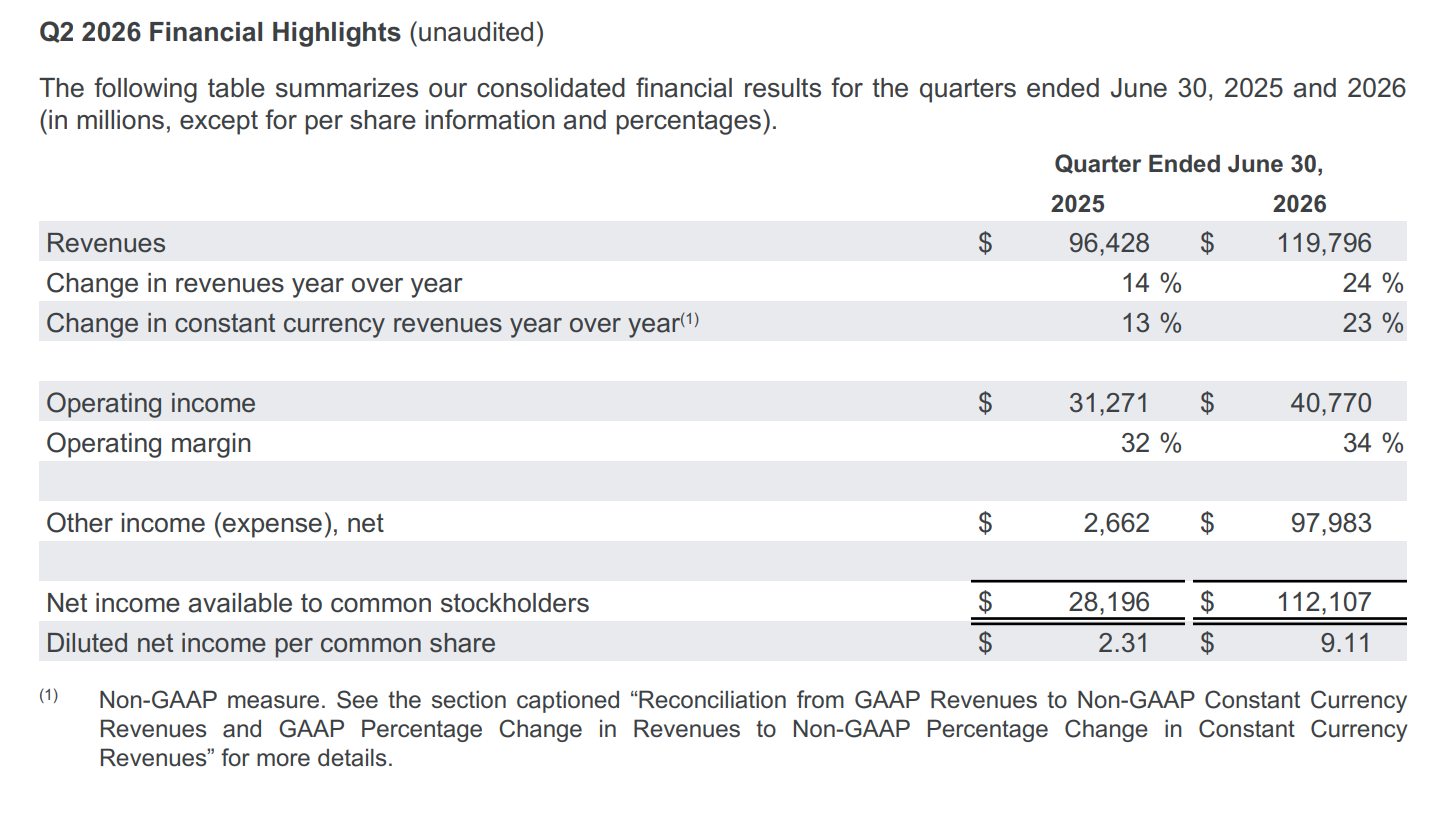
- Odaily Note: As shown in the table above, many investors noted Google's explosive EPS of $9.11 for the quarter, far exceeding the $2.31 of the same period last year. However, this was primarily due to the valuation increase of its 14% stake in Anthropic. Excluding this gain, the EPS would have been only $2.85, below market expectations of $2.95.
Among these, Google Cloud, the segment drawing the most market attention, delivered results that far exceeded expectations. Last quarter, Google Cloud revenue reached $24.77 billion, up 82% year-over-year, making it Alphabet's fastest-growing business segment.
At the same time, Google's traditional core business remained solid. Google Services revenue reached $94.54 billion, up 15% year-over-year, of which Search and other revenue was $63.27 billion, up 17%, and YouTube advertising revenue was $11.06 billion, up 13%.
From revenue and profits to AI business progress, Google delivered almost everything investors were hoping to see. However, interestingly, after the earnings release, Alphabet's stock price did not rise but instead fell nearly 3% in after-hours trading.
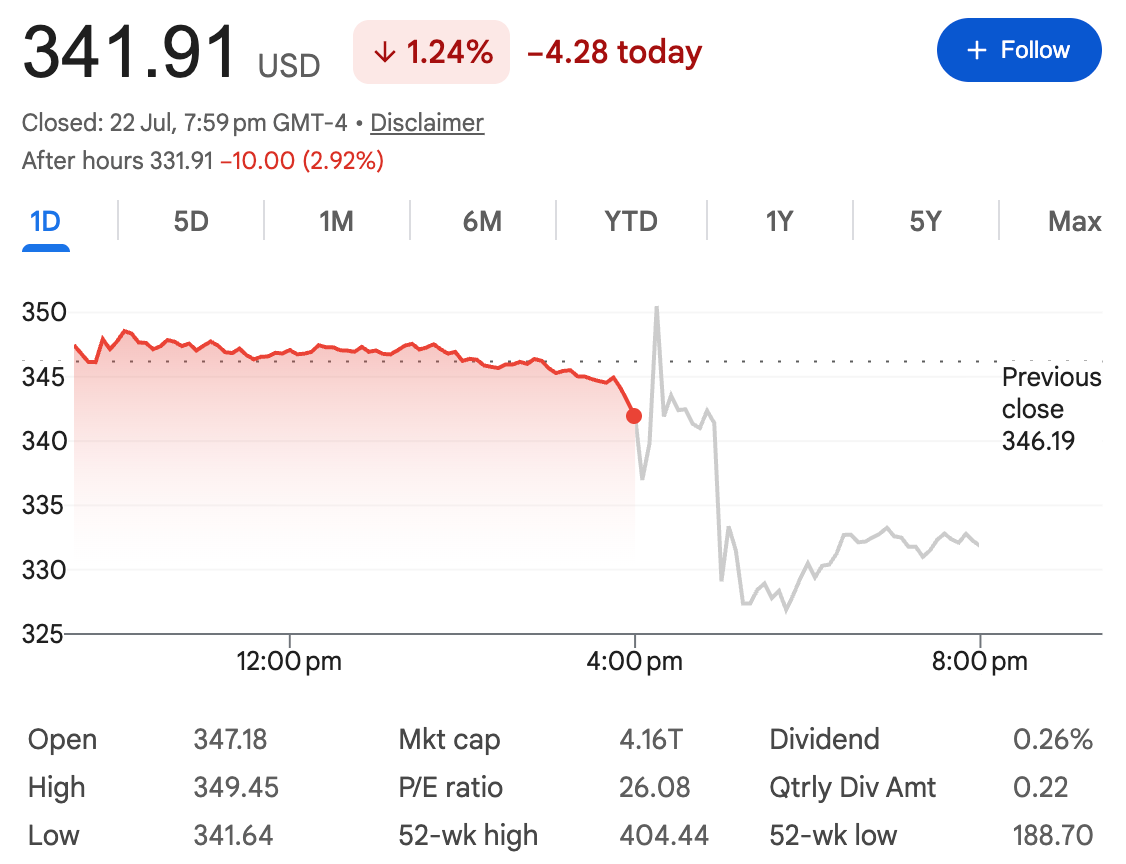
Why isn't the market buying it? The reason isn't hard to understand. Compared to "how much money Google made," the market is now more focused on "how much it will cost Google to win the AI era."
Capex Surges to $200 Billion, Free Cash Flow Turns Negative for the First Time
Over the past few years, thanks to the continuous profit generation from its Search and Advertising businesses, Google has been one of the most cash-rich companies among global tech giants. However, as the AI competition heats up, this model is rapidly changing.
To secure a leadership position in AI infrastructure, Alphabet is continuously scaling up its investments. In Q2, Alphabet's capital expenditure reached $44.9 billion (exceeding market expectations of $44.2 billion) and raised its full-year 2026 capital expenditure guidance from the previous $180-190 billion to $195-205 billion.
In terms of spending categories, most of the funds are allocated to AI infrastructure construction, such as servers, data centers, and networking equipment. This means that in just one year, Google could invest nearly $200 billion to bet on AI.
This massive investment has created new pressure for Google. In Q2, due to the rapid growth in capital expenditure, Alphabet's free cash flow turned negative for the first time. The company's operating cash flow was $39.1 billion, while capital expenditure reached $44.9 billion, resulting in a free cash flow of -$5.855 billion.

During the investor conference call following the earnings release, Alphabet CFO Anat Ashkenazi acknowledged the cash flow issue, stating, "The investment in AI infrastructure will continue to pressure the income statement and cash flow."
It's also worth noting that to support this continuous expansion of AI infrastructure, Google has begun large-scale borrowing. In June of this year, Alphabet completed an issuance of stock and convertible preferred shares, raising net proceeds of approximately $49.6 billion. Concurrently, the company also issued $20.3 billion in senior unsecured bonds to supplement capital needs.
For a company that has long relied on its cash flow advantage to win over investors, this is undoubtedly a significant change. Of course, the market isn't opposing Google's continuous investment in AI. The real question is, "how long will it take for these investments to translate into a new growth curve?"
Google Cloud Performs Well, But Not Enough
Fortunately, the Google Cloud revenue performance in the Q2 report can somewhat alleviate some investor anxiety.
Enterprises training models and deploying AI applications require massive computing resources, and cloud services are the key entry point connecting AI capabilities with commercial clients. In Q2, Google Cloud revenue reached $24.77 billion, up 82% year-over-year, significantly exceeding market expectations and marking the fastest growth rate in recent years.
More importantly, the core driver of cloud business growth has gradually shifted from traditional cloud computing demand to AI infrastructure and enterprise-grade AI solutions. Alphabet stated in its earnings report that Google Cloud's growth in the quarter was primarily driven by enterprise demand for AI infrastructure, Google Cloud Platform (GCP) AI solutions, and core cloud service growth.
Meanwhile, Google Cloud's contracted backlog also continues to expand. As of the end of Q2, Google Cloud's Remaining Performance Obligations (RPO) reached $514 billion, a further increase from the previous quarter. More than half of this backlog is expected to be recognized as revenue within the next 24 months. At least for now, Google's investment in AI infrastructure isn't just about chasing a technology race; it is already translating into actual business growth.
Compared to other major AI players, Google's biggest advantage has always been its more complete industrial chain. From the Gemini model to the self-developed TPU chips to the Google Cloud platform, Google covers multiple layers of the AI infrastructure stack.
The current high-growth trend of Google Cloud serves as a partial, interim validation of the returns on AI investment... But it is still far from enough. After all, while Google Cloud's annualized revenue scale has reached approximately $100 billion, Alphabet's annual capital expenditure has surged to $200 billion.
As investments in AI infrastructure continue to expand, can future revenue growth maintain sufficient speed to ultimately cover this capital expenditure? The market currently has no answer. Judging by the after-hours stock price decline, the market's stance appears to be more cautious.
Gemini's Capabilities: The Biggest Hidden Concern?
If Google Cloud proves Google's ability to reap commercial benefits from the AI wave, then Gemini determines whether Google can maintain its lead in this long-term competition.
Over the past few years, Google has consistently emphasized its "full-stack AI" strategy. From the underlying TPU chips and data centers to the Gemini model and the Google Cloud platform, Google aims to build a complete system covering AI infrastructure and application ecosystems.
According to data disclosed in the financial report, Gemini's user base is also growing rapidly. Currently, the Gemini App has 950 million monthly active users; the Gemini model API processes approximately 22 billion tokens per minute; and nearly 90% of Fortune 100 companies are using Gemini Enterprise.
These figures prove that Google hasn't missed the AI commercialization wave. However, market concerns about Gemini persist.
The reason is that the core of AI competition isn't just about user numbers and infrastructure scale; model capabilities are equally crucial in determining ecosystem attractiveness. Previously, Google's planned release of Gemini 3.5 Pro was delayed, which sparked market concerns about the competitiveness of its models. Especially in high-value application scenarios like AI coding and intelligent agents, competitors like Anthropic and OpenAI are iterating rapidly, and Gemini appears to be showing signs of falling significantly behind.
For Google, the most critical question right now is whether Gemini can still prove itself to be in the top tier.
In the past, Google's greatest strengths were its globally leading Search entry point, powerful engineering capabilities, and vast data resources. However, the rules of competition in the AI era are changing. User habits might shift from traditional search to AI assistants, and developers might prefer more powerful model ecosystems. If Gemini cannot prove itself, even with the most comprehensive infrastructure, Google might face the risk of having its application value intercepted by other models.
The AI Race Shifts Focus to "Value Realization"
Looking back, Alphabet's earnings report presented a very distinct dual nature.
On one hand, Google is proving that AI investment is not just a fantasy of the capital markets. The rapid growth of Google Cloud, the increasing demand for AI infrastructure, and the expansion of Gemini's user base all indicate that AI is gradually transitioning from a technological wave into genuine commercial demand. On the other hand, the market's caution is not without reason. The nearly $200 billion annual capital expenditure, the first negative free cash flow, and the intensely competitive performance of its models mean that Google must convince its investors that this AI gamble will ultimately yield long-term returns exceeding the investment cost.
The challenges facing Google are, in fact, the same issues confronting the entire AI industry. Over the past few years, tech giants like Microsoft, Amazon, and Meta have also been continuously expanding their AI infrastructure investments. Data centers, computing power, and chip procurement have long become the main battlefield for these giants.
Going forward, the market's focus might no longer be on who invests the most, but on who can convert capital investment into commercial value the fastest. For Google and other tech behemoths, the AI race may have just entered its critical phase.


