






拒绝6块股价的英伟达offer,他说他炒股能赚更多


- 核心观点:一位名为 Serenity(@aleabitoreddit)的匿名投资者,通过深入挖掘AI硬件供应链中的“瓶颈点”,精准预测了多只小盘股暴涨,其研究被路透社和彭博社引用,吸引了超过15万全球投资者跟单,但身份和业绩缺乏审计验证,存在风险。
- 关键要素:
- Serenity 的推文拉动 FTSE 250 成分股 Raspberry Pi (RPI) 股价两天涨近 90%,其预测与公司后续 58% 的营收增长高度吻合,验证其研究准确性。
- 其投资逻辑聚焦于 AI 供应链“瓶颈点”(如磷化铟、CPO 光源),避开热门大盘股,从底层材料反推机会,如成功预测 AXT(涨幅 1000%)、SIVE(单日暴涨 73%)等多个案例。
- Serenity 身份完全匿名,自称曾是 AI 科学家、RISC-V 基金会成员,但所有业绩(如年回报 630%)为自报,无第三方审计,且持仓高度集中于流动性差的中小盘股。
- 他目前不卖课、不收费,核心研究免费公开,但 15 万跨三大洲的跟单文化可能引发散户在错误时机跟风的风险。
150,000 people across three continents, from retail investors to hedge fund managers, are copying the trades of a "Twitter stock guru."
His recent public bullish call on a single stock directly triggered a nearly 90% surge in just two days.
On February 17, 2026, on the London Stock Exchange, a small FTSE 250 stock named Raspberry Pi was pushed up 27% in the first hour of trading by buy orders. It accumulated nearly 90% over two days and maintained gains of over 50% within a week.
This British hardware company, with a market cap of just over £500 million, had seen its stock price languish below its IPO price for the past six months.
No analyst predicted it would become one of the hottest UK stocks at the start of 2026.
Reporters from Reuters, Bloomberg, the Financial Times, and The Register were dispatched to review the situation, and their investigations all pointed to the same source.
The day prior in U.S. Eastern Time, an account on X with 58,000 followers posted a tweet titled "Fun trade idea: long $RPI."
The account name is Serenity, the handle is @aleabitoreddit, using a female avatar.
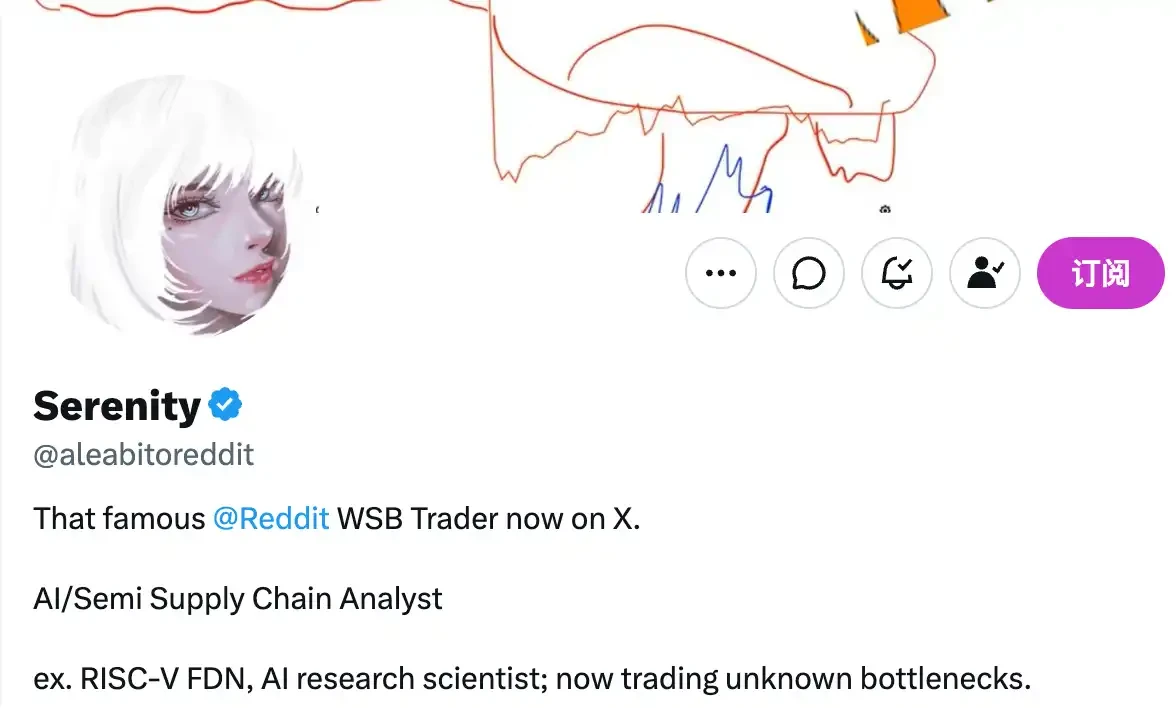
The Bloomberg report began, "It all started on Monday when an X user named aleabitoreddit posted a thread titled 'Fun trade idea'."
The Reuters article directly quoted Serenity's thesis on Raspberry Pi. When questioned about the stock price volatility, a spokesperson for Raspberry Pi stated, "There is no information at the company level beyond what has already been publicly disclosed."
The story doesn't end there.
At the end of March, Raspberry Pi announced its full-year financial results. Revenue grew by 58%. Serenity's prediction two months prior was 55%. The consensus among sell-side analysts, as compiled by Bloomberg, was only 14%. On the day of the earnings release, RPI's stock price jumped another 44.76% in a single day, followed by a 27.43% gain the next day.
This is why, over the past year, an increasing number of Silicon Valley investors have added this Twitter account to their daily must-read list.
A single tweet triggered a 50% swing in the market cap of an FTSE 250 constituent within a week, and two months later, an earnings report validated his prediction.
And the person responsible for repeatedly causing such market movements remains anonymous; no one knows his real name.
The Banned User
Serenity's account bio describes him as an "AI Semiconductor Industry Chain Researcher," "Nature Paper Author," and "RISC-V Foundation Member." He once joked that in 2018, NVIDIA tried to recruit him to lead its AI team, when NVIDIA's stock price was around $6. He declined.
To understand the Serenity account, we need to start with a ban four years ago.
In early 2022, the moderators of r/wallstreetbets, the infamous US retail investor forum, banned an account named AleaBito.
The reason was that this account had posted about a stock whose name sounded like a pyramid scheme: AXTI. With a market cap just over $200 million, its main business was indium phosphide substrates, and the stock was trading at $12. The moderators accused him of pumping the stock and banned him outright.
AXTI later rallied all the way to $70. In a recent review, Serenity himself called it his most legendary trade, with an unrealized gain of 1000% on that single stock.
After being banned, he switched platforms. Moving from Reddit to X, he gave himself a new name, Serenity. His bio contains a line: "The famous WSB trader, now on X."
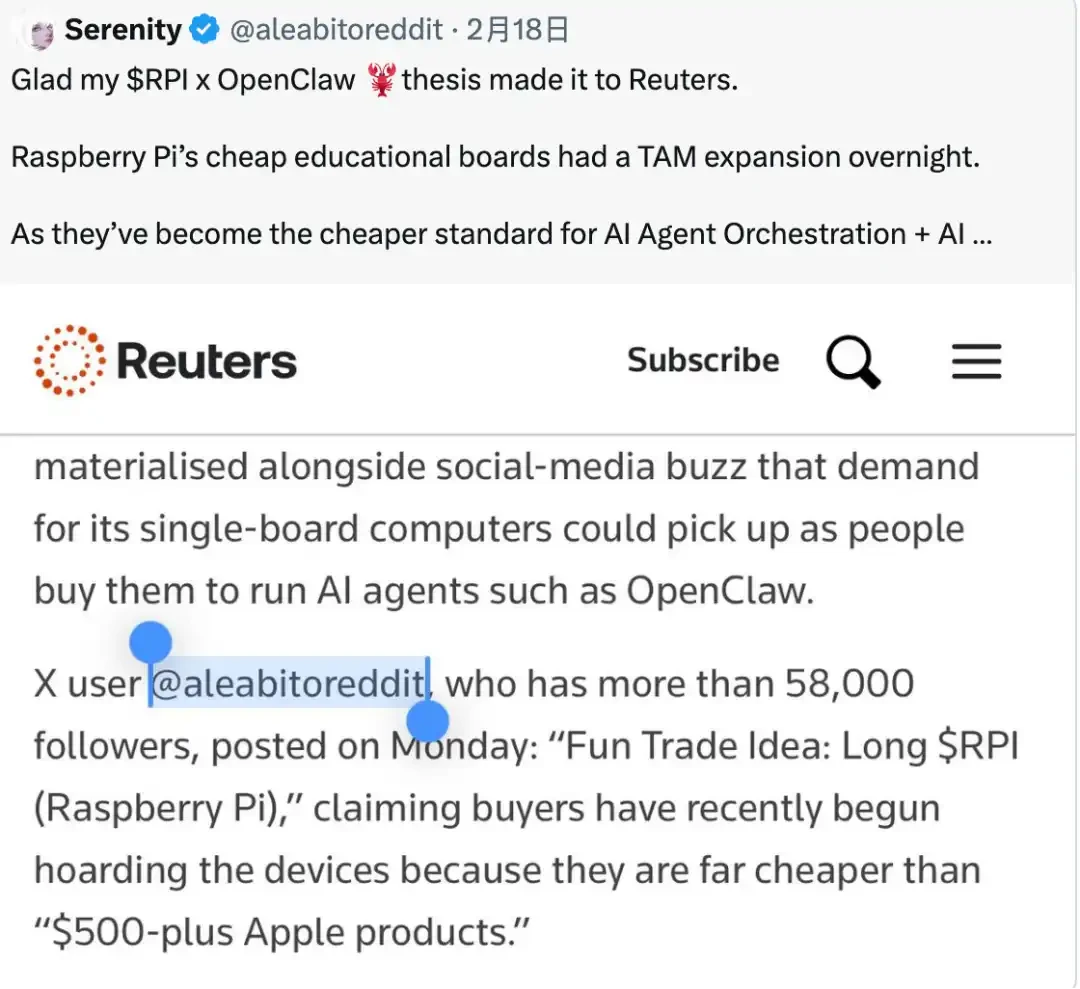
Research analysis once cited by Reuters
Serenity's follower count has grown rapidly this year. Users in the US stock, Taiwan stock, and European stock communities translate his posts. In Chinese-language communities like moomoo, Xueqiu, and PTT, there are copy-trading groups. Some have built dashboards to track his portfolio changes, while others manage hedge funds based on his moves. His only paid product is an Excel sheet, which he jokingly calls "ideas worth a dollar." All core research is shared for free on X.
The Winning Streak
Calling RPI is just one example among his past judgments. Serenity has a string of similar cases, each following the same trajectory: post a tweet, get criticized, then get validated.
First, AXTI. This was the stock that got him banned from WSB. Indium phosphide substrate, the most fundamental material for AI data center optical modules. In February 2025, the East implemented export controls on indium phosphide. By January 2026, licensing was further tightened, forcing AXT to lower its quarterly revenue guidance. Overnight, this small fab in Fremont, California, transformed from a micro-cap stock into a strategic national security asset. He had called this company two years prior.
Second, SIVE. Sivers Semiconductors, listed in Stockholm, Sweden, makes CW lasers for CPO external light sources, a core component for next-generation 1.6T co-packaged optics. After he publicly disclosed his position, the stock surged 73.78% in a single day, instantly jumping its market cap from $130 million to $230 million. On April 15, 2026, Jabil announced a partnership with SIVE to develop 1.6T LRO optical modules with a 2.5x energy efficiency advantage. A month later, on May 19, CHIPS Act Year 2 funding of $6.6 million arrived.
Third, Soitec. A French semiconductor company, nearly monopolistic in SOI substrates for CPO; even Japan's Shin-Etsu needs a license from them. In March of this year, he explicitly changed his view in a tweet and built a position around €43, calling it a "hidden monopoly you can hold long term." Soitec's stock price jumped 16% that day.
There's also a string of Taiwan stocks: FOCI (3363, microlenses and fiber arrays), Win Semiconductors (3105, GaAs foundry), and Tower Semiconductor (TSEM). These stocks were already being discussed in Taiwan's local retail investor circles, but in the English-speaking world, he might be the first to systematically link them to the CPO narrative.
Regarding performance, he self-reported returns of 630% in the year before joining X. His YTD was once over 500% at one point this year, though it has pulled back recently. Of course, these numbers are unaudited and should be taken as a reference. But one thing is verified: Reuters and Bloomberg directly cited his online alias in their reports. 150,000 followers across three continents translate his posts, and hedge funds copy his trades.
The Bottleneck
To understand Serenity's investment logic and what he did right, you first need to grasp the dominant narrative on Wall Street over the past three years. From 2023 to 2026, retail investors worldwide were chasing the same set of stocks: AI giants like NVIDIA, AMD, Microsoft, Google, and Meta. Every sell-side report, every YouTube influencer, every financial headline was calculating whether these companies would beat expectations in the next quarter.
Serenity went the opposite way. He researched downwards, drilling layer by layer, searching for the "screws" on NVIDIA. He called these "chokepoints."
This concept is easy to explain with an analogy. Indium phosphide substrate for AI optical modules is like the Strait of Hormuz for global oil. 20% of the world's oil passes through that strait. Whoever controls it, controls everyone. Another, more everyday example: a high-end kaiseki restaurant in Tokyo's Ginza district. The most expensive item on the bill is the fatty tuna belly, but the restaurant is even more dependent on the shiso leaf underneath the sashimi. 90% of Japan's high-grade shiso is produced by a few family farms in Izu. If a typhoon hits and the farms shut down, every kaiseki restaurant in Ginza would have to close for the day. A chokepoint is like that. No one mentions it normally, but when a problem occurs, everyone is doomed.
Serenity's working method is the exact opposite of mainstream Wall Street analysts. Sell-side analysts look down from the big companies. He works upwards from the chokepoint. He draws his own supply chain map, starting from the NVIDIA H100 cluster and working backwards, layer by layer, to the narrowest bottlenecks. He uses AI to challenge his own thinking, often saying, "I'll have Gemini challenge my thesis," feeding his research to AI to play the role of the opponent. He uses US, Taiwan, European, and Japanese stocks to draw a complete map of global AI chokepoints for the era. Each node is a potential Strait of Hormuz. Every geopolitical event, every earnings report, every export control measure allows him to find the corresponding coordinate on his map and vote with his holdings. Recently, his radar has extended to rare earths and humanoid robots, but the investment logic remains the same: find the narrow points, find the monopolies, find the links whose failure would cripple everyone.
This is something most sell-side analysts on Wall Street can't do. They are siloed: TMT analysts don't look at materials, materials analysts don't look at optics, optics analysts don't look at geopolitics. His most common saying is, "The earlier the view, the more severe the initial backlash."
God of Retail Investors, or Just Another Mythologized Gambler?
At this point, the tone needs to shift. Everything about Serenity that is unverifiable: his identity is completely anonymous, with no photos, real name, or institutional background to be found. "Declined NVIDIA AI team offer when stock was $6," "Nature paper author," "RISC-V Foundation member" – these are all self-reported. Performance is self-reported, unaudited, with no third-party verification. His holdings are highly concentrated, mostly in non-consensus small and mid-cap stocks with poor liquidity, making it easy for retail copycats to enter at the wrong time.
In the history of financial KOLs over the past decade, those with unverifiable identities, self-reported performance, and a thriving copy-trading culture have generally not ended well. However, a few things about Serenity seem different. He currently doesn't sell courses, run signal groups, offer paid training, or charge high subscription fees. Core research is shared for free on X. He doesn't accept ads, chase traffic, or operate as an MCN.
For now, he can't be called a fraud. But he shouldn't be deified either.
Of course, an anonymous user banned from a forum, leveraging over 150,000 people—including Wall Street hedge funds—to work for him for free, validating his theses, spreading his research, and translating his posts... that's quite legendary.


