






SpaceX Chain-Based IPO Dream Shattered: In a Trillion-Dollar IPO Feast, I Only Got 4 Shares


- Core Insight: On June 12, 2026, as SpaceX's IPO debuts on Nasdaq, several leading global crypto platforms (including Bybit, Binance, and Kraken) jointly held the first major on-chain subscription event for a tokenized IPO via the xStocks framework—only to see it collectively "crash." Due to severe upstream quota shortages, the event ultimately led to widespread refunds or symbolic allocations, exposing the fundamental bottleneck where tokenized IPOs remain constrained by the traditional financial system on the supply side.
- Key Elements:
- SpaceX's IPO was priced at $135 per share, raising $75 billion and implying a valuation of $1.75 trillion. However, the aggregated demand from crypto platforms far exceeded the actual available quota.
- Bybit, Binance, and Bitget Wallet canceled their events and issued full refunds after xStocks failed to deliver the underlying shares. Binance returned $557 million in subscription funds to 27,689 addresses.
- Regardless of their investment amount, Kraken users ultimately received a fixed allocation of approximately 4.2786 shares (valued at around $578–$606), with some users unable to trade due to geographic restrictions.
- The xStocks tokens are designed to have a 1:1 correspondence with the underlying shares, held by a custodian broker-dealer. However, the underwriter's allocation rights in actual execution caused the quota for crypto platforms to fall far short of expectations.
- A few platforms, such as BitMart and Gate.io, achieved actual share distribution by directly securing underwriter quotas, resulting in a roughly 40% allocation rate, serving as a positive case study in this event.
Original by Odaily Planet Daily (@OdailyChina)
Author: jk
On June 12, 2026, SpaceX landed on the Nasdaq at an issuance price of $135 per share with the ticker SPCX, raising a staggering $75 billion, setting a record in IPO history. After the market opened, SPCX shares briefly surged past $170, an increase of over 25% from the issuance price, instantly igniting market sentiment for this trillion-dollar IPO feast.
However, on the very same day traditional financial markets were celebrating SpaceX's debut, the first large-scale experiment by the crypto industry to open IPO channels for retail investors through a tokenization framework collectively "crashed and burned." Bybit, Binance, and Bitget Wallet successively announced the cancellation of activities and full refunds. Meanwhile, most Kraken users, previously deemed the most reliable platform, received only a symbolic, "scaled-down" allocation of approximately 4.2786 shares, regardless of the amount they invested.
What is xStocks? The Product Logic of Tokenized IPO Subscription
The core infrastructure at the center of this incident is xStocks, a tokenized equity framework issued by Backed Assets (JE) Limited, a subsidiary of Payward Services, the parent company of Kraken.
xStocks tokens are designed to correspond 1:1 with the underlying real shares, with the physical shares held in custody by a regulated broker.
High Activity in Preceding Events
Kraken was the first to launch SpaceX IPO Access on June 5, with the token code SPCXx, open for subscription to verified users in over 110 regions. Bybit followed on June 7, launching its IPO Express product, designating this SpaceX subscription as its first listed target. The indicative price was set at 135 USDC, plus a 5% underwriting fee, with a minimum subscription of 100 USDC per user and a maximum of 50 subscription orders.
Binance then launched the SPCXx subscription activity under the banner of its "First IPO Campaign." Bitget Wallet also introduced a similar product via the xStocks framework on Solana, with an initial quota of $3 million, which quickly expanded to $13 million due to strong demand, achieving 4x oversubscription within 30 minutes.
Everything Collapsed on Listing Day: xStocks Fails to Deliver Underlying Shares
SpaceX officially listed on the Nasdaq on June 12, raising $75 billion, implying a valuation of $1.75 trillion.
However, on the same day, various crypto platforms issued announcements: The actual underlying share quota xStocks received from underwriters was far lower than expected, making it impossible to deliver the full amount requested by the platforms.
Bitget's official account stated on X: "The xStocks team tried their best to secure quota, but ultimately failed to secure it as expected."
Bybit's official account also confirmed on X: Due to xStocks' inability to deliver the underlying assets, Bybit did not receive any SpaceX share allocation. All subscription funds will be 100% automatically returned to original accounts, and compensation rewards with an annualized interest rate of approximately 10% will be provided to eligible participating users.
Binance, Bitget, and Bybit subsequently announced the cancellation of activities and full refunds, while promising additional compensation to affected users.
On-chain data shows that within 28 hours of Binance's SPCXx subscription launch, it attracted approximately $557 million worth of USDC subscription commitments from 27,689 wallet addresses. Over 81% of these addresses subscribed less than $20,000 individually, but 114 addresses staked at least $500,000 each. After announcing the cancellation, the exchange officially declared full refunds of the locked USDC and airdropped bStocks SpaceX tokens (SPCXB) worth a total of $1 million to all participating users, expected to arrive before June 18.
Kraken, the exchange affiliated with xStocks, delivered equally disappointing results. Community feedback shows that regardless of the amount invested, successfully subscribing Kraken users all ultimately received a fixed allocation of 4.2786 SPCXx tokens. Converted at the $135 issuance price, this is worth approximately $578-$606, with the remaining funds fully refunded. Kraken has not yet officially confirmed this figure.
Simultaneously, some users from mainland China who received allocations reported that their app pages showed trading of SpaceX share allocations was unavailable due to regional issues. This means that the 4 shares obtained from the IPO subscription might not actually be sellable.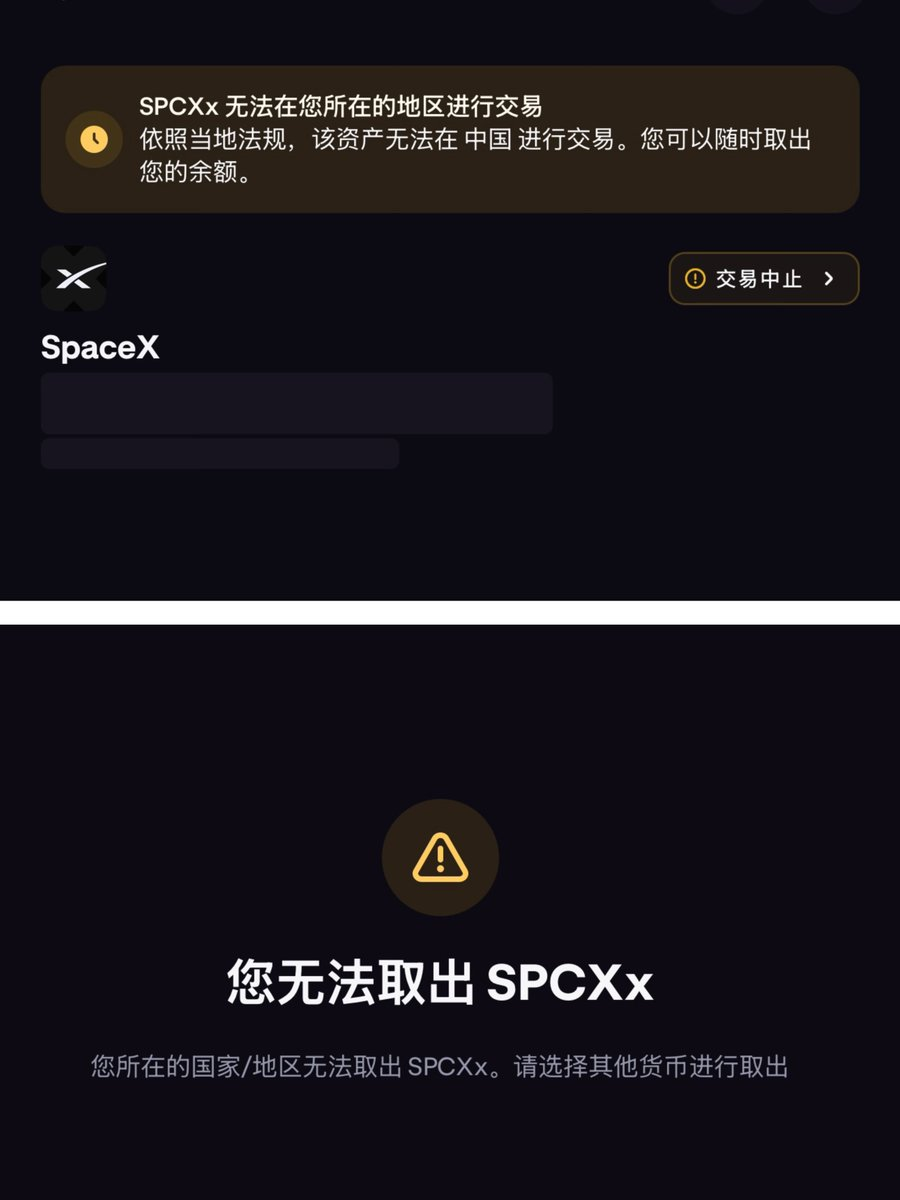
Kraken explained on its support page that the authority to allocate IPO quotas rests with the underwriter. Allocations can be made pro-rata, randomly, on a tiered basis, or based on relationships, among other methods. Partial or zero allocation in a high-demand environment is a normal outcome.
User Complaints Flood Social Media: "IPO Subscription Was a Complete Waste of Time"
After the incident escalated, numerous users in the Chinese community shared their experiences and complaints on X (formerly Twitter).
Kraken user @joeylu0627 detailed their experience: "In my case, I put in 200,000 U [USDT] and ended up with 4.2786 shares of SPCX (worth about $700). The remaining amount was refunded. Luckily, I didn't lose money, just used a large sum to earn a pittance..."
User @jijioulei33190 was more vehement: "Whether you put in 1,000 U or 100,000 U, everyone gets 4.2 shares of SpaceX... Chinese users got the shares, but I **can't trade them. I can only buy, not sell?"
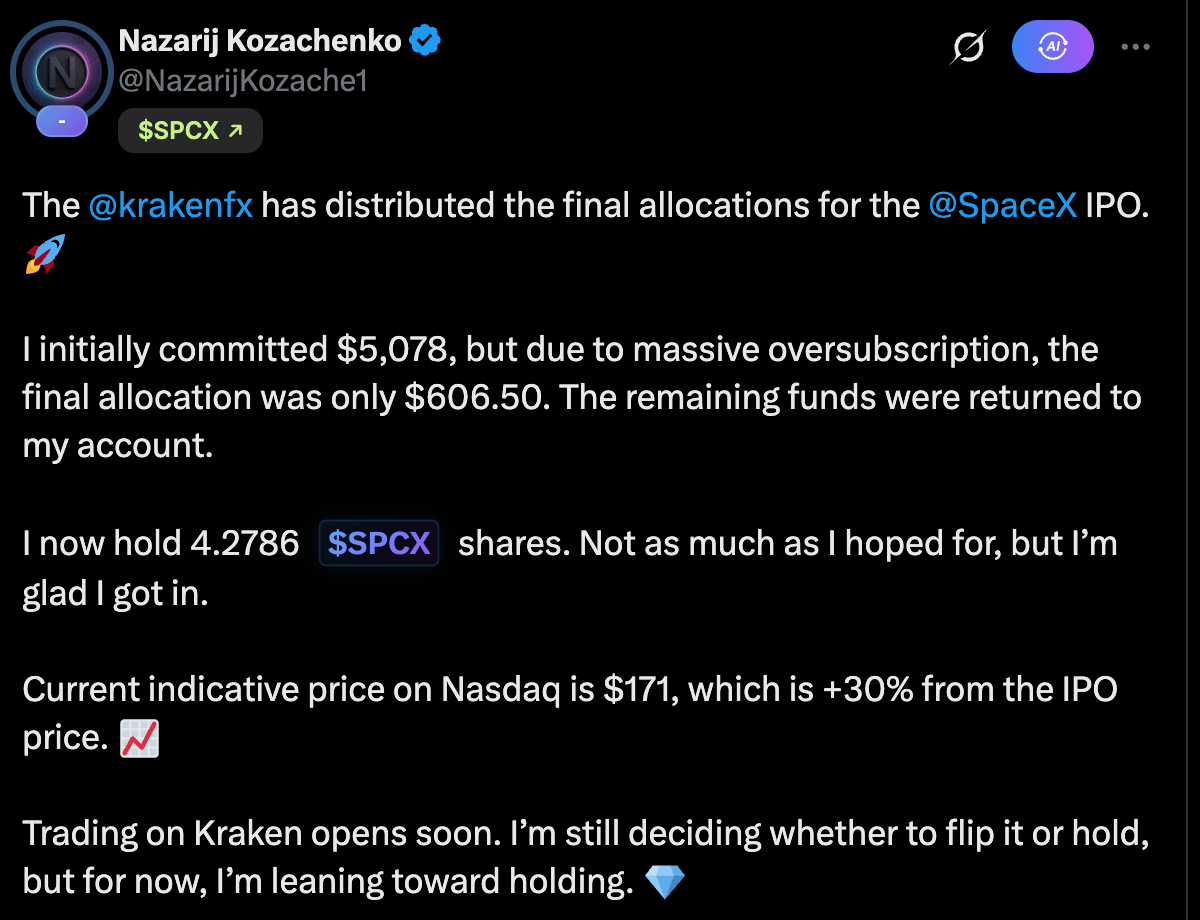
Overseas user receiving a quota worth 606 U
@MengLayer (Chen Xiaomeng) posted a screenshot on X showing the instant exchange of SPCXx back to USDC on Kraken Pro, captioning it: "Used 1 million for IPO subscription, earned 60 U. I'm so awesome." They also quoted another user's complaint: "They refund you if it goes up, and only deliver the shares if it goes down."
Some users speculated that possibly, "seeing the value of the allocated shares increase, the platform privately absorbed the users' shares."
Minority of Platform Success Cases in IPO Subscription
Not all crypto platforms ended with refunds. In this widespread failure of tokenized IPO subscriptions, a few platforms' users actually received shares and realized floating profits.
A noteworthy positive case is BitMart: Its IPOPrime product successfully secured a real SpaceX IPO allocation quota from underwriters. Official announcements and multiple users on X showed allocation results, claiming the platform's estimated success rate was around 40%. This figure was significantly higher than the actual distribution ratios of other platforms during the same period. The shares were directly credited to user accounts with remaining funds automatically refunded, and no lock-up period applied. User @DesiCryptoHub stated that BitMart's allocation rate gave participants "a much higher actual probability of success than most other competing platforms," listing this opportunity as one of the most noteworthy cases in crypto IPO subscriptions this year.
Gate.io also provided actual share allocations. User @px521com2 detailed their subscription bill: "Subscribed $5,786 on Gate -> Refunded $5,557 -> Sold for $268, profit $39. Added to the Kraken part, net profit today totals $127. Given the current crypto market where 'nine out of ten people are cursing,' I'm pretty content to pick up $127." Compared to Kraken's fixed "4.2 shares per person" quota, Gate's pro-rata allocation mechanism provided some users with relatively more flexible actual returns.
Some MSX users also succeeded in the IPO subscription. This platform opened Pre-IPO subscriptions at approximately 119 USDC before SpaceX's official listing, effectively below the issuance price. The platform's social media lead, @Jing_MSX, posted while traveling that day: "Checked before bed and saw $SPCX surged over 20% on its Nasdaq debut. Space X is the first Pre-IPO project I participated in on MSX. My subscription price was 119 U."
Failure in the First Major Test, Future of the Model Uncertain
Kraken emphasized that the quota shortage stemmed from the underwriter's allocation decision, not from a platform technical or operational problem.
In other words, the issue isn't about whether these tokenized stocks can be issued, settled, or displayed on-chain. The problem is that crypto platforms do not genuinely control the upstream resources for IPO allocations.
SpaceX issued approximately 555.6 million shares at $135 per share in this offering, raising around $75 billion, setting a global IPO fundraising record. Amidst extremely high retail subscription demand, the aggregate demand aggregated by crypto platforms far exceeded the quota they could actually secure from the traditional underwriting system.
In this SpaceX IPO feast, most retail investors in the crypto industry ultimately didn't get a seat at the table. This first large-scale test of a so-called "on-chain IPO" also exposed a more fundamental issue: While the demand side might be ready, the supply side remains firmly in the hands of the traditional financial system. As long as the quota sources, underwriting relationships, and asset delivery capabilities are not integrated, no matter how seamless the on-chain entry point is, it will be difficult to change the position of ordinary retail investors in the IPO allocation chain.


