$CATE 1분 만에 65% 급락, fomo 플랫폼 '우연한' 다운으로 또다시 '먹튀' 의혹


- 핵심 의견: Solana 생태계 밈 코인 $CATE가 시가총액 8,000만 달러를 돌파한 후 1분 만에 65% 급락하면서, 현재 시장이 인플루언서 트래픽에 의존하는 토큰은 펀더멘탈 지지 기반이 부족하다는 점이 부각됐다. 또한 극단적 시세 변동 상황에서 거래 플랫폼 fomo의 안정성과 신뢰 위기가 핵심 쟁점으로 떠올랐다.
- 핵심 요소:
- $CATE 급락의 직접적 도화선은 X 계정 정지 및 fomo 플랫폼 다운이지만, 더 근본적인 원인은 이 코인이 독자적인 내러티브 없이 단지 '소형 Ansem' Poorgoat의 보유 및 트래픽 보증에만 의존했기 때문이다.
- Poorgoat는 fomo에서 20만 8천 명 이상의 팔로워를 보유하고 있으며, $CATE에 4만 4,700달러를 투자해 최고 200만 달러 이상의 수익을 기록했다. 그의 '노골적 지지'가 이 코인 과열의 핵심 동력이 됐다.
- 시장 현실을 보면, 순수 커뮤니티 유기적 성장으로 탄생한 토큰의 시가총액 상한선은 약 1,700만 달러(예: $neet) 수준이다. 반면 $CATE는 6만 개 이상의 보유 주소를 보유했음에도 불구하고 150만 달러 미만의 거래액으로 60% 이상이 붕괴하면서 유동성 깊이가 극도로 취약함을 드러냈다.
- fomo 플랫폼 논란은 더욱 가중되고 있다. 7일 수익 랭킹이 에어드랍 수익을 얻은 KOL들이 독점하면서 데이터 조작 여부와 '음모 코인' 여부에 대한 의문이 제기되고 있다.
- fomo 신규 이용자 약관은 자산 안전을 보장하지 않는다고 명시하고 있으며, 수백만 달러 규모의 펀딩에도 불구하고 플랫폼이 5분 안에 500만 달러 거래량을 감당하지 못하면서 기술적 안정성과 개인키 보안에 대한 심각한 의문이 제기된다.
$CATE, one of the most attention-grabbing meme coins on Solana recently, surged wildly from a market cap of just over $2,000 in a little over a week, briefly breaking through an $80 million market cap, only to flash crash 65% in one minute early yesterday morning:
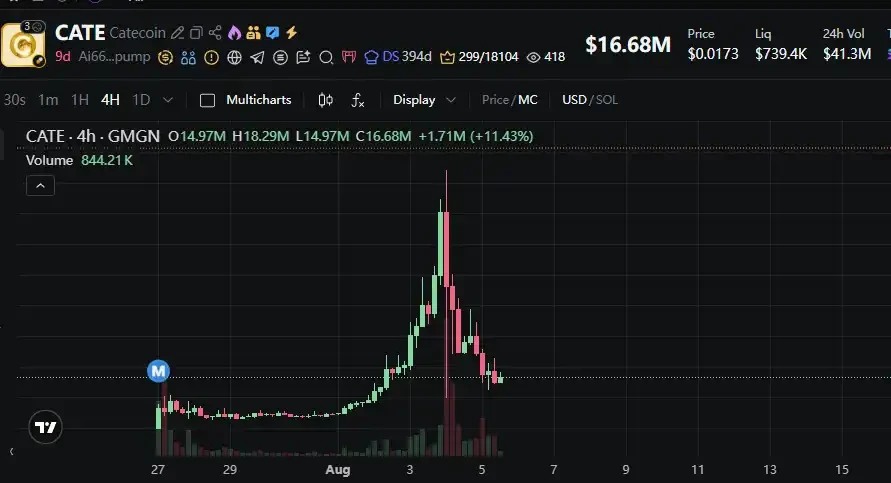
For seasoned on-chain players, seeing a meme coin chart like this is hardly surprising. But when it happens to a focal coin, it's quite dramatic, and it once again reveals some harsh realities of the current market.
The Harsh Reality
Let's start with why this coin flash crashed. Players can all summarize reasons for this massive flash crash:
- $CATE's X account was suddenly suspended
- fomo went down, and users couldn't trade during the outage
The X account suspension is easy to understand, but why would the fomo outage cause this coin to flash crash?
Because, just as $ANSEM relied on Ansem's influence and explicit support, $CATE relied on the influence and explicit support of "Little Ansem," Poorgoat.
Poorgoat, a member of the fomo Hall of Fame (recognized and listed by fomo officials for achieving significant profits on fomo), ranks first on fomo's 7-day profit leaderboard and second on the 30-day profit leaderboard. His average entry point on $CATE was around a $1.4 million market cap, with a total investment of approximately $44,700. At the coin's peak price, his profit from this single trade exceeded $2 million.
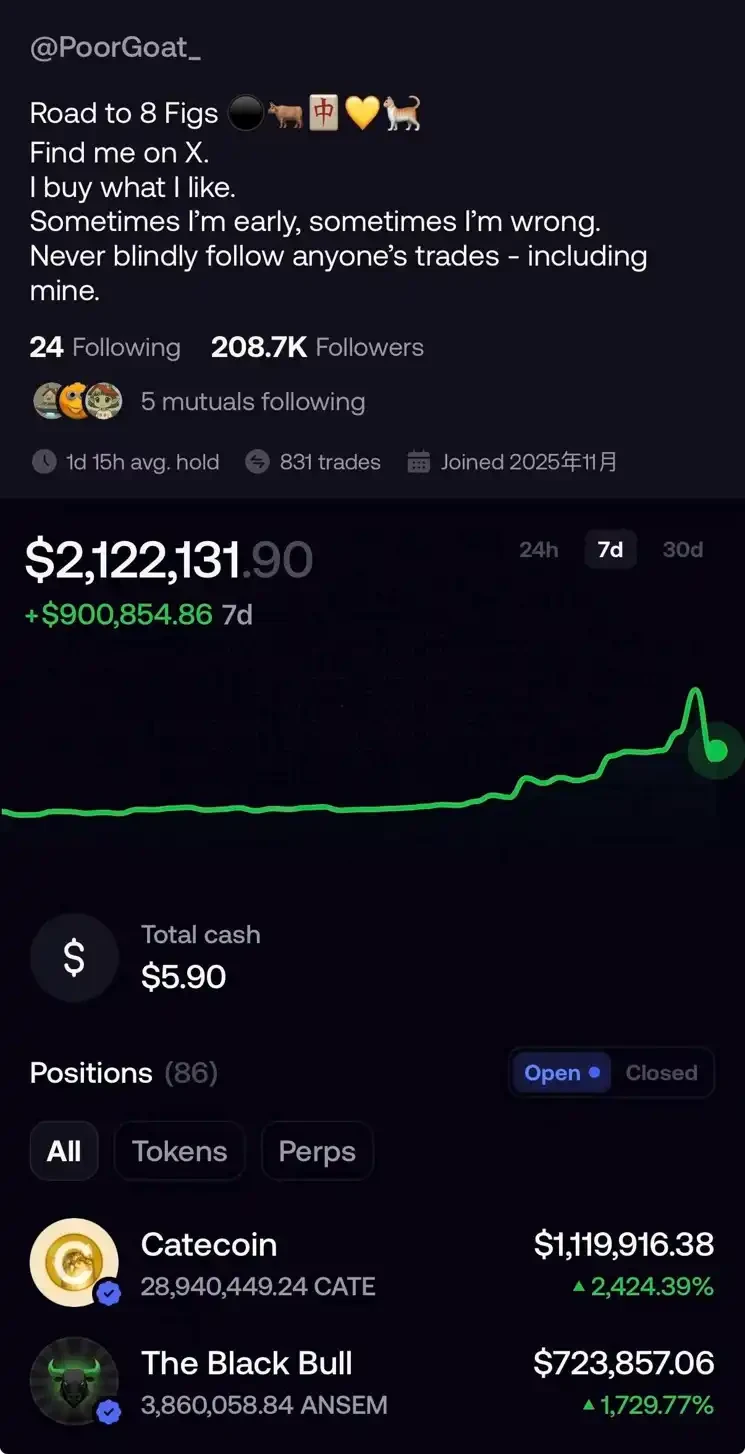
He gained fame by holding onto a $30,000 $ANSEM airdrop and watching it grow to nearly $1.75 million at its peak. Now, he has accumulated over 208,000 followers on fomo.
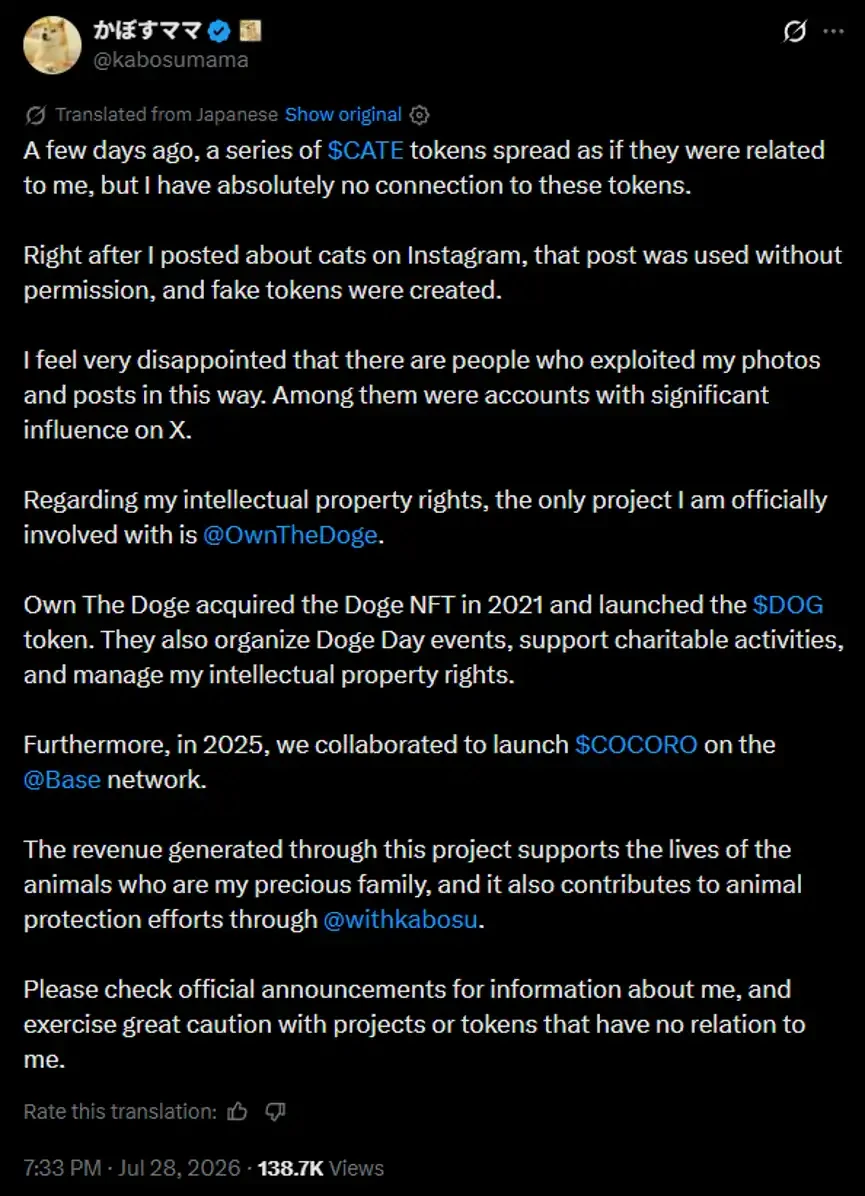
At this point, you should understand why the fomo outage is considered a major reason for the coin's flash crash—because, frankly, this coin has no novelty in its narrative. It's just Doge's "cat sister," and even Doge's owner has publicly denied any association with the coin:
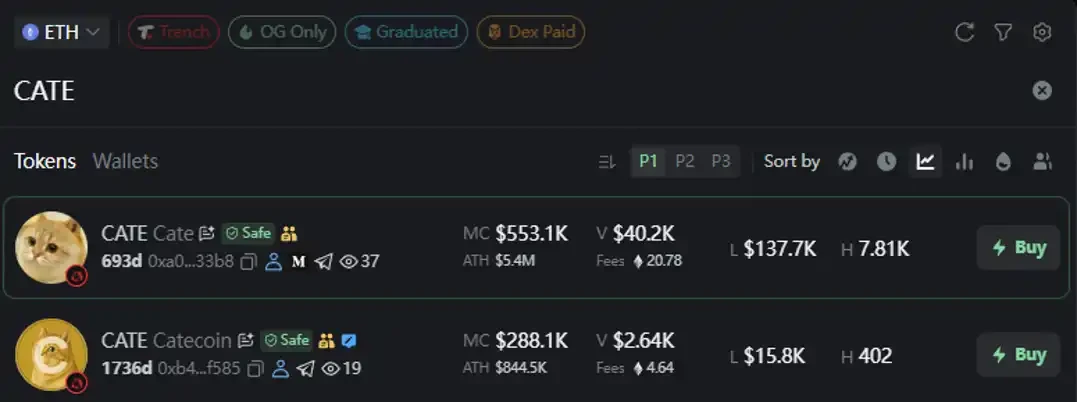
Moreover, the same narrative has existed on the ETH mainnet for quite some time without showing any signs of revival:
What makes this flash crash particularly controversial is that Poorgoat, as the current top influencer on fomo, essentially CTO'd this coin and wrote a long post on X claiming the coin is "organic":
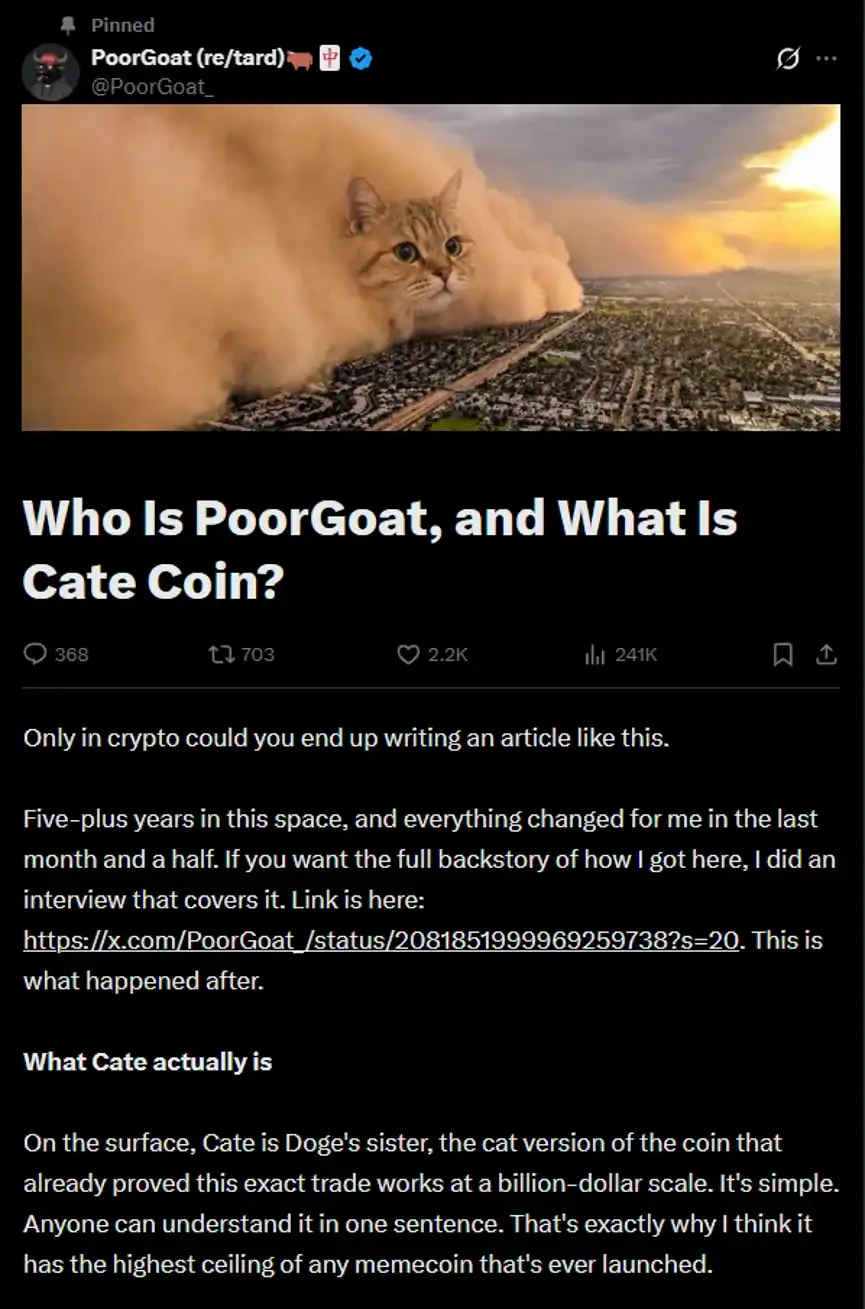
Yet, this "organic" coin, which still has over 60,000 holder addresses, was smashed down over 60% in one minute on less than $1.5 million in trading volume:

This is the harsh reality we're talking about. In the current market, any token that takes the old "organic" community-building route (excluding $SPX, $MOG, etc., which left a strong impression in the previous environment) may have a ceiling of just around $neet's current market cap of approximately $17 million. I won't go into too much detail here about why $neet is considered organic—just look at its price action over the past 460+ days, and it becomes clear:

Next, let's discuss why fomo has fallen into such controversy this time.
Fame Brings Trouble
Actually, earlier this year, when the 6,000x "Nietzsche Penguin" $PENGUIN brought fame to logjam, a trader who now has about $138,000 on fomo, everyone was quite appreciative of logjam's performance. At that time, logjam pocketed around $564,000 in profit from $PENGUIN, and no one doubted it—there was only recognition and well-wishes.
But then, following the "airdrop wealth creation" of $ANSEM—the pioneer of the small-circle airdrop tactic that pumps the coin's price, which originated with $unc—fomo began to face controversy. This was because many of those who received the airdrops were active KOLs on fomo. Their airdrop profits were amplified on fomo, allowing them to dominate the weekly and monthly leaderboards, effectively becoming living billboards for the airdrop coin. Gradually, some players began to suspect that fomo's data was manipulated, and that it was colluding with KOLs to run a scheme, all to attract more users to the app, and then letting the KOLs harvest users once the goal was achieved.
Whether or not insider schemes actually exist, as long as players can associate such narratives with a platform, it will inevitably draw their deep resentment—a fact that is also clearly demonstrated on BSC. Moreover, the most convenient explanation for $CATE's crash this time is "fomo went down"—not because people think the coin is highly correlated with fomo and that being unable to trade is a major bearish signal. Rather, the timing was too coincidental, leading people to believe it was a pretext to trap and liquidate many users trading on fomo.
Currently, $CATE still has over 60,000 holder addresses on-chain, while fomo shows more than 38,400 holder addresses for the coin—meaning over 60% of holders come from fomo. If this many addresses were batch-created by fomo itself, then it would be very difficult for fomo to escape suspicion of manipulation. If not, then it's the retail users on fomo who have been hurt the most.
Another highly controversial incident is that trader MarcellxMarcell, who has nearly 40,000 followers on fomo, "sold the top" when $CATE was around a $45 million market cap. Although users could still export their addresses and trade on-chain during the fomo outage, the community still questions: if you publicly bought in near a $30 million market cap, showing considerable confidence, why would you consider the fomo outage such a massive bearish event?
Recently, fomo's updated user terms explicitly state that it provides no guarantees regarding the security of user assets. However, to export a fomo address, users must log into the fomo website to retrieve their private key, and there are also questions about whether fomo's transmission of the private key to the page is adequately encrypted.

fomo's official explanation is that the outage was caused by overload due to a surge in users, but this is unacceptable to a significant number of players, because the trading volume during that 1-minute flash crash of $CATE wasn't particularly large. Dude, you raised $75 million in funding, and you got paralyzed by less than $5 million in trading volume within 5 minutes?
If users had consistently used on-chain trading terminals like gmgn, they wouldn't have suffered this kind of sudden, unavoidable loss.
Fame brings trouble, but the criticism fomo has faced during its rapid growth is not entirely without merit.