以太坊基金会已死,以太坊多元化组织当立


- 핵심 의견: 이더리움 재단(EF)은 내부 조직 분열과 인재 유출 위기를 겪고 있으며, 54명의 정리해고에 이어 프로토콜 지원 팀이 해체되고 최소 8명의 고위 직원이 사직했습니다. 동시에 Ethlabs, Ethereum Institutional과 같은 독립 비영리 기관이 부상하며 EF의 기능 일부를 수행하고 있으며, 미래에는 EF가 '생태계 마스코트' 역할로 물러날 수도 있습니다.
- 핵심 요소:
- EF는 6월 23일 새로운 구조를 발표하며 54명(구성원의 20%)을 정리해고하고 프로토콜 지원 부서를 공식 해체했습니다. 이는 'EF 설립 이래 최대 규모의 정리해고'로 간주됩니다.
- 전직 EF 연구원 5명이 비영리 연구개발 연구소 Ethlabs를 설립했으며, Joe Lubin, Consensys 등의 지원을 받아 이더리움을 글로벌 경제 결제 계층으로 발전시키는 것을 목표로 합니다.
- 전직 EF 멤버들이 설립한 Ethereum Institutional이 7월 1일 공식 출범했으며, 이더리움의 기관 수준 애플리케이션을 촉진하는 데 주력하고 Ethlabs 등과 협력하여 은행의 수요를 충족시킵니다.
- 전직 EF 공동 전무 이사 왕샤오웨이(Wang Xiaowei)가 사임했으며, 올해에만 최소 8명의 고위 직원이 떠나면서 인재 유출로 인한 조직적 혼란이 가중되고 있습니다.
- EF 보안 팀은 AI 에이전트를 배치하여 이더리움에 대한 레드팀 테스트를 실시했으며, 취약점(예: CVE-2026-34219)을 발견했습니다. AI는 보안 연구 방식을 변화시키고 있지만, 아직 인력을 완전히 대체하지는 못했습니다.
- Ethlabs 멤버들은 ETH가 5년 동안 5000달러를 돌파하지 못한 후에도 여전히 명확한 가치 서사가 부족하여 생태계 발전이 어려움을 겪고 있다고 지적했습니다.
Original|Odaily Planet Daily (@OdailyChina)
Author|Wenser (@wenser 2010 )
Last night, the Ethereum Foundation Protocol Support Team officially announced that the team had been dissolved. Prior to this, Wang Xiaowei, co-executive director of the Ethereum Foundation and regarded as "one of the representative figures of EF organizational reform," had also formally resigned. As of now, at least 8 senior personnel have left the Ethereum Foundation this year.
The other side of these organizational and personnel changes is the encroachment and functional replacement of the Ethereum Foundation by non-profit independent institutions like ETHLabs and Ethereum Institutional. It also reflects recent technical progress, such as the EF security team's use of AI agents for red-teaming the ETH network, which uncovered real vulnerabilities.
As ETH's price faces wave after wave of industry scrutiny, the Ethereum Foundation is confronted with more complex and diverse contradictions and tests following internal reforms, closely tied to the fragmentation and changes facing Ethereum's leading organization.
The Ethereum Foundation Enters an Era of Decline: Multiple Contenders, Talent Attrition, and the AI Upheaval
For a long time, the Ethereum Foundation (hereinafter referred to as EF) has been criticized for its rigid structure, minority decision-making, organizational value, and market-affecting sell-offs. Criticism from within the Ethereum community has been particularly intense. Not long ago, Bankless co-founder David Hoffman went so far as to express his dissatisfaction with the EF by "selling his last ETH position," calling on the Ethereum community to build the ecosystem in their own way.
Now, the formal dissolution of the EF Protocol Support Team has acted like a thunderclap, exposing the internal conflicts and fragmentation crisis within the EF organization to everyone. Notably, this round of organizational change is markedly different from the one initiated by Ethereum co-founder Vitalik last year—this is a thorough personnel purge, considered the "largest-ever round of layoffs since EF's founding," rather than just a change in some of the previous leadership.
When the Leader of the Ethereum Ecosystem Chooses to Cut Its Losses: The Full Story of the EF Layoffs
It all started with the "The New EF Structure" official announcement formally released by the EF on June 23.
In this lengthy, thousands-word article, the EF distinguished its new organizational structure into the Protocol Layer, Access Layer, User Layer, Community Layer, and Institution Layer, subsequently stating that "this organizational restructuring resulted in 54 layoffs, representing 20% of EF's members." Adding a slightly chilling note, the announcement began by mentioning: "Through this process, we have gained the structure, activities, and personnel needed to execute the critical tasks ahead." In other words, the laid-off personnel and departments were considered obsolete, unnecessary, and without value.
It must be said that the EF, long seen as a research organization and ecological leader with an academic temperament, has for the first time revealed the cold and ruthless side of its organizational management.
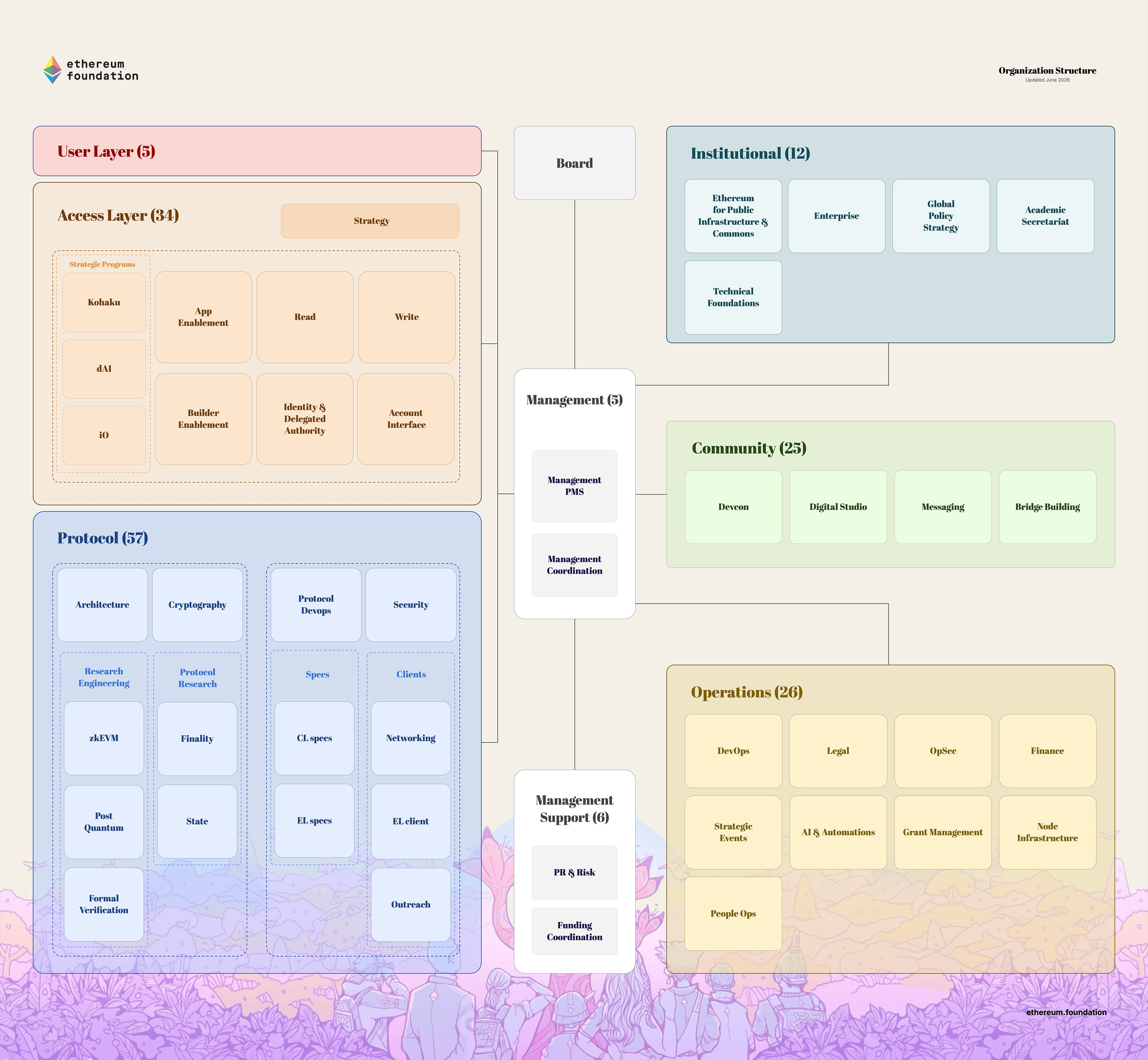
Schematic diagram of the new EF structure
Dissolution of the EF Protocol Support Department Marks a Key Symbol of EF Organizational Fragmentation
It's worth noting that the EF Protocol Support Department's work focused on infrastructure construction, mainly responsible for coordinating the Ethereum protocol development process, including organizing and coordinating core developer meetings, tracking Ethereum network upgrades, supporting EIP advancement, and running Ethereum protocols. Its primary functions have now been divided under the EF's Protocol Layer.
On the same day the EF announced its new structure, Ethlabs, a non-profit research and development laboratory co-founded by 5 former EF researchers, was officially launched. The organization aims to drive Ethereum to become the settlement layer for the global economy. It received support from a series of investment institutions, Ethereum ecosystem projects, independent individuals, and EF foundation members, including Ethereum co-founder Joe Lubin (Chairman of Sharplink, Consensys founder), ETH treasury company BitMine (Tom Lee's Ethereum treasury company), Sharplink, and crypto investment firm SNZ.
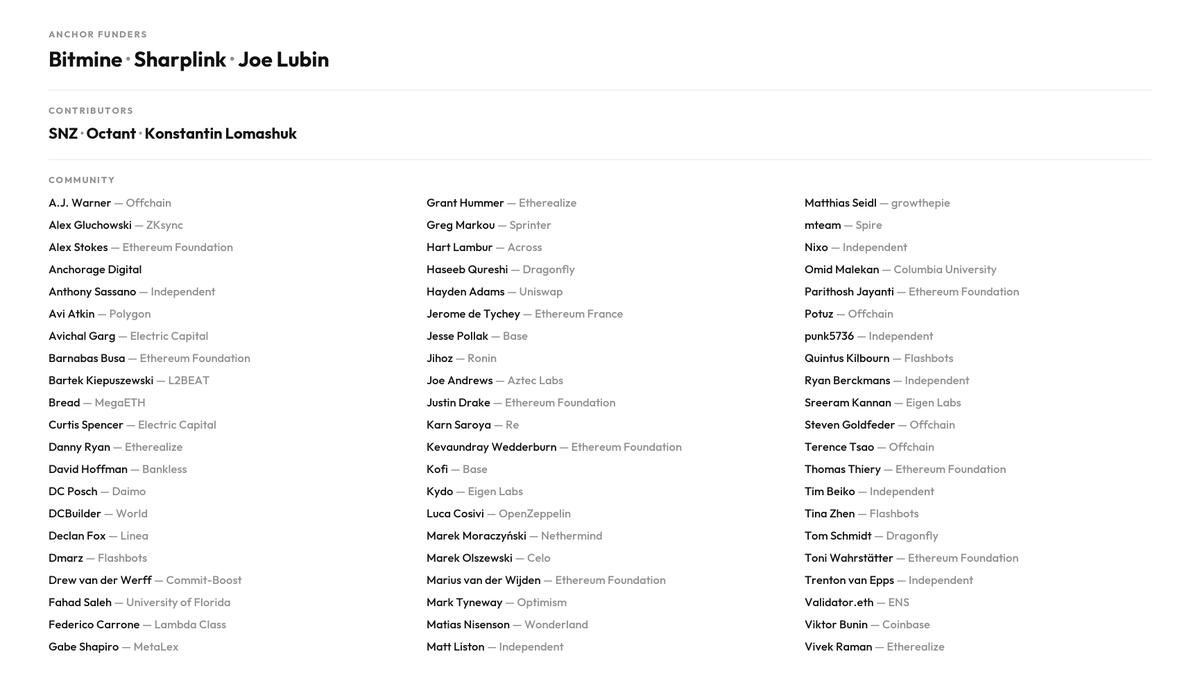
ETHLabs Community Participant List (Source: Official Account)
On July 1, Ethereum Institutional, co-founded by former EF members David Walsh, Marius Smith, and Matthew Dawson, was officially unveiled.
The organization's core concept is "Ethereum's Institutional Application Plan," dedicated to promoting the institutionalization and institutional-grade application of Ethereum, its secondary nodes, applications, and the entire ecosystem. The organization emphasizes its collaboration with Ethlabs, Etherealize, and the Enterprise Ethereum Alliance, handling institutional demand alignment and explaining Ethereum's value proposition to banks. Ethlabs, on the other hand, focuses on transforming related needs into technical products. As an independent non-profit institution, Ethereum Institutional provides free Ethereum application-related consulting for banks and asset management companies.
A week later, Ethereum Institutional announced the launch of core team recruitment, focusing on hiring for technical roles such as Institutional GTM, Marketing and Community Operations, Solutions Architecture, and Technical Project Managers in the coming weeks.
Thus, the EF layoff saga has formally concluded with the emergence of two major non-profit independent organizations and the dissolution of the Protocol Support Department, drawing an imperfect end to the "internal organizational reform" personally initiated by Vitalik last year. Besides the organizational fragmentation and the loss of high-level talent like co-executive director Wang Xiaowei, the EF also faces the impact of AI technology.
The Era of AI Offense and Defense Begins, EF Security Team Tests Upgrade
Yesterday, researchers from the EF Protocol Security Team stated in a blog post that they had deployed a series of AI agents to test software relied upon by the Ethereum ecosystem, searching for vulnerabilities in encryption systems, protocol codes, and smart contracts.
The vulnerabilities discovered by the AI agents include a remotely triggerable panic issue in libp2p gossipsub, the peer-to-peer layer used by Ethereum consensus clients. This issue has been fixed and disclosed as CVE-2026-34219 on Github.
Researchers stated that the AI agents were organized into specialized roles like reconnaissance, searching, patching, and verification, used to find potential attack paths, reproduce failures, and verify their applicability to production code. The EF stated that AI has not replaced security researchers but has changed the workflow, allowing the team to cover far more scope than manual review, while requiring researchers to exercise more careful judgment on a large number of seemingly credible conclusions.
In light of today's official launch of the GPT-5.6 model, the subsequent security maintenance of the Ethereum protocol may be jointly handled by AI models and EF security researchers. Furthermore, despite the EF's current statement that "AI has not replaced researchers," as AI models continue to develop and evolve, the EF security team and even the entire organization's personnel may be further reduced. In other words, the EF will also face the test of AI models on its organizational structure and its own functional performance.
Conclusion: EF Organizational Reform Concludes a Phase; Could Become an Ecosystem Mascot?
In January last year, we conducted a systematic analysis of the EF's organizational reform in the article "Vitalik Fires the First Shot of 'Reform', Where is the Ethereum Foundation Heading?". Back then, Vitalik was still ambitiously pushing for EF organizational reform. By May this year, after over a year of organizational innovation, Vitalik changed his tune, stating that "The Ethereum Foundation should not be the center of the ETH ecosystem; it will shift towards a small, long-termist path".
It must be said, with ETH having grown into a trillion-dollar asset, the EF, an official ecosystem organization established nearly 10 years ago, has entered an awkward state where "a large ship is hard to turn." No wonder Vitalik previously remarked— "I will no longer write regular blog posts and have decided to try writing some science fiction on the topic of decentralized governance."
As former EF researcher and Ethlabs member Ansgar Dietrichs said on a podcast earlier this month, "After failing to break through $5,000 in five years, ETH still lacks a clear value narrative."
As it stands, it is difficult for the EF to carry the banner of "revitalizing the Ethereum ecosystem and driving up the ETH price." Future mass adoption and institutional investment may only depend on organizations like ETHlabs, Ethereum Institutional, and Etherealize.
Perhaps, in the not-too-distant future, playing the role of an "ecosystem mascot" might be more suitable for the EF.
Recommended Reading
Ethereum Catches a 'Midlife Crisis', Analyzing Development Performance by Data
Known: ETH=Nokia, Find: Ethereum=iOS?
Ethereum is 'Sick', Are These Three Prescriptions the Cure?
Where is the Path? Analyzing the 3 Major Abstract Problems Facing the Ethereum Ecosystem
Enumerating Ethereum's Seven Deadly Sins, Who Can Play the 'Saving Symphony'?
Where Lies Ethereum Orthodoxy? Detailed Explanation of the 'Crypto Representative' in Vitalik's Mind
Are L2s a Detour for Ethereum?
Bankless Co-founder Liquidates ETH Holdings, Ethereum Faith Collectively Shattered