US Stocks Daily | Core PCE Plus Tariffs: Market Reprices for a December Rate Hike, Dow Rises Against the Trend, BTC ETF Records Nearly $5 Billion in Monthly Net Outflows (November 26)


- Key Takeaways: US October core PCE at 3.3% year-over-year beat expectations, Q3 GDP was revised up to 4.3%, and the "double-hot" data combined with Section 301 tariff proposals flipped the market narrative from a "December rate cut" to a "December rate hike," triggering sector rotation from AI long-duration assets into cash-flow assets rather than a broad risk-off move.
- Key Elements:
- Inflation has been above 3% for 10 consecutive months with no economic cooling, and both Yahoo Finance and the FT interpreted this as "a December rate hike remains on the table," marking the first complete transmission chain this cycle of "strong data → rate hike → dual sell-off in stocks and bonds."
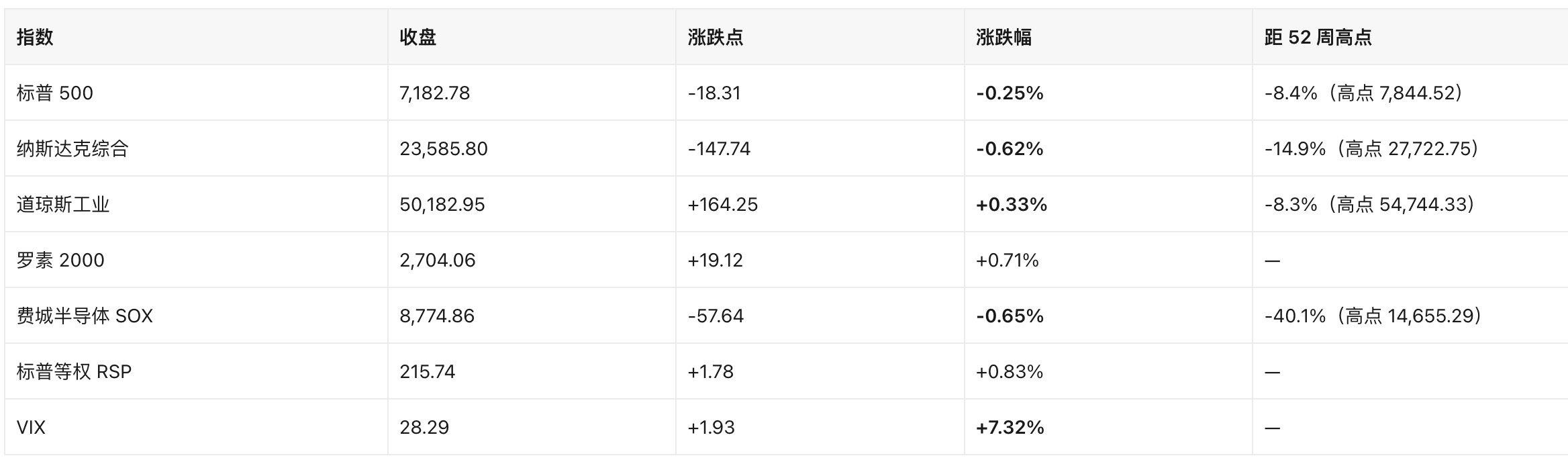
- The Dow fell as much as ~1,100 points intraday before closing up 164.25 points; the S&P was -0.25% and the Nasdaq -0.62%, but the Russell 2000 and equal-weight S&P (RSP +0.83%) rose, confirming sector rotation rather than systemic selling.
- Oracle fell 5.13% and its CDS hit a record high of 356bp; the market has begun pricing the "financing side of AI capex"—companies with cash flow are holding up while those reliant on debt expansion are being sold off, revealing credit stratification within the AI sector.
- BTC rebounded to $60,601.64 (+2.14%), but November spot ETF net outflows neared $5 billion—a monthly record—and Strategy's unrealized loss on its holdings reached $12.6 billion, making the divergence between price and fund flows a core contradiction.
- Crypto treasuries are showing "reverse spiral" signals: Next Technology sold 500 BTC to pivot into AI and received positive feedback, Bit Digital sold ETH to repay debt, and Ethereum treasury companies collectively reduced holdings; there were no new 8-K filings of companies establishing BTC treasuries this period.
- The 10Y yield fell 5.6bp against rate-hike expectations, with the bond market trading "growth damage" and the equity market trading "valuation compression"; the VIX rose 7.32% to 28.29, indicating increased hedging demand.
- Key time windows: MSCI's removal of Strategy on 11/30 triggers ~$2.8 billion in passive selling, and the 12/8–9 FOMC dot plot, if revised upward, will put secondary pressure on high-duration assets.
1. Top Stories
- October core PCE came in at 3.3% year-over-year (expected 3.2%), headline PCE at 3.8%; the same day, the second estimate of Q3 GDP was revised up to +4.3%—inflation has stayed above 3% for 10 consecutive months while the economy refuses to cool, directly flipping the "December rate cut" narrative into a "December rate hike," which served as the anchor for all asset pricing that day.
- The USTR proposed Section 301 tariffs on 14 economies, with China and the EU facing up to 20%—the proposal would take effect no earlier than January 25, 2027, but the "tariffs + hot inflation" combination forced the market to reprice stagflation risk, directly triggering the intraday plunge of roughly 1,100 points in US stocks.
- The Dow fell about 1,100 points intraday before closing up 164.25 points—the most dramatic intraday reversal of this cycle; the S&P closed at 7,182.78 (-0.25%) and the Nasdaq at 23,585.80 (-0.62%), while the Russell 2000 and the equal-weight S&P (RSP +0.83%) actually rose—this was not a broad risk-off, but a sector rotation from "long-duration AI" to "cash-flow assets."
- Oracle fell 5.13% (down as much as 8% intraday), with its CDS hitting a record high of 356bp, as the market began pricing the "financing side of AI capex"; Bloomberg reported that the Nasdaq 100 has entered bear market territory.
- Crypto: BTC rebounded from below 58,000 intraday to 60,601.64 (+2.14% over 24 hours), but November spot BTC ETF net outflows approached $5 billion, a monthly record, and Strategy's holdings carried an unrealized loss of $12.6 billion versus cost—the divergence between the price rebound and deteriorating fund flows is the core contradiction in crypto equities this cycle.
2. US Stock Market and Macro
2.1 Index Closes (16:00 ET, 2026-11-25)
Driving Logic (Event → Sector → Direction)
- ① Inflation and GDP "double hot" on the same day: the October PCE and second estimate of Q3 GDP released at 8:30 ET together pushed real rate expectations higher, with long-duration assets hit first;
- ② The tariff proposal landed in the same time window, reinforcing "second-round inflation" concerns;
- ③ Pressure on the AI financing side surfaced: Oracle's CDS hit a record 356bp and Nebius fell 12% intraday; one strategist said outright that capex is "as good as it gets," with capital rotating out of AI hardware into financials, industrials, and energy;
- ④ The intraday reversal stemmed from valuation-recovery buying + pre-Thanksgiving short covering, not from improved fundamentals—the VIX still rose 7.32% to 28.29, indicating rising hedging demand.
Sector Performance (11/25): XLK -0.83%, XLV -0.56%; XLI +0.83%, XLE +0.74%, XLF +0.71%, XLP +0.46%. Tech was the only heavyweight sector to decline, corroborating the "equal-weight index outperformed the cap-weighted index by 1.08 percentage points" observation.
2.2 Macro Data (Released 8:30 ET, 11/25, BEA Original Text)
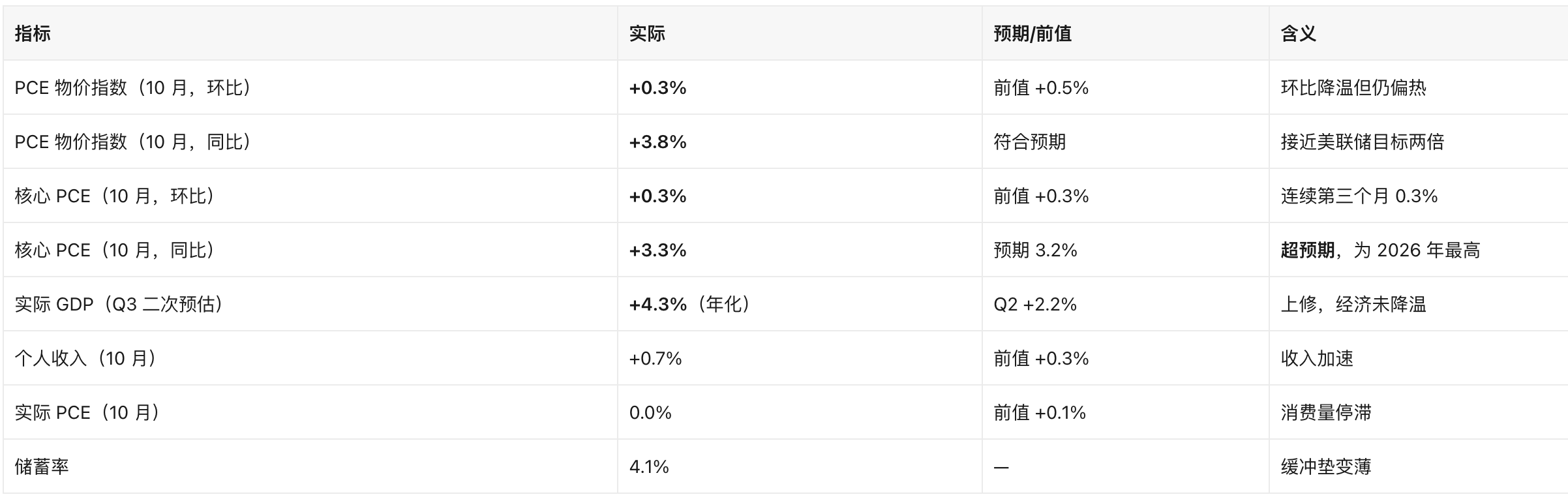
Market Interpretation: Yahoo Finance wrote directly that "the inflation data cemented a December rate hike, and possibly more next year"; FT said the GDP upward revision "keeps a December hike on the table"; Reuters noted that "policymakers at odds" over the causes of high inflation. This is the first time in this cycle that the full transmission chain of "strong data → rate hike → stocks and bonds both fall" has played out.
2.3 Rates, Dollar, and Commodities (11/25 Close / Post-Close ET)
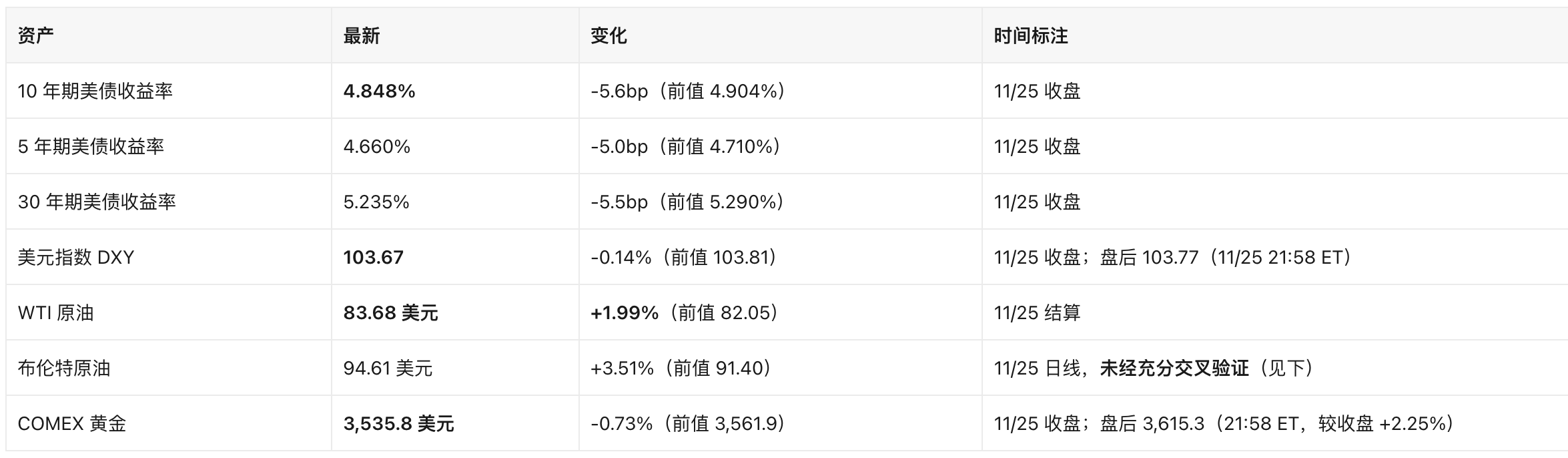
- Rates and stocks falling together was the day's biggest "anomalous signal": rising rate-hike expectations should have pushed yields higher, yet the 10Y fell 5.6bp instead, indicating that safe-haven buying and "AI credit risk" outweighed inflation pricing—the bond market is trading "damaged growth," while the stock market is trading "valuation compression."
- Gold dipped to 3,425.2 intraday (a near 15-month low) before rebounding to 3,615.3 after the close: Bloomberg said the tariff plan "reinforced rate-hike bets," weighing on gold, but post-close safe-haven and inflation-hedge demand bought it back, with direction yet to converge.
- Crude: WTI closed at 83.68 (+1.99%), Brent daily at 94.61 (+3.51%), consistent with media reports that "Brent surges 3.5%"; the driver was Yemen's Houthis claiming attacks on Saudi Arabia's Ras Tanura refinery and ships in the Strait of Hormuz. However, the hourly Brent series only rose to about 90.8 over the same period, and overnight front-month quotes fell back to 90.67—a $4 gap between the two readings, suspected to be a contract rollover splicing discrepancy; the official ICE settlement price was unavailable, so this figure is cited with caution in this report.
3. Hot Stocks and Sectors
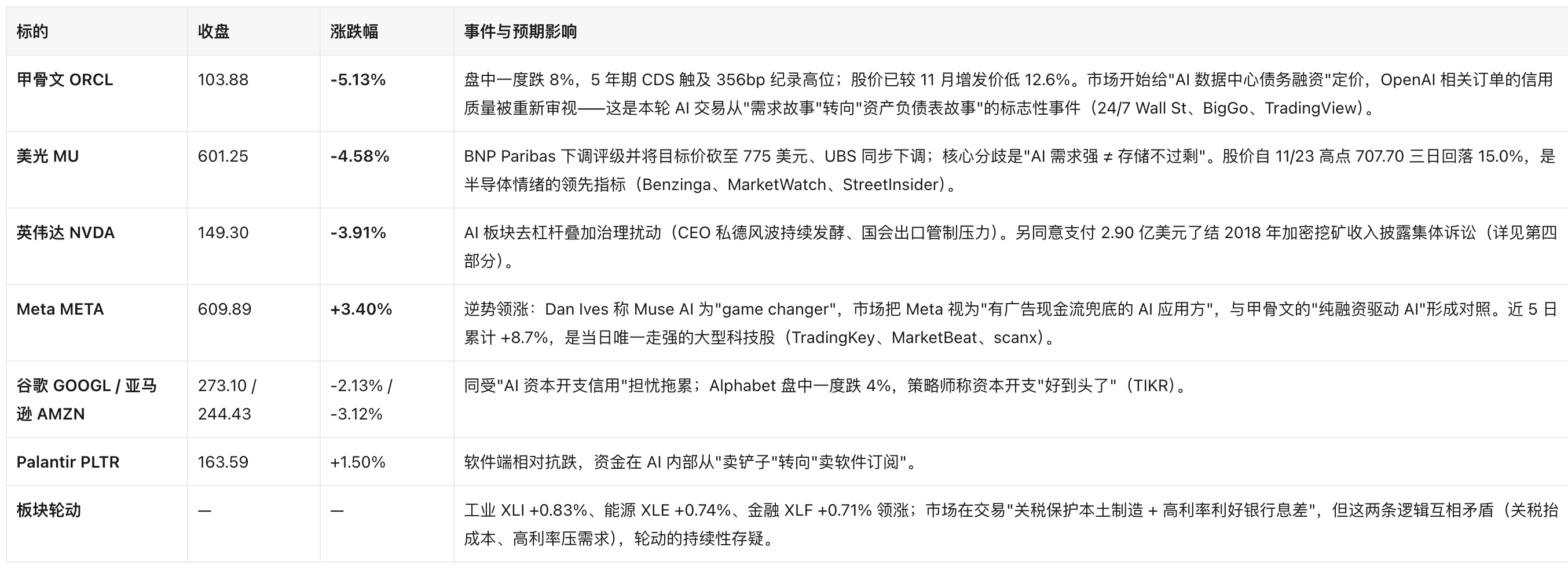
Interpretation: What happened today was not an "AI bubble burst" but rather credit stratification within the AI sector—companies with cash flow (Meta, Palantir) held up, while those expanding via debt financing (Oracle, Nebius) were sold off. This dividing line matters more than index levels.
4. Crypto-Related US Stocks
4.1 DAT Company Developments
Strategy (MSTR)—Purchases Nearly Stalled, Pivoting to Protect Preferred Stock
- From 11/16–11/22, it added only 457 BTC, worth $29.6 million, at an average price of $64,898; as of 11/22, holdings stood at 851,305 BTC, with a cumulative cost of $64.23 billion and an average price of $75,446.
- Based on BTC's close of 60,601.64 on 11/25, the holdings' market value was $51.59 billion, an unrealized loss of $12.64 billion versus cost; the company's market cap was $33.77 billion, i.e., market cap / holdings market value = 0.65x (scope: common stock market cap only, excluding debt, preferred stock, and cash), with the discount persisting.
- Financing and buybacks: during the week, it sold 1.9257 million MSTR shares through its ATM, raising net proceeds of $176.7 million, of which $29.6 million was used to buy BTC and the rest to repurchase STRC; it repurchased 2,183,747 shares of STRC preferred stock for $211.8 million; the digital credit securities repurchase authorization was raised from $3 billion to $4 billion, with $1.12 billion remaining; the MSTR common stock repurchase authorization has $1 billion remaining; the MSTR common stock ATM has $17.92 billion remaining (potential dilution pressure).
- Market narrative: reports said "Strategy paused purchases to shore up cash reserves," consistent with its move to convert $1 billion from the USD Reserve into cash—switching from "buying BTC indefinitely" to "protecting dividends and credit."
- Stock price: $79.96, +3.11%, just 13.6% above the 52-week low of $70.37 and 59.7% below the 52-week high of $198.40.
- Near-term hard constraint: under its new "non-operating company" rule, MSCI will remove Strategy from its global indexes, and passive funds must sell by 11/30; media estimates put the scale at about $2.8 billion (not confirmed by MSCI).
Bitmine (BMNR)—ETH Treasury Losses Exceed $10 Billion Yet Still Pays Dividends
- Holds 6.09 million ETH, with crypto assets plus cash and equivalents totaling $11.1 billion; at ETH 1,694.68, the ETH holdings are worth about $10.32 billion, consistent with the announcement's figures.
- Unrealized ETH losses exceed $10 billion, yet it still declared a cash dividend of $0.01 per share.
- Stock price: $13.44, +1.97%.
- Background: Ethereum treasury companies as a group have entered a "selling" phase; Bit Digital sold 29,825 ETH to repay $50 million to Galaxy.
Exits (the most important structural signal this period)
- Next Technology Holding (NXTT): on 11/21, it sold 500 BTC at an average price of $58,468, raising $29.22 million, leaving 5,333 BTC; the announcement explicitly stated it "does not currently expect to buy more BTC," with proceeds redirected to AI software R&D. Stock price: $3.61, +8.08%—the market gave positive feedback to "selling BTC to pivot to AI," a useful pricing reference for similar companies going forward.
4.2 New Additions to the Crypto US Stock Watchlist
- SVRN (OceanPal): on 11/24, it completed a PIPE funded with NEAR tokens to launch a new crypto treasury strategy. It is a third-generation crypto treasury not based on BTC/ETH, small in scale with limited disclosure, listed for observation only and not as a trading reference.
- No 8-K from a US-listed company "first announcing the establishment of a BTC treasury" was found this period: a full-text search of SEC EDGAR 8-K filings from 11/23–11/26 found no new buyers. The new direction has reversed from "corporate entry" to "corporate exit" (NXTT selling, Bit Digital selling ETH, Ethereum treasury companies collectively reducing holdings)—this is the most noteworthy shift in framing this period.
4.3 Broad Crypto US Stocks (11/25 Close)
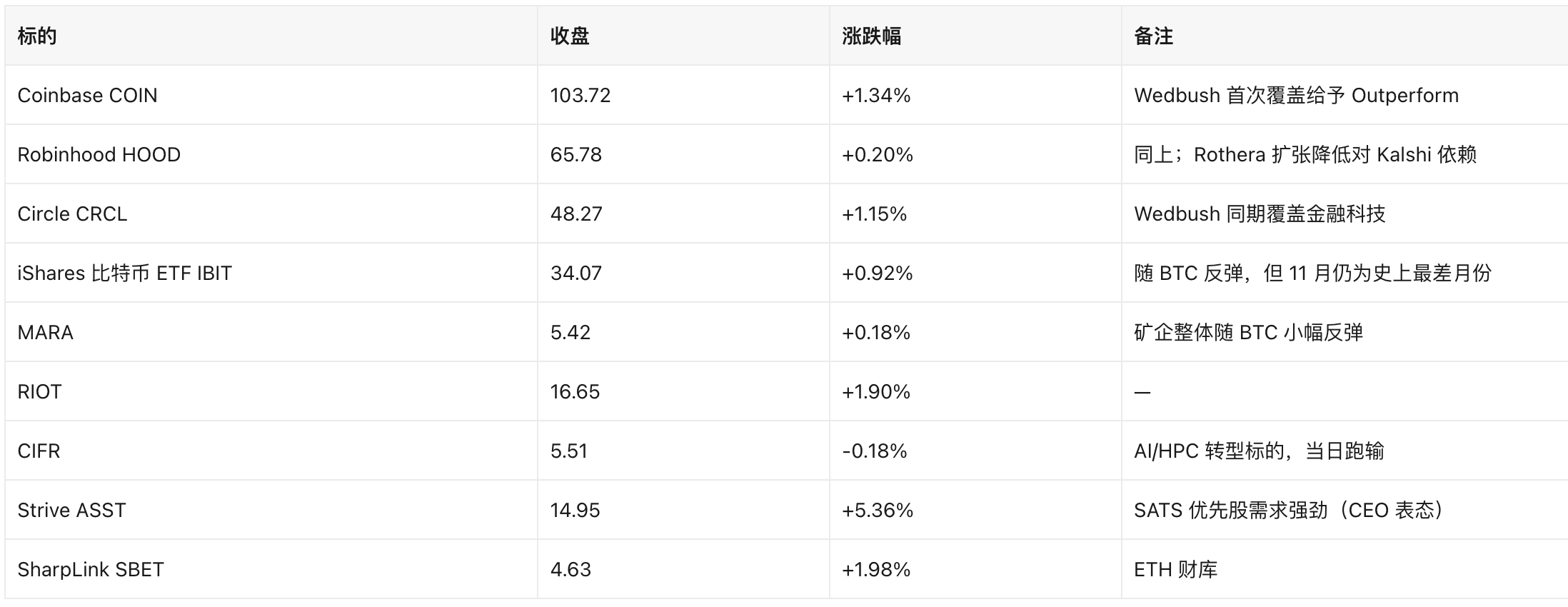
- ETF fund flows (within 3 trading days): US spot BTC ETF cumulative net outflows in November totaled nearly $5 billion, a monthly record; single-day net outflows on 11/24 were $570 million, the sixth consecutive trading day of net outflows. Official single-day net flows for 11/25 were not yet available and are not estimated here.
- Product and compliance actions: Fidelity filed for a spot Chainlink ETF; Franklin Templeton added HYPE to its crypto ETF; CFTC staff issued guidance on expense-charging requirements for BTC/ETH ETFs.
- NVIDIA (NVDA) agreed to pay $290 million to settle a 2018 investor class action alleging it understated the contribution of crypto mining to gaming GPU revenue in 2017–2018.
4.4 Regulatory and Accounting Drivers
- The US House Financial Services Committee advanced the "Strategic Bitcoin Reserve Act"; The Block said "the path to passage is narrow"—if enacted, it would be a valuation re-rating event for corporate BTC holders, but it is currently only procedural progress.
- Senators Warren and Van Hollen led calls to repeal the SEC's Regulation Crypto and innovation exemptions—regulatory directions are still colliding, and policy uncertainty has not eased.
- Ukraine passed a law legalizing and taxing the crypto market, effective July 2027; the Hong Kong Monetary Authority launched a tokenized debt securities platform; UniCredit offered principal-protected BTC exposure to Italian retail clients.
5. Crypto Market Background (Context for the Previous Section Only)
- BTC: $60,601.64, +2.14% over 24 hours; it fell below 58,000 intraday and is 9.9% above the 52-week low of 55,149.57.
- ETH: $1,694.68, +1.96% over 24 hours; Ethereum's decline exceeded BTC's, with CoinDesk noting that "BTC held up relatively well amid the stock selloff."
- Month-to-date in November, BTC has fallen more than 25%, with altcoins led lower by Hyperliquid; CoinShares research head Butterfill said it may be in the "tail end of a bear market."
- Correlation with US stocks: BTC and the Nasdaq are both high-duration assets, but they moved in opposite directions that day (Nasdaq -0.62%, BTC +2.14%), indicating that crypto has already completed its deleveraging and short-term correlation has declined; what truly moved in sync were "crypto US stocks"—squeezed simultaneously by coin prices and equity risk appetite.
6. Geopolitical Impact
1. The US proposed Section 301 tariffs on 14 economies (China and the EU up to 20%, India up to 25%, with a separate 17% negotiating offer)
- Transmission: higher import costs → sticky core goods inflation → reinforced December rate hike → further valuation compression for high-duration assets (AI, crypto); simultaneously a positive for domestic manufacturing and some industrial goods.
- Key mitigating factor: Flexport and other institutions confirmed that "it will not take effect before January 25, 2027," as it is in the proposal and comment period and not immediately effective; the day's selloff was more a "repricing of expectations" than a "cash-flow shock."
- Uncertainties: the pace of retaliation from the EU and China; whether US retailers (Walmart came under pressure that day) can pass on costs.
2. Yemen's Houthis claimed attacks on Saudi Arabia's Ras Tanura refinery + ships in the Strait of Hormuz
- Transmission: higher Brent risk premium (+3.51%) → gasoline/diesel crack spreads → transport and chemical costs → inflation expectations ticking up again. OilPrice noted that "oil traders are ignoring Persian Gulf supply threats," indicating the market views it as a short-term disruption rather than a structural supply cutoff.
- Direction: higher oil prices are positive for energy stocks (XLE +0.74% already confirmed) and negative for airlines, transport, and consumer sectors; the impact on crypto is indirectly negative via "inflation → rate hike."
3. A US-backed consortium signed an agreement to acquire Lukoil's overseas assets
- Transmission: restructuring of Russian crude flows → possibly increasing non-OPEC supply in the medium term → bearish for oil prices, though overshadowed in the short term by Middle East risks.
4. Russia-Ukraine: Ukraine passed a crypto legalization and taxation law (effective July 2027)
- Transmission: provides a template for crypto compliance in Eastern Europe, positive in the medium to long term for compliant trading platforms and stablecoin payments, but the scale and timeline are both distant.
7. Key Focus Today (Next 24–72 Hours)