Saving the Nasdaq! "Big Short" Burry Turns Bullish: Short Positions Nearly Wiped Out, a Quarter of Holdings in Cash to Prepare for Bottom-Fishing


- Core View: Michael Burry cleared out his Nasdaq 100 put options during the tech stock selloff, shifting his positioning from short to leaning long—his most bullish stance in recent memory—but stressed that the stance is "temporary" and that he is still evaluating short opportunities.
- Key Elements:
- About 25% of the portfolio is in cash and actively being deployed into the market, with only Palantir and MetLife put options retained and the rest "almost entirely long."
- He holds out-of-the-money Nvidia call options bought last Friday, which have already doubled; he plans to short again once the stock approaches $200 and market optimism heats up.
- Major long positions include Latin American e-commerce company MercadoLibre, Australia's Temple & Webster and JD.com, as well as individual stocks such as Adobe, PayPal and Lululemon.
- Why the put option strategy failed: rising VIX and market declines made put options on AI-related resilient companies nominally expensive, making direct shorting of common stock the primary tool for expressing bearish views.
- The position adjustment synchronized with the Nasdaq 100 narrowing its intraday loss after falling more than 4.7%, reflecting professional investors' risk rebalancing amid the retreat of the AI trade.
Original author: Yang Chen
Original source: Wallstreetcn
Investor Michael Burry, known for shorting US real estate in 2008, adjusted his portfolio positions during this round of tech stock selloff. After closing out his put options on the Nasdaq 100, his overall positioning has shifted from short to net long—his most bullish stance in some time.
In a post on his Substack column "Cassandra Unchained" on Wednesday morning, Burry said: "Globally, my portfolio is more long and less short than it has been in some time."
He added that, aside from put options on Palantir and MetLife, he is currently "for the time being almost entirely long." The "for the time being" qualifier is because he is still continuously evaluating short opportunities.
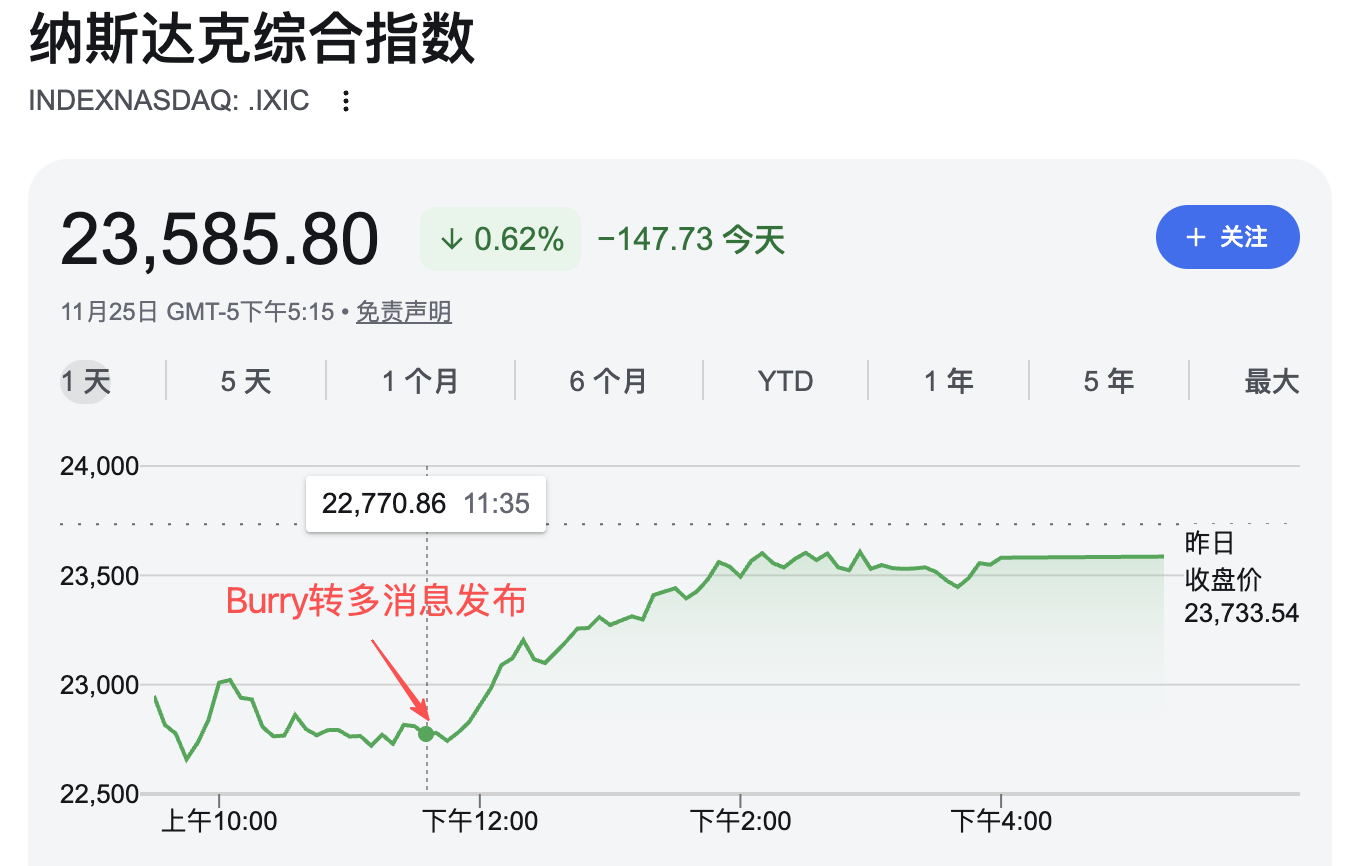
By Wednesday midday, US stocks pared their losses with trading volume rising, indicating growing investor interest in unwinding some bearish stock positions. The Nasdaq 100 fell more than 4.7% at one point before cutting losses by roughly half; the Dow Jones Industrial Average briefly turned positive.
The timing of this rebound coincided almost exactly with news that Burry had sold his remaining tech put options.
Cash at roughly 25%, still holding Nvidia call options bought last Friday
Burry disclosed that about 25% of his portfolio is in cash, and he is actively deploying those funds into the market.
He also holds Nvidia call options purchased last Friday. "These options are far out of the money; I only spent a few dollars to buy them. They've already doubled, and I haven't decided how to handle them," he said. "My plan is to short Nvidia again when the stock approaches $200 per share, during a period of rising market optimism. Now is not the time."
Major holdings revealed: Latin American e-commerce and Chinese ADRs included
Burry's larger disclosed positions include MercadoLibre Inc., Temple & Webster Group Ltd., and JD.com Inc.
He also holds shares in Adobe Inc., Birkenstock Holding Plc, Deckers Outdoor Corp., Molina Healthcare Inc., HCA Healthcare Inc., Lululemon Athletica Inc., Fiserv Inc., Veeva Systems Inc., PayPal Holdings Inc., and Build-A-Bear Workshop Inc.
In addition, Burry holds junior preferred shares of Fannie Mae and Freddie Mac, preferred shares of QXO Inc., and multi-year LEAP call options on Sprouts Farmers Market Inc. and Zoetis Inc.
Market impact: portfolio rebalancing as the AI trade fades
Burry explained why the put option strategy has become ineffective in the current environment.
He noted that with the VIX elevated and the market falling, even the put options of solid companies with only a tangential connection to AI infrastructure carry very expensive notional prices. "This makes directly shorting common stock the primary tool for expressing bearish views at present.
Despite the low cost, the asymmetry of shorting stocks is in the wrong direction," he wrote. The assets in which he currently holds long positions include "undervalued common stocks, LEAP call options, and preferred shares."
Burry's position adjustment comes amid a significant drawdown in tech stocks. The Nasdaq 100 touched bear market territory intraday, reflecting deepening doubts about the sustainability of the AI-driven rally.
For investors, Burry's moves offer a window into how professional investors reconfigure risk when volatility intensifies: elevated put option costs undermine hedging efficiency, while direct shorting is uneconomical under asymmetric risk—prompting some capital to rotate into undervalued individual stocks and long-dated options.
Burry made clear that his current bullish stance is "temporary," and short opportunities remain under evaluation.
He cited a reference price of $200 per share for shorting Nvidia again, contingent on waiting for a window of resurgent market optimism. This conditional setup suggests he does not believe the current decline is over, but is waiting for a better entry point to short.