US Stocks Daily | Philadelphia Semiconductor Index Plunges 7.9% in a Single Day, Nvidia Gives Back 5.9%, Bitcoin ETF Monthly Outflows Exceed $4.7 Billion (November 25)


- Key Takeaways:The market is shifting from "AI narrative pricing" to "real interest rate pricing." The SOX's 33.2% drawdown from its high marks the collapse of the crowded AI long trade, with capital rotating from long-duration assets to assets with certain cash flows. Crypto assets are being squeezed by record ETF redemptions and shrinking DAT financing.
- Key Elements:
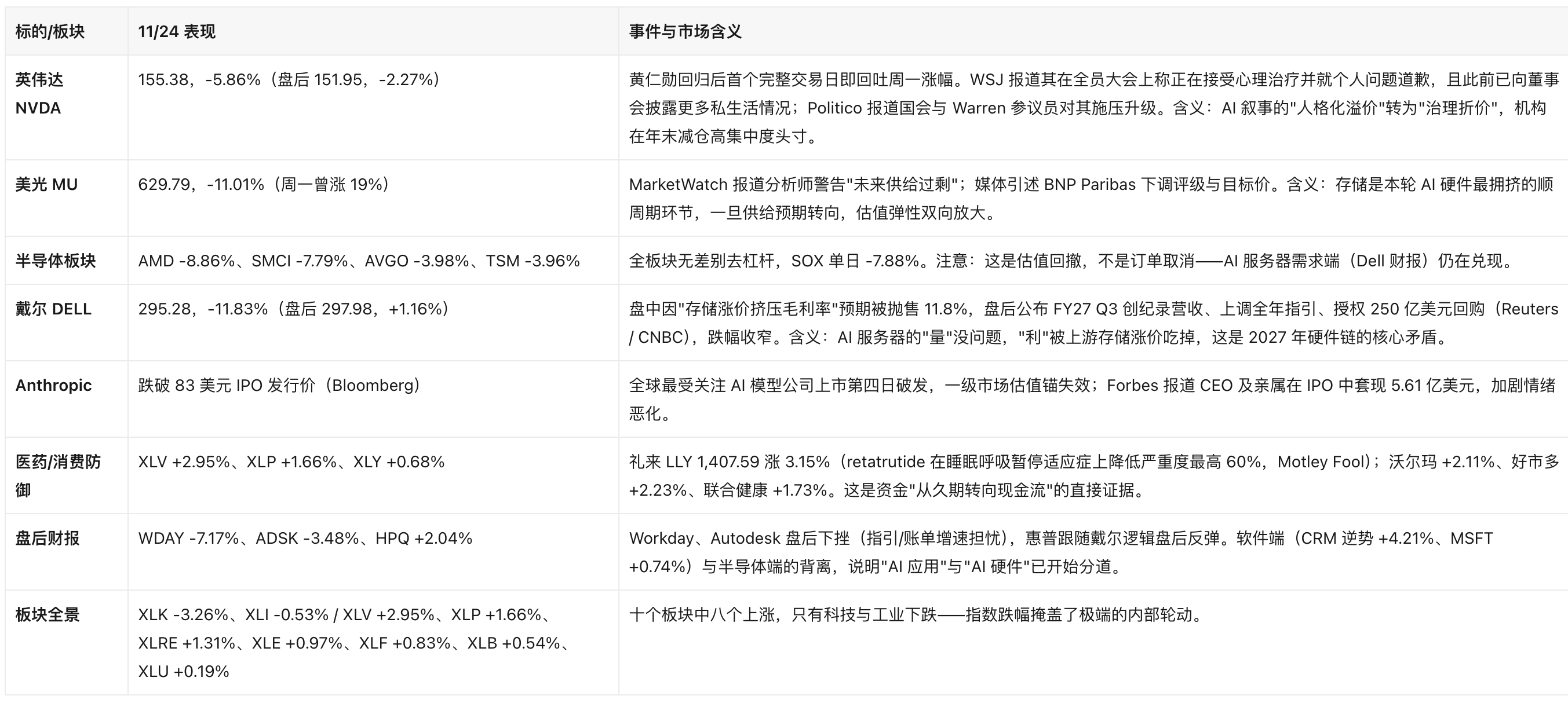
- The Philadelphia Semiconductor Index fell 7.88% in a single day, bringing its cumulative drawdown since October 6 to 33.2%; Nvidia fell 5.86%, and governance discount is beginning to be priced in.
- Anthropic broke issue price on its fourth trading day, invalidating the pricing anchor of the AI primary market and serving as the psychological trigger for the tech selloff.
- The Dow bucked the trend to rise 0.85%, led by healthcare +2.95% and consumer staples +1.66%, indicating sector rotation rather than broad risk-off.
- U.S. spot Bitcoin ETFs saw net outflows of $4.71 billion in November, a single-month record; BTC traded at $59,223.5, just 7% above its 52-week low.
- Strategy holds 851,300 coins with unrealized losses of $13.81 billion; mNAV discount stands at 35.1%, the positive feedback loop of issuing shares to buy coins has failed, and the company is shifting to repurchasing preferred stock to repair credit.
- ETH treasury deleveraging: BTCS sold 27,300 ETH to repay Aave debt, creating a negative feedback loop of "price drop—sell coins—further drop."
- The probability of a December rate hike is 88%, with the benchmark converging to 25bp; long-end yields barely moved, confirming this is risk premium repricing rather than recession trading.
1. Top Stories
- The Philadelphia Semiconductor Index (SOX) fell 7.88% in a single day, the most violent one-day reversal since the AI trade began—Monday's 6.5% Nasdaq rebound driven by "Jensen Huang's return" was fully erased. Chip stocks have been the most crowded long trade in US equities over the past two months. The SOX has retraced 33.2% cumulatively from its October 6 high of 13,217.8, and index-level deleveraging is still underway.
- Nvidia closed down 5.86% and fell another 2.27% after hours—CEO Jensen Huang apologized at an all-hands meeting over personal conduct issues and disclosed more details to the board. Combined with Politico's report of mounting congressional pressure over China export-control hearings, a "governance discount" is starting to be priced in.
- Anthropic fell below its IPO price on its fourth trading day—the last pricing anchor in the AI primary market has failed, and the money-making effect of AI IPOs has reversed, which is one of the psychological triggers for this tech selloff.
- The Dow rose 0.85% against the trend, led by healthcare (XLV +2.95%) and consumer staples (XLP +1.66%)—this is not a broad risk-off, but a sector rotation from "long-duration AI assets → cash-flow-certain assets," and also the key point of divergence for judging the depth of any further decline.
- Crypto assets and crypto-linked US stocks broke down in tandem: BTC at $59,223.5 (-1.30% over 24 hours), just 7% above its 52-week low; Strategy closed at $77.55, a new 52-week low; US spot Bitcoin ETFs saw net outflows of $4.71 billion in November, a single-month record.
2. US Equity Market and Macro
2.1 Index Closes (US Eastern Time, 16:00, 2026-11-24)
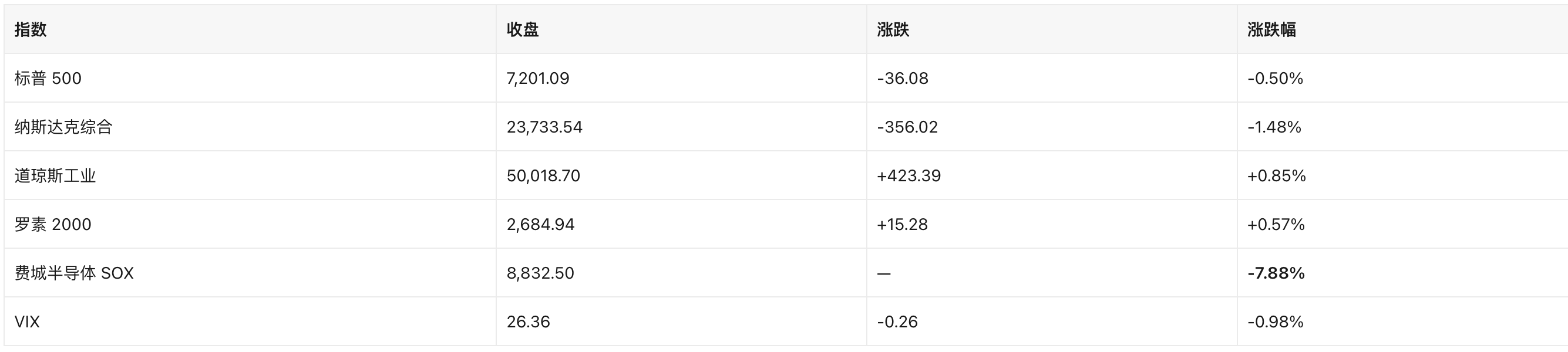
Driving logic: Monday's rebound was driven by "Jensen Huang's return + White House endorsement" (Nasdaq +6.5% in a single day), which was sentiment repair rather than an improvement in liquidity; the trigger chain for Tuesday's giveback was:
① Anthropic's break below IPO price loosened the AI valuation anchor; ② Nvidia governance news weakened institutional confidence in holdings; ③ Micron's rating downgrade exposed the structural contradiction of "strong AI demand but excess memory supply"; ④ December rate-hike expectations pushed up real rates, directly compressing valuations of high-duration assets.
The VIX only edged down to 26.36 (without breaking Monday's low), indicating that the market is buying protection rather than in full-blown panic—consistent with the judgment of "rotation" rather than "crash."
Medium-term positioning: The S&P is 8.2% below its 52-week high of 7,844.52, the Nasdaq is 14.4% below its high of 27,722.75, the SOX is 33.2% below its October 6 high, and the Russell 2000 is 12.5% below its 52-week high. At the index level, the S&P remains in its year-to-date high range, but its leadership structure has been broken.
2.2 Macro Data (Released US Eastern Time 11/23–11/24)
- CB Consumer Confidence (November): 103.3, expected 92.4, previous 91.9, the highest in nearly two years. The backdrop is a sentiment recovery after the Democrats won the midterm elections, but CNBC noted that inflation concerns remain. Implication: the "soft data" on demand does not support a recession narrative, but rather weakens the case for rate cuts.
- November Markit Composite PMI preliminary 54.6, expected 55.6, previous 55.9; manufacturing 54.5 (expected 54.5), services 54.7 (expected 55.6)—expansion but weakening at the margin.
- Richmond Fed Manufacturing Index +3 (expected -2, previous -2), a recovery in regional manufacturing.
- Home prices: FHFA Home Price Index 0.0% month-over-month (expected 0.2%); S&P/CS 20-City seasonally adjusted +0.1% month-over-month, +2.6% year-over-year (expected 2.7%)—home price momentum is flattening.
- ADP weekly employment +21.0K (previous +23.8K), the labor market is cooling slowly but not stalling.
- On Monday (11/23), Fed's Williams: inflation is still "too high", and rates need to remain restrictive "for some time," the direct source of this week's hawkish pricing.
2.3 Rates, the Dollar and Commodities
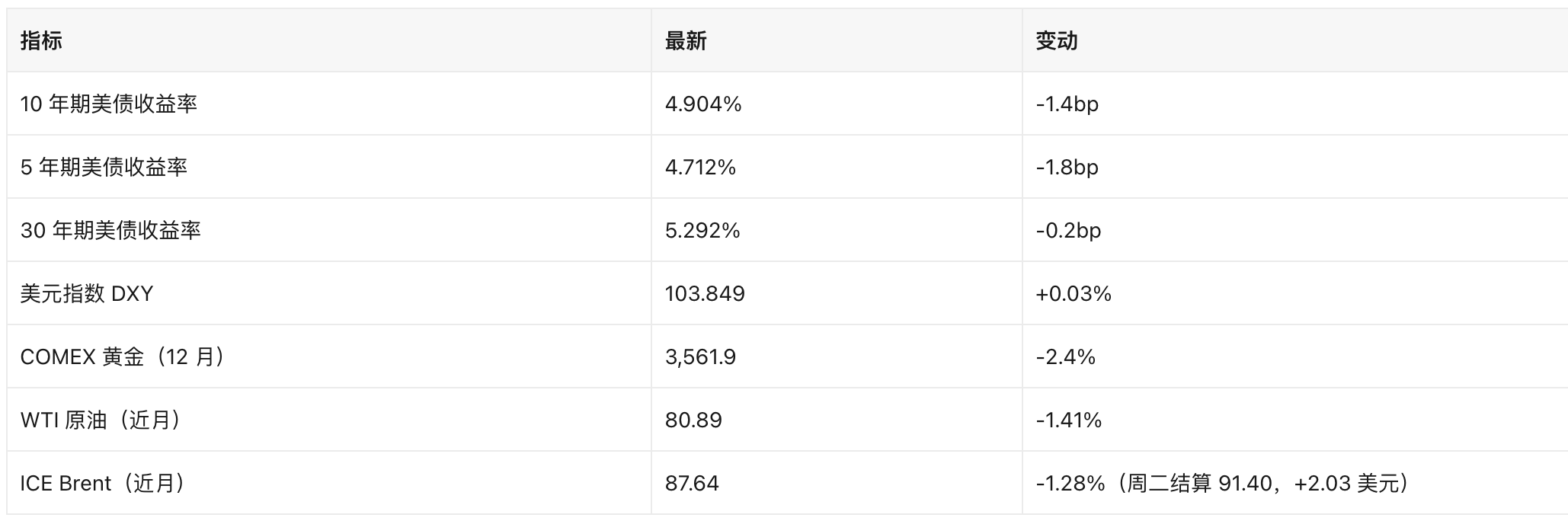
Key points: Long-end yields barely moved during the crash-style decline (10Y only -1.4bp), indicating that this is not a "recession trade" but "high real rates + risk premium repricing." Gold falling 2.4% also confirms that funds did not flow into safe-haven assets, but into cash and the short end. The December 8-9 FOMC (including the quarterly SEP) is currently priced by the market as a "rate hike": CME FedWatch showed an 88% probability of a December hike after the November 10 CPI; CoinDesk reported on 11/23 that traders had abandoned bets on a "50bp hike," with the baseline converging to 25bp. If the 11/25 core PCE comes in above expectations, this pricing will be further locked in.
3. Hot Stocks and Sectors
4. Crypto-Linked US Stocks
4.1 DAT Leader: Strategy (MSTR)
Daily quote: $77.55, -8.12%, breaking below the previous 52-week low of 77.69, a new 52-week low; market cap $32.696 billion, 52-week range 198.40 / 77.69.
Holdings and cost basis (SEC 8-K, filed 2026-11-23, data as of 11/22):
- 11/16–11/22 added 457 BTC for $29.6 million at an average price of $64,898;
- Cumulative holdings 851,305 BTC, cumulative cost $64.23 billion, average price $75,446;
- Based on BTC's closing price of $59,223.5 on 11/24, holdings are worth $50.42 billion, with unrealized losses of $13.81 billion (-21.5%);
- Simple calculation (equity market cap ÷ holdings value) = 0.65, i.e., the stock trades at a 35.1% discount to the net asset value of its holdings (before deducting convertible bonds and preferred stock, so this is an upper-bound figure; Yahoo Finance also reported the same day that it trades "at a discount to book value").
Financing actions (same 8-K):
- ATM issuance: sold 1,925,676 MSTR shares during the week for net proceeds of $176.7 million, but only $29.6 million of that was used to buy bitcoin, with the rest used to repurchase STRC;
- The digital credit securities repurchase authorization was raised from $3 billion to $4 billion, with $1.12 billion remaining as of 11/22; STRC repurchases during the week totaled $211.8 million;
- USD reserves of $3.73 billion + USD cash of $1.09 billion.
Signal interpretation: When the stock price is below the net asset value of holdings (mNAV < 1), the positive-feedback model of "issuing shares to buy bitcoin to increase bitcoin per share" fails—issuance dilutes rather than accretes. The company therefore prioritizes using raised funds to repurchase high-yield preferred stock (STRC) to lower leverage costs; this week's bitcoin purchases ($29.6 million) were only 1/7 of the preferred stock repurchases ($211.8 million). This is the most important structural change in the DAT model this cycle, and also the turning point for MSTR from a "premium arbitrage machine" to "credit repair."
4.2 New Entrants and Transformations
- No new faces meeting the criteria of "first-time bitcoin purchase announcement / DAT transformation" this period (past 24-48 hours), so there are no additions to the "crypto US stock watchlist" this period. CoinDesk, The Block, Decrypt, Bitcoin Magazine and Google News aggregation were searched, and no cross-verifiable first-purchase announcements were found.
- Developments among existing DATs:
- Twenty One Capital: added 172.25 BTC, holdings of 43,841 BTC (reported 11/23);
- Strive (ASST): zero additions last week, holdings maintained at 43,404 BTC, closed at $14.19 -8.27%—the stock's high beta to the coin price remains;
- ETH treasuries begin deleveraging (the most important new risk this period): BTCS sold 27,300 ETH ($43.8 million) to repay Aave debt, with the CEO calling it "not reckless" (CoinDesk 11/24); separately, CoinShares liquidated its ETH and cut half of its SOL holdings for $19.3 million. Implication: DeFi leverage in ETH treasuries is forced to sell coins when market conditions deteriorate, creating a negative feedback loop of "decline → insufficient collateral ratio → sell coins → further decline," which is the structural reason why ETH is weaker relative to BTC.
- Watchlist flag: Trump Media (DJT) closed at $3.65 -6.05%, and its $884 million convertible bonds mature on 11/30 (FT); the company has warned it may sell some bitcoin to repay debt—this is the clearest "forced selling" event window in the next five trading days.
4.3 Broad Crypto US Stocks
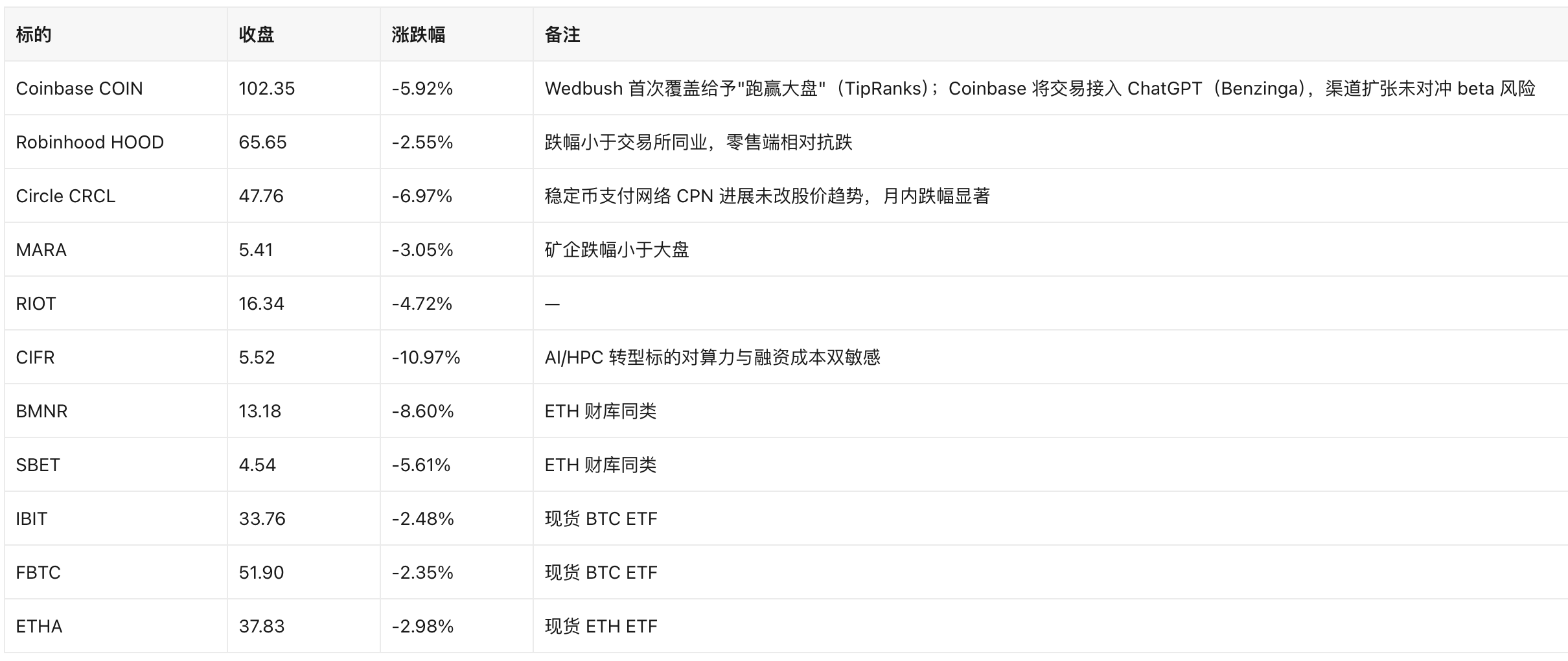
ETF fund flows (key):
- US spot Bitcoin ETFs have seen net outflows of $4.71 billion month-to-date in November, a single-month historical record;
- Single-day net outflows of $570 million on 11/24, with BTC falling below $60,000;
- The prior week (11/17–11/21) saw net outflows of $1.8 billion, with analysts saying outflows have become "structural."
4.4 Regulatory and Accounting Drivers
- No new SEC guidance or accounting standard changes this period; the driver comes from rates: December rate-hike expectations are pushing up real rates, directly depressing the valuations of non-cash-flow assets (BTC) and highly leveraged DATs.
- Hidden pressure from accounting treatment: Under fair value accounting, Strategy's $13.8 billion unrealized loss must be reported each quarter, and the market prices it on "market cap / holdings NAV" rather than EPS, causing the discount to self-reinforce.
- Correlation signals: This period MSTR (-8.12%) fell 6.2 times as much as BTC (-1.30%), and CIFR (-10.97%) fell 8.4 times as much as BTC—leveraged crypto stocks are amplifying coin price moves rather than leading them; this is the opposite transmission direction from "stocks leading coin prices" in 2024–2025, indicating that this cycle is a contraction driven by the financing side (ETF redemptions, DAT discounts).
5. Crypto Market

- BTC is 39.5% below its 52-week high and only 7.4% above its 52-week low; Decrypt called this the worst decline since the FTX event.
- The dominant variables are ETF redemptions (-$4.71 billion in November) and DAT financing contraction (MSTR mNAV discount, ETH treasury coin sales to repay debt), rather than on-chain fundamental events.
- Trading-side events: Coinbase won the dismissal of a class action by Terra stablecoin holders; Coinbase integrated spot trading into ChatGPT. Limited impact on the stock price.
6. Geopolitical Impact
1. Iran and the Strait of Hormuz (transmission chain to oil prices, inflation, and rates)
- Facts: According to ABC News citing UKMTO, 3 oil tankers were attacked in the Strait of Hormuz; the US imposed a naval blockade on Iran, and Treasury Secretary Bessent announced a new round of sanctions on 11/23–24 targeting Iran's oil "shadow banking" and corrupt oil traders (Fox News / Benzinga); Iran warned it would use "all tools" to counter the blockade and threatened European bases within a 4,500-km range (Reuters / Iran International); the Saudi-led coalition ordered the evacuation of Hodeidah port (Al Jazeera).
- Price reaction: Brent settled Tuesday at $91.40 (+2.03), a three-month high range; but it later fell back in electronic trading to $87.64 (-1.28%) on reports that "US-Iran diplomacy is still continuing" (Bloomberg).
- Transmission: Rising oil prices → inflation expectations → reinforcing a December rate hike → rising real rates → weighing on long-duration AI stocks and crypto assets; at the same time benefiting energy stocks (XLE +0.97%, XOM +0.85%, CVX +1.24%). Uncertainty: Ceasefire/diplomatic progress would simultaneously lower oil prices (positive for valuations) and raise risk appetite, so the direction is not one-way.
2. Political Landscape After the Midterm Elections
- The Democrats won the midterm elections (CNBC), and November consumer confidence jumped to 103.3. A divided government usually means fiscal expansion is constrained and uncertainty over tariffs and industrial policy declines—broadly neutral to slightly positive for US equities, but there is a risk that AI regulation (Politico: Warren pressuring Nvidia) and the pace of crypto legislation could be re-sequenced.
3. Supply Chain
- The memory (RAM) shortage has pushed AI server quotes up by as much as 45% after signing (Tom's Hardware), with the cost of three memory-heavy CPU nodes doubling. This is evidence that "AI demand is real, but profits are being redistributed within the supply chain," and it is also the two sides of the same coin in which Dell and HP's gross margins are compressed while Micron is questioned over excess supply.
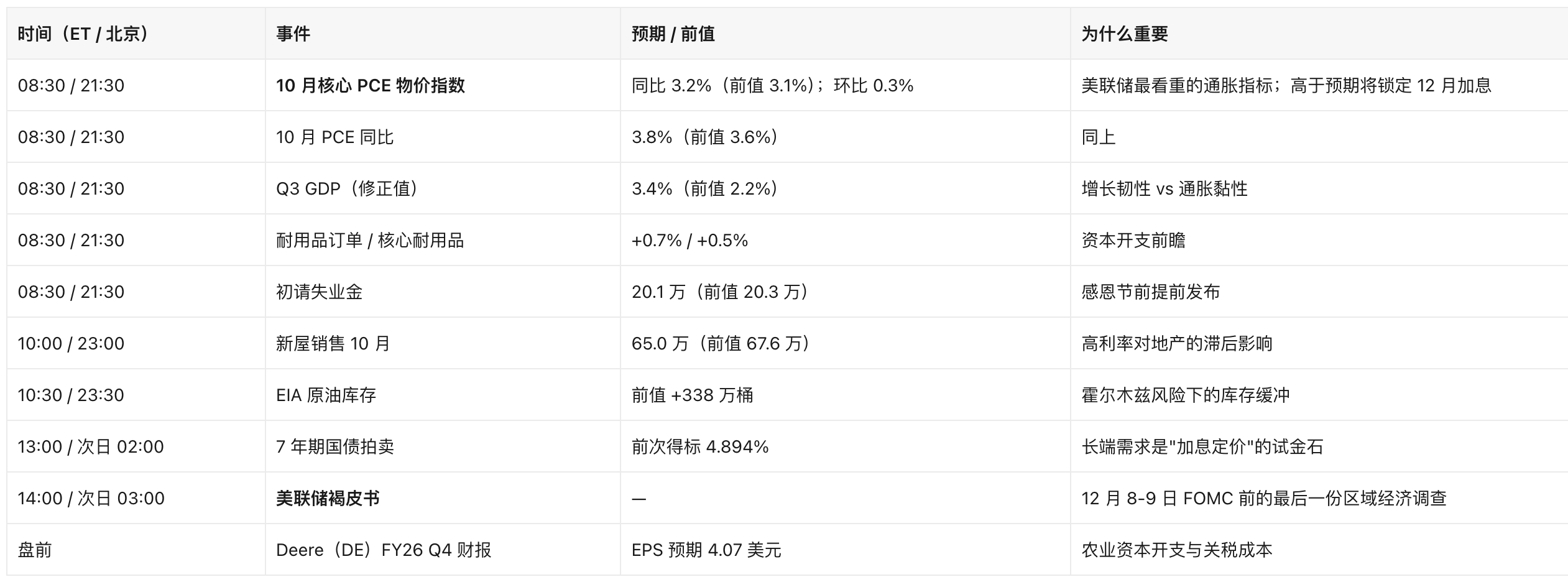
7. Focus Points Today and Over the Next 24 Hours
US Eastern Time 11/25 (Wednesday)—the last full trading day before Thanksgiving
Market structure risks
- Market closed for Thanksgiving on 11/26, and early close at 13:00 ET on 11/27: Thinner liquidity makes passive selling pressure in the AI sector more likely to amplify volatility; at the same time, the half-day session on Friday often sees one-sided "month-end rebalancing" moves.
- Crypto US stock calendar: Trump Media's $884 million convertible bonds mature on 11/30 (may trigger bitcoin sales); Strategy will disclose