US Stocks Daily | Black Thursday Returns: Nasdaq Plunges 5.5%, Philadelphia Semiconductor Index Crushed with a Single-Day Drop of 12.2%, Data Center Supply Chain Sees Collective Valuation Selloff (November 6)


- Key Takeaways: The Democratic sweep of both congressional chambers has turned "anti-data center" rhetoric into a policy agenda, triggering a systemic repricing of the AI trade. The Nasdaq fell 5.52% into technical correction territory, crypto assets were sold off as high-beta tech stocks, and total liquidations across the network exceeded $1.03 billion.
- Key Elements:
- The Nasdaq closed at 24,315 points, down 11.90% from its high; the Philadelphia Semiconductor Index fell 12.25% with a 38.43% drawdown, officially entering deep bear market territory.
- The VIX surged to 28.18 (+69.66%), reflecting a simultaneous pricing of risk-off and tightening across falling stocks, rising oil, rising gold, and falling yields.
- Bitcoin fell 5.57% to $75,949, Ethereum dropped 7.77%, and 24-hour liquidations across the network reached $1.03 billion.
- MSTR fell 9.29%, with its market cap/bitcoin holdings ratio dropping to 0.85x. The premium flipping to a discount has turned the "financing to buy bitcoin" positive feedback loop into a negative one—the most critical pricing signal for the DAT model this cycle.
- Semiconductors led the decline, with memory/storage names falling the most (longest capacity expansion cycle, most sensitive to capex expectations). Vertiv fell 14.02%, outperforming Nvidia to the downside, reflecting the "capex forced to be constrained" logic.
- At the Senate level, Sherrod Brown won re-election, effectively blocking the crypto-friendly legislative path, with regulatory focus shifting toward consumer protection and accountability.
- Geopolitical risks unresolved: Ships in the Persian Gulf came under attack again, Brent rebounded 4.88% to $99.24, and sticky inflation kept December rate hike pricing at roughly two-thirds.
1. Top Stories
- The Democratic Party has swept both chambers of Congress; "anti-data center" has shifted from a campaign slogan to a policy agenda, and AI trades face systematic repricing. The Democratic Party has secured a Senate majority and more than 250 House seats, which NPR characterized as "full control of Congress." Congressional leaders immediately issued a public call for a "National data center moratorium now." This is the direct political trigger behind the -4.36% reversal plunge the day after the 3% rally on 11-04.
- The Nasdaq fell 5.52% in a single day, officially entering a technical correction; the Philadelphia Semiconductor Index fell 12.25%, the worst-performing asset across the board. The Nasdaq closed at 24,315.00, down 11.90% from its 10-06 high of 27,599.79; the SOX closed at 9,011.14, down 38.43% from its 6-22 high of 14,634.72. Reuters said the "blue wave wiped out $2.5 trillion in Nasdaq market value," while CNBC tallied that the "Magnificent 7 shed $1 trillion in a single day."
- Safe-haven demand and tightening are being priced in simultaneously: stocks fall, oil rises, gold rises, yields fall. The VIX spiked from 16.61 to 28.18 (+69.66%), the 10-year Treasury yield fell to 4.84% (-6bp) and the 2-year to 4.46% (-12bp); yet Brent crude rebounded 4.88% to $99.24 and gold rose to $4,094.5 — inflation pressure remains unresolved, and December rate-hike pricing still sits at roughly two-thirds.
- Crypto assets were sold off as "high-beta tech stocks," with leveraged positions liquidated in a concentrated wave. Bitcoin fell 5.57% to $75,949.75 and Ethereum fell 7.77% to $2,234.07, with total liquidations across the network exceeding $1.03 billion (The Block). MSTR fell 9.29%, closing with a market cap of $54.99 billion against a crypto holdings value of $64.51 billion, bringing market cap/holdings down to 0.85x — the most important pricing signal for the DAT model this cycle.
- The geopolitical roots of the oil rebound were not resolved by the election. Another vessel was attacked in the Persian Gulf and an oil tanker was struck off the coast of Qatar; Iran said "countries that assist US military attacks are legitimate targets." The 8.5% oil price collapse on 11-04 was built on the assumption that "the war is winding down," and that assumption was discounted by reality on 11-05.
2. US Stock Market and Macro
2.1 The Three Major Indexes and Volatility (2026-11-05 Close, EST)
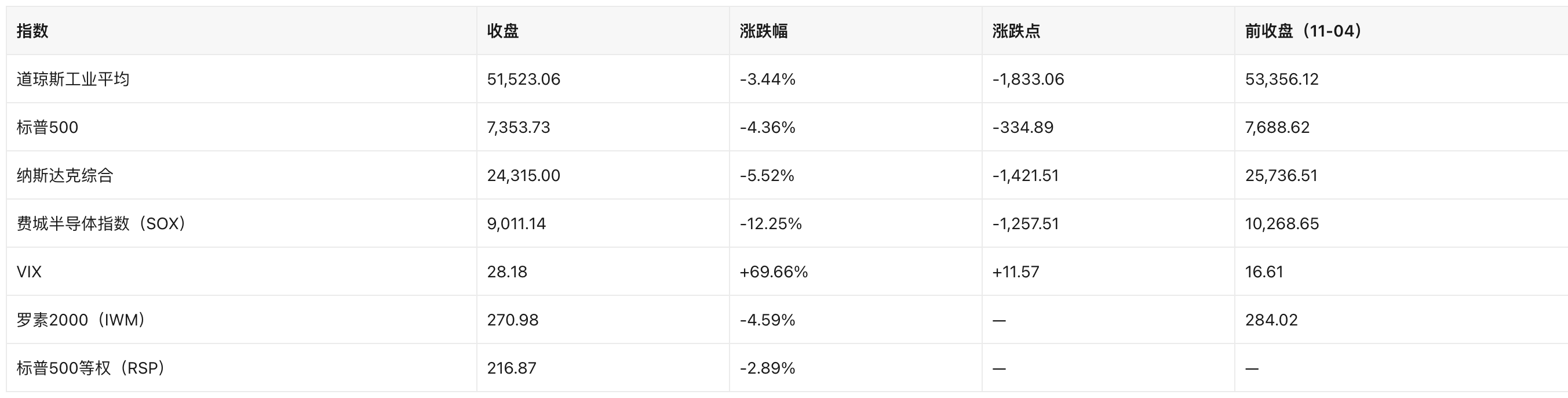
Drawdown positions (from 52-week highs): Nasdaq -11.90% (high of 27,599.79, 10-06) → has entered a technical correction; S&P 500 -5.95% (high of 7,818.93, 10-06); Dow -5.20% (high of 54,349.12, 08-05); SOX -38.43% (high of 14,634.72, 06-22) → semiconductors are already in deep bear-market territory. Reuters said the Nasdaq posted its largest single-day drop in 19 months; Yahoo Finance called it the worst performance on the day after a midterm election since 1896.
2.2 Sector Performance (11-05 Close)

Drivers in order:
① Reversal of policy expectations (Democratic Congress → rising risks around data center approvals/power costs/algorithm regulation);
② Deleveraging of crowded trades (over-concentration in tech weights; single-day retail selling was the highest since the pandemic);
③ Valuation sensitivity to interest rates (a December rate hike is still being priced in). Defensive sectors (XLP, XLU, XLC) all fell less than 1%, a typical "sell duration, not cash flow" structure.
Note one anomalous divergence:
Crude oil surged 3.55%, yet XLE fell 2.98%. This shows capital is engaging in an "overall risk budget contraction" rather than going long energy stocks on oil prices; it also reflects that US shale giants still refuse to expand capital expenditure even at high oil prices (OilPrice, 11-05).
2.3 Macro Data and the Fed

What the readings mean: strong employment + strong productivity should be good for a "soft landing," but under the current framework it amounts to "the Fed has no reason to stop hiking." This is another rendition of "good data turning into bad news" — in contrast to 11-04's "election tailwinds trump everything."
The next landmine: October nonfarm payrolls will be released on 11-06 at 08:30 ET, with the market expecting 63k–65k new jobs (aggregated figures vary across institutions; IndexBox reports 65k). In an environment dominated by "rate-hike panic," data that is too strong will raise the probability of a hike, while data that is too weak will trigger recession fears — risks in both directions are amplified.
2.4 Rates, the Dollar and Commodities
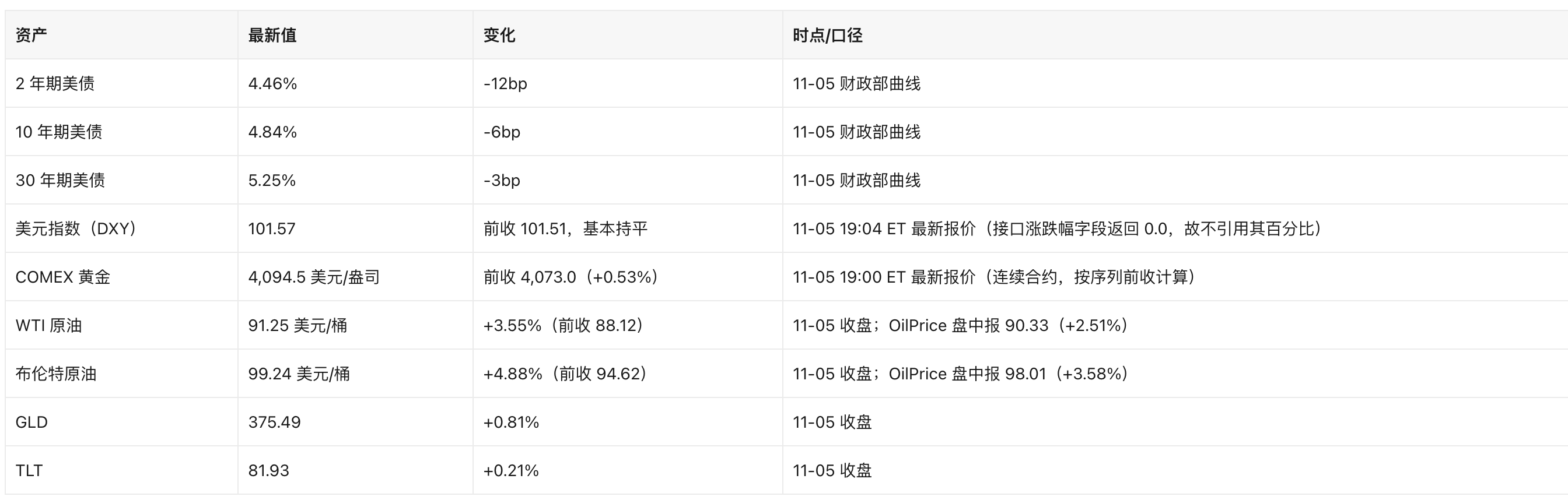
The yield curve shows a safe-haven shape of "the short end falling faster": the 2-year -12bp exceeds the 10-year -6bp. This coexists with "rate-hike expectations not yet dispelled," indicating that the dominant variable of the day was safe-haven buying triggered by deleveraging in risk assets, not easing expectations.
3. Hot Stocks and Sectors
3.1 Semiconductors: the Core of This Selloff

Transmission logic: the market is not worried about "AI demand disappearing," but about "approval and power bottlenecks in AI infrastructure pushing order timing later." Memory (Micron, SanDisk) fell the most because they are the segments with "the longest capacity expansion cycles and the greatest sensitivity to capex expectations" — once data center construction is delayed, visibility on memory orders is the first to suffer. Nvidia fell relatively less (-9.26%), indicating the selling was concentrated in "infrastructure supporting players" rather than "compute chips themselves," though both sit within the same beta.
Note: Micron had already been under pressure from pausing construction on its $4.5B Taiwan fab, a stock-specific compounding factor.
3.2 Data Center Supporting Players: Declines Exceeded the Chips Themselves

Vertiv is the leader in data center power/cooling, and its decline (-14.02%) exceeded Nvidia's, precisely evidence that "capex expectations" were directly discounted: policy risk falls on "whether to build data centers," not "whether to buy GPUs." The market's pricing logic that day can be summarized as "forced control on capex."
3.3 Big Tech: Broad Declines but Clearly Tiered
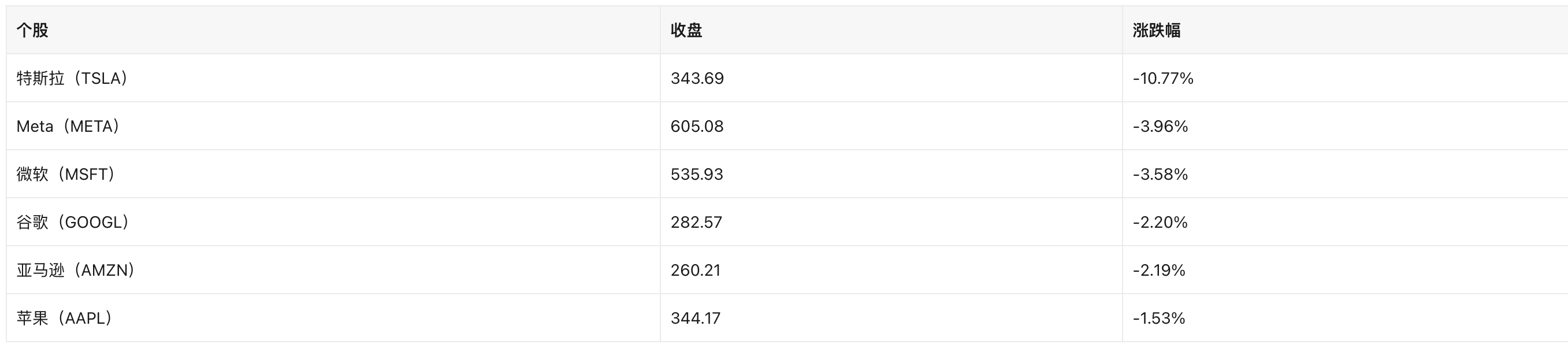
Apple fell the least, consistent with the day's logic that "low AI capex exposure = low policy risk"; Tesla fell 10.77%, which beyond its high-beta nature, media attributed to Musk's earlier election bet reversing against him (24/7 Wall St; a media interpretation, not a company announcement).
3.4 Contrarian/Resilient Threads
- Consumer staples, utilities and communication services all fell less than 1%, as capital made a defensive switch "from growth to cash flow."
- Gold rose above $4,094, with GLD +0.81%, one of the few certain beneficiaries of the day.
- ConocoPhillips (COP) doubled its Q3 profit to $4 billion and raised its dividend 11% (OilPrice), yet the stock still fell 1.08% — the "earnings boost" from the war has been viewed by the market as one-off.
4. Crypto-Related US Stocks
4.1 DAT Leader: Strategy (MSTR) — The Premium-to-Discount Turn Is the Most Critical Signal This Cycle
11-05 close: MSTR $129.30, -9.29%; closing market cap $54.988 billion (Nasdaq).
Holdings and cost basis (SEC 8-K, disclosed 2026-11-02, data as of 11-01):

mNAV (market cap/holdings value): holdings value = 849,327 × 75,949.75 = $64.51 billion; market cap $54.99 billion → 0.85x. That is, Strategy currently trades at a 15% discount to its Bitcoin net asset value (1 - 0.85). Bitcoin's current price of $75,949.75 is only 0.66% above its cumulative average cost of $75,451, leaving unrealized gains almost entirely erased.
Why 0.85x matters: the engine of the Saylor model is "when mNAV > 1, use high-premium stock/convertible bonds to exchange for BTC, achieving accretion in per-share coin holdings." When mNAV falls below 1, the same ATM issuance would dilute per-share coin holdings, turning the positive feedback loop of financing to buy coins into a negative one. This is the mechanism at the core of the collective pressure on DAT this cycle, and it also explains why MSTR's decline (-9.29%) exceeded Bitcoin's (-5.57%) — leverage and premium are contracting simultaneously.
Financing and buyback actions (same 8-K):
- ATM: during 10-26 to 11-01, neither STRF nor STRC preferred shares had new sales; MSTR common stock raised net $164 million, of which $65.5 million was used to buy coins and $98.5 million was retained as USD cash.
- Buybacks: repurchased 2,092,035 shares during the period for $208.2 million (including STRC, etc.).
- Remaining capacity: STRC still has $17.51 billion and STRF $1.62 billion available for issuance; MSTR's common stock buyback program has $1 billion remaining.
Structural observation: STRC (Variable Rate perpetual preferred stock) has returned to around $100 par on the secondary market, and its daily dividend mechanism restores its function as "low-cost ammunition for buying coins" (CryptoSlate, 11-05). In other words, Strategy's incremental coin-buying capacity is shifting from "premium stock issuance" to "preferred stock/fixed-income-style instruments" — an inevitable migration in an mNAV<1 environment.
Calendar risk: MSCI will announce its index constituent adjustments on 11-11, effective 11-30; MSCI has previously passed new rules that could exclude DAT-type companies from its indexes. If MSTR is removed, passive funds will be forced to sell — the clearest single-event risk over the next 5 trading days.
4.2 Other DAT and Holdings Company Developments
Miners and Hashrate (including AI/HPC transitions):
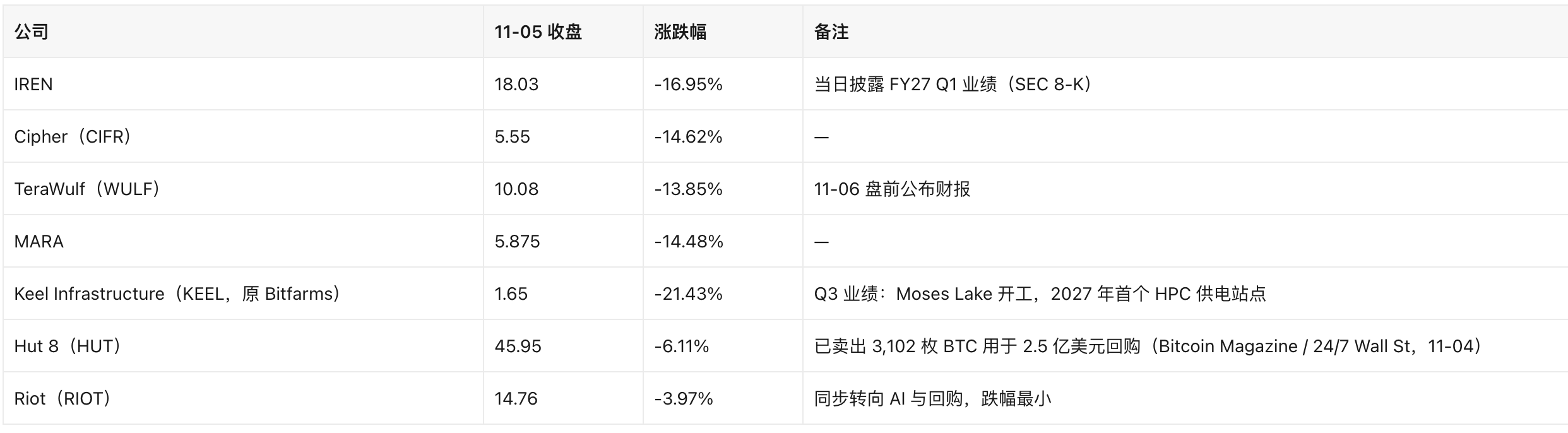
Miners are shifting from "hoarding coins" to "selling coins to fund AI capex and buybacks" (Hut 8, Riot), while DATs are still "hoarding coins." The former has steadier cash flow when coin prices fall, while the latter is fully exposed to mNAV contraction.
4.3 Broad Crypto US Stocks: Exchanges, ETFs and Payments

Spot ETF fund flows: on 11-04, US spot Bitcoin ETFs saw combined net inflows of $74.57 million, ending a prior three-day cumulative net outflow of $1.16 billion; total net assets of spot Bitcoin ETFs stood at $102.26 billion. Fund flow data for 11-05 had not yet been released at the time this article was generated (19:00 ET), and is typically published that evening ET — an item to track today, not to be replaced with speculation.
Payments and stablecoin on-chain actions:
- Samsung Wallet launched a Solana-based USDC "stablecoin account" for Galaxy users in the US.
- Anchorage Digital applied for CFTC swap dealer registration, planning to offer European-style BTC/ETH options.
- PayPal/Visa/Mastercard had no major on-chain announcements that day.
Product side: Canary's staking Injective ETF (INJC) listed on Nasdaq, with NAV including staking yield. Crypto ETFs are evolving from "spot holding" to "yield-bearing."
4.4 Regulatory and Accounting Drivers
- The single most unfavorable outcome for crypto emerged at the Senate level: Sherrod Brown won the Ohio Senate seat, which the Digital Chamber called "the most materially adverse outcome for crypto," and Democrats will shift the focus of crypto issues toward consumer protection and regulatory accountability. This means the friendly version of the Clarity Act legislative path that the market had previously hoped for is essentially blocked.
- State-level enforcement is spreading: Arkansas sued prediction market platform Kalshi, alleging it constitutes illegal gambling.
- Reverse friction from traditional finance: Apple and Home Depot joined the opposition camp against the "tokenized stocks" proposal pushed by ICE, the parent of the NYSE — the tokenization narrative is meeting resistance within TradFi.
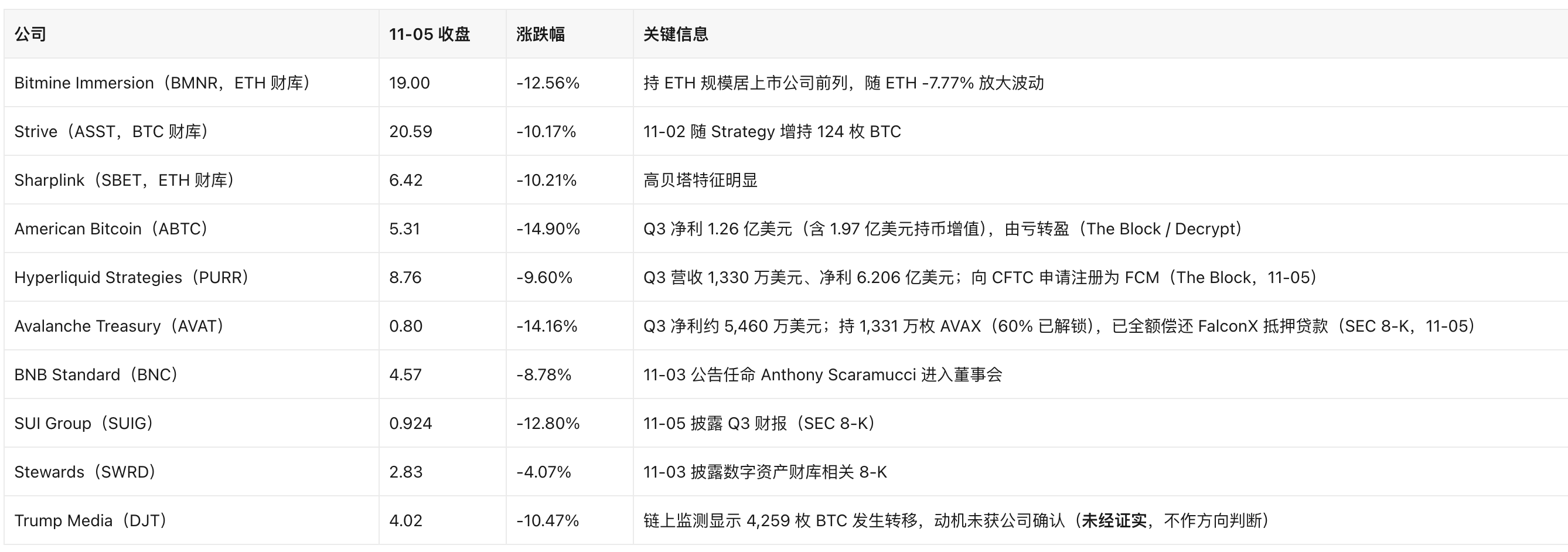
- Accounting basis note: large "fair value gains on crypto holdings" have already appeared in the income statements of AVAT and ABTC (AVAT about $60 million, ABTC $197 million), indicating that fair value accounting is still amplifying DAT earnings volatility — profits are inflated when coin prices rise, and EPS will be similarly hit in reverse when prices fall. This must be normalized before evaluating "low-P/E DATs."
4.5 Crypto US Stock Watchlist
Recent additions to the watchlist:
- BNB Standard Corporation (BNC): formerly CEA Industries, renamed on 2026-09-29 and pivoted to a BNB treasury; appointed Anthony Scaramucci as a director on 11-03.
- Avalanche Treasury Corp (AVAT): an AVAX treasury holding 13.31 million AVAX; disclosed Q3 on 11-05 and initiated a buyback.
5. Crypto Market

- Bitcoin has erased all of its post-midterm gains, falling back below $76,000; 24-hour liquidations across the network totaled $1.03 billion (The Block).
- The transmission chain is clear: Nasdaq selloff → risk budget contraction → high-beta crypto assets sold first → cascading liquidation of leveraged positions → falling