US Stock Market Daily | Intel's Disastrous Guidance Combined with AI Cash-Burn Anxiety Sends US Tech Stocks Plunging Across the Board; Nasdaq Posts Monthly Decline of Over 5%, Worst Month of the Year (October 31)

This article is about 4996 words, reading the full article takes about 8 minutes
On Friday, October 30 (US Eastern Time), all three major US stock indices closed lower, with the Nasdaq Composite falling 2.86% to 25,437 points, recording its worst monthly performance since March 2025. The core driver of this sell-off was anxiety over AI infrastructure capital expenditures—Amazon's Q3 capital expenditure reached $75.9 billion with full-year guidance raised to approximately $220 billion, compounded by Alphabet's search advertising miss and Intel's Q4 guidance falling significantly below market expectations, sending the Philadelphia Semiconductor Index down 7.20%. Crypto-related US stocks declined across the board, with Bitcoin ETFs recording cumulative net outflows of approximately $111 million in October. Next week, focus will be on Apple's earnings report, October nonfarm payroll data, and the evolution of geopolitical tensions in the Middle East.

AI Summary
Expand


- Key Takeaways:The visibility of returns on massive AI capital expenditures has been called into question, compounded by Intel's disastrous Q4 guidance and the Federal Reserve's hawkish pause, triggering concentrated selling in tech and semiconductor sectors, with risk-off sentiment spreading to crypto-related US stocks.
- Key Elements:
- Amazon's Q3 capital expenditure reached $75.9 billion, with full-year guidance of approximately $220 billion (over 65% directed toward AI infrastructure); Alphabet's Q3 capital expenditure was $51.4 billion, with free cash flow negative for two consecutive quarters.
- Intel's Q4 revenue guidance of $15-16 billion fell far below expectations of approximately $17 billion, with gross margin guidance of 38% well below Q3's 44.1%; shares fell 28% in a single day, erasing nearly $150 billion in market capitalization.
- The Federal Reserve held rates steady in October with hawkish language; a Reuters survey showed nearly all economists expect another rate hike in December; WTI crude oil at $102.95 elevated levels exacerbated inflationary pressures.
- The semiconductor index SOX fell 7.20% in a single day, with AMD and ARM down 10%, as capital rotated into defensive sectors including healthcare, consumer staples, and energy.
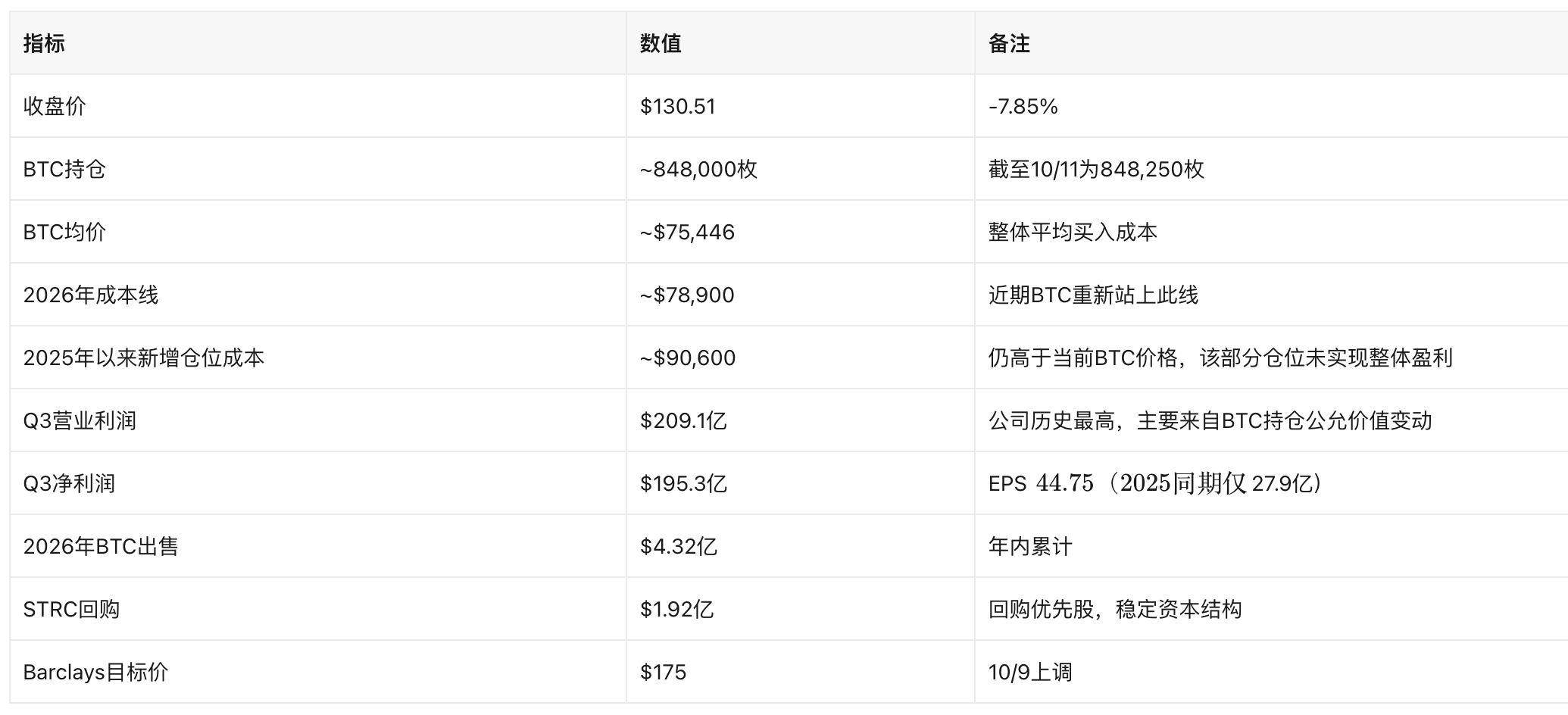
- Strategy's Q3 operating profit of $20.9 billion primarily stemmed from BTC fair value changes (FASB ASC 350 taking effect), with holdings of approximately 848,000 BTC; however, MSTR fell 7.85% in line with the broader market, with mNAV significantly below 1.0x.
- Coinbase fell 10.62% in a single day ahead of its Q3 earnings report—more than 14 times the decline of BTC (-0.74%)—as the platform's beta amplified amid contracting risk appetite.
1. Top Stories
- AI CapEx Panic Triggers Tech Stock Selloff: Amazon's Q3 capital expenditure reached $75.9 billion (far exceeding analyst expectations), with full-year CapEx guidance raised to approximately $220 billion, of which over 65% is directed toward AI infrastructure; Alphabet's Q3 capital expenditure was $51.4 billion, with free cash flow negative for two consecutive quarters (-$9.07 billion). The market has begun questioning the visibility of returns on massive AI investments, leading to concentrated selling across the tech sector.
- Intel's Q4 Guidance Disappoints, Shares Plunge 28% in a Single Day with Nearly $150 Billion in Market Cap Wiped Out: Intel's Q3 revenue came in at $16.5 billion (+21% YoY, Non-GAAP EPS $0.52 beat expectations), but Q4 guidance was only $15-16 billion (market expected ~$17 billion), Non-GAAP EPS $0.25 (market expected $0.43), and gross margin guidance of 38.0% was also well below Q3's 44.1%. The stock plummeted over 28% at the open, dragging down the entire semiconductor supply chain.
- Fed Holds Rates Steady at October Meeting, Hawkish Signals Point to December: The Fed's October 27-28 FOMC meeting decided to keep rates unchanged, with the statement noting the need to "wait for the accumulation of more information." However, Reuters reported that nearly all economists expect another rate hike in December, as inflation remains stubborn amid elevated oil prices (WTI $102.95).
- Strategy Posts Record Q3 Profit of $20.9 Billion, but MSTR Still Falls with the Broader Market: Strategy released its Q3 2026 financial results, with operating income of $20.91 billion (primarily from fair value changes on BTC holdings) and net income of $19.53 billion (EPS
44.75). The company holds approximately 848,000 BTC at an average price of about75,446. It also repurchased192 million in STRC preferred stock. Barclays had previously raised its price target to175. - Middle East Geopolitical Conflict Continues to Push Oil Prices Higher, Gold Plunges 3.63% in a Single Day: The U.S.-Iran standoff remains unresolved, with WTI crude closing at
102.95 (+0.93%), maintaining triple-digit highs. Spot gold briefly fell below3,900 intraday, closing at $3,884.90 (-3.63%), marking the largest single-day decline in recent memory. Elevated oil prices exacerbate inflationary pressures and compress the Fed's room for rate cuts.
2. U.S. Stock Market and Macro Overview
Major Index Closes (ET 2026-10-30 16:00)

Data Source: Yahoo Finance
Notable Sector Divergence
- Hardest-Hit Sectors: Semiconductors (SOX -7.20%), AI hardware/computing power chain (Intel -28%, AMD -10%, ARM -10%, Dell -10%, SanDisk -11%, NVDA -3%+)
- Resilient/Advancing Sectors: Pharmaceuticals (Eli Lilly +3.77%, AstraZeneca +7.04%), Consumer Staples (Walmart +2.01%, Costco +1.94%), Energy (ExxonMobil +1.18%, Chevron +1.67%)
- Large-Cap Tech Platforms Relatively Resilient: Apple within -1%, Alphabet within -1%, Microsoft -1.58%, Amazon -1.40%
Key Macro Indicators

Fed Developments
- October 27-28 FOMC Meeting: The federal funds rate was left unchanged, with hawkish language in the statement emphasizing the need to "wait for the accumulation of more information" before making adjustments.
- Market Expectations: A Reuters survey (10/20) showed nearly all economists expect another rate hike in December. Inflation remains stubborn amid elevated oil prices (WTI > $100), weighing on consumer sentiment.
- Transmission Logic: Fed's hawkish pause → short-end rates remain elevated → tech growth stocks face valuation pressure (rising discount rates) → compounded by uncertainty over AI CapEx returns → triggers concentrated selloff.
3. Key Stocks and Sectors
1. Intel (INTC): Q3 Beat but Q4 Guidance Disappoints, Down 28%
- Q3 Results: Revenue $16.5 billion (+21% YoY), Non-GAAP EPS $0.52 (beat expectations of
0.40), DCAI (Data Center and AI) segment revenue7.3 billion (+78% YoY, strongest growth in 15 years). - Q4 Guidance: Revenue
15-16 billion (market expected ~17 billion), Non-GAAP EPS0.25 (market expected0.43), gross margin 38.0% (Q3 was 44.1%). - Market Reaction: The stock plummeted over 28% at the open, with market cap evaporating nearly
150 billion to approximately342 billion. CEO Lip-Bu Tan emphasized improved execution and progress in process technology, but the market focused on the deteriorating near-term profitability outlook. - Contagion Effect: Dragged down the entire semiconductor supply chain — AMD -10%, ARM -10%, NVDA -3%+, TSMC -4%. The market has begun reassessing the sustainability of AI chip demand.
2. Amazon (AMZN): AI CapEx Shocks the Market, Down ~1.4%
- Q3 Results: Revenue
201.9 billion (+12% YoY), operating income28.1 billion (+61% YoY), record operating margin of 13.9%. AWS revenue46 billion (+39.3% YoY), annualized run rate184 billion. - Capital Expenditure: Q3 cash CapEx
75.9 billion (far exceeding expectations), full-year guidance approximately220 billion, with further significant increases expected in 2027. Management stated that AI infrastructure investments are aimed at expanding revenue and FCF over the long term, but acknowledged that AI services currently have lower margins than the core cloud business. - Market Reaction: Stock fell approximately 1.4%. Investors' core concern: the accelerating pace of AI "cash burn" with an unclear return timeline.
3. Alphabet/Google (GOOGL): Search Advertising Slowdown + Elevated CapEx, Down 12.64% on 10/29
- Q3 Results (released after close on 10/28): Revenue
127.6 billion (+25% YoY, below expectations of128.2 billion), net income26.2 billion (-25% YoY), free cash flow -9.1 billion (negative for the second consecutive quarter), CapEx $51.4 billion. - Highlights and Concerns: Google Cloud revenue doubled YoY to
30.7 billion (beat expectations of28.8 billion), with TPUs beginning external sales; however, search advertising revenue was $63.4 billion (only +12% YoY), below expectations, with AI Mode queries showing relatively low monetization efficiency. - Market Reaction: Fell 12.64% on 10/29, the largest single-day decline since IPO, with approximately $500 billion in market cap wiped out. Multiple investment banks cut price targets (RBC $425→$400, D.A. Davidson $350→$300).
4. Semiconductor Sector (SOX -7.20%)
- Intel's disappointing guidance triggered a chain reaction across the supply chain: AMD -10%, ARM -10%, Qualcomm/Dell -10%+, SanDisk -11%, TSMC -4%.
- Core market logic: Declining visibility of returns on AI hardware investment → downward revision of semiconductor cycle expectations.
5. Defensive Sectors Outperform
- Pharmaceuticals: Eli Lilly +3.77%, AstraZeneca +7.04%
- Consumer Staples: Walmart +2.01%, Costco +1.94%
- Energy: ExxonMobil +1.18%, Chevron +1.67% (benefiting from oil prices holding above $100)
- Logic: Capital rotation from tech growth stocks to defensive sectors, reflecting risk-off sentiment.
4. Crypto-Related U.S. Stocks
4.1 DAT (Digital Asset Treasury) Company Developments
Strategy (MSTR): Record Q3 Profit, but Stock Falls with the Broader Market
Source: Yahoo Finance, StockTitan SEC Filing
- mNAV Observation: MSTR closed at $130.51. Based on a rough calculation of 848,000 BTC × $77,206 ≈ $65.47 billion in holdings value (before deducting debt), mNAV is significantly below 1.0x, reflecting the market's discount on DAT leverage and funding chain sustainability. Peter Schiff had previously questioned the sustainability of STRC's fundraising capacity.
Crypto U.S. Stocks Watchlist Additions
- Vanguard ETF Purchases Metaplanet Shares for the First Time: According to a Coingape report on 10/26, a Vanguard ETF purchased 4.5M shares of Metaplanet (a Japanese BTC treasury company) for the first time. This marks further recognition of the DAT model by traditional asset management giants. (Source: Coingape)
- AZI (Autozi Internet Technology): Announced in February an investment of
1.1 billion in counter-cyclical acquisitions of1.87 billion in digital assets, partnering with crypto giants to enter the DAT and compliant payment infrastructure space. Further developments to be tracked.
4.2 Broad Crypto U.S. Stocks
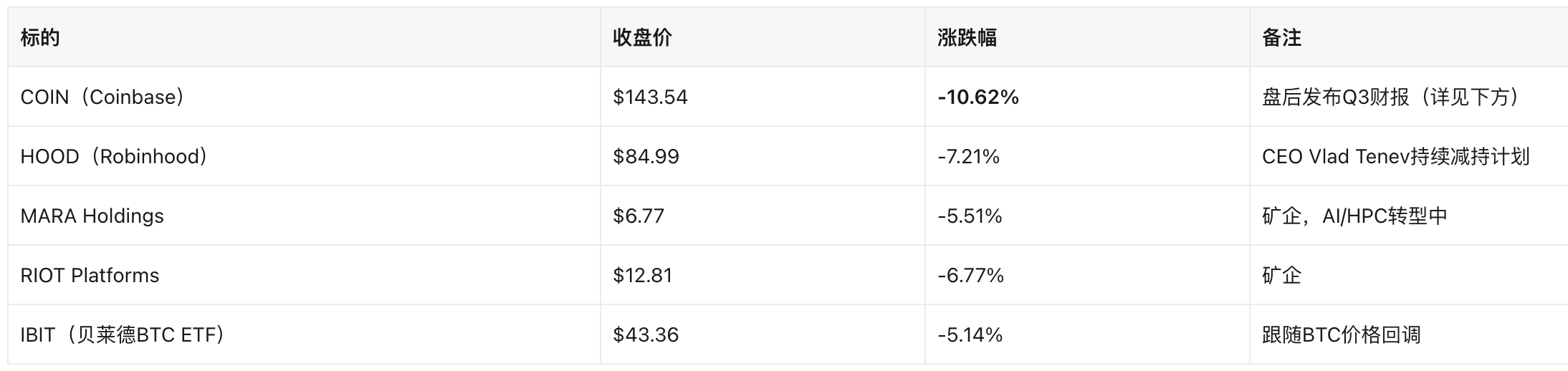
Coinbase (COIN) Q3 Earnings (released after close on 10/30)
- COIN released its Q3 2026 earnings after the U.S. market close on 10/30. Specific figures await detailed disclosure, but the stock had already fallen 10.62% that day, reflecting market concerns about slowing revenue growth at crypto trading platforms.
Bitcoin Spot ETF Fund Flows
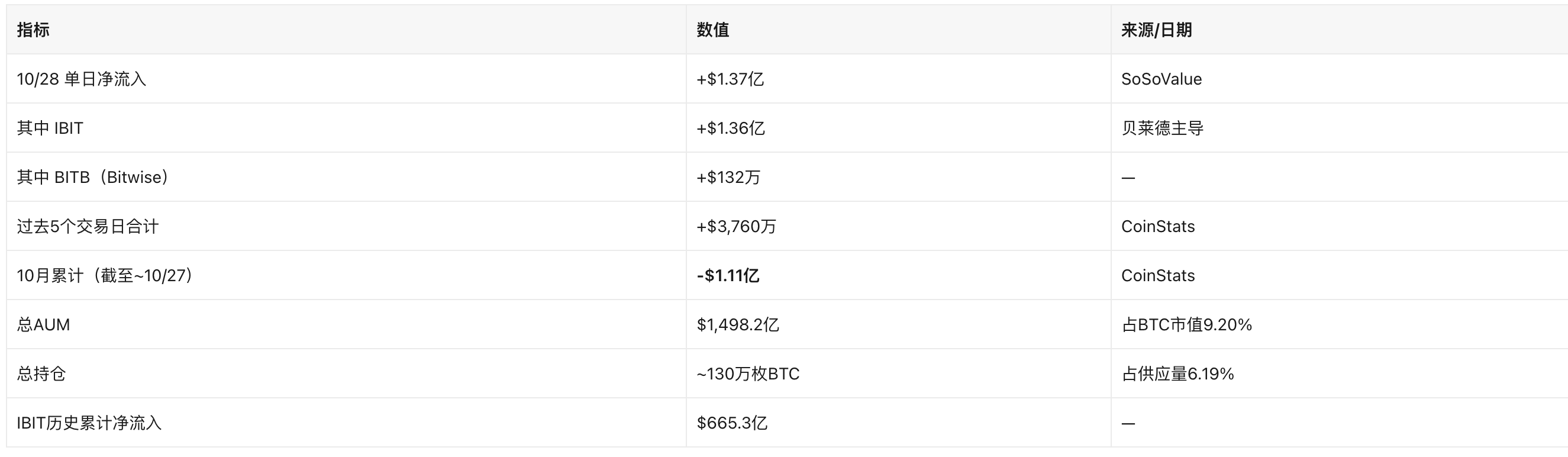
- Trend Assessment: October saw a slight overall net outflow, but 10/26-28 saw three consecutive days of inflows (led by IBIT), indicating marginal improvement in institutional demand. Compared to the June doldrums with $4.52 billion in net outflows, current fund flows are relatively stable.
Stablecoins and Payments
- Circle: No major news for the day.
- Visa/Mastercard/PayPal: No major crypto-related announcements for the day.
- Binance Security Incident: Reuters reported on 10/30 that Binance reported a security issue, with BTC/crypto prices coming under short-term pressure. Specific details await further disclosure. (Source: Reuters)
4.3 Regulatory and Accounting Drivers
- Fair Value Accounting Standard (FASB ASC 350): Now in effect, allowing DAT companies (such as Strategy) to recognize fair value changes on BTC holdings in their income statements. Strategy's Q3 operating profit of $20.9 billion primarily stems from this. The standard continues to encourage more companies to consider adding BTC to their balance sheets.
- SEC Guidance: No major new developments. The market is watching for further refinement of SEC disclosure requirements for DAT companies.
4.4 Crypto U.S. Stock Correlation Signals
- BTC $77,206 (-0.74%) vs MSTR (-7.85%): MSTR's decline far exceeds BTC's, reflecting the DAT sector being dragged down by the broader tech selloff sentiment, with mNAV discount widening further.
- COIN (-10.62%) vs BTC: Coinbase's decline is more than 14 times that of BTC, highlighting how the "beta" characteristic of crypto trading platforms is amplified in a risk-off environment.
- SOX (-7.20%) vs MARA/RIOT: Mining companies' declines are close to the semiconductor sector, reflecting a systematic reassessment of the AI/computing power supply chain.
5. Geopolitical Impact
1. U.S.-Iran Standoff and Middle East Situation
- Latest Status: The U.S.-Iran negotiation deadlock continues. The Trump administration maintains its naval blockade of Iran, rejecting Iran's proposal to "lift the blockade first, then advance negotiations." Iran has responded firmly, with its military warning of countermeasures.
- Energy Transmission: The Strait of Hormuz risk premium remains elevated, with WTI crude at
102.95 (+0.93%) and Brent crude holding in the105-110 range. Elevated oil prices → higher U.S. gasoline prices → rising inflationary pressures → compressed Fed rate cut room → pressure on tech growth stock valuations. - Transmission to Crypto Markets: Geopolitical conflicts typically benefit BTC's "digital gold" narrative, but inflation concerns triggered by elevated oil prices are currently more dominant — Fed hawkishness → risk assets under broad pressure → BTC follows the decline.
2. Tariffs and Trade
- The U.S. effective tariff rate on global trading partners remains at a high of approximately 13.7% (as of February 2026 data).
- The impact of trade frictions on the semiconductor supply chain warrants attention: Intel's weak Q4 guidance partially reflects global demand uncertainty.
3. U.S. Midterm Elections
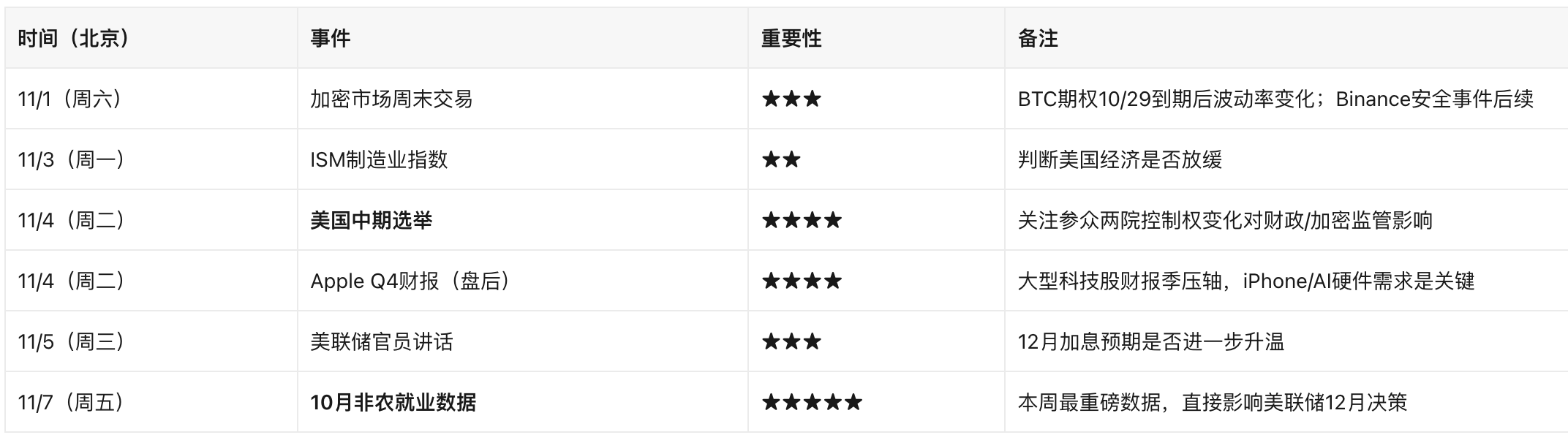
- November 5 (next Tuesday) is U.S. midterm election day. The races are tight, and the market remains vigilant about policy uncertainty.
- Election results could impact: fiscal policy direction, crypto regulatory legislative progress, and trade policy direction.
6. Today's Focus (Next 24-48 Hours)
Key Calendar
Crypto U.S. Stocks Special Focus
- Coinbase Q3 Earnings Analysis: Released after close on 10/30, to be digested by the market over the weekend/next Monday. Watch trading volume, subscription revenue, and regulatory progress.
- Strategy Q3 Results Digestion: The market will reassess MSTR's mNAV and funding chain sustainability around BTC $77,000. Watch for any new BTC purchase announcements.
- Bitcoin ETF Fund Flows: October saw a slight overall net outflow; whether early November continues or reverses this trend will be a barometer for institutional demand.
- Binance Security Incident Follow-Up: If confirmed as a major security breach, it could trigger short-term panic in crypto markets and regulatory scrutiny.
Risk Factors
- AI CapEx Return Concerns Spreading: If Apple's earnings also show AI investments dragging on margins, the tech sector selloff could intensify.
- Oil Prices Breaching $110: If the Middle East situation escalates further, oil prices could climb another notch, exacerbating inflation and Fed hawkish expectations.US stocksWelcome to Join Odaily Official CommunityRecommended Articles